
Pete Sheehy in the clubhouse of the real Yankee Stadium
I don’t think many journalists ever interviewed Pete Sheehy, but I was among the few who did. Pete, who was the clubhouse man at Yankee Stadium for about seven decades, didn’t like to talk, and I suppose that accounts for the fact that he made only rare appearances in print. I arranged an interview through a mutual friend, and I wasn’t with Pete for very long before I realized what a challenge I had taken on. In fact, Pete was forthright about it — in his way. He told me that he figured he had kept his job for so long, being in the confidence of members of the Yankees and, for a time, the football New York Giants, because he knew how to keep his mouth shut. Whatever he knew about Babe Ruth, Billy Martin, and Mickey Mantle, he kept it to himself.
 So I asked Pete if it were possible that a man who had had such intimate contact with the Yankees of the ‘twenties to the ‘eighties could have a favorite. This was how Pete answered: “Joe.”
He didn’t have to say any more. “Joe” meant DiMaggio, and his choice didn’t surprise me. My father had been a Yankee fan since the Ruth era, too, and although I never asked him, I am confident that he would have said “Joe” too — despite a reverence for Lou Gehrig.
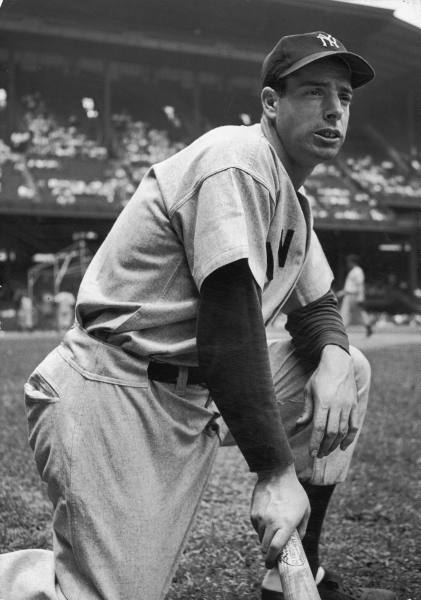 DiMaggio had an outstanding career. He was among the very best hitters, baserunners, and outfielders of his time or any time. Not the very best, necessarily, but one of the best. As Kostya Kennedy mentions in his book, 56: Joe DiMaggio and the Last Magic Number in Sports, a poll taken in 1969 named DiMaggio the “greatest living baseball player.” DiMaggio believed it; he was that kind of a guy. But there were skeptics who noted, for instance, that Ted Williams, DiMaggio’s contemporary, outstripped the Yankee in every major hitting category and had a longer career, despite combat duty tours in two wars.
If there is an inequity in the way DiMaggio is regarded, it may be attributed at least in part to the fact that he played for the New York Yankees while they were the preeminent team in baseball if not in sports in general. DiMaggio appeared in 10 World Series in his 13 years in the majors.
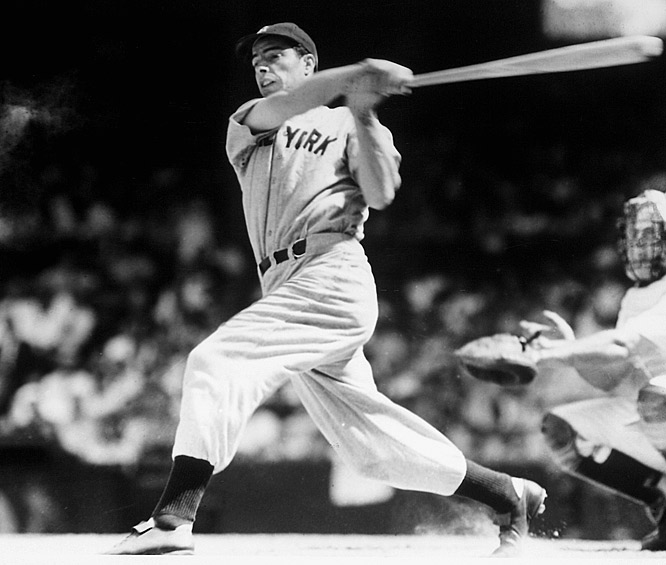
But the primary reason for the aura around Joe DiMaggio may be the record he set 60 years ago this season — the record that was the occasion for Kennedy’s book. In the 1941 campaign, DiMaggio got a base hit in 56 consecutive games.
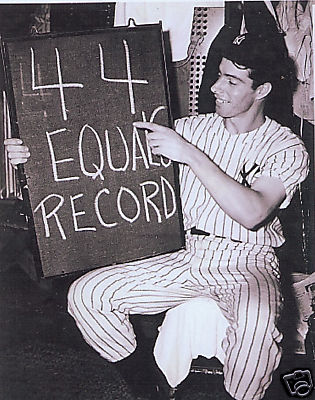 To put that record in context, Kennedy points out that more than 17,000 men have played Major League baseball, and only DiMaggio has achieved it. The only others to come close were Willie Keeler, who hit in 44 straight games in 1897 in the dead-ball era, and Pete Rose, who hit in 44 in 1978. (Keeler’s streak began on the first day of the ’97 season, so the hit he got in the last game in ’96 puts his official record at 45.)
The subtitle of Kennedy’s book refers to the fact that while DiMaggio’s record once formed a holy trinity with Babe Ruth’s single-season and lifetime home run records, Ruth’s marks have been exceeded several times and in some cases under questionable circumstances. DiMaggio’s 56 is the only individual record of its kind still standing.
Kennedy describes in his very literate book the atmosphere in which the streak occurred. It captured the attention of the whole country — and even folks in some other countries. DiMaggio’s sizable family, people who were tight with him, baseball fans, and people who didn’t know anything else about him or the game were all caught up in his day-day-progress. Everywhere, Kennedy writes, people stopped to ask each other: “Did he get a hit today?”
 And, as Kennedy artfully shows, this didn’t happen in a vacuum. In 1941, there was something far more ponderous on people’s minds — the increasing aggression of Nazi Germany. The idea that the United States could stay out of the war seemed more and more like wishful thinking as American plants turned out material to assist the European allies and as more and more American men were drafted into military service. DiMaggio’s streak was a fortuitous respite in such an atmosphere — the counterpart, in a way, to Susan Boyle’s triumph on Britain’s Got Talent in the midst of worldwide recession and seemingly pointless wars.
 The streak served another purpose, too. It was something for Italian-Americans to cling with pride as they — thanks to Benito Mussolini — came under the same kind of suspicion that was being directed at Americans of Japanese and German background. Even at that, DiMaggio’s own father, Giuseppe, who had made his living as a commercial fisherman, was placed under wartime restrictions that kept him from approaching San Francisco Bay.
 In telling this story, Kennedy carefully constructs a portrait of DiMaggio that isn’t at all endearing. DiMaggio was a cold fish. He was known from his youth for his spells of silence. Kennedy writes a lot about DiMaggio’s relationship with his first wife, movie actress Dorothy Arnold, and that isn’t a happy tale. DiMaggio — in spite of the girls he invited to his hotel rooms — missed Dorothy when he was on the road. But when he was home, he stifled her, resented her, and often subjected her to his emotional and sometimes his physical absence.
This book is peppered with the interesting characters who played large and small parts in DiMaggio’s life — his relatives, including his major league brothers, Don and Vince; his somewhat “connected” Italian-American friends in Newark; his fans — not the least of whom were the boys Mario Cuomo and Gay Talese; and, of course, his fellow ballplayers: Gehrig, Phil Rizzuto, and DiMaggio’s wacky road-trip roommate, Lefty Gomez.
On the field, DiMaggio appeared impassive as the streak progressed. If a pitcher had boasted that he would stop DiMaggio, and DiMaggio got a hit off him, there would be none of the fist pumping that cheapens the game today. Inside, however, Kennedy writes, DiMaggio’s stomach was often in knots. And, of course, if he didn’t have to talk about the streak, he didn’t:
” ‘You nervous about the streak?’ a reporter would call out and it would be Lefty who would turn and reply, ‘Joe? Nah, he’s fine. Me? I threw up my breakfast.’ “
Books: “The House that Ruth Built”
April 30, 2011
 “Jumpin” Joe Dugan, who spent a few seasons as Babe Ruth’s teammate, had this to say: “To understand him, you have to understand this. He wasn’t human.”
I get that. Ruth may not have had it all — he wasn’t much of a base stealer — but he had more of it than anyone else. There’s no point in arguing about it. I love Aaron, Mays, Banks, and Mantle as much as the next fellow, but none of them went 94-46 with a 2.16 ERA before becoming one of the best hitters in history and a fine outfielder to boot. In addition to that, his bombastic personality and his enormous charity revitalized a flagging game in a way that no one else could have done, making his name familiar to people around the globe — down to our own time — no matter how much or how little they know about baseball.
I get that. John McGraw didn’t get that. McGraw was the manager and a part owner of the New York Giants, and he was by reputation one of the best skippers ever. He believed in “scientific baseball,” which was the only way to play the game successfully in the dead-ball era. McGraw was all about place-hitting, bunting, stealing, studying your opponents and taking advantage of their weaknesses.
 McGraw was not about the long ball — especially not the home run — which was coming into vogue at the beginning of the 1920s. As Robert Weintraub explains in this lively and entertaining book, Babe Ruth – the first home run hitter par excellence – represented to McGraw the ruin of the game. McGraw, by Weintraub’s account, despised Ruth, called him a “baboon” and a “bum,” and predicted that he would hit into a hundred double plays a year.
Weintraub’s book covers the 1923 season, the Yankees’ first season in the original Yankee Stadium – not the knockoff they play in now. The team first appeared in the city when three New York guys bought the minor league Baltimore Orioles franchise and moved it north in 1903. The Highlanders, as they were known for most of the first decade, played in Hilltop Park — the present site of the Columbia Presbyterian Medical Center — until 1913, when they moved into the Polo Grounds as tenants of the Giants. At the point at which Weintraub picks up the story, McGraw was fed up with the Yankees in general and Ruth in particular.
 McGraw, as Weintraub recounts, was accustomed to being the toast of the town, and he became increasingly agitated as the Yankees gained in popularity. By 1921, he engineered the Giants management’s decision to tell the Yankees to move out of the Polo Grounds. This, it turned out, was a serious error, because it spurred Jacob Ruppert and Cap Huston — whom McGraw had inspired to buy the Yankees — to build Yankee Stadium just across the Harlem River.
McGraw had a brief period of satisfaction left to him, because the Giants and Yankees won their respective pennants in 1921 and 1922, so that the whole World Series was played in the Polo Grounds, where Giants pitching made a monkey of Ruth. After the ’22 affair, there was widespread talk that the Babe was through.
 In the ’23 season, though, Ruth — seriously chastened by his failures — made at least a show of curbing his appetites — sexual and otherwise — and he tore the league apart, winning the Most Valuable Player award. The rest of the Yankees, led by their dour little manager, Miller Huggins, had an outstanding year, and the momentum carried them to a World Series win that finally took the wind out of McGraw. McGraw was so bitter that he made the Giants dress at the Polo Grounds for the away games and cab it over to Yankee Stadium. The manager himself walked across the Macombs Dam Bridge.
The only bright spot for McGraw in that ’23 series was his reserve outfielder, “Casey” Stengel, who hit two game-winning home runs, one of them inside the park. During the off season, McGraw traded the aging Stengel to the Braves. “It’s a good thing I didn’t hit three home runs,” Casey said. “McGraw might have sent me out of the country.”
This is a colorful book, loaded with the characters of the ’20s – Warren G. Harding, Charles Chaplin, Damon Runyon, Fanny Brice. And, of course, all those ballplayers – Frankie Frisch, Bob and “Irish” Meusel, Everett “Iron Man” Scott, George “Highpockets” Kelly.
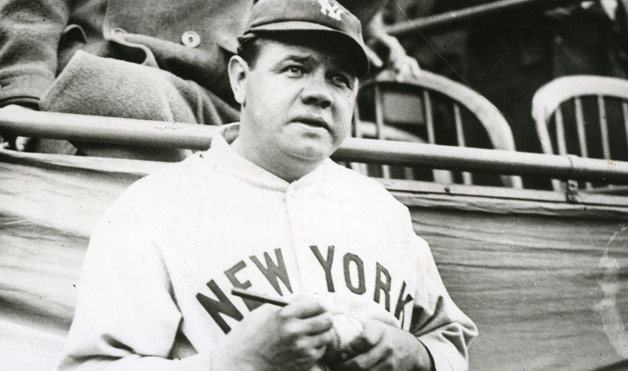 The real heart of this book, though, is found in the stories of McGraw and Ruth, two low-born, hard drinking, brawlers who clawed their way to the top where their lives intersected at a pivotal time in baseball in general and in New York baseball in particular.
“Batter, batter, batter!”
April 13, 2011

ED REULBACH
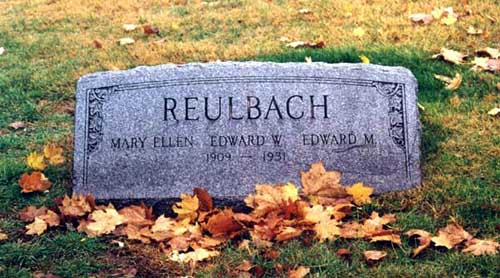
I was surprised the other day when I stumbled across the information that Ed Reulbach is buried in a Catholic cemetery in Montclair, New Jersey. I have always associated Reulbach with the Chicago Cubs, and I have never associated him with New Jersey.
Reulbach’s name is not well known today, except by people like me who live in the past. He was well known in his own time, however; he was one of the most dominant pitchers of his era. Actually, in some respects he has had relatively few equals in the whole history of the game, but he pitched in the dead-ball era and he isn’t on the minds of the play-by-play announcers whose memories don’t go back much farther than the 1960s.
I’m in the midst of reading The House that Ruth Built, a new book about the 1923 baseball season in New York. (A review will follow soon.) The author refers to a pitcher who threw both ends of a double header, and that’s what got me thinking about Reulbach. Modern pitchers are such fragile creatures that the idea of one of them throwing a double header is absurd. A modern pitcher rarely throws more than five or six innings at a time.
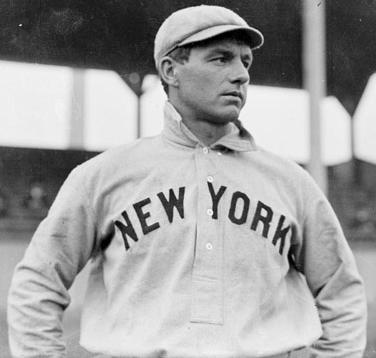
JOE McGINNITY
This wasn’t always the case. It wasn’t long ago that a starting pitcher was expected to throw a complete game. Whether he did or not depended on his performance on the mound, not the number of pitches he threw. Even then, pitching double headers was unheard of after 1926, when Dutch Levsen, pitching for the Indians, became the last to do it.
The most spectacular performance in this regard was turned in by “Iron Man” Joe McGinnity of the New York Giants, who pitched three double headers in the month of August, 1903, and won all six games without relief. McGinnity won 31 games that year. Perhaps more significantly — in view of the modern practice of counting pitches — he won 35 games in 1904, , 21 in 1905, and 27 in 1906.
Altogether, there were 45 instances of a pitcher throwing a double-header. Grover Cleveland Alexander did it a couple of times. Also in this elite group was Fred Toney, who won a double bill for Cincinnati in 1917. What’s even more remarkable is that in that same season, Toney and Hippo Vaughan of the Chicago Cubs joined in the only game in history in which both pitchers pitched no-hitters for nine innings. Vaughan lost it in the 10th.
Reulbach’s performance stands out, because on September 26, 1908, he pitched two games for the Cubs against Brooklyn, and they were both shutouts. He’s the only pitcher in the history of the game to pull that off. To emphasize his point, he allowed a total of eight hits in the two games.
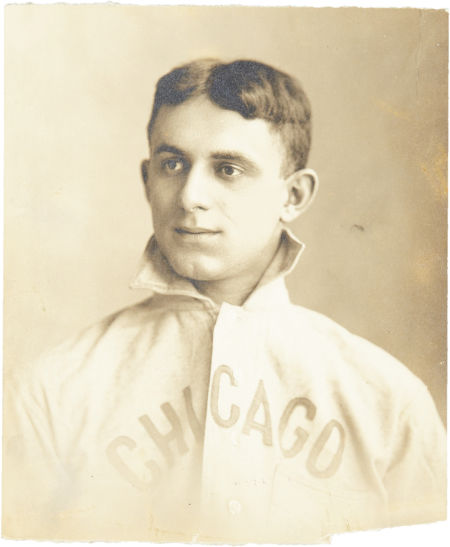
For the record, Reulbach pitched nine more seasons after the year of his double shutouts and he finished with a .632 won-loss percentage and an ERA of 2.28.

The stone on the Ruelbach family grave makes no mention of the pitcher's career. His lifetime ERA has been bettered only 10 times, and he was the first pitcher to throw a one-hitter in World Series play.
Talking baseball
March 10, 2011

PETER SCOLARI
But to put that story in context, Scolari told me that his father — attorney Art Scolari — had played baseball at East Side High School in Paterson (this would have been long before Joe Clark got there) and then was an All-American shortstop at Drew University. Paterson? I was born in Paterson. My dad, who was about 13 years older than Art Scolari, went to Central High School where he ran track — particularly relays — and later managed a semi-pro baseball team that played all around the Paterson area.

PETER SCOLARI / New York Daily News
I haven’t told Peter Scolari this yet, but after our conversation, my web browser stumbled on a story in a 1939 issue of the old Daily Record of Red Bank, N.J., reporting that a teenager named Lawrence Mahoney, who was from Lincroft, had successfully defended his state horseshoe pitching championship for the fifth time in a row. It was no snap, according to the story: breathing down Mahoney’s neck was 15-year-old Art Scolari of Paterson. Mahoney was 9-0 in the tournament; Scolari was 8-1.
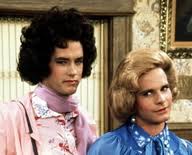
Tom Hanks and Peter Scolari in their "Bosom Buddies" regalia
I could have talked about baseball all night — it’s one of my many excuses to talk too much — but I was at the George Street Playhouse in New Brunswick to talk to Peter Scolari about his current project, a production of Ken Ludwig’s new play, “Fox on the Fairway.” This play, with a golf theme, had its world premiere last year in Washington, D.C. It’s a farce, and that’s a word that sends up the skyrockets, because farce done badly — or even done “all right” — is a painful experience for an audience. I’ve been there. Scolari, who knows a lot more about it than I do, made that point: “I don’t like to see a farce in which folks do an okay job. I’ll watch ‘The Sunshine Boys’ or ‘The Odd Couple’ and have a great time if everybody does a ‘good’ job. If I go to a farce and everybody does a ‘good’ job, I think, ‘Why did you do this?’ ”
I’ve read Ludwig’s play, but reading farce is like reading a recipe. It lays out the parts and the moves, but it can’t even hint at the reality. I have also read at least one negative review of the Washington production, but the fact that a farce doesn’t work with one company doesn’t mean it won’t work with another. Ludwig, after all, is the author of “Lend Me a Tenor” and “Crazy for You,” both of which won him Tony awards. And Scolari knows a thing or three about playing comedy in general and farce in particular.
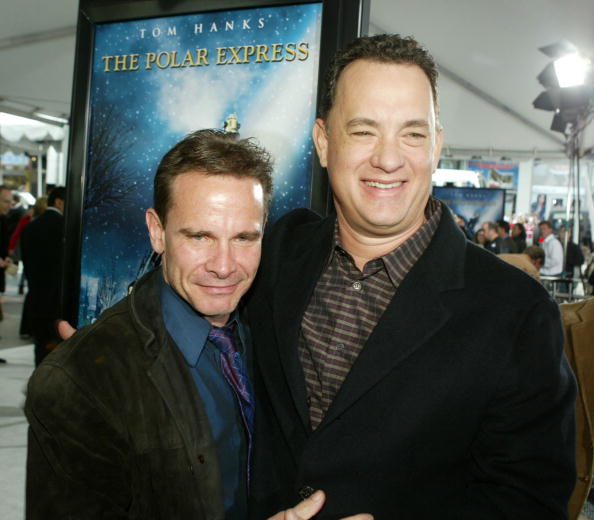
Peter Scolari and Tom Hanks in 2004 at the premiere of "Polar Express" in which they both appeared
Scolari first drew national attention in 1980 when he co-starred with Tom Hanks in “Bosom Buddies,” a TV sit-com about two young men who dress in drag so they can live in a women-only hotel where the rent is dirt cheap and about what they can afford. The show, which lasted a couple of seasons, was indirectly inspired by the Billy Wilder movie “Some Like it Hot.” Since then, Scolari has put together a long resume of television and stage appearances, mostly in comedies, including 142 episodes of Bob Newhart’s second hit series, “Newhart.”
Talking to Scolari, who is witty, thoughtful, and articulate, was an entertainment in itself. If I weren’t aware that I was keeping him from his train after he had spent a full day of rehearsal, I would have prompted him to talk for another hour, just so I could listen. If I had had unlimited time and he had had unlimited patience, I would have steered him back around to baseball, because no sport lends itself to talk as well as baseball does, and my guess is that Scolari appreciates that as much as I do. I asked him which New York team he roots for now that he is living on the East Coast again after his sojourn in California. He could have simply said that he roots for the Yankees, but this wasn’t a guy answering questions. This was a guy talking baseball:

Thurman Munson, Yankees catcher, captain, All-Star, and MVP, was killed in a plane crash in 1979. He was 32.
“I follow the Yankees. I make no apologies about it, but they’re not the Yankees. For me the Yankees who owned my heart ended with the captain, with Thurman Munson. I never got over that, to be honest with you, as a fan. So you come back, and they’re your team, and they’re in the Bronx, and that’s really important — but it’s not quite the same.”
 Brian Vanderbeek, Facebook friend and Modesto Bee sports writer, called attention today to a report from Bloomberg that the Little League World Series — played each summer in South Williamsport, Pa. — has expanded the use of video replays to resolve disputed calls. When replays were introduced to the tournament in 2008, they affected only plays at the outfield fence — home runs, ground-rule doubles, and issues of fan interference. Last year, questions of fair and foul balls were added. Now replays can be used to review force outs, tags on the basepaths, hit batsmen, and missed bases.
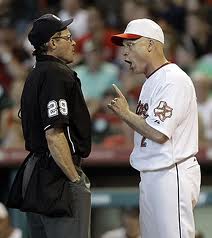 In addition, the original rule was that only umpires could call for review of a replay. Under the new rubrics, a team manager is entitled to one unsuccessful challenge in the first six innings of a game and one in extra innings. The league’s complete explanation of the procedure is available by clicking HERE.
The league emphasized in its announcement that replay appeals have been rare so far and that no appeal has yet resulted in reversal of a call. From my point of view, that information means that if the league comes to its senses and stops monkeying with a game that is not broken, it won’t make much difference.
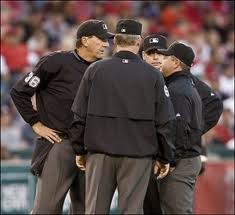 The introduction of instant replay appeals in baseball is the latest ill-advised, unnecessary change that alters the nature of the game. The designated hitter rule was one; it took away an exciting element of strategy in which the manager of a team frequently had to decide whether to stay with a pitcher who was doing well or yank him for a pinch hitter. The DH also eliminated those situations in which the pitcher batted in a crucial situation and tried to use his limited offensive skills to move baserunners along. What did baseball gain by getting rid of those elements? I also object to artificial turf, but there’s no point in belaboring that here.
 It is an intrinsic part of baseball to rely on the judgment of the umpires and to suffer over their bad calls. That’s been going on for more than 160 years, and the Republic has endured. In that respect, it’s a lot like life in general. What exactly is the league trying to teach pre-teen children by taking that human side out of baseball — that it isn’t a game after all? Or is this more about self-important adults than it is about kids?
I have to share Brian’s comment: “(I) can’t wait for an overturned North Korean home run to spark nuclear war.”
“. . . . and welcome to Yankee Stadium.” – Bob Sheppard
July 12, 2010

BOB SHEPPARD
I spent a Yankee game in 1972 sitting next to Bob Sheppard in the booth from which he announced the players and sent other pertinent information rolling through the stadium like summer waves rippling along a shore. He was, as many have been saying in the wake of his death, a gentleman. He began his career at Yankee Stadium in 1951 – the same year that my father took me there for the first of many times. That means something to me, because Bob, with his courtly manners, his precise diction, and his John Barrymore tone, fit right into the atmosphere in the stadium at that time. As it turned out, he worked long enough to be the last vestige of the mood of those days, when many men came to the ballpark in suits and ties and many women in objects of finery from that now nearly extinct artisan — the milliner.
MARK BELANGER
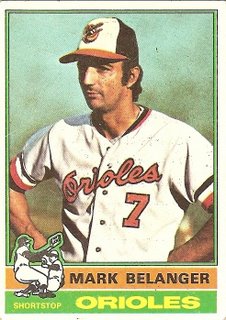
Bob, who taught speech at the university level, had a great respect for words, including proper names, and he didn’t understand people who didn’t share that feeling. He told me that when Mark Belanger of the Baltimore Orioles made his first appearance at Yankee Stadium – probably in 1965 – Bob approached him and asked whether the name was pronounced Bel-ANN-zher, BEL-un-zher, or Bel-un-ZHAY. Belanger, who was to become one of the great defensive shortstops in American League history, said that some people pronounced the name one way, some another. Bob persisted, asking how Belanger wanted it pronounced, and was scandalized when the young man didn’t seem to care. Belanger himself pronounced it Bel-ANN-zher, so that’s the pronunciation Bob used.

BOB SHEPPARD
Bob was known for several traits, including his religious devotion and his dependability. He told me, though, about an incident in which the Yankees had scheduled a 5 p.m. start for a twi-night double-header to make up for a rainout. Bob had forgotten to put the change in his date book. The phone rang at his Long Island home, and the caller — a member of the Yankee staff — asked what Bob was doing. “I’m just putting a steak on the grill for dinner,” Bob said. “That’s nice,” said the caller. “We’re in the second inning.”
There has been a lot published today about how various baseball personalities regarded Sheppard. My favorites were from Oscar Gamble, who used to refer to Bob as “the man upstairs” and from Reggie Jackson, who said that when Bob said “44,” he made it into a bigger number. You can read Bob’s obituary by clicking HERE.

HERM DOSCHER
One of the wonderful things about baseball is that it provides players with so many ways to be remembered — and many of those ways have little or nothing to do with success on the field.
Herm Doscher was an example. So was his son, Jack. In fact, together they constitute one example, because they were the first father and son combination to play the major leagues. Herm played third base for five different teams in the National Association and the National League from 1872 to 1882 – a spotty career for which there don’t seem to be a lot of statistics – and he was later a major league umpire. He was reputed to be hard-nosed in that role. He once ejected Rochester Broncos outfielder Sandy Griffin for arguing a call and, when Griffin wouldn’t leave the field, Doschler forfeited the game to the St. Louis Browns — who were leading 10-3 in the eighth inning anyway.
Jack Doscher (actually John Henry Doscher Jr.) was a pitcher from 1903 to 1908 with three teams including the Brooklyn Superbas, appearing in only 27 games. Doscher died in 1971 at the age of 90 and was at one point recognized as the oldest surviving player for the Brooklyn Dodgers, successors to the Superbas.
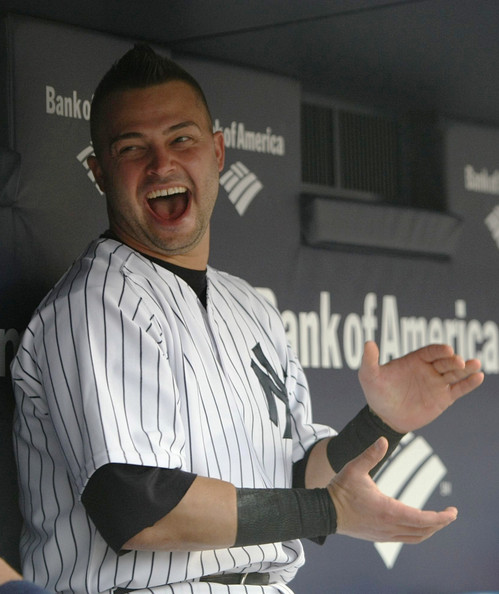
NICK SWISHER
The Doschers come to mind today because Major League Baseball announced this evening that Yankees outfielder Nick Swisher had been elected to the All Star Team. Whatever one thinks of the wacky manner in which those players are chosen these days, Swisher last season and this has made a good case for himself on the field. This is the first time Nick Swisher has been named to the All Star team, and it puts him in an exclusive baseball group — fathers and sons who have made the team. Swisher’s dad, Steve – a National League catcher for 10 years in the ’70s and ’80s – was on the 1976 team when he was with the Cubs, although he didn’t get to play. One of Steve Swisher’s colleagues on that ’76 team was Ken Griffey Sr., whose son also became an All Star — many times.
Altogether, 195 men who have played in the majors had sons who followed. A handful had two sons make it to the bigs. Three men — Sammy Hairston, Ray Boone, and Gus Bell — sent sons and grandsons to the majors. The Hairstons hold the record for multigenerational families with five major league players, although the Delahanty family had five of the same generation.

STEVE SWISHER
The Swishers are the tenth family to have a father and at least one son on the All Star team. (There have been three such families in the World Series.)
I was introduced to baseball by my father, who had managed a semi-pro team and knew a lot about the game. I would like to have been a better baseball player for his sake, but that gene went missing. Dad never expressed any disappointment about my weak performance; he wasn’t cut out that way. We made up for it with the many hours we spent together watching the Yankees in the Bronx and on TV or listening to them on the radio in our grocery store. We did other things together, but baseball provided the strongest bond. Dad’s been gone for more than 30 years, but I still watch baseball with him in mind. Meanwhile, it’s fun to speculate about the satisfaction Steve Swisher must be deriving from Nick’s success in general and from this benchmark in particular.
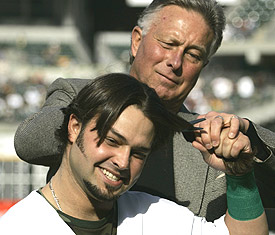
Steve Swisher cuts Nick Swisher's hair in 2007 on the field at the Oakland Coliseum. Nick Swisher had let his hair grow for 10 month so that he could donate it to a program that assists cancer patients.
Books: “The Codes of Baseball”
June 1, 2010

MICKEY MANTLE

WILLIE MAYS
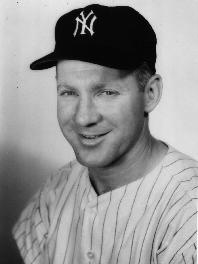
WHITEY FORD

DENNY McLAIN

JIM PRICE
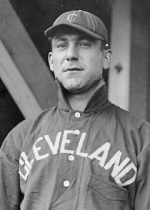
NAPOLEON LAJOIE

TY COBB
Book Review: “Top of the Order”
May 21, 2010

KIRBY PUCKETT
The only time I have carried on a conversation with a naked man, the man was Kirby Puckett. I met him in the Twins’ locker room after a game at Yankee Stadium, and although I had no real business there, and although he had no idea who I was, and although he had just finished playing nine innings and hadn’t showered yet, Puckett couldn’t have been friendlier. The conversation confirmed Puckett’s reputation as Mr. Nice Guy, which is a good reputation to go along with one of the outstanding baseball careers of the 20th century.
Unfortunately, Puckett’s image and Puckett himself eventually came to grief. He was accused and acquitted of sexually assaulting a woman at a Minneapolis restaurant, and he was described in a column by Frank Deford as someone very different from his teddy bear image. He also developed glaucoma and suffered a stroke and died when he was only 45.
Things like that happen to a lot of people, but they take on Shakespearean proportions when they happen to the kinds of heroes and flops that baseball creates in a way that other team sports seldom do. That’s because baseball, unlike other team sports, pauses so often to focus attention on an individual player at an individual moment in time. This is why baseball has contributed so much to literature and film.
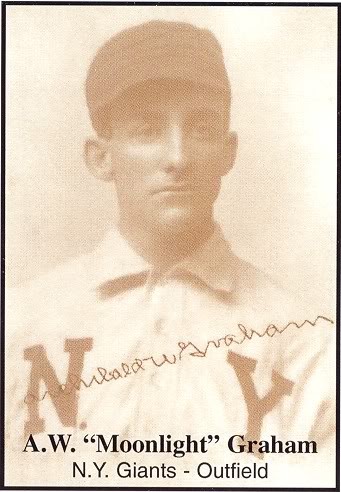
"MOONLIGHT" GRAHAM

JIM BOUTON
“… till it’s over”
April 19, 2010
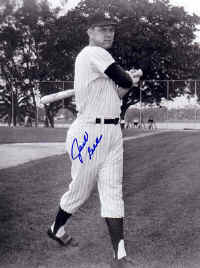
JACK REED
The 20-inning game the Mets won on Saturday got me to thinking about a 22-inning game between the Yankees and the Tigers in June 1962. I was watching that game at home, but I left, drove about 10 miles to visit a friend for several hours, and then drove home and found my brother watching the Yankees and the Tigers. That was long before VCRs and the YES Network’s “encores,” and I was dumbfounded when Tony told me it was the same game I had been watching before I left. It ended exactly seven hours after it had started. The Yankees won, 9-7.
As if the game wasn’t enough of a curiosity in itself, the way it ended was one of those delightful surprises that baseball is so good at providing. For a few years back then, the Yankees carried on their roster an outfielder named Jack Reed, whose job was to play center field in the very late innings so that Mickey Mantle, near the end of his career, could rest his battered and diseased legs.

CLETIS BOYER
Nothing more was expected of Reed, and usually nothing more was forthcoming. But the young man from Silver City, Mississippi, picked the top of the 22nd inning in that game to hit the only home run of his career, providing the Yankees with the runs they needed to win. Reed, incidentally, may not have spent much time in major league baseball, but he is one of a handful of players who can boast of appearing in both the World Series and a college bowl game – three games with the Yankees in the 1961 fall classic, and the 1953 Sugar Bowl with Ole Miss.
Yankee third baseman Cletis Boyer had hit a three-run homer in the first inning off Tigers starter Frank Lary, who was usually hard on the Yankees.

ROCKY COLAVITO
And while Rocky Colavito probably would have said that he’d rather the Tigers had won, even if he had gone hitless — ballplayers always say things like that — he had one of the biggest days of his career, collecting seven hits in ten times at bat. Meanwhile, the Tigers pitchers held the Yankees scoreless for 19 consecutive innings in that game — two shutouts, end to end.
Another note: Yogi Berra, who was 37 years old, caught the complete game.
 CharlesPaolino's Blog