You’re lookin’ swell, Dolly!
December 30, 2024

September 17, 1932
I use this photo as wallpaper on my computers, because it is one of the best baseball action shots I have ever seen. The play took place on September 17, 1932 at the Baker Bowl in Philadelphia. The airborne player is Dick Bartell of the Phillies. The catcher, waiting to make the tag, is Gabby Hartnett of the Cubs. His teammates, visible in the first-base dugout, seem rather nonchalant about the play, but not so the fans—consisting largely of men in suits—who are on their feet. This was the first game of a double header. In the fourth inning, with the Phillies ahead 6 to 1, Bartell was trying for an inside-the-park home run. He was out on the play, but the Phillies would win the game, 7 to 1, and drop the second game, 5 to 1.
Although this episode is all about Bartell and Hartnett, I have always been drawn to the umpire, the trim figure crouching behind the plate, his mask off, his eyes glued to the anticipated point of impact. This is Albert “Dolly” Stark, an innovative, complicated, and ultimately tragic member of baseball’s dramatis personae. One of Stark’s distinctions was that he was the first Jewish umpire in baseball’s modern era and perhaps only the second Jewish umpire since baseball’s beginnings. I don’t know how we can be certain of this, but Jacob Pike, who umpired in the National Association in 1875 , is said to have been the only Jewish arbiter before Stark.

Stark was born in 1897 on the lower East Side of Manhattan. When Stark was a youngster, his dad died, and his mother lost her eyesight. After a police officer found the boy sleeping on a city street, Stark was consigned for a while to a facility for homeless children. Later, in an attempt to earn money for himself and for his family, he played second base for semi-pro and minor league teams. He tried out with the Yankees and Senators, but at 115 pounds, he could not compete at that level. It was during his playing days that he picked up the nickname “Dolly,” a reference to Monroe “Dolly” Stark, a shortstop with the Cleveland Naps and Brooklyn Superbas. Despite the surname, the Dollys were not related.
Albert Stark first umpired at the University of Vermont in 1921. By 1927, he was umpiring in the Eastern League where he did well enough to earn a promotion to the National League. At the time, Stark was also coaching basketball at Dartmouth College and continued until 1936. It might seem to us only common sense that an umpire does not remain stationary on the field but moves around in order to get the best view of a play. However, this was not a common practice until Stark introduced it, shifting positions behind the plate and running alongside fielders and runners to get the best view of plays.
The enmity between players and umpires, if is a staple of baseball lore, and at times it weighed heavily on Stark. And yet, when the Sporting News conducted a poll among players in 1934, they voted Stark the most competent umpire in the National League. If there were an award for the best-dressed umpire, Stark might have won that one too. He was very conscious of his appearance and always impeccably attired on the field in those days when umpires were decked out in suits, dress shirts, and ties, In 1935, Stark became the only umpire before or since to be honored at a day of his own. The event was held at the Polo Grounds in upper Manhattan where National League president Ford Frick presented Stark with a new car that had been purchased with small donations from Stark’s many fans.
In spite of this adulation, Stark’s relationship with baseball was sometimes tumultuous. In 1928, for instance, he wanted to quit in the middle of the season, because he didn’t think he was doing his job well. Bill Klem, one of the great umpires of that period, talked him out of it. Then, after the 1929 season, Stark again thought of quitting, this time because of the tense and lonely nature of umpiring, but he did continue in the 1930 season.
In 1936, Stark quit umpiring because, he said, he wasn’t being paid enough. His salary at the time was $9,000 per season which, according to some sources, was the equivalent of more than $200,000 today. Stark told Ford Frick—by then, the commissioner of baseball—that he would like to stay in the game in a different role, such as business manager or scout, but he never found such an assignment. He resumed umpiring in 1937 but had to retire in 1940 because of a knee injury.
Stark found other outlets for his talents. Among other things, he started a line of women’s apparel—the “Dolly Stark Dress; in 1936, he and Bill Dyer were the first radio team broadcasting Phillies games on WCAU; and he was co-host of an early television sports program, Your Sports Special, on the CBS network in 1948 and 1949.
Stark had a troubled private life. He financially supported his mother and sister, and his sister, who was chronically unwell, took her own life. He married in 1952 but was divorced after four years. Stark died in New York City in 1968.
A spouse in every port
April 17, 2019
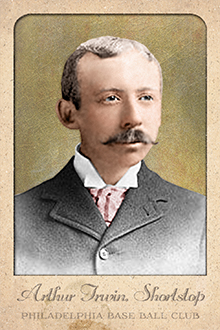 In the early days of television, WOR in New York had a weekday program called Million Dollar Movie—one of the first features to bring movies to TV audiences. I was reminded the other day of one of the movies I saw on that show when I was about 12 years old: The Captain’s Paradise starring Alec Guinness and Yvonne DeCarlo, the former Peggy Middleton. Guinness played a ferry captain who had two wives simultaneously, one in Gibraltar and one in Morocco.
This film came to mind when a member of a Facebook baseball group I frequent posted some 19th centuries photos and asked for help in identifying the players. I was able to name all of them, including Arthur Irwin, who was one of the more colorful characters of the 15,000-or-so men who have played major league ball.
 Irwin—who also had his hand in about a half dozen other sports—was born in Toronto in 1858 but grew up in South Boston. He was a feisty, light-hitting shortstop and, after turns in amateur and minor league ball, he played in the bigs from 1880 to 1894. In two of those years, he was a player-manager. He was the starting shortstop for the 1884 Providence Grays of the National League; that team beat the New York Metropolitans of the American Association in what is now recognized as the first interleague national championship series.
Irwin, who was widely disliked, was frequently in the middle of baseball controversies, including an open revolt against National League owners. In 1890, Irwin was among the members of the Brotherhood of Professional Base-Ball Players—the game’s first union—who bolted from the league for one season and formed their own league—popularly known as the Players’ League.
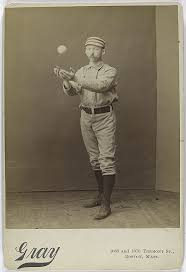 Tracing Irwin’s career after that is enough to make a person dizzy. He managed major and minor league teams, owned a pieces of a couple of minor league franchises for a while, umpired for a year in the National League—throwing out nine players in fifty games—coached baseball at Dartmouth College and on-and-off at Penn, and in 1907 became a a scout for the New York Highlanders—forerunners of the Yankees. By 1912, most of the Highlanders roster were players whom Irwin had scouted.
One of the players Irwin coached at Penn was the future novelist Zane Grey whose first baseball book, The Short-Stop, includes a dedication to Irwin, and whose second baseball book, The Young Pitcher, features a character, Worry Arthurs, who was based on Irwin.
In 1909, George Stallings, the New York manager, rented an apartment that overlooked Hilltop Park, which was in northern Manhattan where the New York Presbyterian/Columbia medical complex is now. From that apartment, Irwin, using binoculars, stole signs from the visiting teams and used mirrors to relay the signs to the Highlanders on the field until the practice was exposed.

FRANK CHANCE/Detroit Public Library
At the end of 1912, Frank Farrell, president of the New York club, promoted Irwin to business manager and gave him carte blanche. That led to rift between Irwin and Frank Chance, who was then managing the team, and Chance wound up resigning before his contract was done, telling The New York Times that he “did not think it was possible to assemble so many mediocre players on one club.”
After leaving the Highlanders, Irwin knocked around the minor leagues as a manager. During that period, in 1921, he was managing the Hartford Senators in the Eastern League when he noticed Lou Gehrig, then a Columbia student, playing for a semi-pro team. Irwin talked Gehrig into signing with Hartford—the first pro contract for the Iron Horse. That got Gehrig into trouble at Columbia, because he was not supposed to be playing pro ball and playing on the college team as well. He had to skip a year of play at Columbia.
 Gehrig wasn’t the only contribution Irwin made to pro ball. In 1883, when he was playing with the Providence Grays, he broke two fingers on his left hand. So he modified a buckskin driving glove so that he could continue to play, and he wore it from then on. Prior that, only first basemen and catchers wore gloves, but Irwin’s innovation became a trend, and almost every fielder had a glove by the next season. Irwin made a deal with a manufacturer to market the glove under his name.
Irwin didn’t limit his energy to baseball. He was also president of short-lived pro soccer league in 1884 and he was involved in one way or another in boxing, roller hockey, rugby, and marathon bike races.
He scored one of his biggest successes when he patented a mechanical football scoreboard that was adopted at fields around the country and earned him a lot of money.
In 1921, Irwin, who was ill with a serious stomach condition, left New York City for Boston aboard the steamship Calvin Austin and went overboard in what was almost certainly a suicide.
Oh, about Alec Guinness.
After Irwin died, it was revealed that he had married one woman in Boston in 1883 and another woman in Philadelphia in the 1890s. He had three children with the first wife and one with the second, and he was still married to both when he died. He almost never saw the family in Boston and provided them with almost no support.
Pitching great Waite Hoyt described Irwin as one of the most disgusting men he ever knew. But somebody liked him: He was posthumously elected to the Canadian Baseball Hall of Fame, at least in part because of his leading role in turning the foundering Toronto Maple Leafs into a successful franchise.
Read Eric Frost’s profile of Irwin by clicking HERE.
Read Kevin Plummer’s article about Irwin, including his role with the Maple Leafs, by clicking HERE.
“And the count is four … four … four ….”
August 29, 2015

In the episode of the television series Taxi in which Jim Ignatowski is hired as a driver for the Sunshine Cab Company, the first scene takes place in Mario’s, the cabbie hangout. The core group of drivers on the show are there to celebrate the fact that one of them, Tony Banta, has finally won a prize fight. Their excitement isn’t dampened at all by the fact that Tony won by default when his opponent fell while climbing through the ropes and knocked himself out. After all, Tony argued, he had to make it through the same ropes. In that scene, one gets a fleeting glimpse of a framed print among the clutter behind the restaurant bar. It is a reproduction of Dempsey and Firpo, the 1924 painting by George Bellows. The painting portrays the incident a year before when 80,000 people were admitted to the Polo Grounds in Upper Manhattan—the baseball park had a capacity of 55,000— to watch Jack Dempsey defend his world heavyweight boxing title against the popular Argentinian Luis Firpo.
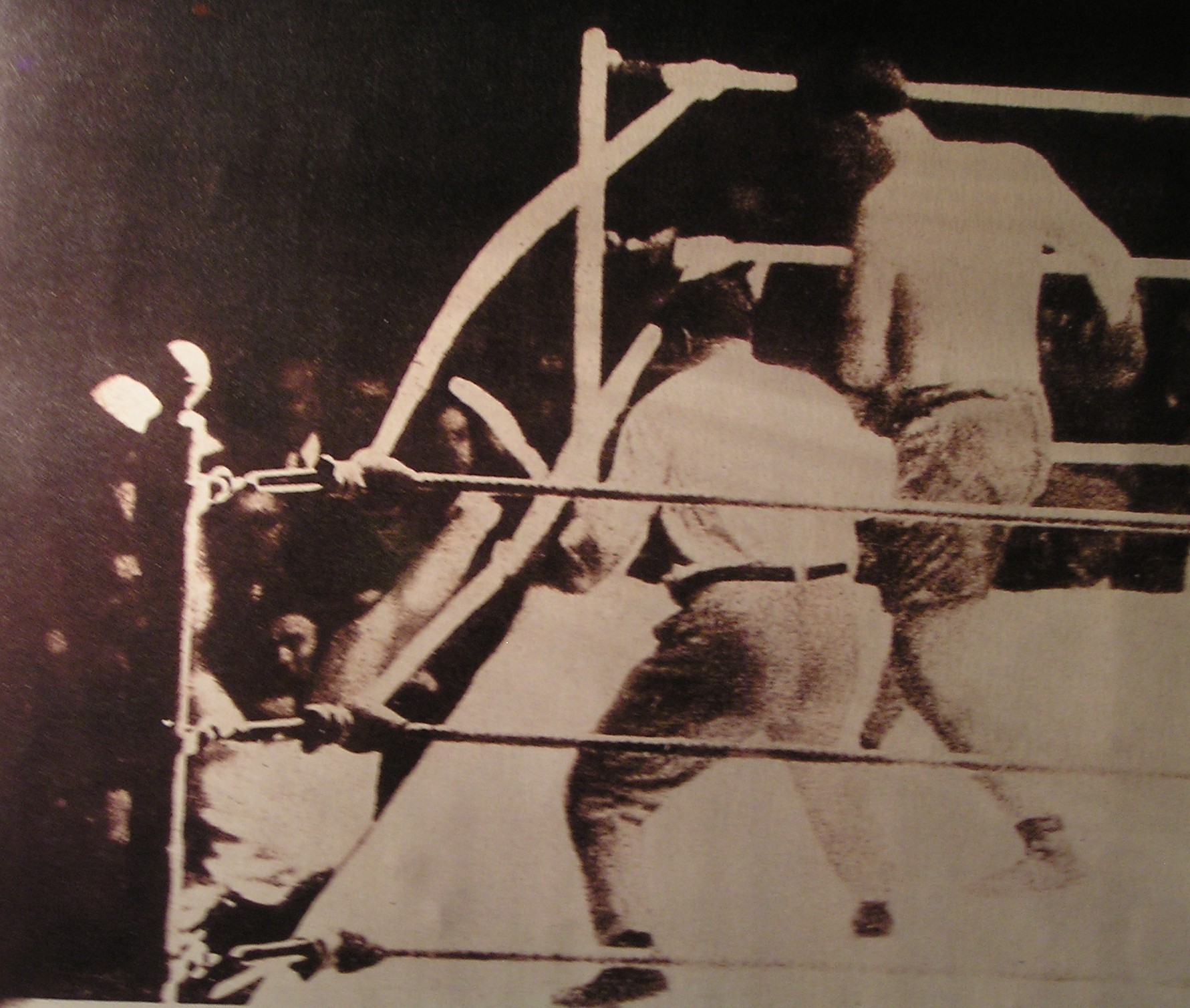
The fight lasted only into the second round, and both men took their licks. In the first round, Dempsey knocked Firpo down seven times; that was made possible by the rules that prevailed at the time, permitting a boxer to stand over a floored opponent and knock him down again as soon as he got up, and also by the fact that three knockdowns in one round were not yet considered a technical knockout. A rule adopted later required a boxer to go to a neutral corner when his opponent was knocked down.
Later in the first round, Firpo landed a right on Dempsey’s chin and knocked him through the ropes and into the ringside seats. What happened next generated one of those exquisite controversies that arise in sports. The sports writers sitting at ringside helped Dempsey back into the ring. Analysis of the film of the fight indicates that the referee had counted only to four when Dempsey was back on the canvas, but observers who were checking their watches claimed that as many as fourteen seconds had elapsed when Dempsey was ready to continue.
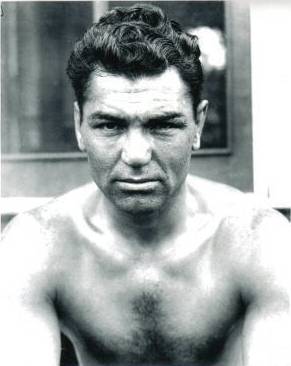
JACK DEMPSEY
Because of the count, and because Dempsey didn’t get back into the ring under his own steam, the argument arose and has persisted that Firpo should have been awarded a knockout and crowned heavyweight champion of the world. If Dempsey had been out of the ring for twenty seconds, the rule in place at the time would have resulted in a TKO. As it turned out, Dempsey knocked out Firpo in fifty-seven seconds of the second round, and Firpo never did win the title. Dempsey who was a wild and wooly character, often involved in controversy, earned enormous amounts of money as a fighter. He later operated a popular restaurant in Manhattan. Firpo became an automobile dealer and a large-scale rancher. He and Dempsey later jointly managed an Argentinian boxer named Abel Cestac who became the heavyweight champion of South America.
I don’t follow boxing any more, but when I was younger I had a conflicted relationship with the sport. I enjoyed its history, its characters, and its ritual, and I admired boxers such as Archie Moore, Carmen Basilio, Rocky Marciano, Ray Robinson, and Floyd Patterson. On the other hand, I thought, and still do, that boxing is fundamentally barbaric.
Boxing was a subject that interested George Bellows, who did a number of works that portrayed amateur fights. He may be best known for his scenes of New York City life. He promoted American intervention in World War I and the war, including atrocities attributed to German troops, provided him with some riveting subject matter. When he was criticized for painting images of a war he did not witness, he asked rhetorically if Leonardo had attended The Last Supper.
King of the Hill, in a manner of speaking
July 6, 2013
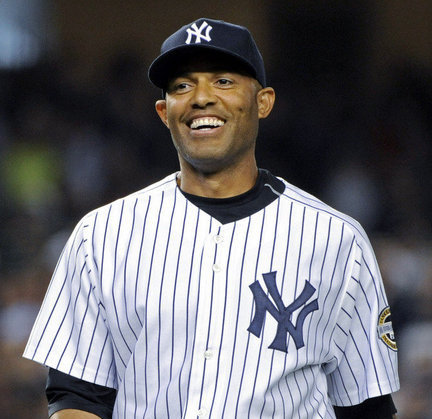
MARIANO RIVERA
The Times, perhaps because it realizes that the window of opportunity is rapidly closing, published a story on June 30, in which Joshua Prager makes the case that by “just about every metric, simple or complex, (Mariano) Rivera is the greatest relief pitcher ever.”
I love Mariano Rivera, and baseball metrics, as much as the next fellow, but I have a problem with words like “ever” in comparisons like this one.
In the recent Times account, the marquee statistic among those used to make this case is the so-called WHIP, which is the average of walks plus hits per innings pitched. When the story was written, Rivera’s average was 1.0035, meaning that in the 1086 innings that Rivera has pitched in his career as of this moment, he has allowed about one hit or walk per inning. A WHIP average approaching this has been rare over the history of baseball. That statistic wasn’t kept until relatively recently, but it has been calculated retroactively and, as The Times points out, Rivera’s average is the third lowest among pitchers who have thrown 1000 or more innings.
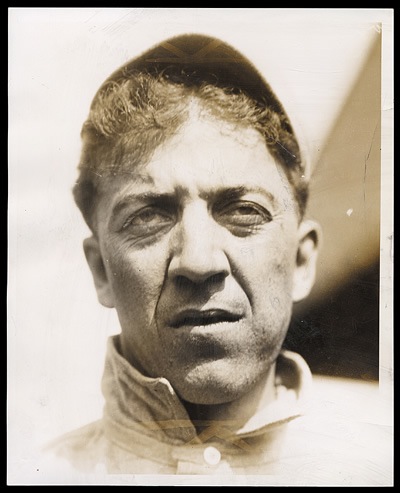
ADDIE JOSS
The lowest WHIP average, 0.9678, belongs to Addie Joss, who pitched for the American League Cleveland franchise from 1902 to 1910 and also was a very popular sports writer in Toledo and Cleveland. Joss pitched a one-hitter in his major league debut, pitched the second perfect game in major league history, and pitched another no-hitter. He was ill throughout most of his career and died at 32 after contracting malaria. Because he pitched only nine seasons, he was not eligible for election to the National Baseball Hall of Fame, but he was admitted under a special rule.
Second place on the WHIP list, with an average of 0.9996, is Ed Walsh, who pitched from 1904 to 1917, virtually all of it with the Chicago White Sox. He also holds the record for lowest career earned-run average: 1.82. His finest individual season came in 1908 when he went 40–15 with 269 strikeouts, 6 saves and a 1.42 ERA.
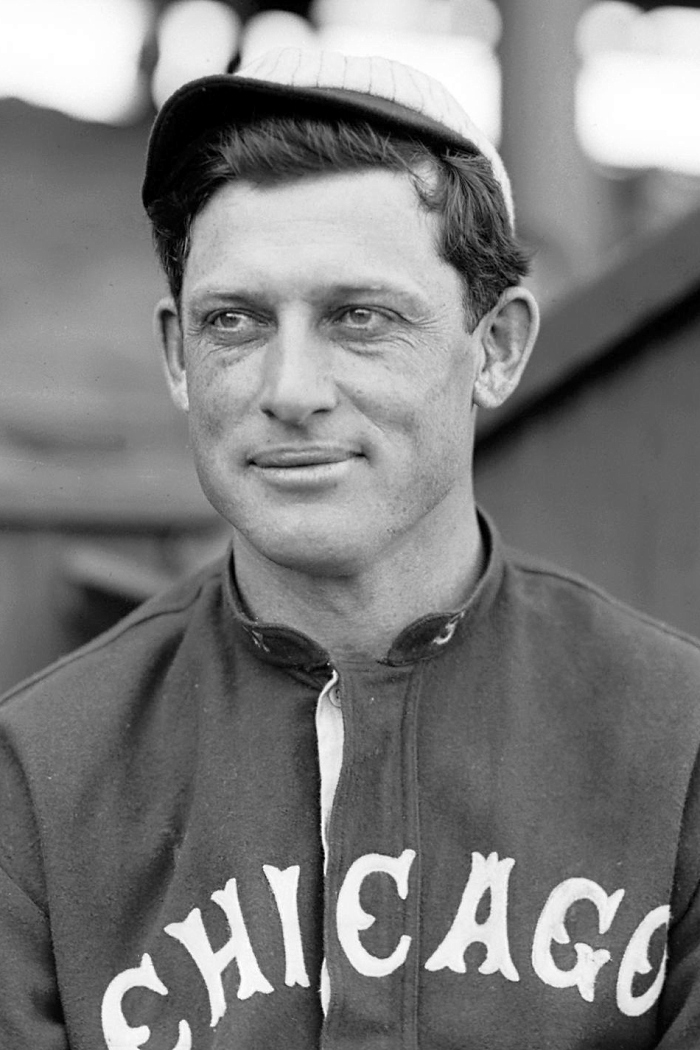
ED WALSH
Inasmuch as The Times called attention to these two players, I will cite their records in order to make my own point. As The Times story mentions, most of Rivera’s relief appearances consist of one inning. Addie Joss and Ed Walsh were starters, not relievers. But the relief specialist as we now know him — the middle reliever, the set-up man, the closer — didn’t exist in that era or for many decades afterward. Ed Rommel’s 17-inning relief appearance in 1932 was an anomaly, to be sure, but relievers for most of baseball history could not count on pitching one inning per appearance.
In compiling his WHIP average, Joss appeared in 286 games and pitched 2327 innings, an average of 8.14 innings per game. Walsh appeared in 430 games and pitched 2964 innings, an average of 6.89 innings per game. To cite a later example, Hoyt Wilhelm, who pitched mostly relief for many teams from 1952 to 1972, appeared in 1070 games and pitched 2254 innings, an average of 2.10 innings per game.
At this writing, Rivera had appeared in 1086 games and pitched only 1251 innings, an average of 1.15 innings per game. His performance has been astounding. It is unheard of for a pitcher to achieve his level of success, to be virtually unhittable, while throwing only one pitch. But pitching one inning per game is a modern, one might say post-modern, phenomenon in baseball. It’s pointless to speculate about how Rivera would have fared if he had been a starter or a long reliever or the jack-of-all-trades that was common in the earlier history of the game. We can certainly appreciate him for the unique player he has been, but “the greatest relief pitcher ever” — EVER? In a game like baseball, that has been played by so many men and that has evolved over so many years, that kind of statement is impossible to defend.
Books: “The Longest Fight”
July 16, 2012

JOE GANS
Prize fighting was part of my growing up.
My parents associated with some people who were connected to the boxing game: a promoter, a ring announcer, a cut man. At times, Mom and Dad would attend fights; I remember Mom coming home after one of those occasions with flecks of blood on her pink suit. Apparently they were at ringside.
In those days, the 1950s, we could watch fights on broadcast television, and we saw Carmine Basilio, Ezzard Charles, Jersey Joe Walcott, Sugar Ray Robinson, and Archie Moore.
Then, as now, I was a little schizophrenic when it came to boxing. I liked watching fighters like the ones I named, but I didn’t approve of boxing and thought it should be banned. I thought, and think now, that an enterprise in which the object is to knock your opponent senseless has no place in a civilized society.

WILLIAM GILDEA
Boxing was, in fact, illegal in most of the United States in the period discussed in William Gildea’s book, The Longest Fight. Where it was legal, one of the most prominent practitioners of “the sweet science” was Joe Gans, Gildea’s subject, the lightweight champion of the world and the first African-American to hold a world boxing title.
Gans held the lightweight title from 1902 to 1908 and he won the welterweight title as well in 1906. A native of Baltimore, he was strikingly handsome, well spoken, witty, courteous, and charming. Those qualities plus his nearly matchless skill in the ring attracted a large following, including white folks in numbers that were unusual for a black athlete in the days when Jim Crow was in such full vigor that racial epithets and garish cartoon figures of black Americans were commonplace in daily newspapers.

A postcard promoting the first Gans-Nelson fight.
Gildea recounts that Gans put up with plenty of abuse during his career, but he had learned the wisdom of restraint, and he practiced it in and out of the ring. When a white opponent spat in Gans’s face while the referee was going through the ritual of instructions, Gans bided his time until the fight began. His demeanor in everyday life was disarming, and he won over many people who otherwise would have included him in their overall prejudices about black people.
Gildea reports that people such as promoters and managers took advantage of Gans, because they knew a black athlete had no recourse and often was risking his life just by climbing into the ring with a white boxer.
”BATTLING” NELSON
In what was arguably the biggest fight of Gans’s career — the “long fight” referred to in the title of this book — the manager of Oscar “Battling” Nelson insisted that Gans submit to three weigh-ins on the day of the contest, and under unheard of conditions. Gans just stood for it. No one, he knew, wins at the weigh-in.
That fight took place in September 1906 under a broiling sun in the Nevada desert town of Goldfield. Gans defended his lightweight title against Nelson, whom Jack London called “the abysmal brute” for both his free-swinging style and his penchant for dirty tactics like groin punches and head-butting. Nelson was also an unapologetic racist who made no bones about his revulsion for Gans and black people in general. It was a fight to the finish, and the finish didn’t come until the referee disqualified Nelson for a low blow in the 42nd round, after two hours and 48 minutes of combat.
By that time, Gans had beat the tar out of Nelson whose face, Gildea writes, was almost unrecognizable, but if Nelson had one positive attribute it was that he could take punishment, so he was still standing when the referee made Gans the winner.

Gans during one of the three weigh-ins before the fight in Goldfield.
Gildea describes the “fight to a finish” in episodes running through the book, interrupting the account from time to time to relate other aspects of Gans’s career and private life, including the two dives he acknowledged, his warm relationship with his mother, his romantic ties, his establishment of a Baltimore hotel and saloon that was a drawing card for a stylish crowd, both black and white, and his early death.
Gildea, whose carefully crafted narrative makes this book especially enticing, clearly explains the quality that made Gans a perennial winner. He blocked his opponents’ punches, moved as little as possible, threw a punch only when he saw an opening. And when he did punch, the blow was short and direct — in fact, Gildea writes, Gans introduced the technique of reaching out to touch his opponent and freezing the distance in his mind.
Gans is largely forgotten today, but as Gildea demonstrates, he was an important figure in the history of boxing and, more significantly, in the history of black citizens in the United States. Like the black men and women who were the first to venture into other fields, Gans took a barrage of slings and arrows for the team, and he did it with style.
Murder most foul
November 24, 2011

GREG HALMAN
When I first heard the other day that Greg Halman had been stabbed to death I was, of course, shocked, but not just because of the murder itself. Murder usually takes us by surprise, whether the victim was someone we knew, someone we only knew about, or someone we never heard of. It’s in the nature of the crime that it seems to come, as it were, out of left field.
In this case, my shock was doubled because the victim was a major league baseball player. It’s a hangover from my growing-up years when I thought those guys were special. I came to learn, as we all do, that they’re subject to all the weaknesses and vulnerabilities of our kind. I know that intellectually, but emotionally I’m the type who still thinks Santa Claus will show himself some day and sit in judgment over the sheep and the goats.
The fact is, though, that baseball players may be more susceptible to homicide than the general population is. Something like 17,000 men have played in the major leagues and I know of ten who have been murdered. What’s that – one in about 1700? The murder rate in the United States last year – ostensibly an all-time low – was nearly one in 10,000.

LUKE EASTER
The ones I know about are Frank Bell, Frank McManus, Ed Morris, Lymon Bostock, Tony Solaita, Gus Polidor, Ivan Calderon, Dernell Stenton, and Luke Easter.
The one that most sticks in my mind is Easter, because he was one of my first “favorite” players. He came into the major leagues in 1949 when I was seven years old. He was about six-foot-four and weighed 240 pounds. I got most of my baseball on the radio then, and for a while I thought his name was Lou Keester. I didn’t know it then, but because he was black he didn’t get to play in the bigs until he was 34 – although he was inconsistent when reporting his age and place of birth. He is a prime example of the damage that racism did to major league baseball. He appeared in only six seasons in the majors and played in more than 100 games in only four. He was a good first baseman and a slugger in semi-pro ball — which was a big deal in his day — and in the Negro Leagues. He hit a total of 86 home runs in 1950, ’51, and ’52; he played only 396 games in those three seasons, and he was 37 years old in 1952. He and Mickey Mantle were the only players to hit a ball over the right-field scoreboard in Cleveland’s Municipal Stadium. Easter’s traveled 477 feet.
After his major league stint, Easter played in the minors until he was 48 and coached for a while. Wherever he went, he added to his reputation as a genuinely nice man who liked to help other players. When he and baseball were done with each other, he went to work for the Aircraft Workers Alliance and became the chief union steward at a company in Euclid, Ohio. In 1979, he was delivering payroll money to a bank when he was accosted by armed robbers who shot him to death when he wouldn’t turn over the money.
When a fan remarked that he had witnessed one of Easter’s longest home runs, Easter said: “If it came down, it wasn’t mine.”
Touch ’em all, Mr. Freese!
October 28, 2011

Gene and George Freese
All the excitement about David Freese and his World Series heroics has got me thinking about George and Gene Freese, who were also major league baseball players, though no relatives of David, as far as I can tell. Gene and George were brothers, but they were not the Deans, the DiMaggios, or the Alous. I remember them because they played in the 1950s and 1960s, when I was still reasonably alert, and because I have the kind of mind that retains things such as the names of obscure baseball players.
George Freese appeared in only 61 major league games — “only” being a relative term inasmuch as most of us don’t appear in any — but he hung around the game longer than that as a coach, minor league manager, and scout. I might have remembered him anyway just because he was Gene Freese’s brother, but George has a distinction of his own: he is one of I guess a couple of hundred players who have hit inside-the-park grand slam home runs. I have never seen one, but I recall reading about George Freese’s 1955 homer in Baseball Digest. The writer described an inside-the-park grand slam as the most exciting play in baseball, and while I don’t go in much for hyperbole, I can understand why he would say that. It must seem to the fans as if the earth has stopped turning its axis while they hold their collective breath and watch that ball and the batter racing for the plate.
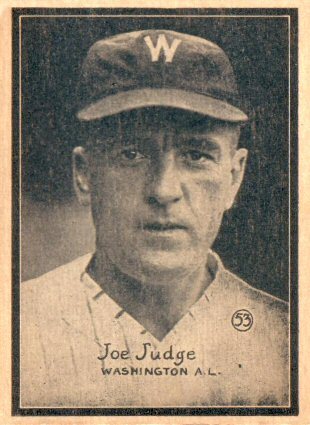 For many years after George Freese ran his home run home, I thought of his feat as unusual. Certainly, in decades of watching baseball, I had never seen anything like it. But I have learned since that there have been far more such homers than I would have imagined. Even Yankee pitcher Mel Stottlemyre hit one — in 1965. Some players have hit more than one, and some players have hit more than one in one season — for example, third baseman Joe Judge, who did it twice in 1925.
Many of the inside-the-park grand slams were hit during the dead-ball era, and the first one was hit by Harry Stovey of the Worcester Ruby Legs in 1881. Stovey did it again in 1886. It was appropriate in a way that he was the first to turn this trick, because he was the pre-eminent home run hitter of his day and the first player to hit 100 home runs in his career.

HARRY STOVEY
Books: “Wonder Girl”
August 31, 2011
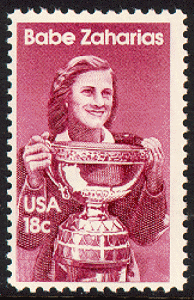 If ever an athlete embodied the phrase sic transit gloria mundi, it was Babe Didrikson Zaharias. There are a couple of generations of adults among whom she is virtually unknown, and yet she was such a combination of natural ability, hard work, and results, that she has no peer.
I’m not an expert on this subject. I had only the vaguest idea of who Babe Didrikson was until I read Don Van Natta’s excellent book, Wonder Girl. But thanks to Van Natta’s scholarship, his journalistic discipline, and his entertaining and literate writing style, I now know plenty about Babe – and I’m glad I learned, even at this late stage of my life.
Babe Didrikson died of cancer in 1956, when I was 16 years old. In those days, I followed baseball and boxing, so I had only the slimmest knowledge that she was a prominent golfer. What I learned from Van Natta’s book is that Babe Didrikson would have excelled at almost any sport she chose and that she made a considerable mark in both track-and-field and in basketball before she turned her whole attention to golf.
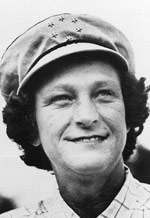 I’ll mention only one particular performance, because every time I think about it I am impressed all over again. Babe, who gave up on education before she finished high school, took a job with a Dallas-based insurance company, but not because she was interested in actuarial tables. Some companies in those pre-television days sponsored amateur sports teams that competed with each other around the country and acted as living advertisements for their employers. Babe’s principal job at the insurance company was playing basketball and track, both of which she did at a championship level. She was so extraordinary, in fact, that in 1933 her boss and coach sent her to the American Athletic Union’s national championship meet in Illinois.

DON VAN NATA JR.
I mean that literally. He didn’t send the rest of the team — only Babe. And competing against squads from around the U.S., she entered eight of the ten events and won the gold medal in broad jump, baseball throw, shot put, javelin, and the 80-meter hurdles and tied for first in the high jump. She collected a total of 30 points; the second-place team scored 22. In that meet, Babe qualified for the 1932 Olympic Games in Los Angeles, where she won two gold medals and a silver and set two world records and an Olympic record.
I had to tell that story. But Van Natta’s book isn’t engrossing only because it reports on that and Babe’s many other achievements. This book tells the story of an American life. Babe’s parents were faithful and hard-working natives of Norway who settled in Texas. They had a large family, and they lived from hand to mouth. Babe loved this family and she remained loyal to her parents and siblings and other connections, always including their financial well being in her reasons for driving herself so hard.
Babe was a tomboy, and when she grew older she was perceived as mannish. This plus the fact that she remained single for so long led busybodies, including prominent sports writers, to speculate about her sexual orientation. She also was the target of verbal abuse from sports writers and others who believed, as Joe Williams wrote in the New York World Telegram, that “it would be much better if she and her ilk stayed at home, got themselves prettied up and waited for the phone to ring.” The rough-and-tumble Babe broke through the barrier of snobbery that surrounded amateur golf at that time; she was a founding member of the LPGA.
She put an end to much but not all of that talk when she married popular pro wrestling villain George Zaharias in 1938. The marriage lasted a lifetime, but it was tumultuous. Zaharias was a compulsive promoter, and he insisted that Babe keep up an exhausting schedule of competition and personal appearances, even when she would rather have taken a break.
 An important factor in the story of Babe Didrikson’s life was her complicated personality, which was at the same time endearing and obnoxious. She was a bold braggart, constantly tooting her own horn. Van Natta reports that Babe would walk into the clubhouse before a golf match and announce herself by saying, “Babe’s here! Who’s gonna finish second?” And when she wasn’t bragging and even lying about her prowess, she was needling and annoying her opponents, deliberately trying to throw them off their game. But it is part of the genius of Van Natta that while he tells a great deal about this aspect of Babe Didrikson, he tells it in the wider context of her life, so that her braggadocio does not define her in the reader’s mind.
Babe Didrikson was diagnosed with rectal cancer and underwent a permanent colostomy. There would still be enough greatness in her to resume her golf career and win tournaments. But the cancer prompted her to rise to the occasion in another way. She became a tireless campaigner for funds to support cancer treatment and education, and she made a point of visiting cancer patients, especially children, to encourage them to go on with their lives.
Babe Didrikson: a life worth remembering.
From the mound to the altar
August 25, 2011

WARREN SPAHN
Since it was our 47th wedding anniversary, Pat and I went to dinner Monday night at that great Italian place in Clinton. We ate on the patio. In the opposite corner was a family of four — parents and a teenager of each gender. Before we got there, some guy who was riding a bike along the sidewalk recognized the family and stopped to talk. In fact, he parked the bike and sat down on the brick wall and made himself comfortable. The father in the family act, pretty much ignoring everyone else at the table, spend the time shooting baseball trivia questions at the visitor. I found this a little off-putting, both because he was talking loud enough for us to hear and because of the quality of the questions. What left-handed pitcher won the most games lifetime? Puh-leez! Give me something I can work with, will ya? (By the way, that was Warren Spahn with 363, which is also the greatest number of wins by any pitcher who spent his entire career in the live-ball era.)
Now, me? I would have asked him about Allen Travers, capisce? I was thinking about Travers the other night when the announcers on the Yankee broadcast were obsessing over the fact that Phil Hughes had thrown 106 pitches in a game for the first time this season.
EDDIE ROMMEL
Besides making me worry that Hughes might have to spend the rest of his life with a prosthetic arm, that conversation got me to thinking about all the great performances that would never have taken place if the pitch count had been a part of baseball from the beginning.
I was thinking, for example, about Eddie Rommel — later an American League umpire — who spent 12 years pitching for the Philadelphia Athletics and supposedly invented the knuckle ball as we now know it. In 1932, Rommel came in in relief against the Indians in the second inning, behind 3-2. He pitched 17 innings, gave up 29 hits and 15 runs, and won the game 18-17. The 29 hits allowed is still the single-game record.
Travers was a different matter. He was a student at St. Joseph’s College in Philadelphia in 1912 when Ty Cobb of the Detroit Tigers went into the stands at Hilltop Park in New York to pummel a New York Highlanders fan who had been verbally abusing him during a game. It turned out that the fan had lost one hand and several fingers from the other hand in an industrial accident. Ban Johnson, president of the American League, suspended Cobb indefinitely. When the Tigers were supposed to play the Athletics in Philly a couple of days later the team announced that they wouldn’t take the field until Cobb was re-instated.

Fr ALOYSIUS TRAVERS
The League told the Tigers they faced a $5,000 fine and would forfeit every game until there were players. To avoid the penalties, the Tigers enlisted Allen Travers — non-playing manager of the St. Joseph baseball squad — to round up a team off the streets and sandlots of Philadelphia. The nine guys were signed by the Cardinals. Travers was on the mound, and no one counted his pitches. He pitched eight innings and gave up 24 runs, which is still the major league record. The Athletics won the game, 24-2.
Travers later became a Jesuit and taught in college and high school in New York and Philadelphia. The 24 runs allowed wasn’t his only record. He was also the only major league player to become a Catholic priest.
But who’s counting?
You can read a fuller account of Father Travers’ experience by clicking HERE.
Books: “Stan Musial: An American Life”
July 15, 2011
 It might be significant that I couldn’t think of any way to begin this post about Stan Musial — any way but this, that is. The thesis of Stan Musial: An American Life is that, because Musial played his whole career with the St. Louis Cardinals, he has been perennially undervalued vis-a-vis his contemporaries who played in cities like Boston and New York. I grew up during his career, and it’s true that, living in the New York area — especially after the National League teams both slunk out of town — Musial was not the topic of everyday conversation.
He was, as New York Times columnist George Vecsey suggests in this book, just kind of there, and the next thing we knew he had accumulated more than 3,600 hits and had established himself as one of the best hitters of his era.
Musial came from Donora, Pa., which was a gritty industrial town where his dad worked in a steel mill whose management wasn’t concerned about the employees’ health. Vecsey draws a detailed picture of life in that town, and that may be the most worthwhile part of this book. Young Stan was a good athlete, but he got into the Cardinals’ organization as a pitcher — something he wasn’t suited for.
 In 1941, he had a storybook season. He started out in the spring in the Cards’ baseball camp in Hollywood, Fla., where he was supposed to pitch batting practice, and by the end of the summer he had been converted into a hard-hitting outfielder and was called up by the parent team for the last week of a pennant race.
He played for the Cardinals until he retired in 1963, amassing one of the great personal records in the game plus a reputation for reliability, and for dignity on the field, and for a cheeful and hospitable approach to life. He was well liked in and out of the game.
While it is true, as Vecsey writes, that Musial’s extraordinary career has been overshadowed in the popular mind by the careers of contemporaries like Joe DiMaggio in New York and Ted Williams in Boston, his numbers are indelibly preserved in the record book where they put the accomplishments of other players in perspective, for better or for worse. Derek Jeter, for instance, has achieved what only 28 out of about 17,000 major league players have achieved, and yet he can’t escape the ink that says that Musial’s mark in total hits is out of reach.
But Vecsey, writing about “an American life,” does a little too much fawning over Musial and not enough exploring of aspects of the ballplayer that Vecsey himself brings up. He dwells on Jackie Robinson’s revolutionary appearance with the Brooklyn Dodgers in 1947 and he intimates that Musial was at most a passive participant in the breaking of the color line, but he does not deeply plumb Musial’s attitude on race.
 Vecsey reports that Musial was spared military service during the heat of World War II on the grounds that he was a parent and the sole support of his mother and father – who, incidently, had several other children; that he declined to join an army unit when a baseball colleague urged him to do so, and that, when his number was up, as it were, he served at the tail end of the war by playing baseball in Hawaii and then by flying a stateside desk. The author writes, too, that Musial was not an activist when his fellow players rebelled against the reserve-clause system that for a long time made players the property of their owners, the Fourteenth Amendment notwithstanding. In a broader way, Vecsey writes that Musial was a peacelover, meaning that he liked to avoid conflict. We are left to infer that Musial was happy in statu quo so long as things were going well for him — which they were for several decades.
Vecsey does at least let a voice other than his own — that of former Cardinals star Curt Flood — speak to the question of who Stan Musial really is. Flood unsuccessfully sued major league baseball after refusing to agree to a trade in 1969; his suit was the opening shot in a movement that ultimately changed labor relations in baseball.
In his autobiography, Flood wrote that he and other players respected Musial as a player and as a person; they thought of him as a man who would not consciously do harm. But, Flood continued, “He was just unfathomably naïve. After twenty years of baseball, his critical faculties were those of a schoolboy. After twenty years, he was still wagging his tail for the front office – not because he felt it politic to do so but because he believed every word he spoke.”
 CharlesPaolino's Blog