“To love at all is to be vulnerable” — C.S. Lewis
December 18, 2009
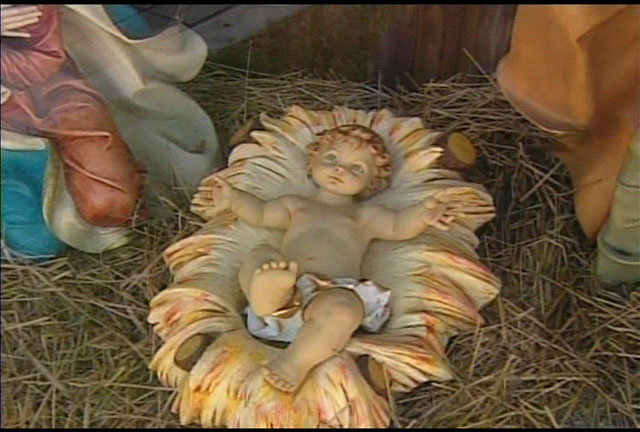 There are two things I still have to dig out in order to observe Christmas properly. One is the heirloom manger figures; the other is the DVD of the “Dragnet” episode in which the statue of the infant Jesus is stolen from a creche in a Los Angeles mission church. That’s the original 1953 version with Ben Alexander playing Frank Smith.

JACK WEBB and BEN ALEXANDER
For the benefit of the uninitiated, LA detectives Joe Friday (Jack Webb) and Frank Smith are called to a church in a Latino neighborhood by Father Rojas because the statue has gone missing as the Christmas morning Masses are approaching. The poker-faced cops mechanically set about looking for the culprit, but have to return to the church on Christmas Eve to tell the priest that they have come up dry. While they’re standing with him near the sanctuary, they hear a racket coming from the direction of the front doors, and a little boy, Paco Mendoza, comes up the center aisle pulling the statue in a wagon. When the priest questions him in Spanish, the boy explains that he had promised that if he got a wagon for Christmas, Jesus would get the first ride. Frank Smith wonders aloud that the boy has the wagon already, before Christmas arrives. In one of the great exchanges in television history, the priest explains that the wagon didn’t come from the usual source; it was one of the toys refurbished by members of the fire department. “Paco’s family,” he tells the detectives, “they’re poor.” To which Friday, glancing at the Christ child back in its crib, says in his monotone: “Are they, Father?”
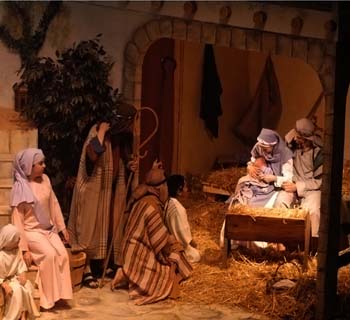 Our manger scene consists of white plaster figures, made in France, that belonged to my mother. She told me that she received the set from a Syrian priest when she was a child, and it wasn’t new then. Most of the figures have been broken and repaired one or more times, and one of the animals mysteriously disappeared about ten years ago. The set has a classic look to it, so we wouldn’t consider replacing it. It’s a few cuts above those translucent, illuminated plastic ones that have appeared on various lawns in the past week or so.
The tradition of assembling a manger scene — living or otherwise — originated in the 13th century with Francis of Assisi. The “Dragnet” crowd apparently wasn’t familiar with the tradition in which the image of the child is not placed in the manger until Christmas Eve, in time for the midnight Mass. A church like the one depicted in that episode would almost certainly have adhered to that custom. I have noticed that the child hasn’t been placed even in many of the lawn scenes that are out there now.
 The child, of course, is the centerpiece of the feast, the vulnerable, innocent child who is both God and man in the belief of hundreds of millions of Christians. Why would God appear in human form — and as a newborn child? There is a learned and lovely reflection on this question on the blog “This Very Life,” written by Tania Mann in Rome. Those who are going to celebrate this holy day — and are very busy getting ready for whatever it implies for them — might want to spend a few minutes contemplating the reason for it all. If so, click HERE.
“Hear the word of the Lord” — Hosea 4:1
September 7, 2009
 I see by the papers that the publishers of the New International Version of the Bible are preparing a new edition of the scriptures that is likely to re-ignite the debate about sexist language.
I was discussing sexist language with one of my English classes the other day. The text for that class advises students to use the construction “his or her” in order to avoid expressing gender bias. So, for instance, students are advised to write. “A person who has been drinking at a party should surrender his or her keys to a sober friend,” rather than, “… surrender his keys to a sober friend,” which is grammatically correct, but some say not correct in other ways.
 Several years ago, a translation called Today’s New International Version was introduced in which many gender references were changed in order to avoid what the publishers felt were unwarranted or unnecessary male nouns or pronouns. For example, a verse from the Gospel According to Matthew was altered from “How can you say to your brother, ‘Let me take the speck out of your eye ‘ ….” to “How can you say, ‘Let me take the speck out of your eye’ ….” That doesn’t seem to alter the meaning of the verse, although I don’t know why the translator, if he or she wanted to alter that verse didn’t resort instead to “How can you say to your sister or brother ….”
An even more curious change affected a verse in St. Paul’s First Letter to the Corinthians: “For since death came through a man, the resurrection of the dead comes also through a man.” That was changed to: “For since death came through a human being, the resurrection of the dead comes also through a human being.” The first man referred to was Adam – who was incontrovertably male – and the second man referred to was Jesus – also incontrovertably male, so that change seems unnecessary if it does not actually obscure Paul’s meaning.
 The committee working on the new translation has explained that every gender reference in the Bible will be reviewed, but the outcome remains to be seen — sometime in 2011.
This aspect of Today’s New International Version was controversial. Some Christians who rely on this version argued that the text should stick as close to the original as possible, for reasons of authenticity and scholarship. Some objected to the tinkering with gender references as a disingenuous bow to political correctness. And some, including the translators, argued that those and other changes were designed to make the Bible more attractive to a younger audience and more accessible to all English-speaking people.
My own view as a reader of the New American Bible is that a book that is presented to the reader as the Bible should reproduce as closely as possible the language and meaning of the original writers and traditions. Reading the scriptures without historical context is always a risky business, and not just with respect to gender bias. Serious readers of the scriptures should know enough about the cultures in which they were written to understand that the status of women was very different from their status in the 21st century and even more different from the status they should occupy in the 21st century. There are many popular and scholarly commentaries on the Bible that explain the contents and background of the scriptures from a variety of religious perspectives and for a variety of audiences.
Meanwhile, the Huffington Post report on the revisions to the New International Version of the Bible is at this link:
http://www.huffingtonpost.com/2009/09/01/new-international-version_n_274299.html
 Bill McGraw writes in the Detroit Free Press about what seems like the increasing tendency of political figures to invoke the name of God to justify virtually anything. The immediate inspiration for McGraw’s column was a remark by Detroit City Councilwoman Monica Conyers, who is in the crosshairs of a potential federal bribery indictment. “On Tuesday,” McGraw writes, “when it became clear the feds were closing in on Conyers, she described herself to viewers of her weekly TV show as ‘a child of God,’ and told viewers ‘if you’re not praying for me, then you’re just adding to the problem.’ Then she added: ‘All these things that are going on right now … I believe in my heart that God will deliver me from them.’ ”
McGraw went on to reminisce about invocations of the Diety by Detroit public figures over the past couple of decades, including former Police Chief William Hart who was charged in 1989 with using public funds to subsidize $72,000 in rent on his daughter’s former home in Beverly Hills. “With God as my witness,” Hart said, “I swear I did not do that.” He was subsequently convicted of stealing $2.3 million.
 McGraw observed that few office holders have made as many public references to God as did George W. Bush while president of these United States. “I trust God speaks through me,” the president told an audience in Lancaster, Pa., in July 2004. “Without that, I couldn’t do my job.” I’ve seen that quote many times, and I’ve always suspected that the president said, or at least meant, “I trust God speaks to me.” I don’t know about George Bush, but I don’t think I would attribute to God many of the things that come out of my mouth.
Running the ball out of bounds
March 30, 2009
 I came across a web site today in which George W. Bush was referred to as a modern-day Pontius Pilate. It was not intended as a compliment. The site was an elaborate comparison of Pilate’s administration in first-century Judaea and Bush’s administration in 20th century Texas, with the emphasis on the 152 persons who were executed while Bush was governor. The Catholic Church is opposed to the death penalty – as it was opposed to the war in Iraq – but George Bush was invited nonetheless to address the students at Notre Dame University.
Although I voted for Barack Obama, I disagree with his policies on abortion. I have to wonder, however, if those who don’t think Obama should speak at the university also expect Notre Dame to exclude from the discussions going on in its classes and seminars – exclude from the content of any essay, term paper, dissertation – references to the work of any person – scientist, author, dramatist, theologian, philosopher, political figure – whose views differed with those of the church.
Does anyone seriously believe that because Notre Dame invited Obama to speak, the university doesn’t subscribe to the church’s teaching on abortion, or that a single one of those graduates will change his moral views because he hears a speech by the president of the United States?
As for the honorary degree to be conferred on Obama, if the whole man is to be recognized anywhere in our society, one would hope it would be recognized at an institution of higher learning. It’s true, as some have said, that Notre Dame must remain constantly aware of what it is to be a Catholic university, but it also must remain aware of what it is to be a university.
“The swiftness of wind, the depth of the sea ….”
March 17, 2009
 One thing we can learn from St. Patrick is not to dismiss the ideas of other people as though they had no value. Patrick converted people from old Celtic religions to Christianity, but he seems to have realized the merit in those traditions. The prayer attributed to him and recorded after his lifetime in the Book of Armagh exhibits something easily overlooked about so-called pagan faiths – that they recognized perhaps more clearly than monotheistic religious communities sometimes do the immanence of the divinity in everything that exists. That came across to us in Iceland a couple of years ago when we accidentally came across a group of people welcoming the summer solstice with an ancient ritual that addressed the gods present in nature. My generation of Catholics was taught at an early age, from the old Baltimore Catechism, that God is “the Supreme Being who made all things and keeps them in existence.” In our eagerness to imagine God in a form we can understand – which often means turning him into a human image and, therefore, not God at all” – perhaps we miss the chance to understand what that means: “and keeps them in existence.” Patrick’s prayer implies that he did not miss that chance:
“I bind to myself today the power of heaven, the light of the sun, the brightness of the moon, the splendor of fire, the flashing of lightning, the swiftness of wind, the depth of the sea, the stability of earth, the compactness of rocks.”
Matthew 7:1
March 16, 2009

ARCHBISHOP FISICHELLA
A difference of opinion within the Catholic Church over a case of rape in Brazil calls attention to the destructive role that legalism and rhetoric can play in situations that are difficult enough on their own. This dialogue involves a nine-year-old girl who was raped – her stepfather is accused – and who underwent the abortion of twin fetuses after doctors determined that giving birth to the child would seriously endanger the girl’s life. I adhere to the Catholic position on abortion, but I don’t claim to have a pat answer for a girl who finds herself in such a situation, nor for her mother, who had to decide what to do. And the destructive rhetoric that I referred to stems from folks on both sides who think of abortion as a black-and-white issue. I don’t advocate relativism, but things like rape occur in the real world to real people, and that is the context for our discussion of abortion, whether we like it or not. At the same time, the question of the beginning of human life is far from settled, and that, too, must color the discussion.
In this case, Jose Cardoso Sobrinho, the archbishop of Recife, Brazil, publicly announced that the Catholic doctors who had participated in the abortion, and the girl’s mother, had incurred excommunication. Archbishop Sobrinho also said that the accused stepfather had not been excommunicated and offered the absurd, misogynistic rationale that abortion is a more serious sin than rape.
The church’s approach to this case provoked a strong negative reaction, but despite an initial endorsement from the Vatican, the National Conference of Brazilian Bishops said last week that the excommunications were improper, because they did not “take the circumstances into consideration” – a reference to the stress under which the girl’s mother acted and the fact that the doctors involved do not regularly perform abortions.
But Archbishop Rino Fisichella, president of the Pontifical Academy for Life, went further than that. Writing in L’Osservatore Romano, the Vatican newspaper, he upheld Catholic teaching on abortion but criticized the church in Brazil for acting in the first instance as though it were Thomas Becket tossing King Henry out of the fold – without regard to the “arduous” decision that was involved in this case, saying that such situations require “mercy.” Instead, Fisichella said, the girl “above all should have been defended, embraced, treated with sweetness, to make her think that we were all on her side – all of us, without distinction.” As though he were speaking to the girl, Fisichella wrote: “There are others who merit excommunication and our pardon, not those who have allowed you to live and to regain hope and trust.”
I don’t know anyone who has formed an opinion on abortion, one way or the other, out of meanness or callousness, but the emotional outbursts that accompany the public debate can be hurtful and are never helpful. Abortion is a difficult, heart-wrenching matter, complicated by seemingly unsolvable psychological, social, and economic problems. The intransigence and name-calling that often accompany the debate over this issue – to say nothing of the violence that has at times erupted – does not help. Archbishop Fisichella wrote that the inner conflict experienced by the doctors in this case should have been taken into account before they were held up to public oprobrium. I think that’s good advice to apply to any discussion of abortion.
“Never again”?
February 28, 2009

“… and unto dust …”
February 25, 2009
 I always feel a little guilty right about now in the rolling year. No, not because we’re supposed to feel guilty during Lent. Not exactly, anyway. I get a little self conscious about all those Lents in my childhood, the Lents everyone in my house and people of our acquaintance couldn’t wait for. In those days, the emphasis in Lent was on the “giving up,” at least in popular culture. For me, that meant a hiatus in the constant gorging on candy and ice cream and Yoo Hoo as I worked, if you can call it that, in my family’s grocery store. Naturally, I looked forward to resuming that self-destructive behavior, but I wouldn’t have traded all the candy and Yoo Hoo in the world for what was unleashed in my grandmother’s kitchen when this day came.
Like many women of her generation and background, Grandma had a repertoire of Italian meals that she cooked only during Lent. Besides being restricted to the season, they were parsed out on certain days during the five weeks of “penance.” My favorite was the hand-made pizza with wild mushrooms Grandpa had picked up in Ramapo. I even loved the spaghetti with anchovy sauce, though I don’t think I could stomach it now. Of course, whenever she was cooking – and when wasn’t she cooking? – Grandma would call me into her kitchen and slip me whatever preliminary scraps were available – a clear violation of the fast. While some people, including me, still practice some material sacrifices during Lent, the season has a much more positive spin now than it did in the 1940s and ’50s. Presumably, those who endured the trials of those days piled up treasures in heaven, as we used to say. I piled up IOUs.
 CharlesPaolino's Blog