
- MICHAEL JACKSON
When I learned last night that Michael Jackson had died, I was at a fair – kiddie rides, foot-long hot dogs, funnel cakes – in a town in Bergen County. I drove about an hour and half to get there — not for the hot dogs, which were fine, but to listen to Noise from the Basement, a band in which my son plays keyboard. I would do it again.
When I got home and checked my blog here on wordpress, I saw that traffic on my journal had already soared beyond the normal number of daily visits – by a factor of eight. This was caused by the death of Farrah Fawcett. Her passing apparently sent many people scurrying to a search engine, and some of their searches tripped over two entries I have made in the past couple of months complaining about the way some of the media and some of the public were reacting to her illness.
It might be fortuitous for Farrah Fawcett’s memory that she and Michael Jackson died almost simultaneously. Because of the complicated life that Jackson led, there is likely to be an endless stream of speculation about the nature of his death, and even some serious commentary on the meaning of his life.
I have to say that Michael Jackson meant nothing to me, one way or the other. I didn’t pay close attention to the coverage of his life, but I did see and hear enough to know that the difference between fact and fiction was difficult to discern. If the far more sedate lives of Charles Dodgson (Lewis Carroll) and Sir James Matthew Barrie are any example, some of the questions about Jackson’s behavior will never go away.
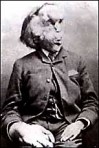
- JOSEPH MERRICK
One small issue in Jackson’s life that did get my attention was the report in 1987 that he had offered to buy the remains of Joseph Carey Merrick, known in popular culture as “John” Merrick, the “elephant man,” a 19th century Englishman who was severely deformed by a disease that has not been conclusively identified. I have spent far more time learning about Merrick than I have ever devoted to Michael Jackson, because I have been interested in Merrick’s determination to achieve some sort of human dignity despite a condition that, through no fault of his own, made it impossible for him to live in society. In fact, he had to be protected from the public. It’s worth noting that Dr. Frederick Treves, who was principally responsible for providing Merrick with a home at London Hospital, had misgivings about his own role in making Merrick something of a darling of British society, including the royal family.
My initial reaction when I heard that Jackson had tried to buy Merrick’s remains was disgust. I couldn’t imagine any legitimate purpose to such a thing, and I felt strongly that Jackson would be violating Merrick’s memory by removing what remains of him from the hospital that gave him the only true sanctuary he ever knew. Although there have been many public reports that Jackson did, indeed, acquire Merrick’s “bones,” my reading indicates that it never happened. Some have claimed that Jackson himself deliberately spread that rumor after having viewed the remains in London, but I haven’t found any substantiation of that idea. The bizarre tones and the uncertainty of this bit of Jackson’s history or legend is a microcosm of the odd and often mysterious biography that will be written and re-written for years to come.
Peter Conrad wrote an interesting essay in The Guardian about Michael Jackson in anticipation of Jackson’s appearance in London next month. It’s at http://www.guardian.co.uk/music/2009/jun/14/michael-jackson
Tammy Paolino — the name is no coincidence — also wrote an insightful piece about the impact of Jackson’s death. It’s at http://blogs.courierpostonline.com/mamadrama/ in an entry dated June 26.
Thoughts while painfully idle
June 25, 2009

BLUE BUG
I’ve stayed as far away from the Octomom story as one can get while remaining on this planet. Still, I felt uncomfortably close when I stumbled over a photo in the Los Angeles Times. It shows a display mounted on the outside wall of a Volkswagen parts business in Whittier, Calif., where Nadya Suleman lived until recently. (It’s something on the subject of my distance from this story that I learned the woman’s name for the first time today. For real.)
The item in the Times reads, in part, as follows:
Back in February, the world’s media converged on Whittier hoping to get a glimpse of octuplets mother Nadya Suleman and her 14 children.
There, drivers can’t help but chuckle at a display owners Ralph and Diva Chase have set up. Mounted on the wall of the building is half a grabber-blue 1969 Volkswagen Beetle. Inside, a black-hair mannequin — respectfully named Teri, not Nadya — is sitting with her legs crossed and is surrounded by babies. A box of diapers sits on the bug’s roof.
Ralph Chase said his 22-year-old niece, Jenna White, put the display together, meant as a tribute to Suleman and her mark on Whittier. “She’s Teri’s stylist,” he joked.
They sometimes change Teri’s clothes to freshen her look, and some people have come by to donate clothes for the display.
What caught me up short was the blue Beetle. See, I drive a blue Beetle. It’s not a ’69; it’s a ’99 with more than 167,000 miles on it, but from a distance it looks uncomfortably like the one Teri and the kids are sitting in.
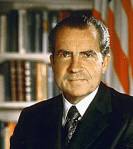
'THAT MAN'
So this is “a tribute to Suleman and her mark on Whittier.” It got me to wondering, if I were to sacrifice my Beetle to commemorate someone’s mark on Whittier, whom do I envision beaming out from behind the wheel. Oscar de la Hoya? Nomar Garciaparra? Andy Etchebarren? Eric Stoltz? Or – should I even say it? – That Man who, the tapes tell us, wanted to “destroy” Thomas Eagleton – “pipsqueak that he is”?
I have to go with Andy Etchebarren. He was the last player to bat against Sandy Koufax – and he hit into a double play. That seems about right.
Grasping at straws
June 22, 2009

THE GIGLIO
You have to see this to appreciate it: Men of Our Lady of Mount Carmel parish in Williamsburg dancing through the streets with a 65-foot-high, three-ton tower on their shoulders. It’s such an exquisite demonstration of — well, I’m not quite sure what it demonstrates — that it would be sacreligious to question it. Like Jerry Lewis’s career and the popularity of sushi, it just is.
The occasion is a belated celebration of the feast of San Paolino. The feast day is today, but the dance of the giglio will take place on July 12 during the parish’s annual street fair.
My attention was attracted to this, of course, because of the name of the saint. On an English church calendar, one finds him listed as St. Paulinus of Nola. His full name, rendered in Latin, was Pontius Meropius Anicius Paulinus. The dance of the giglio is a tradition that was imported to Brooklyn and a few other spots in these United States from Nola, the Italian city where Paolino was bishop in the fifth century. Although his feast is celebrated with sausage and peppers and zeppoli, he wasn’t Italian. This is part of a pattern in which one national group attaches itself to a saint who actually is from somewhere else: St Anthony of Padua from Portugal, St Nicholas of Bari from what is now Turkey, St Patrick from Britain, for example.
Paolino, or Paulinus, was born in Bordeaux. He was highly bred and wealthy and he had political power, but he and his wife put all that aside for religious life. Paolino became very influential in the church and was closely associated with St. Jerome and St. Augustine, among others, and his poetry is still highly regarded and, in fact, is the subject of a current book.

SAN PAOLINO
At one point, before he entered religious life, Paolino was Roman governor of Campagna, which is not far from where my family lives. However, I must confess that my connection to him is tenuous – what with him being French and celibate and all. But I take what I can get and throw his name around whenever I get the chance.
The giglio, incidentally, is a tower covered with paper lilies – hence the Italian term giglio — with a statue of the saint perched on top. The tower rests on a platform on which a small band is seated, and the men of the parish carry this whole assembly on their shoulders.
Although I have to admit, when challenged, that San Paolino and I probably have nothing to do with each other beyond our common baptism, I still feel I have made some progress.
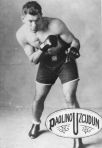
PAOLINO UZCUDUN
After all, when I was a kid and hadn’t yet heard of the saint from Nola, I clung to a clumsy heavyweight named Paolino Uzcudun, whose claim to fame was that his title fight with Primo Carnera represented the greatest combined weight ever in a championship bout.
The party of the second part
June 5, 2009

ELAINE STRITCH
I had a phone conversation last night with Elaine Stritch concerning her upcoming appearance at the Paper Mill Playhouse in “The Full Monty.” Something in her conversation put me to mind of a song written by Johnny Mercer sometime around the time I was born. I’m crazy about Mercer’s stuff – and there’s a lot to be crazy about since he wrote about a thousand songs. His lyrics were so hip; I never get tired of listening to them.
The song I was thinking about last night was “The Waiter, the Porter, and the Upstairs Maid.” This was part of the lyric:
The people in the ballroom were stuffy and arty / So I began to get just a little bit frayed / I sneaked into the kitchen, I dug me a party / The waiter and the porter / And the second storey maid. / I peeked into the parlor to see what was a-hatchin’ / In time to hear the hostess suggest a charade / But who was in the pantry a-laughin’ an’ scratchin’ / The waiter and the porter and the upstairs maid.
There’s a great recording of this song by Bing Crosby, Mary Martin, and the Jack Teagarden Orchestra. The smart-alec lyrics were perfect for Crosby.

JOHNNY MERCER
The reason I thought of that song last night was that Elaine Stritch was telling me about the sort of egalitarian social life she leads in which she is likely to talk to and even make friends with almost anybody. “I don’t know how I’d live,” she said, “if I couldn’t talk to the consierge when I get home after a performance or a rehearsal.”
I asked her what she meant by a remark attributed to her: “Being bored is the greatest sin.”
She said: “What is boring is spending your life with the same kind of people all the time. I avoid that. I reach out. I spent half of my life in kitchens. At parties, I would end up in the kitchen, having a ball. Or I’d be with the musicans; I l0ve to hang out with musicians.”
“But,” she said with a laugh, “I also had a lovelyevening with the Queen of England, so the hell with everybody.”
Mr. Mercer — on four:
If ever I’m invited to some fuddy-duddy’s / I ain’t-a gonna watch any harlequinade / You’ll find me in the kitchen applaudin’ my buddies / The waiter, the porter and the upstairs maid.
So, what have we learned here?
June 3, 2009

SUSAN BOYLE
Andy Burnham, the British culture secretary, wants the Office of Communications to investigate whether the television network and the producers of “Britain’s Got Talent” had acted responsibly toward Susan Boyle in the runup to the show’s finals. The implication is that the people behind the show that vaulted Boyle from the obscurity of a Scottish village to the limelight of YouTube should have done a better job of protecting her from the effects of sudden fame.
Burnham made reference to Britain’s broadcast code when he called for a determination that “duty of care” had been exercised with respect to Susan Boyle, who was briefly hospitalized for exhaustion after coming in second in the show’s finals. The Office of Communications doesn’t think the broadcast code covers what happened to Boyle, but Burnham said: “We are living in a world where it is not just about what happens on telly on a Saturday night. There is 360 degree scrutiny, 365 days a year. We need to look after people, not just around the camera. Broadcasters should always put people’s welfare first.”
This has prompted some bitter responses from readers of The Times of London, some sympathetic to Susan Boyle, some not. Some of the readers were outraged that the government would even think of becoming involved in a trivial, private matter. I liked the comment from Al of Manchester:
The UK is full of cruel people feasting on a diet of bile soaked Tabloid fodder and Reality TV trash. First they jeered and sneered at Susan for not looking like a singer and now they do the same because she not “tough enough to take it”. What a sad place and sad people we’ve become.
And Jessica of Eastbourne:
Can I just say that “they” did not treat Susan any differently than any of the other contestants. Susan was a victim of the throwaway celebrity culture that the UK and the US fawn over so much. If anyone “threw her away” it was the public, and the show’s producers are not as much to blame as we are.
What I loved about the reporting of this story is that after the universal handwringing and public penance over the snickering and eye-rolling when Susan Boyle first appeared on the show, the media couldn’t mention her without pointing out how “dowdy” she is, how unlikely a celebrity she is, or without calling attention again to the fact that she is a “virgin” who has “never been kissed.”
“All my life’s a circle” — Harry Chapin
May 31, 2009

Photo by Jim Dirden
I just finished reading a new biography of Pete Seeger by Alec Wilkinson of The New Yorker. It’s a short, well-written work that gives a good look at Pete’s personality. It is based on a series of interviews Wilkinson conducted at Pete’s home in Beacon, N.Y.
This isn’t a fawning portrait. Pete’s doubts and insecurities come through, in his own words.
It is also interesting to learn in this work about Pete’s parents, and particularly his father, Charles, who was also an idealist.
There is a lack of balance in the way many people react to Pete. There are many who think of him only as a folksy singer of campfire songs – sort of a Tennessee Ernie Ford. There are those who cast him in a messianic role that he himself would reject. And there are those who think he is the antichrist because, like many thoughtful people of his and his father’s generation, he associated for a time with people who felt Communism held the answers to chronic economic, social, and political problems. Pete acknowledges – including in this book – that that was a mistake, but more than a half century later, some folks still pillory him for it.

Pete is well known not only for singing but for encouraging his audiences to sing with him. Wilkinson’s book examines this practice, which for Pete isn’t just a cutsey stage trick. Calling on people to sing goes to the heart of Pete’s notion of what music is for, and gets to discuss that in his own words in this book.
Pete Seeger has been an important figure in the history of the past seven decades – not always clearly understood, even by himself. Wilkinson’s book at least helps formulate the questions.
Good, good grief
May 30, 2009
 I just read — for the purpose of reviewing it — a book called “Security Blankets: How Peanuts ® Touched Our Lives.” This is a collection of about 50 stories from people who feel their time on earth has been enriched somehow by the comic strip, the books, the TV specials, the tchatchke, or by some encounter with Charles Schulz himself.
It appears to me that the book is an attempt to reinvigorate the trade in stuffed Snoopy dolls (referred to repeatedly in the book as “plush”) or other “collectibles.” Maybe the Peanuts market is suffering from the combined effects of Schulz’s absence, the aging of the Peanuts Generation, and the paucity of disposable income.

THE RED BARON
That’s not to say that there aren’t some good stories here. One of my favorites was submitted by a man whose father was not only a World War I flying ace, but who piloted a Sopwith Camel and, in August 1918, actually outran the Red Baron himself.
Several of the people whose little essays appear in this book said, in one way or another, that their own cares or frustrations became a little easier to bear when they realized that others shared their feelings. Of course, the “others” were fictional cartoon characters, although many a Tuesday night meeting in the basement of a Unitarian church might have provided the same kind of support, except in flesh and blood rather than pen and ink. The writers in “Security Blankets” may have been unwittingly identifying with the often solitary and unfulfilled artist behind those characters rather than with the characters themselves.
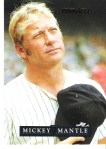
MICKEY MANTLE
Still, these stories reminded me of a book I read that contained a collection of letters that had been written to Mickey Mantle whose family published them after his death in order to raise money for an organ-transplant program. The letters told Mantle how much he had meant either to the writer or to someone in the writer’s life — a father, perhaps. Mantle, I have read elsewhere, was always mystified by sentiments of this kind. He felt, I suppose, like Louie DePalma — the “Taxi” character — who said of his girlfriend: “She sees something in me … something that’s not there.”
But both cases may be related to an idea I passed along to my students last semester — that once a writer has published a story, a poem, or an essay, he no longer owns it. Once he has published it, it belongs to the reader — and to each individual reader in a unique way. Neither the writer nor the writer’s critics can tell the reader what the reader can infer from the work. Maybe that’s true of cartoonists and swtich hitters, too: that once they have led their lives, they cannot control, nor contradict, what people infer from them.
“But on the other side, it didn’t say nothin’. That side was made for you and me.” — Woody Guthrie
May 27, 2009
 One of my favorite encounters with the unique Italian mentality involved a police officer who was trying to give me driving directions to the Piazza di Venezia in Rome. He repeated the directions several times, but each time I was stumped when he said, “You’ll see a sign that says ‘don’t turn left.’ Turn left.’ ” Finally, he became frustrated with me and told me to follow him with my car while he walked me through the first part of the trip. At the end of a narrow street – an alley, really – he turned toward the car and held up both hands. He walked over to the driver’s widow, pointed at the universal symbol displayed on the street corner, and asked, “Si vede il segno che significa non girare a sinistra?” Yes, I said, I could see the sign that meant “don’t turn left.” “Beh!” he said. “Svoltare a sinistra!!”
Oh.
The Christian Science Monitor has interesting reviews of several books and a web site that explore various aspects of the signs that tell us where we should or can or should not or cannot go. It’s at this link: http://www.csmonitor.com/2009/0522/p17s03-algn.html
 Condominium living has its ups and downs. Among the downs are some of the provisions in the covenant one agrees to when buying onto a condo community. Most of the provisions make sense; they are designed to preserve the value of everyone’s property. But part of the overkill in our community is the prohibition against attaching anything to the outside of the structure. For the most part, that makes sense, but there should be an exception for a flag holder. You have to use some ingenuity to display a full-size flag here. Pat came up with the idea of using the gizmo that we screw into the beach to hold the umbrella. It works well in the mulch in the garden in front of our unit, so our flag is out there, but it looks kind of lonely.
 I’ve been reading a lot lately about World War II, and I am really learning about it for the first time. I had only the most broad-brush knowledge of the war – the military challenges and the political issues. And I really never appreciated, except in the abstract, the suffering endured by those who served in the military forces.
The Washington Post had a good Memorial Day editorial today. It’s at this link:

ELLEN DEGENERES
Thank heaven for Cspann. That’s where I stumbled across Ellen DeGeneres giving the commencement address at Tulane. It’s a pleasure to see her any time, but her address to the Tulane grads was a refreshing departure from the usual approach on such occasions. And it reinforced the depth of character that makes her such an admirable figure.
Her account of the impact on her life of, first, keeping her sexual identity a secret for fear of reprisals and, second, suffering reprisals when she finally decided to get throw off the burden of secrecy, is food for thought about how we treat each other in the supposedly post-modern world.
The speech is at this link:http://video.google.com/videosearch?q=”ellen+degeneres”&hl=en&emb=0&aq=f#
 CharlesPaolino's Blog