The lady and the dragon
August 11, 2009

KUKLA, OLLIE, and FRAN ALLISON
The stamps the Postal Service issued today under the title “Early TV Memories” omit broadcasting legend Gertrude Berg but do include the influential puppet show “Kukla, Fran and Ollie,” which first appeared 60 years ago. The show adopted the medieval format of hand puppets on a miniature stage, but added on-camera human being Fran Allison to interact with the characters. The major figures were Kukla — a bald creature inexplicably dressed as a clown, and Ollie – a dragon. They were joined as the situation dictated by about a dozen others, including Beulah Witch, Madame Oglepuss, Colonel Crackie, and Fletcher Rabbit, a letter carrier who was always singing “Buffalo Gal, Won’t You Come Out Tonight?”
The show, which was live when it first appeared, was done without a script. While Fran Allison was sort of an innocent, many of the puppet characters were wise-crackers. The impromptu gags often brought on audible laughter from the crew — with whom the characters frequently exchanged remarks. There is an instance of that kind of interaction — a gag about ad agencies — in the 1951 episode at the link below. That episode also has an example of a commercial — this one for a brand of shampoo — that is worked into the story line, a common device in early televison. There is also a more conventional commercial for Tide at the end of the program. The half-hour show included only those two commercials.

KUKLA and OLLIE
“Kukla, Fran and Ollie” was the brainchild of Burr Tillstrom, who appears briefly at the end of the episode I have linked to. Tillstrom worked all the puppets and provided their voices. What is most striking about his concept in this show is that it was not played for slapstick laughs and it was not condescending to children. It was conducted on such a thoughtful level, in fact, that its audience among adults was reputed to be at least as large as its audience among children. In the episode I have linked to, the characters make several references to “Tallulah” and “Tallulah’s place in New York.” Those were references to the stage and film actress Tallulah Bankhead, who was one of many public figures who were enthusiastic followers of the show.
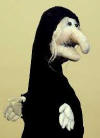
BEULAH WITCH
The leisurely pace of “Kukla, Fran and Ollie” was in sharp contrast to the frenetic programming that dominates television today. Tillstrom’s show relied heavily on character, and that was an important part of its attraction for adults. In this and other respects, the show foreshadowed — and, in fact, led to — the Muppets. The simple and silly figure of Oliver Dragon — who could be at turns romantic and manipulative — became as real and sympathetic to his audience as Burt and Ernie and Kermit became to theirs. Tillstrom and Allison recognized that; in fact, Ollie unblushingly discusses his charisms in the episode at this link:
http://video.google.com/videosearch?gbv=2&hl=en&q=kukla%20fran%20and%20ollie&ie=UTF-8&sa=N&tab=iv#
A Los Angeles Times story about the release of a DVD collection of later episodes of “Kukla, Fran, and Ollie” is at this link:
http://www.latimes.com/entertainment/news/la-et-kukla11-2009aug11,0,1322349.story
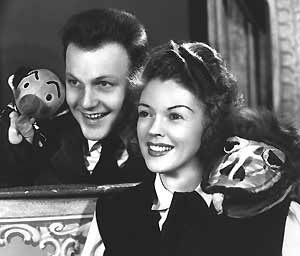
KUKLA, BURR TILSTROM, FRAN ALLISON, and OLLIE
“Newman!”
August 9, 2009

"Nevertheless!"
The Baltimore Sun this week published a story about the impact of digital media on the U.S. Postal Service and specifically on handwritten letters. The basis for the story is familiar: Handwritten letters, which were already in decline, have all but disappeared now that modern electronics provide so many other means to send messages. The Sun reporter discussed this development, and the recently-announced contraction of the postal system, with young people and with older people. The result was predictable.
I am almost 67 years old, and I can’t recall writing letters by hand. I used to write a lot of long personal letters — I recently discarded most of them — but I wrote them on a typewriter. Still, I have some nostalgia for the handwritten letter, mostly because I recall when my mother wrote letters to her out-of-state friends and relatives. Mom had won awards for her handwriting when that was still considered an important part of a person’s training, and she wrote those letters in a disciplined and attractive cursive. Correspondence in those days did not have the convenience of immediacy, and I recall the excitement when Andy, the mailman — who used to sing when he made his twice-a-day visits — brought a response from Lexington, South Carolina, or some other exotic port.
 Of course, that form of correspondence is still available to anyone who wants to exercise his handwriting skills and experience the anticipation of awaiting an answer. That wouldn’t be me. Like many people in this century, I communicate with people all day long through the various means now available, and I think I get as much satisfaction out of the quick reply as Mom did out of the long-term one.
 The Sun’s story and other reports on this topic include remarks from some authorities who worry that increasing reliance on e-mail, text messages, tweets, and whatever program may appear next, threatens to cause our handwriting skills to atrophy. But our kind have lost other communication skills that became obsolete, and we don’t seem to be any the worse for it. Well, we may be worse, but I doubt that our writing skills had anything to do with that.
The Sun’s story is at this link:
http://www.baltimoresun.com/features/bal-md.pa.lettersaug07,0,5960461.story?page=1
Sui generis
August 5, 2009
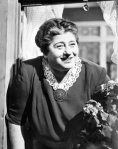
GERTRUDE BERG
A few months ago, I wrote in this journal that my wife and I had discovered and watched on line a few episodes of the television series “The Goldbergs.” Those episodes are at http://www.archives.com.
After I wrote that blog, I heard from a publicist who was handling a new documentary film about the owner, writer, and star of “The Goldbergs” — Gertrude Berg — who was one of the most remarkable women of the second half of the 20th century. As a result of that contact, I wrote the following story, part of which has appeared in the Courier-Post of Cherry Hill and has been picked up on other blogs:
When the U.S. Postal Service issues its “Early TV Memories” stamps this summer, don’t look for Gertrude Berg.
The New York City native, who 80 years ago created the domestic situation comedy, and became a media mogul, was not included with the likes of Lucille Ball and Harriet Nelson, who decades later followed her into American homes.
But Berg is being reintroduced to the American public in a documentary film – “Yoo Hoo, Mrs. Goldberg” – written and directed by Aviva Kempner.
The title evokes the phrase associated with Berg during the radio and television runs of the show she created and controlled, most widely known as “The Goldbergs.”
The principal character, Molly Goldberg, and her neighbors in a Bronx apartment building, interacted by leaning out their windows and calling: “Yoo Hoo, Mrs. Goldberg … Yoo Hoo, Mrs. Bloom.”
From her window, Molly – portrayed by Berg – invited listeners and viewers into the Goldberg household to share the lives of her husband, Jake; their children, Sammy and Rosalie; and Molly’s brother, David Romaine.
The show ran on radio from 1929 to 1946 – five days a week for much of that time – and on television from 1949 to 1956. Berg herself wrote every script in longhand.
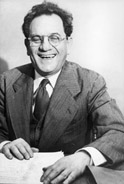
PHILLIP LOEB
There were also a stage play, a movie, a lucrative vaudeville tour, a comic strip, a jigsaw puzzle, a newspaper column, a line of women’s dresses, and a popular cookbook – although Berg couldn’t cook.
Berg’s rise to prominence, Kempner emphasized, occurred “at the time of the greatest domestic anti-Semitism in America, and during the rise of Adolf Hitler in Europe.’’
Berg presented the family as Jewish – adopting a mild Yiddish accent and a unique use of language that became a hallmark of the character:
As Molly shows off a hat, a neighbor asks: “With what dress are you going to wear it?’’
“With mine periwinkle,’’ Molly answers, striking a pose: “Visualize!”
And Berg didn’t shy away from difficult issues affecting Jews.
The documentary points out that in 1933, the year Hitler became dicator of Germany, she had a rabbi conduct a Seder service on the program. And after Kristallnacht in 1938, she wrote an episode in which a stone smashed an apartment window while the Goldbergs were celebrating Passover; Molly calmed the children and urged Jake to continue leading the Seder.
“And yet,’’ Kempner said, “Molly Goldberg was universal. You didn’t have to be Jewish to love her.’’
This urban mother first appeared on radio a month after the stock market crash, and the Goldbergs became so important to the national psyche during the Great Depression, as people maintaining the family circle in spite of want, that Franklin Roosevelt himself acknowledged it.
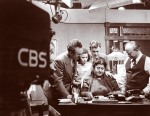
THE CAST OF "THE GOLDBERGS"
Kempner – based in Washington, D.C. – made the documentary through her Ciesla Foundation, whose goal is to “produce films about under-known Jewish heroes.” Kempner – whose work includes a 2000 film about baseball legend Hank Greenberg – said that although the Gertrude Berg film is complete, she is still raising money to pay for it.
The new film includes vintage photos and motion pictures and input from members of Berg’s family, actors, her biographer and others, including U.S. Supreme Court Justice Ruth Bader Ginsburg.
The story they tell has its dark sides.
Berg, born in 1898, did not grow up in the kind of setting she portrayed in her shows.
“She never had a nurturing mother like Molly Goldberg,’’ Kempner said. “She created what she didn’t have.’’
Berg’s own mother sunk into depression after the early death of her son and ended her life in a mental institution. Berg’s father badgered Gertrude into working at resorts he opened in the Catskills and in Florida but never supported her career as an actress and producer.
By contrast, her husband, Lewis Berg, a chemical engineer, typed many scripts from his wife’s handwritten originals.
Especially unsettling in Gertrude Berg’s life was the impact of “Red Channels,” the publication that purported to expose Communists working in radio and film.
One of those identified was Philip Loeb, an actors’ union leader, who played Jake Goldberg on the television series. Berg herself was listed as a “sympathizer.”
CBS and her sponsor pressured Gertrude Berg to fire Loeb. She refused, and her show was cancelled. NBC eventually picked up the show, but Loeb had accepted a cash settlement out of consideration for Berg and the other actors. Blacklisted from radio and film, he committed suicide in 1955.
Berg won an Emmy for her portrayal of Molly Goldberg, and a Tony for her 1959 Broadway performance in “A Majority of One,” and her autobiography was a best seller.
Still, only a small percentage of Americans today know who Gertrude Berg was, Kempner said, “and I want to restore her correct place in our cultural history.’’
The home web site for the film is at http://www.mollygoldbergfilm.org/home.php Information about theaters showing the film is available there.
The Ciesla Foundation web site is at http://www.cieslafoundation.org/
“Down the road of life we’ll fly.” — Vincent C. Bryan
August 3, 2009
 The controversy of the federal government’s “cash-for-clunkers” program dramatizes the odd position we Americans have put ourselves in as victims of our own success.
The program provides a $4,500 subsidy for a qualified buyer who wants to trade in an old inefficient vehicle for a new and “greener” one. Everybody wins in this program: the buyer can afford a new car, the auto dealer and — by extension — the manufacturer gets rid of inventory, the environment is subject to one less outrage, and the junk yard gets another heap to turn back into cash. The program is so beneficial, and consequently so popular, that it went broke in a hurry, and the question of whether to re-fund it is now being debated in Congress.
 One of those opposed to more funding for this program is U.S. Sen. John McCain — Sarah Palin’s former running mate. McCain thinks this program is an unfair subsidy of the auto industry, as distinct from other classes of business that are at risk in this economic downturn. But the auto industry is getting this attention because it has become such a pervasive part of the overall economy; if it goes down, according to conventional wisdom, everything else goes with it.
 At the root of this phenomenon is the American obsession with cars and with new cars in particular. This has been out of control for a long time, but we were too giddy to notice. The industry produces too many cars, and whole sectors of the economy have grown around that practice like barnacles. This has happened in a country that has failed miserably at building an efficient mass-transit system, though it talks endlessly, and without blushing, about the need to get travelers off the roads and onto trains and buses and monorails and — while we’re daydreaming — into teletransporters. I don’t know if this is what McCain means by his opposition to this latest proposal to expand the federal deficit, but despite the rhetoric about reforming the auto industry, the game plan really seems to be to help it continue overproduction. And what do we think will happen in the long run if we win at that game? I admit to a prejudice here, because I drive a car until it has well over 150,000 miles on the clock, but if we continue the same behavior and expect a different outcome, aren’t we all — by definition — crazy?
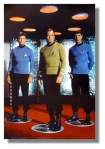
"Beam me up"

JOHN F. KENNEDY
You can’t turn your back on anybody.
Take Harvard University, for example, an institution one might think of as a temple of virtue. It turns out that Harvard has been using the trade-mark laws to get control of common expressions. The university has an pending application, for example, to register the phrase “Managing Yourself.” The rationale is that the phrase is used by the university in promotional campaigns for one of its schools, and Harvard doesn’t want someone claiming a prior right to the words. As if.
If that sounds overly cautious, consider the fact that the university has filed a trademark application for the expression “The world’s thinking” based on the idea that the school may want to use those words in the future.

KAHLIL GIBRAN
Among the items so highly treasured in Cambridge is the line “Ask what you can do,” used by the Kennedy School of Government in a variety of campaigns. Those words were, of course, a high point in the presidential inaugural address of a Harvard alum, and the John F. Kennedy Presidential Library is said to be raising its corporate eyebrows over alma mater’s decision to nail down the clause.
There’s no word on whether Harvard has checked with the heirs, if any, of the Lebanese philosopher Kahlil Gibran, who wrote a remarkably similar “ask not” formula in his 1925 work entitled — cough, cough! — “New Frontier.”
Is it all very innocent? One Harvard professor, Harry Lewis, takes at least philosphical exception, expressed in the Boston Globe as follows: “Universities should not be in the business of locking words down. We’re in the business of enlightening the world. To lock down common English phrases seems to be antithetical to the spirit of what universities are supposed to be about.’’
Meanwhile, if Harvard intends to go on registering phrases for which it hasn’t yet found a use — well, Yogi, watch your back.
You can read the Globe’s account of this matter at the following link:

“I thought drama was when the actors cried, but drama is when the audience cries.” — Frank Capra
July 20, 2009

MILTON BERLE
Saul Austerlitz filed an interesting story for the Los Angeles Times about the ambition of many comic actors and comedy directors to work in drama. I once attended a lecture by Milton Berle in which he talked about this subject. As do a lot of comic actors, Berle maintained that comedy was the more difficult genre inasmuch as no one is funny all the time, or even a lot of the time, whereas most of us are serious much of the time and some of us all of the time. At least, I think that’s what he said.
Berle had a few opportunities to prove that he was capable of playing straight roles. His autobiography revealed that he nursed his share of bitterness over certain events and personalities in his life, and those probably provided a well for him to draw on.
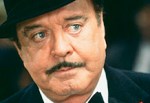
JACKIE GLEASON
Jackie Gleason who, like Berle, made his name with the broadest of comedy, had a flair for drama and demonstrated it in “The Hustler” and “Requiem for a Heavyweight.” He had already shown in a couple of his comedy characters — particularly “the poor soul” — that he could play a part for pathos, although when he tried to put that character virtually intact in a serious film — “Gigot” — the result was uninspired.
Anyway, those interested in film comics in particular might be interested in the Austerlitz piece — inspired by a new Adam Sandler project, at this link:
http://www.latimes.com/entertainment/news/la-ca-comedians19-2009jul19,0,4668140.story
“Life, death, and rebirth are inevitable.” — Rig Veda
July 18, 2009
 It was sort of uplifting yesterday to be able to sit at a restaurant on the boardwalk at AsburyPark, admiring the details on the Paramount Theater/Convention Center building, and watching the passing parade. The last time I drove near that boardwalk, many years ago, I was afraid to get out of my car. It wasn’t that I was afraid of the people there; I’m kind of foolhardy in that way — seldom afraid of people. I was afraid that looking more closely at what was obvious from inside my car would break my heart altogether. I knew what happened there, but I had never seen it.
We were staying in Belmar for a couple of days this week, so we drove up to Asbury Park to tread the boardwalk and have dinner. There was a very mixed crowd making the promenade — which reminded us of the corniche in Beirut. That was one of the best things about the reborn boardwalk, that all sorts of people seem to feel welcome there.

CONVENTION HALL (DETAIL)
There wasn’t a crowd there last night although several of the retaurants were doing a brisk trade, but the waitress at Tom McLoone’s told us that on weekends the boardwalk is packed. Again, better than it’s opposite.
One can’t help wondering, though, how this regeneration will be sustained and made to grow. I understand progress has been stunted by the general economic malaise, and while it is heartening to see what is new on the boardwalk, it is chilling to see what is still in ruins and to see the voids where businesses and games and rides have vanished. I tried to recall where Bubbleland was located — the collection of kiddie rides that was owned and managed by Lloyd McBride, who also was one of my instructors in communications when I was an undergrad at Seton Hall. We took our eldest three children there, and Mr. McBride — I still have too much respect for him to call him anything else — would often let them ride for free.
I was sorry that at the same time I was feeling a certain elation at seeing that boardwalk revived I also had a sense of foreboding that this grand experiment wasn’t going to work. But when we got home, I puttered around the Internet until I found an interview with Mr. McBride that was published in the Spring of ’08. He’s retired from Seton Hall and he lost his rides to eminent domain, but he’s still in Asbury Park and he assured the interviewer that the city “will come back.” Since I’m too much of an optimist to be afraid of people, I think I’ll be too much of an optimist to think that Mr. McBride could be wrong.
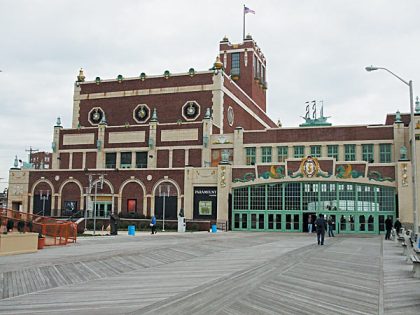
THE PARAMOUNT THEATER AND CONVENTION HALL
Never say never in Neverland
July 11, 2009

MICHAEL JACKSON
The Christian Science Monitor has joined the chorus whose song is that Michael Jackson was likely one of the the last “mega-stars.”
A story in the Monitor this week, written by Stephen Humphries, included these passages:
That Jackson could command such an audience is testament to the kind globe-straddling star power that was possible in an earlier, simpler entertainment age. Amid today’s fragmented popular culture, in which an unlimited buffet of mass media has segregated consumers into niche-oriented tribes, Jackson was arguably one of the world’s last superstars.
“It isn’t just that Michael Jackson was the last superstar because he was one of the last people to benefit from an unfragmented media,” says Timothy Burke, a cultural historian at Swarthmore College in Pennsylvania. “He may also have been one of the last people who could surprise us with a stunning innovation where we didn’t have that sense already of being so jaded by the ubiquity of spectacularly good entertainment. That someone could just leap on the stage and do this thing, and you could go, ‘Wow, I’ve never seen that before!’ “

LUCIANO PAVAROTTI
I don’t know that either niche marketing or a need for innovation supports the bold prediction that no one after Jackson will be able to appeal to a global audience.
Luciano Pavarotti, for example — whose estate was worth about a half billion dollars the last I read about it — appealed to millions of people all over the world, including people who knew nothing about opera, including people who did not want to know anything about opera, and he didn’t appeal to them because he was an innovator — certainly not in the sense that Michael Jackson was. Pavarotti’s performance was pretty much traditional. Whether he was, as a friend of mine claimed, “the second greatest tenor in history,” is a matter of conjecture — and conjecture, I might add, that has no real meaning. Most of those who bought Pavarotti’s recordings, attended his concerts, and watched his television appearances, wouldn’t know if he were second greatest or not. What they knew was that they liked him, and that was all that mattered. The implication of my friend’s remark was that Enrico Caruso was the greatest tenor in history, and Caruso and Pavarotti were alike in this: There was something about each of them that simply appealed to people, including those not normally in the opera crowd. The very fact that the something can’t be quantified, while both tenors’ enormous audiences and coincident earnings can be quantified, should tell us that it’s foolhardy to predict that no such performer will appear again.

SUSAN BOYLE
Susan Boyle’s experience is also instructive. The record-setting video on YouTube featured Boyle, not Jackson. That doesn’t imply any parallel between the two as performers, and that’s exactly the point. Boyle’s appeal was unpredictable. No one saw it coming. And I dare say that even experts in the field, if they had heard Susan Boyle perform before her appearance on the British TV competition, would not have forseen her appeal, which has cut across all the usual borders of musical taste and which, it is important to note, has been a function of a new mode of almost universal communications whose implications and whose future we can’t even imagine. Jackson only got to scratch the surface of the rapidly evolving technology. Even if Susan Boyle turns out to be a comet that will soon fade to black, we don’t know that there won’t be another Susan Boyle who will burst out into the world via YouTube or some unforseen successor to it and re-define the concept of a “star” in ways we haven’t dreamed of.
There are no small roles.
July 3, 2009

JOHN DILLINGER
Amid all the tsurris about Michael Jackson’s death bubbles the question of how long his fame will endure. He will have done well, it seems, if the public fixation with him lasts as long as its interest in John Dillinger, an anti-social holdup man and murderer who was shot to death 75 years ago. Once Independence Day is out of the way, we can focus our attention on John Dillinger Day, an observance that commemorates his death, which occurred on July 22, 1934.
There are those, of course, who say that it wasn’t Dillinger who was gunned down outside a movie theater in Chicago, and I suppose we’ll have to live with those who will claim that Jackson didn’t die in Los Angeles last week but is living in Buenos Aires with Adolph Hitler, Emilia Earhart, and Elvis Presley. At last, a fourth for bridge.
The reviews in the Christian Science Monitor and the Washington Post are unenthusiastic about the movie “Public Enemies,” in which Johnny Depp portrays Dillinger. Dan Zak writes in the Post:

JOHNNY DEPP
There’s no excitement in the bank-robbing, no thrill of the chase, no emotion over justice served or thwarted. Depp’s Dillinger is neither charming nor despicable, nor does he occupy that delicious gray area between the two. His spree unspools dispassionately, cold as a Colt .380.
Peter Rainer in the Monitor writes:
Mann’s hero-worshipy treatment of Dillinger is undercut by the film’s dreamtime existentialist aura. In reality, the working poor cheered Dillinger’s bank raids but in “Public Enemies” the Depression is just a prop, and so Dillinger’s populist hero status, what little we see of it, makes scant sense. (This is probably why we see so little of it.) Missing, as a result, is the knockabout tumult of a time when gangsters could ascend to the same stardom as the movie actors who played gangsters. Dillinger was, for a while, every bit as big as Jimmy Cagney. Mann pirouettes around the twin realities of the Depression and the star culture it engendered and offers instead a moody blues doominess. It’s a vacuum filling a vacuum.
So Depp becomes neither Clyde Barrow nor Robin Hood. Maybe, in his old age, he can play Bernie Madoff.
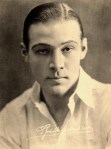
RUDOLPH VALENTINO
I noticed references to a public wake for Michael Jackson, and that got me to thinking about the manner in which previous celebrities of that magnitude have taken their leave, as it were.
I should qualify this observation immediately inasmuch as I’ve been hearing for several days that there has been no other celebrity of that magnitude — and today I heard the Chicago Tribune music critic say that there won’t be another, at least not among singers. These are meaningless statements, of course, because the magnitude of any person’s celebrity is affected by multiple factors, most of them subjective. Enrico Caruso, for example, was treated all over the world as if he were royalty — even by people who had never heard him perform, and 88 years after his death he is still the standard by which male singers are measured. His name, in fact, is a synonym for “male singer.”

BABE RUTH
A man whose status as an international celebrity was emerging just as Caruso died was Babe Ruth. He transcended the sport that his fame was based on to such a degree that Japanese soldiers during World War II, nearly a decade after his career had ended, would shout “to hell with Babe Ruth” as an insult to American servicemen. Like Caruso, Ruth remains the model to whom his successors are compared.
When Ruth died, he had been retired for 14 years. His body lay in state at Yankee Stadium where an estimated 100,000 people of every age and description bid him a solemn farewell. When Francis Cardinal Spellman celebrated Ruth’s funeral mass at St Patrick’s Cathedral in Manhattan, a crowd estimated at 75,000 filled the church and spilled out into the rain-swept streets.
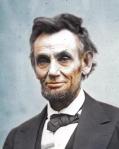
ABRAHAM LINCOLN
It is likely that no outpouring of grief in this nation, at least, has exceeded that which followed the murder of Abraham Lincoln. In retrospect, the reaction was not out of proportion to the importance of his death; in some respects, one might argue, the country has not yet fully recovered, given the debacle of Reconstruction and its aftermath.
Contemporary accounts describe the American people, including many who recently had excoriated Lincoln and his policies, as either numb with shock or crazy with anger. Millions of people stood along the right-of-way as the funeral train carried Lincoln’s body over the 13-day journey from Washington to Springfield.
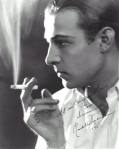
RUDOLPH VALENTINO
Perhaps the instance that will prove the best analogy for the case of Michael Jackson is that of Rudolph Valentino, the silent film actor whose life and career were as tumultuous and controversial as Jackson’s. Valentino died in 1926 at the age of 31 from complications after surgery for appendicitis and gastric ulcers. His funeral, which was something of a circus, attracted an estimated 100,000 people in the streets of New York, a large number considering the limitations on travel at the time. The crowd erupted in a riot that lasted most of one day and required more than 100 mounted policemen plus police reserves to restore order. Several of Valentino’s fans committed suicide and the actress Pola Negri sent to the funeral home 4,000 roses in an arrangement that spelled out her name. During the wake period, Negri announced that she had been Valentino’s fiancee — something no one else was aware of — and promptly collapsed on his coffin in a fit of hysteria. She followed the funeral train from New York to California and was composed enough to stand for photographs whereever the train stopped.

POLA NEGRI and RUDOLPH VALENTINO
 CharlesPaolino's Blog