“Did the pipes play ‘The Flowers of the Forest’?” — Eric Bogle
September 17, 2009

PETER, MARY, and PAUL
Behind the stage at the Walpack Inn was a white mobile home, and sitting at the kitchen table, smoking, was a legend — to everyone but herself. I had taken Mary Travers at her word. She had said, “If you come to the concert, come around afterward and see us.” So when the music was over we and the kids trooped around to where she had said she’d be. I wondered as I raised my hand to knock whether she had meant that invitation literally. I hesitated long enough for Paul Stookey to open the door on his way out. He didn’t ask who we were or what we wanted. He held the door open for us and cheerfully said, “Go on in.” And we went in and sat with Mary in the blue haze at the kitchen table as if we belonged there.

MARY TRAVERS
I had the good luck to talk to Mary in person and on the telephone about a half dozen times. She was an important singer — an important public personality — and she and her partners had a right to be proud of their achievements as musicians and as citizens. Mary may have been proud but, in my experience, she had no ego. Her ability to speak so eloquently to the problems of the most humble of people no doubt could be traced to the fact that she did not see herself as anyone’s better.
I heard someone recently commenting that Mary “can’t sing anymore” — a reference to the dark and husky voice that evolved from years of use and abuse. I have to wonder if someone making that observation ever understood what Mary was singing for. Her voice always had a natural melancholy — listen to her recording of “The Green Fields of France” — and that quality became more pronounced with age. Maybe it was an unconscious expression of a growing realization that time was running out on dreams of social and political justice.
There has been a lot of high-blown rhetoric in response to the recent deaths of major national figures. Nothing could be less appropriate this time.
“. . . better to burn than fade away …” — Neil Young
September 13, 2009

KURT COBAIN
Old Man Trouble can’t stay away from Kurt Cobain’s door. The huzzerai over the plaque honoring him in his hometown in Washington seems to have died down, but now there is a problem with how his image is used in the video game Guitar Hero 5.
Courtney Love, who was married to Cobain at the time of his death in 1994, gave Activision, the publisher of the game, permission to use Cobain’s image, but she says she did not know or agree that the avatar could be activated so as to sing other writers’ songs. Krist Novoselic and Dave Grohl, Cobain’s Nirvana-mates, are also annoyed. Love says there will be legal action against Activision if the game isn’t altered so as to restrict the use of Cobain’s image to songs associated with him.

SHIRLEY BOOTH
There have been similar blowups in the past, including one involving the great stage and screen actress Shirley Booth, who played the housemaid Hazel from 1961 to 1966 in a TV series based on Ted Key’s cartoon character by the same name. After the show left the air, in 1971, Key gave Colgate-Palmolive permission to use the Hazel image in a commercial for a detergent called Burst.
The sponsor or its ad agency hired an actress named Ruth Holden to provide the voice in the commercial, but the voice sounded exactly like Shirley Booth’s voice, as I recall myself. Anyone who was familiar with Booth and saw that commercial would have assumed the voice was hers.
Shirley Booth thought so, too. She sued the sponsor and its ad agency in federal court, but the court didn’t agree with her complaint.
For now, you can see the Kurt Cobain avatar and read a Christian Science Monitor blog about Courtney Love’s objections, both at this link:
All together, now ….
August 25, 2009

UMBERTO BOSSI
Back in June, Michael Kinsley wrote in the Washington Post that the United States needs a new national anthem. “The Star-Spangled Banner” is unsingable, according to Kinsley, and some of its lyrics are offensive. This is hardly an original idea, and it is likely to go as far this time as it has in the past.
But meanwhile, Michael Kinsley, meet Umberto Bossi. Bossi is a senator in Italy, and he is campaigning to get Italy to dump its national anthem, “Fratelli d’Italia” (“Brothers of Italy”). Bossi thinks the current anthem is a musical mediocrity, and he doesn’t like a line that refers to the nation as “You whom God created as a slave of Rome.” Correspondent Anna Momigliano, writing in the Christian Science Monitor, agrees with Bossi, arguing that the lyric “we are ready to die if Italy calls” is a heavy burden for millions of school children who probably sing the anthem more often than most Italians.
 Bossi doesn’t seem to care what replaces the present anthem, but he has suggested that an operatic piece would at least improve the quality of the music. He has suggested one chorus in particular, “Va, pensiero” from Giuseppe Verdi’s “Nabucco.” This song is widely known in Italy; in fact, it was adapted into a popular song. That’s not Bossi’s rationale, though. He says no one would understand the words anyway, but that the music is nice. Bossi, apparently, is a practical man.
“Va, pensiero” is sung in the opera by a chorus of Hebrew slaves during the Babylonian Captivity. The lyrics refer in part to Psalm 137 (“On the willows there, we hung up our harps ….”). How this applies to modern Italy, I am not aware. Bossi, by the way, is the same chap who has proposed that northern Italy secede from the rest of the republic.
You can read Anna Momigliano’s column at this link: http://features.csmonitor.com/globalnews/2009/08/24/senator-wants-to-change-italys-national-anthem-%e2%80%93-to-opera/
You can read Michael Kinsley’s column at this link:
http://www.washingtonpost.com/wp-dyn/content/article/2009/06/11/AR2009061103039.html

KURT COBAIN
I suppose Kurt Cobain had it both ways — he was who he wanted to be, and he wasted the person he was, if such things can be measured by longevity alone. But it’s a little late to moralize about how his life was spent. Without intending it, although he might have enjoyed it, Cobain is at the center of a tempest in Aberdeen, Wash., his hometown. More specifically, a monument to the musician placed in a public park, and even more specifically, a word on that monument, has the pond stirred up.
The monument in question bears a picture of Cobain and seven quotes from him. “The duty of youth is to challenge corruption,” for instance. One of the quotes begins with the words “Drugs are bad for you ….” — a sentiment that should play well in Aberdeen, if you’ll pardon the stereotype. But the rest of that quote includes a word that shocks the sensibilities of some Aberdeenians, a word one seldom sees engraved on public monuments, the word, if you get my drift.

ROBERT DE NIRO
“I don’t like that word,” said one member of the Aberdeen governing body. “The city pays thousands of dollars a year just to remove it from our parks — painting and sandblasting.”
“The majority of the people who are going to make their way down there, it’s not like that’s the first time they’re ever going to see that word,” said another councilman, who was a founder of the official Kurt Cobain Memorial Committee in a city that appreciates Cobain’s talent and his contributions to music.
Language is so interesting. One word is widely regarded as offensive and another word that means precisely the same thing is fit to be pronounced in a middle-school sex-education class. It’s all in the connotation, isn’t it?
One night about 20 years ago a couple came to spend the evening with us and, on the way, they picked up a video — “Midnight Run.” While we watched, our female guest blushed and apologized profusely for bringing that movie, because she hadn’t expected Robert De Niro’s language which was laced with a word fit for — well, for a Kurt Cobain monument. Meanwhile, we all roared at that movie, which, thanks to De Niro and Charles Grodin, is one of the funniest of its kind ever made.

KURT COBAIN
Years later, I watched that movie on television, and it wasn’t nearly as funny. That was partly because I had already seen it, but it was also partly because De Niro’s language had been dubbed out with language that sounded ridiculous coming from the mouth of such a character. It’s hard to know what to make of that. It’s only a word, after all, and people like De Niro’s character use it so habitually that they aren’t even aware of it. And yet, many of us, like the Aberdeen councilman, don’t like it and don’t want to hear it or see it cut into granite in a public park.
It’s one of those things that makes us human beings so fascinating.
The Los Angeles Times reported on the Aberdeen dispute and how it was resolved. The story is at this link:
http://www.latimes.com/news/nationworld/nation/la-na-hometown-aberdeen16-2009aug16,0,19620.story
Never say never in Neverland
July 11, 2009

MICHAEL JACKSON
The Christian Science Monitor has joined the chorus whose song is that Michael Jackson was likely one of the the last “mega-stars.”
A story in the Monitor this week, written by Stephen Humphries, included these passages:
That Jackson could command such an audience is testament to the kind globe-straddling star power that was possible in an earlier, simpler entertainment age. Amid today’s fragmented popular culture, in which an unlimited buffet of mass media has segregated consumers into niche-oriented tribes, Jackson was arguably one of the world’s last superstars.
“It isn’t just that Michael Jackson was the last superstar because he was one of the last people to benefit from an unfragmented media,” says Timothy Burke, a cultural historian at Swarthmore College in Pennsylvania. “He may also have been one of the last people who could surprise us with a stunning innovation where we didn’t have that sense already of being so jaded by the ubiquity of spectacularly good entertainment. That someone could just leap on the stage and do this thing, and you could go, ‘Wow, I’ve never seen that before!’ “

LUCIANO PAVAROTTI
I don’t know that either niche marketing or a need for innovation supports the bold prediction that no one after Jackson will be able to appeal to a global audience.
Luciano Pavarotti, for example — whose estate was worth about a half billion dollars the last I read about it — appealed to millions of people all over the world, including people who knew nothing about opera, including people who did not want to know anything about opera, and he didn’t appeal to them because he was an innovator — certainly not in the sense that Michael Jackson was. Pavarotti’s performance was pretty much traditional. Whether he was, as a friend of mine claimed, “the second greatest tenor in history,” is a matter of conjecture — and conjecture, I might add, that has no real meaning. Most of those who bought Pavarotti’s recordings, attended his concerts, and watched his television appearances, wouldn’t know if he were second greatest or not. What they knew was that they liked him, and that was all that mattered. The implication of my friend’s remark was that Enrico Caruso was the greatest tenor in history, and Caruso and Pavarotti were alike in this: There was something about each of them that simply appealed to people, including those not normally in the opera crowd. The very fact that the something can’t be quantified, while both tenors’ enormous audiences and coincident earnings can be quantified, should tell us that it’s foolhardy to predict that no such performer will appear again.

SUSAN BOYLE
Susan Boyle’s experience is also instructive. The record-setting video on YouTube featured Boyle, not Jackson. That doesn’t imply any parallel between the two as performers, and that’s exactly the point. Boyle’s appeal was unpredictable. No one saw it coming. And I dare say that even experts in the field, if they had heard Susan Boyle perform before her appearance on the British TV competition, would not have forseen her appeal, which has cut across all the usual borders of musical taste and which, it is important to note, has been a function of a new mode of almost universal communications whose implications and whose future we can’t even imagine. Jackson only got to scratch the surface of the rapidly evolving technology. Even if Susan Boyle turns out to be a comet that will soon fade to black, we don’t know that there won’t be another Susan Boyle who will burst out into the world via YouTube or some unforseen successor to it and re-define the concept of a “star” in ways we haven’t dreamed of.
“Shoot me a pot, and I’ll pour me a shot.”
June 15, 2009
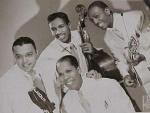
THE INK SPOTS
Whatever may be wrong with the age we live in, it has this advantage: Anything can pop into your head and you can find it on line. The Ink Spots, for instance. The other day I noticed an obituary for Huey Long – not the Kingfish from Louisiana, but the Texan who was among the legitimate members of the Ink Spots singing group.
One has to qualify members as “legitimate,” because successful singing groups often have a kind of pseudo-life that goes on and on long after the original DNA has sputtered and died. Anything “legit” about the Ink Spots had disappeared by the early ’60s, but today there are still guys billing themselves under the group’s name.
By some counts, there were eleven men who could call themselves Ink Spots without running afoul of the criminal code, and Huey Long, who died last week at the age of 105, was one of them.

HUEY LONG AT 103
Reading about Huey Long’s death put a song in my head — “If I Didn’t Care.” This song is one of my earliest musical memories; I remember hearing it on the radio that was on all day in our house when I was growing up. Also, my parents had several of the group’s Decca recordings. I looked around on line and soon found a video of the real Ink Spots singing that song. They approached many of their songs in the same way: the tenor sang the melody and a bass then recited either the same lyric or the bridge, embellishing it with terms like “honey chile’ ” and “darlin’ .”
One of my favorites among the Ink Spots recordings is “Java Jive,” which I found at http://www.archive.org/details/JavaJive . I think that song was original with them. The only rendition I like as much as theirs is Christopher Lloyd as Jim Ignatowski, singing it in the Sunshine Cab Co. garage on “Taxi,” but that’s a whole other thing. I also like the Ink Spots recording of “My Prayer” by George Boulanger and Jimmy Kennedy — which was the number 3 record in the country for a while in 1939. It’s been recorded by at least 40 different artists, ranging from the Platters to the Mantovani Orchestra. The Ink Spots version is at http://www.last.fm/music/The+Ink+Spots/_/My+Prayer
The party of the second part
June 5, 2009

ELAINE STRITCH
I had a phone conversation last night with Elaine Stritch concerning her upcoming appearance at the Paper Mill Playhouse in “The Full Monty.” Something in her conversation put me to mind of a song written by Johnny Mercer sometime around the time I was born. I’m crazy about Mercer’s stuff – and there’s a lot to be crazy about since he wrote about a thousand songs. His lyrics were so hip; I never get tired of listening to them.
The song I was thinking about last night was “The Waiter, the Porter, and the Upstairs Maid.” This was part of the lyric:
The people in the ballroom were stuffy and arty / So I began to get just a little bit frayed / I sneaked into the kitchen, I dug me a party / The waiter and the porter / And the second storey maid. / I peeked into the parlor to see what was a-hatchin’ / In time to hear the hostess suggest a charade / But who was in the pantry a-laughin’ an’ scratchin’ / The waiter and the porter and the upstairs maid.
There’s a great recording of this song by Bing Crosby, Mary Martin, and the Jack Teagarden Orchestra. The smart-alec lyrics were perfect for Crosby.

JOHNNY MERCER
The reason I thought of that song last night was that Elaine Stritch was telling me about the sort of egalitarian social life she leads in which she is likely to talk to and even make friends with almost anybody. “I don’t know how I’d live,” she said, “if I couldn’t talk to the consierge when I get home after a performance or a rehearsal.”
I asked her what she meant by a remark attributed to her: “Being bored is the greatest sin.”
She said: “What is boring is spending your life with the same kind of people all the time. I avoid that. I reach out. I spent half of my life in kitchens. At parties, I would end up in the kitchen, having a ball. Or I’d be with the musicans; I l0ve to hang out with musicians.”
“But,” she said with a laugh, “I also had a lovelyevening with the Queen of England, so the hell with everybody.”
Mr. Mercer — on four:
If ever I’m invited to some fuddy-duddy’s / I ain’t-a gonna watch any harlequinade / You’ll find me in the kitchen applaudin’ my buddies / The waiter, the porter and the upstairs maid.
“All my life’s a circle” — Harry Chapin
May 31, 2009

Photo by Jim Dirden
I just finished reading a new biography of Pete Seeger by Alec Wilkinson of The New Yorker. It’s a short, well-written work that gives a good look at Pete’s personality. It is based on a series of interviews Wilkinson conducted at Pete’s home in Beacon, N.Y.
This isn’t a fawning portrait. Pete’s doubts and insecurities come through, in his own words.
It is also interesting to learn in this work about Pete’s parents, and particularly his father, Charles, who was also an idealist.
There is a lack of balance in the way many people react to Pete. There are many who think of him only as a folksy singer of campfire songs – sort of a Tennessee Ernie Ford. There are those who cast him in a messianic role that he himself would reject. And there are those who think he is the antichrist because, like many thoughtful people of his and his father’s generation, he associated for a time with people who felt Communism held the answers to chronic economic, social, and political problems. Pete acknowledges – including in this book – that that was a mistake, but more than a half century later, some folks still pillory him for it.

Pete is well known not only for singing but for encouraging his audiences to sing with him. Wilkinson’s book examines this practice, which for Pete isn’t just a cutsey stage trick. Calling on people to sing goes to the heart of Pete’s notion of what music is for, and gets to discuss that in his own words in this book.
Pete Seeger has been an important figure in the history of the past seven decades – not always clearly understood, even by himself. Wilkinson’s book at least helps formulate the questions.
Lemme hear that high note!
May 12, 2009

PAUL POTTS
I saw Paul Potts singing on TV last week and heard an announcement that his new CD would be in stores on May 4. I went to Border’s and bought a Potts CD which turned out to be from 2007. I can’t complain about that; I took it off the shelf without examining it very closely. He has a pleasant enough voice that reaches into the upper end of the tenor range seemingly without strain. I think he lacks the firepower demanded by much of the tenor repertoire, but tenors – like cigars and coffee – are a matter of taste.
I, for one, never bought into all the excitement about Pavarotti. Clearly, I’m outnumbered. My taste is affected by the fact that I’m kind of a tenor maven, so I listen to many singers that most people have no reason to know about – obscure figures like Edmond Clement, Francesco Tamagno, Leon Escalais, and Father Sidney McEwan. I think the perennial discussion about “the greatest tenor” is a pointless exercise, because there are no objective criteria on which to base such a judgement. It’s more a question of “favorite” than of “greatest.”

Giovanni Martinelli
For example, I prefer some tenors over some singers whom I know to be technically superior, precisely because I prefer them. Giovanni Martinelli is an example. He was nicknamed the “lion of the opera” because of the way he sometimes roared out his notes. He had his detractors on that account, but he has me as a fan for the same reason. When he was in his 70s he made a recording of “Wintersturme” from “Die Walkure” – but sung in Italian as “Cede il Verno” – and I think it’s the equal of a recording that Lauritz Melchior made at a much younger age.
My favorite tenor altogether is Count John McCormack, a legendary Irish singer whose career included roles with the world’s major opera companies as well concert tours, many recordings, and radio appearances. When McCormack first appeared on the operatic scene, he called himself Giovanni Foli (after his wife, Lily Foley) on the theory that he would fare better if audiences thought he was Italian.
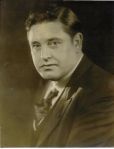
JOHN McCORMACK
It’s part of opera lore that McCormack once greeted Enrico Caruso as “the world’s greatest tenor” to which Caruso replied: “And when did you become a baritone?” I love to listen to McCormack singing Italian and French with that lilting brogue. But I especially like to hear his Irish songs, many of which are so melancholy. I also have a few recordings on which he speaks (one is a funny radio conversation with Bing Crosby), and I find it hard to listen to McCormack without smiling.

KAREEM SALAMA
The Daily Star in Beirut published this story today about Kareem Salama, whom the writer describes as America’s first Muslim country-and-western singer-songwriter. It’s funny: Just yesterday a family member was telling me of his disagreement with his sons – they’re 17 and 18 – over whether there is any difference between “country music” and “country and western music.” The boys’ opinion is that “western” is not part of the genre. The dad cites Tex Ritter and Gene Autry, among others, as evidence of the contrary. My own opinion is that the genre can no longer be defined – if it ever could be. It has evolved from the front porch to the honky tonk to the high-tech audio/video recording studio, and there are more and more people in the industry who have less and less of the kind of life experience that generated the form in the first place. That’s to be expected. And now we have Salama, who may be the first but probably won’t be the last Muslim to put on the broad-brimmed hat. As the story indicates, although he was born and reared in Oklahoma and now lives in Texas, he brings to his music a perspective and a range of interests that never would have occurred to those who dreamed of an “Old Rugged Cross” or warned that “There’s No Excuse if You Don’t Know the Savior.”
It’s a brave new world.
Special to The Daily Star
BEIRUT: If you’re tired of arguing with your pals about whether culture-clash between down-home America and the Muslim Middle East is inevitable, you need look no further than Kareem Salama. The 31-year-old Salama is known as America’s first Muslim country-and-western singer-songwriter. Born in Ponca City, Oklahoma to Egyptian immigrant parents, he goes horseback riding and enjoys his mother’s southern cooking. He’s performed in Italy and Germany, typically with a guitar accompanist and black cowboy boots. He even sings in a southern twang.
Salama’s music reflects many influences – pop, rock and folk as well as country-and-western. Then there’s the inspiration he takes from the Koran. “I enjoy listening to the Koran recited with a beautiful voice,” he said in an email interview, “or listening to songs praise God or the Prophet Mohammad or praising something good in general.”
He says the work of 17th-century English poet John Donne’s has been “a favorite of mine when I was a teenager and it still is. In order to memorize them, and other western poems, I made them into songs with a melody. This is common in Arabic poetry because it is written and then sung using ‘maqamat.’ I memorized some Arabic poetry the same way.
“Sayidna Ali wrote a line of poetry that says, ‘If it were that wealth were brought by intellect then all the rich people would be wealthy.’ Wealth and fame, these things are difficult to explain.”
Salama describes his music is a hybrid of an American-Arab experience. His latest self-marketed debut albums include 2006’s “Generous Peace” and “This Life of Mine,” from 2007. During Israel’s summer 2006 bombing campaign against Lebanon, Salama released a special single dedicated to the crisis, “Prayers at Night.”
Salama’s parents moved to the US in the late 1960s, where they pursued a university education at various universities, including MIT. Salama himself holds a B.Sc. in chemical engineering and earned a law degree in 2007.
The singer-songwriter depicts a near-idyllic American childhood. “I spent it doing stuff outside like playing baseball with friends or sitting on the porch at night drinking Kool Aid,” he reminisced. “Maybe we’d even sneak out and throw toilet paper at the neighbor’s house.”
Though he hasn’t been in Egypt for some time, he said he finds American rural life not unlike what he found while visiting his parents’ home. “The country style here resembles the ‘Shaabiyyah’ element in Egypt,” he said. “I grew up in the country and my music has a more traditional style to it.”
The songwriting process he describes will be familiar to young pop musicians around the world. “Sometimes I have a thought or idea about a song,” he says. “I sit with my guitar. I start singing it with a melody or rhythm underneath it. Then a line or idea comes to me about something and it flows out of me in tandem always with the melody. Then I write a rhythm.”
Afterward, he sits with his producer, who works the melody and the chord progression around the song with a piano interlude here, or a riff there.
Salama says he writes his own lyrics, mostly about chivalry, love, home and family values. Yes, he knows Umm Khoultoum and likes her music. “I don’t demonize or idolize any particular time or era,” he says, “because there’s something good in all times. You get more modern progression sound in the remixes today, but there’s still enough of the old, because people still appreciate it.”
Though he doesn’t sing about Arabic cultural heritage, Salama believes he still weaves its spirit into his music. He says his lyrics are inspired by readings from Al-Ghazali, John Makdisi and “Maqamaat al-Hareeri” as much as good old Southern race/slavery narratives – “Uncle Tom’s Cabin” for instance. “There is an enjoyment of the old and the new,” he said. “That’s why I think country music is the most lucrative market in the USA.”
Salama continues to live in Texas where he pursues his musical career. He still prefers shawarma over falafel, loves to go horseback riding and believes line dance resembles Arabic dabkeh. A polymath, he’s finishing a book on political fiction.
Though he’s faced challenges as the son of immigrants, Salama depicts himself as an American nationalist. “As far as my relationship with my American-ness, yeah I love my home,” he said. “I’d still visit other places but I love this place. I had a good childhood and I’ve always been happy where I was born. I can relate to it. As for the racist element, I think of it like this: it’s like having a family with a history in abuse; at the end of the day they’re still your family.
“I don’t neglect the Egyptian part of me or that of my parents,” he continues. “But you get some people here who have a bad experience and they wake up one day and say; ‘I’m only Egyptian or I’m only Lebanese.’ That’s fine but in my opinion, I say I’m sorry you’re not just one thing.”
For more information on Salama’s performances and music, visit www.kareemsalama.com

Copyright (c) 2009 The Daily Star
Posting my blog at http://www.autoinventions.com has added plenty of hits, although I can’t understand the pattern at all. One movie review blog I wrote has been getting more hits than anything else, but I can’t see why.
 CharlesPaolino's Blog