Netflix Update No. 73: “Mrs. Brown”
November 22, 2012
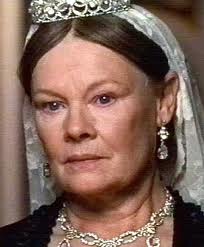 When we took a bus tour of London many years ago, the guide pointed out that all the iron work outside the apartment windows was painted black. She said this practice dated to the reign of Queen Victoria, who was so distraught by the death of her husband, Prince Albert, that she called for the paint job as a sign of mourning. That sounded a little hokey to me, but it made a good story.
Victoria’s mourning for Albert, who died in 1861, was no joke, however. The queen was plunged into a lengthy state of depression, and lived a comparatively isolated life for a British monarch, although surrounded by her children and official household. One person who managed to pierce the shell around the queen was John Brown, a Scottish servant. Their relationship is the subject of the 1997 film “Mrs. Brown,” which stars Judy Dench as Victoria and Billy Connolly as Brown.
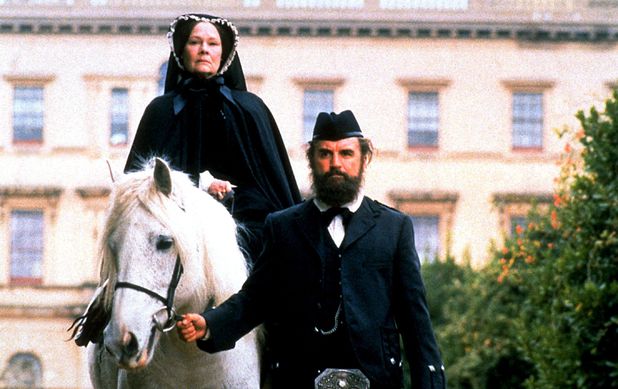
The queen had retired to Balmoral Castle after her husband’s death, and Brown — who had a long-standing association with the family — was sent there principally to care for her pony and accompany her when she chose to ride.
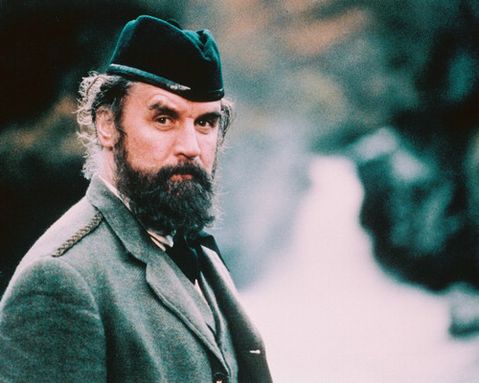
From the start, Brown showed the queen none of the truckling deference she was accustomed to. In fact he spoke to her rather bluntly, addressing her as “woman,” and said exactly what was on his mind. This appealed to Victoria, and she started to rely more and more on Brown’s advice, and he more and more took control of the affairs of the castle, and particularly of anything that had to do with the comings and goings of the queen.
This development along with Brown’s abrupt personality and penchant for drinking irritated pretty much everyone else in the household, especially Albert Edward, the prince of Wales, the queen’s son and later King Edward VII. Meanwhile, there was mounting pressure for Victoria to become more visible to her subjects — pressure that included a movement in Parliament to deinstitutionalize the monarchy. At first Brown supported the queen in her resistance to this pressure, but his change of heart on the matter led to a crisis in their relationship.

To what extent, if any, there was a romance between Victoria and John Brown is still a matter of conjecture. Certainly folks at the time thought there was something afoot, and that’s why the queen was derisively referred to as “Mrs. Brown.”
Although certain aspects of the story are fictionalized in this account, the movie basically portrays real events. The film was made by the BBC for television, but instead it was released as a theatrical property and made a lot of money. The performances, including Anthony Sher’s turn as a foppish Benjamin Disraeli, are outstanding. Judi Dench won a Golden Globe Award and was nominated for an Oscar.
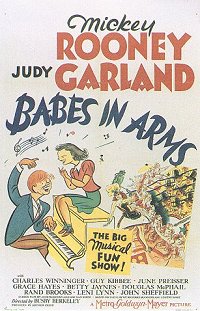
“Babes in Arms”
November 4, 2012

JUDY GARLAND and MICKEY ROONEY
Knowing that a storm visitor was a fan of Judy Garland, I picked out Babes in Arms from the On Demand list, and wound up watching it myself. I did that because this 1939 film was based on a 1937 Broadway musical by Richard Rodgers and Lorenz Hart. I’ve always been curious about that show, but I’ve never seen it produced on stage. I knew well before the movie was over that the stage show has to have been better.
This was one of the “let’s put on a show” movies that Garland made with Mickey Rooney. It turns out that it was only loosely based on the Broadway show. In fact, I have since read that once the brains at MGM got the rights to the show, they made wholesale changes to the script and threw out all the songs except the unmemorable title song and the memorable “Where or When,” which was introduced on Broadway by Ray Heatherton (who later had a long run on television as the “Merry Mailman”) and Mitzi Green.

RAY HEATHERTON
That means, that MGM — specifically producer Arthur Freed — cut “My Funny Valentine,” “I Wish I Were in Love Again,” “Johnny One Note,” and “That’s Why the Lady is a Tramp” (which is heard only as incidental background music). Freed added two old songs of his own — “I Cried for You” and “You Are My Lucky Star” — and he and Nacio Herb Brown wrote “Good Mornin'” especially for this movie. E.Y. Harburg and Harold Arlen, who had contributed three classic songs to The Wizard of Oz, were employed on this movie to write “God’s Country,” a heavy-handed finale that was influenced by the war under way in Europe.
This film was directed by Buzby Berkeley in an era when the canteen didn’t stock de-caf coffee. It is, in a word, exhausting. The production numbers with their quick-step marches are dated and Rooney in particular, as talented as he is, is manic — a fault that is made more conspicuous by the fact that Garland’s performance is comparatively understated.
Apparently there was some racially insensitive material in the Broadway production, and there is an offensive minstrel sequence in the movie. Blackface was common into the 1950s; in fact, when I was a kid, my parish used to stage annual minstrels complete with end men in burnt cork exchanging idiotic banter with “Mr. Interlocutor.” It’s as hard to watch now as it should have been then.
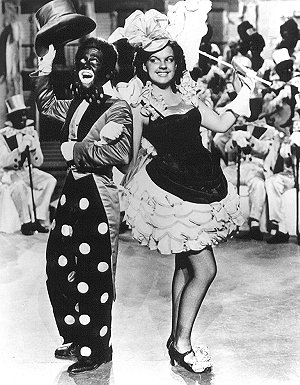
Rooney and Garland in blackface
I’ve read some attempts to rationalize this display, including one argument that the caricatures were mild, but there is nothing mild about Rooney’s lampooning in particular. He’s Jolson in overdrive.
There is a clever number in which Rooney and Garland do good-natured send ups of Franklin and Eleanor Roosevelt. This scene was cut from copies of the film distributed after FDR died in 1945, but it has been restored and is one of the most worthwhile things in the movie.
“You’ve got to be taught to hate and fear”
October 23, 2012
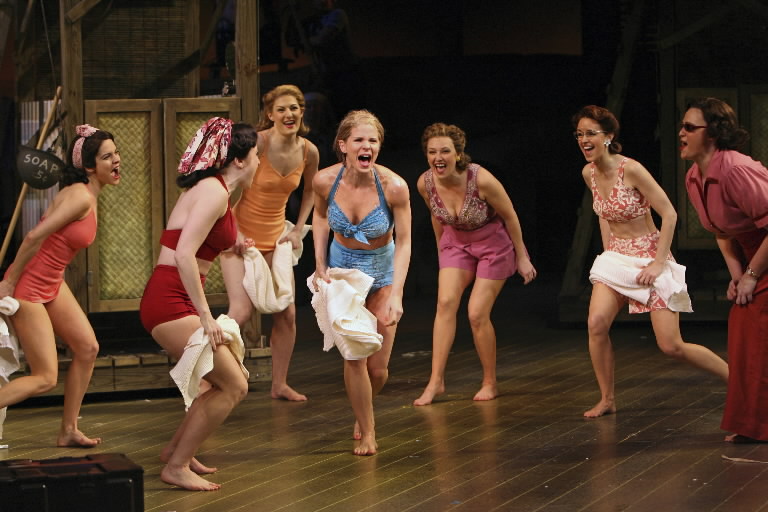
Nellie Forbush (Kelli O’Hara) and the navy nurses sing “I’m Gonna Wash that Man Right Outta My Hair” in the Lincoln Center revival of “South Pacific”
On one of our first dates, I took Pat, now my wife, to see a major production of South Pacific, the Rodgers and Hammerstein musical. Betsy Palmer played Nellie Forbush and William Chapman played Emile de Becque. Neither of us had ever seen the show on stage, but both of us had seen the 1958 film with Mitzi Gaynor and Rossano Brazzi (with Giorgio Tozzi dubbing Brazzi’s songs), and both of us owned the cast albums from that film and from the original Broadway production with Mary Martin and Ezio Pinza.

JAMES MINCHENER
The musical play, which first appeared in 1949, was based on James Minchener’s 1947 book, Tales of the South Pacific. This book, which won the Pulitzer Prize, is a collection of loosely connected stories based on Michener’s experiences as a Navy officer on the island of Espiritu Santo. I find it an absorbing book because of its ability to transport the reader into the unique environment of the Pacific Islands during that war.
Rodgers and Hammerstein combined three of Michener’s stories to create the musical play, and they determined to deal with two instances in which romantic liaisons were disrupted by racial prejudice. One of those situations arises when Navy nurse Nellie Forbush, whose previous life experience was confined to Little Rock, Arkansas, falls in love with French planter Emile de Becque but discovers that he had previously lived and had children with a Polynesian woman. For reasons that she herself cannot articulate, Nellie is repulsed by the idea, and she undergoes a wrenching internal struggle.
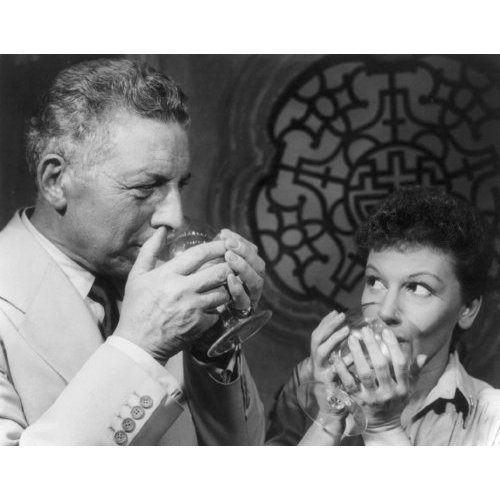
EZIO PINZA and MARY MARTIN
The other conflict involves a Marine lieutenant, Joe Cable, who falls in love with a Tonkinese girl who is not yet an adult, but refuses to marry the girl because of the color of her skin. In a scene in which De Becque and Cable discuss their contradictory crises, De Becque declares that he does not believe that racial prejudice is inborn, and Cable punctuates that idea with a lyric: “You have to be taught to hate and fear / You have to be taught from year to year / It has to be drummed in your dear little ear / You have to be carefully taught … to hate all the people your relatives hate.”
This lyric brought opprobrium down on Rodgers and Hammerstein from some quarters in the United States. Cable’s song was described as not only indecent, because by implication it encouraged interracial sex and — God forbid! — breeding, but that it was pro-communist because who but a communist would carry egalitarianism so far? Some Georgia politicians actually tried to stifle the song through legislation. Rodgers and Hammerstein’s position was that the song was about what the play was about and that, even if it sank the show, the song would stay.

RICHARD RODGERS and OSCAR HAMMERSTEIN
We saw the recent revival of South Pacific at the Lincoln Center twice, and this past weekend, we had the opportunity to see it again in a production at the non-profit Ritz Theatre in Haddon Township, New Jersey. One of the impediments to mounting this show is that it requires an outstanding cast and company; it can’t be faked. The Ritz was up to that challenge in every respect. In fact, Pat and I agreed that Anabelle Garcia was the best Nellie Forbush we had ever seen.
South Pacific was written shortly after World War II. The original production won a Pulitzer Prize and ten Tony Awards. In fact, sixty-two years later, it is still the only musical to win all four Tony Awards for acting.
What is striking about South Pacific is that although it is necessarily performed entirely in the milieu of the 1940s, it does not get old. Racism is still a serious issue in the United States, and some of the criticism directed at this show for addressing that issue sounds disturbingly like rhetoric we can still hear today.
Netflix Update No. 72: “588 rue paradis”
September 12, 2012

RICHARD BERRY
Henri Verneuil created a moving reflection on family ties and cultural roots in his 1992 film, the partly autobiographical 588 rue paradis. The French-language film, which Verneuil wrote and directed, concerns playwright Pierre Zakar (Richard Berry), who has been influenced by his socially ambitious wife Carole (Diane Bellego) to change his name from the Armenian Azad Zakarian, distance himself from his working-class background, and keep his parents at arm’s length. Carole is particularly determined that the couple’s two children not be influenced by their Armenian heritage.
As the film opens, Pierre is anticipating the Paris opening of one of his plays, and he has invited his father, Hagop (Omar Sharif), to attend. Carole arranges for the elderly man, who for decades has worked along with his wife and other family members as a shirtmaker, to stay in a ridiculously large suite in a sumptuous hotel — and not in his son’s home.

OMAR SHARIF and RICHARD BERRY
Pierre lets Carole know that he doesn’t approve of this arrangement, but he doesn’t insist on changing it. Instead, he spends as much time with his father as possible, making excuses for Carole, who has deliberately sent the children off on a trip so that they won’t see and be contaminated by their grandfather.
Throughout this period, the inscrutable Pierre entertains memories of his childhood, some more pleasant than others, but especially of his mother, Araxi (Claudia Cardinale), whom he calls “mayrig,” an affectionate Armenian term for mother. He also meets a young Armenian woman whose humility and earnestness contrast sharply with Carole’s personality.

OMAR SHARIF and CLAUDIA CARDINALE
While Hagop is still in Paris, an unexpected magazine article about the Zakarian family appears, and Carole uses the occasion to goad Pierre into reprimanding his father, something Pierre will forever regret. This incident and its aftermath is the stimulus for a long delayed confrontation between Pierre and Carole and for a decision by Pierre about taking control of his own life.

DIANE BELLEGO and RICHARD BERRY
Even with Omar Sharif and Claudia Cardinale as worthy distractions, Berry is irresistible in this part. His cool exterior in contrast to the turmoil inside him effectively creates the dramatic tension that underlies this domestic story. This is Henri Verneuil’s second film about the Zakarian family; the first, in which Sharif and Cardinale played these same roles, was Mayrig in 1991.
Netflix Update No. 71: “A Thousand Years of Good Prayers”
August 29, 2012

FEIHONG YU and HENRY O
It’s been done to death in the movies: an aging parent travels to visit an estranged child in an effort to repair the relationship. It was done again in the 2007 film “A Thousand Years of Good Prayers,” and with satisfactory results.
This film, directed by Wayne Wang, was adapted from a short story by Yiyun Lee , for whom this was a first turn at a screen play. The story concerns Mr. Shi (Henry O), who travels from Beijing to Spokane to visit his recently divorced daughter, Yilan (Feihong Yu). It is clear from the moment Yilan meets Mr. Shi at the airport that the two are barely on speaking terms and that she is not enthusiastic about his visit.

FEIHONG YU
When father and daughter are together, Yilan rarely makes eye contact with Mr. Shi and she says as little as possible to him, particularly in response to his softspoken but blunt observations and questions about her personal life. Subtitles are employed when they speak to each other in Mandarin Chinese. Soon Yilan invents excuses to be absent from her apartment, even when she has no reason to be.

HENRY O and VIDA GHAHREMANI
Left on his own, Mr. Shi finds evidence in Yilan’s apartment that she has been planning to send him on tours of other parts of the United States. He also spends time in a nearby park, where he strikes up a relationship with a mature Iranian woman, whom he knows only as “Madam.” Neither of them speaks much English, but in the skilfully directed scenes, they manage to make themselves understood to each other as they discuss their families. Madam is eagerly expecting the birth of a grandchild — something Mr. Shi devoutly wishes his only child would also provide — but the curve of Madam’s life takes an unexpected turn that Mr. Shi would have no reason to envy.
Mr. Shi, who proudly tells anyone he meets that he was a “rocket scientist” in China — a half truth, it turns out — is, philosophically at least, a devout communist, something that contributes to the distance between him and his daughter. He also acknowledges that he was not a good parent because he was away from home so much, and he answers Yilan’s complaint that he was cold with the rationale that he and her mother were “quiet people.”

VIDA GAHREMANI
But the most significant factor in the estrangement is Yilan’s resentment of what she construes to be her father’s infidelity — an ironic complaint in the light of his condemnation of her relationship with a married man. But neither knows all of what has happened in the life of the other, and the story hangs on the likelihood that people so closed off from each other for so long can ever repair the damage.
The movie is beautifully photographed with a high-end high-definition camera and even viewers with conventional receivers will notice the sharpness of the images. Silence is an important element in the drama itself and it plays an important part in the film. It’s a thoughtful story that will appeal to a thoughtful audience.
Netflix update No. 70: “The Answer Man.”
July 31, 2012

JEFF DANIELS and LOU TAYLOR PUCCI
When I saw a film named The Answer Man in the Netflix catalog, I thought it might be about Albert C. Mitchell, who had a radio show by that name that was still running when I was a kid. In that show, Mitchell offered to answer any question that was called or mailed in by a listener. The show was contrived to give the impression that Mitchell could answer these questions off the top of his head, but that wasn’t the case. Steve Allen famously did a parody of this show in which he played the “Question Man.” He would be given an answer, and he would provide the question. One answer, for example, was “the cow jumped over the moon.” The question was, “What happened when lightning hit the milking machine?”

LAUREN GRAHAM and JEFF DANIELS
Anyway, the movie isn’t about that. Instead, it’s about a writer named Arlen Faber (Jeff Daniels) whose one success was a book called Me and God, in which he revealed that he had had a personal encounter with the Creator of all that is . The book took the form of a series questions and the Almighty’s answers. This one success was the only one Faber needed. The original book and a wide variety of spin-offs — including a cook book — written by other people made him a wildly popular celebrity.

MAX ANTISELL
But Faber wasn’t interested in fame. In fact, in the 20 years after the book appeared, he hasn’t made a public appearance or consented to an interview, despite the pleas of his publisher. He spends most of his time in his Philadelphia apartment and, on the rare occasion that he speaks directly to another human being, his behavior ranges from disagreeable to obnoxious.
His routine is upset, however, when his life intersects with those of two disconnected strangers: Elizabeth (Lauren Graham), a single mother who has just opened a chiropractic office, and Kris Lucas (Lou Taylor Pucci), a young man whose bout with alcoholism has put at risk the book store he runs with his assistant Dahlia (Kat Dennings).
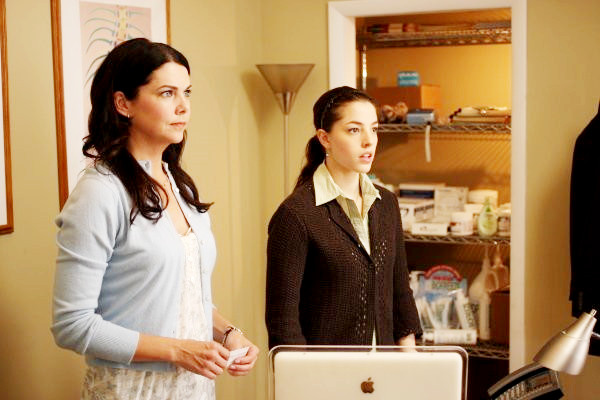
LAUREN GRAHAM and OLIVIA THIRLBY
Faber comes in contact with Lauren because he needs treatments for his bad back. Lauren and her receptionist, Anne (Olivia Thirlby), don’t know what to make of the volatile and manipulative Faber, but Faber is attracted to Laurenr — the first such attraction for him in decades — and he develops an uncharacteristically benign relationship with her young son, Alex (Max Antisell). Faber wants to get rid of some of the books that he has accumulated in his apartment, and he tries to sell them to Kris, who has no cash to buy them with. The impending loss of his store is not the worst of Kris’s problems, though. His effort to stay sober isn’t helped by the fact that he lives with an endearing but alcoholic father. In a desperate attempt to keep from slipping under the waves, Kris blackmails Faber into an arrangement in which Kris will take a few of Faber’s excess books off his hands each time Faber, drawing on his supposed supernatural source of wisdom, answer one of Kris’s questions .

JEFF DANIELS and MAX ANTISELL
There is, of course, a reason why Faber has hidden from public view for two decades, and that back story eventually comes out into the daylight.
This film, which was made in 2008, got mediocre reviews, but we found it engaging. I did object to some unnecessary physical humor, but the premise is unusual, the main characters are interesting, and the actors are effective in those roles. Although this is described as a romantic comedy, Pucci’s performance as a young man in the grip of addiction is particularly disturbing.
Don’t believe the critics.

Neflix Update No. 69:”Lou”
July 11, 2012

LILLY BELL TINDLEY
On that list of “films I’m going to see someday,” put down Lou, an Australian production from 2010.
This movie, shot entirely in New South Wales, takes up a well worn topic — the relationship between a child and an elderly relative — but does it with a sensitive and touching twist. The story, written and directed by Belinda Chayko, focuses on a rural family that consists of a young mother and her three daughters, living in difficult straits since the husband-father walked off about ten months before. The mother, Rhia (Emily Barclay), is under enormous pressure because of unpaid bills, her inability to properly parent her children, and her need for a male figure in her life.
Rhia’s oldest daughter, 11-year-old Lou (Lilly Bell Tindley) is particularly troubled by the family’s circumstances which have poisoned her relationship with her mother. In a desperate attempt to increase the family’s income, Rhia agrees through a social service agency to take care of her husband’s father, Doyle (John Hurt), who is exhibiting symptoms of dementia. Since Rhia works, this arrangement means that Doyle is often left in the custody of Lou, who already resents his presence in the house. Over time, though, the girl develops first an interest in Doyle, a former merchant seaman who loves to talk about his adventures in the Pacific, and then an affection for the old man.

JOHN HURT and LILY BELL TINDLEY
The time Doyle spends with the three girls — including an unauthorized trip to the beach — lifts his spirits but further alienates Lou from her disapproving mother. Doyle often fixes his imagination on his former wife, who left him many years before, and he begins to believe that she has returned to him in the person of Lou — an idea that Lou at first discourages but then, out of compassion for Doyle, permits to continue.
This is a slow-paced story in a bucolic setting but the sustained tension in the family’s life and the dangerous potential in Lou’s alliance with Lou makes the movie compelling.
This movie was the debut Lilly Bell Tindley, who was 11 at the time, and that makes her performance all the more remarkable. Chayko liked to put the camera right in Tindley’s beautiful and expressive face, and Tindley made the most of it. We should be hearing more from this young lady.
The well-traveled John Hurt is a heart-breaking but endearing figure as Doyle, and Barclay is wholly convincing as the confused and beleaguered mother.
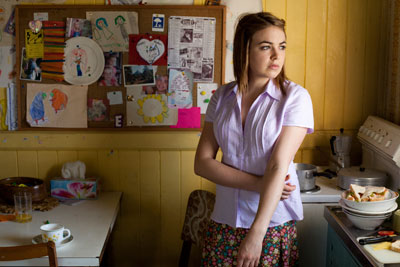
EMILY BARCLAY
Netflix Update No. 68: “Kiss Me Goodbye”
July 10, 2012
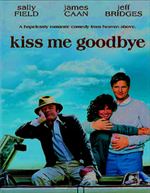 By coincidence, we watched Barbara Walters’ absurd “documentary” about heaven two days after watching the 1982 comedy Kiss Me Goodbye. The Walters program didn’t refer to that film, but it did include clips from Ghost and other entertainment properties that alluded in some way to life after death.
In Kiss Me Goodbye, the person who has managed to live on after his physical death is a Broadway musical star and choreographer named Jolly (James Caan) who expired after he fell down a staircase during a party in his Manhattan home. As the film opens, Jolly’s widow, Kay (Sally Field), is about to move back into the house after having abandoned it for several years. Kay is engaged to Rupert (Jeff Bridges), a moderately conservative man, and she wants to begin the marriage in the stylish digs.
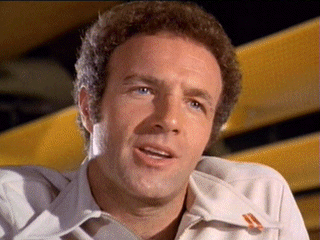
JAMES CAAN
Her plans are disrupted when she discovers that Jolly’s ghost inhabits the place and claims that he wants to reestablish their relationship. Kate’s erratic behavior worries and confuses Rupert and the others in her circle, and eventually she worries them even more by telling them about her encounters with Jolly.
Rupert, who is already jealous of the attention Kate gets from Jolly’s former colleagues, is upset by her ghost stories, but not enough to leave her. Instead, he pretends that he, too, can see Jolly and suggests that the three of them take a trip in the country together. The result, of course, is chaos.
The key to the story is found in Jolly’s real reason for manifesting himself to Kate — and the reason is not what he claims and not what may seem obvious.

SALLY FIELD
This is light fare, something on the order of milkweed spores. A story that barely stands on its own isn’t helped by some excessively broad comedy, including a particularly annoying bit of slapstick about exorcising a spirit from a dog. I read in what I admit is not an authoritative source that James Caan disliked this movie, took the part for the money, and considered the time he spent making the film one of the worst periods of his life — probably an exaggeration unless he’s had an especially charmed existence. Still, his soave, self-assured character provides by far the most fun in the film.
Sally Field was nominated for a Golden Globe as best actress in a comedy, which makes sense, I suppose, because she was, as usual, playing herself, something she should be good at after so much practice.
Kiss Me Goodbye is a remake of Dona Flors e Seus Dois Maridos, a 1976 Brazilian film which, in turn, was based on a 1966 novel, by the same name, written by Jorge Amado.
Kiss Me Goodbye was the last theatrical movie made by the distinguished actress Claire Trevor, who appears as Kay’s meddling mother, Charlotte.
Netflix No. 67: “Arranged”
June 30, 2012

ZOE LISTER JONES and FRANCIS BENHAMOU
My mother once told me that she refused a marriage that had been arranged by her father and uncle. I gave her credit for her chutzpah, because I knew how stern and single-minded those Lebanese gentlemen were. Of course, given the possible consequences for me, I was also grateful for her decision.
Mom took that stand sometime in the 1930s. I don’t know if arranged marriages were more common then, but they are still practiced now, even in the United States, and they are increasingly an anomaly in an era in which couples as often as not dispense with marriage itself.
The practice of this tradition in the 21st century — specifically among observant Muslims and Orthodox Jews — is the subject of Arranged, a 2007 movie based loosely on the personal experience of executive producer Yuta Silverman.

MARCIA JEAN KURTZ
The story concerns Rochel Meshenberg (Zoe Lister Jones) and Nasira Khaldi (Francis Benhamou) who begin their teaching careers the same fall at a school in Brooklyn. Rochel wears the conservative clothing expected of an Orthodox Jewish woman and Nasira wears Muslim garb. These outward signs of their religious identities lead their students to openly express the expectation that the teachers hate each other. The students’ open expression of this assumption, and the teachers’ means of addressing it prompt the school principal, Mrs. Jacoby (Marcia Jean Kurtz), to make some very inappropriate observations about the way the teachers dress and in general how they adhere to the religious traditions of their families.

MIMI LIEBER
While the young women are dealing with issues in their new careers, their families are busy trying to arrange marriages in keeping with centuries-old practices. Nasira takes this in her stride, but Rochel’s rejection of a series of unappealing prospects creates tension in her family, and especially between her and her mother, Sheli (Mimi Lieber), who is determined to settle Rochel’s future and protect the family’s image in the Jewish community.
These circumstances have the effect of creating a bond between Rochel and Nasira — a bond their parents don’t appreciate. As a function of this friendship, the mischievous Nasira decides to directly intervene in the selection of a spouse for Rochel.
This low-key film, which was shot in about two weeks, is laced with attractive characters and talented actors. From my perspective as neither Jewish nor Muslim, it seems to be respectful of the traditions of both peoples even while it comes down on the side of cultural openness and personal freedom.

Netflix Update No. 66: “How About You?”
June 29, 2012

JOAN O’HARA and HAYLEY ATWELL
Every so often, acting trumps story. That’s the case with “How About You?”, a 2007 Irish film based on a short story by Maeve Binchy.
I can’t speak for the short story, but the film is predictable. Thirty-something Kate Harris (Orla Bradley) runs a residence that is occupied by older people, including four who are particularly nasty. Kate’s sister, Ellie (Hayley Atwell), appears unexpectedly to ask Kate to help her finance a trip around the world Ellie is planning with her boyfriend. Kate clearly doesn’t approve of Ellie’s lifestyle but grudgingly gives her a job cleaning the house and attending to the needs of the residents. Ellie develops an interest in sweet, fragile Alice Peterson (Joan O’Hara), and tries to take the edge off Alice’s loneliness — with a little smoke as part of the remedy.
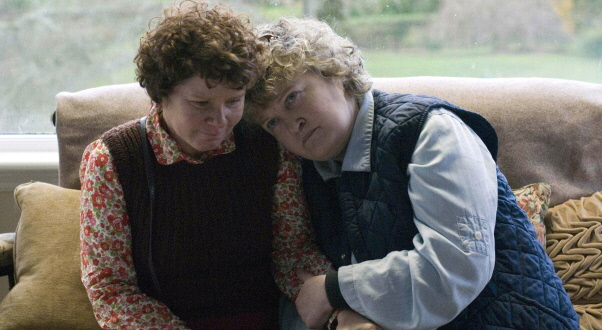
IMELDA STAUNTON and BRENDA FRICKER
But Ellie has no patience with the sour quartet that includes the widowed former judge Donald Vanston (Joss Ackland); the spinster Nightingale sisters, Heather (Brenda Fricker) and Hazel (Imelda Staunton); and former singer-actress Georgia Platts (Vanessa Redgrave).
As Christmas approaches, most of the residents leave for the holiday, but not these four. Meanwhile, Kate receives word that her mother has suffered a stroke. Kate wants to be with her mother and leaves the reluctant Ellie to manage the house and look after the unholy quartet.

VANESSA REDGRAVE
Kate warns Ellie that the house is constantly being inspected by a local health official who could drop in at any time. With Kate gone, Ellie makes an effort to maintain control, but the unreasonable demands of the residents wear out her limited patience.
In her climactic conflict with the group, Ellie confronts them with the unvarnished truth about the way they are living. They take her remarks to heart, and gradually they reveal the events in their past lives that brought them to this house and turned them into such bitter human beings.

HAYLEY ATWELL and ORLA BRADY
I won’t describe how the story turns out, but suffice it to say that not many viewers would be surprised.
In spite of the see-it-coming-a-mile-away resolution, the film is worthwhile because all of the characters are interesting and all of the actors are talented. The most complex figures are the Nightingale sisters, one of whom is a skillful artist and the other a pool shark. We learn only enough about their dark family background to be tantalized, but we never hear the details and we never witness the denouement.
The title of the film is a reference to the song by Burton Lane and Ralph Freed that Mickey Rooney and Judy Garland introduced in the 1941 film Babes on Broadway. The song is heard several times during this movie, including a barroom rendition by Vanessa Redgrave.
 CharlesPaolino's Blog