Netflix Update No. 88: “Cookie’s Fortune.”
December 29, 2013

PATRICIA NEAL
The dysfunctional family is a tried-and-true topic for a novel or a movie, and it was put to good use in the 1999 film Cookie’s Fortune.
The movie was written by Anne Rapp and filmed on location in Holly Springs, Mississippi; the ensemble cast includes Glenn Close, Charles S. Dutton, Julianne Moore, Liv Tyler, Patricia Neal, Chris O’Donnell, Ned Beatty, and Lyle Lovett.
As Easter approaches in a small southern town, widow Jewel-Mae “Cookie” Orcutt (Patricia Neal), who has never reconciled herself to the death of her husband, Buck, has decided that her own death will reunite her with him. She uses one of her revolvers as the instrument for this transition. Her body is discovered by her daughters Camille Dixon (Glenn Close) and Cora Duvall (Julianne Moore). Camille, a half-mad playwright, cares only that news of the suicide will disgrace the family so she forces the dotty but lovable Cora to help her in a clumsy attempt to make the death look like murder.

GLENN CLOSE and JULIANNE MOORE
This scheme has an unintended consequence when the police come to suspect and arrest a black man, Willis Richland (Charles S. Dutton), who lives on Cookie’s property, does odd jobs around the place, and is her closest friend in town. Camille, who has a tenuous grip on sanity, knows better, of course, but her fear of scandal and her desire to become the grande dame of Cookie’s house keep her lips sealed. Among those who find it unlikely that Willis killed Cookie is Cora’s funky prodigal daughter, Emma (Liv Tyler), who has just returned to town after going AWOL. Unlike her mother and aunt, Emma shared a mutual affection with Cookie, and she is confident of Willis’s integrity — and that’s without knowing that Willis has deeper ties to the family than anyone but Cookie was aware of.
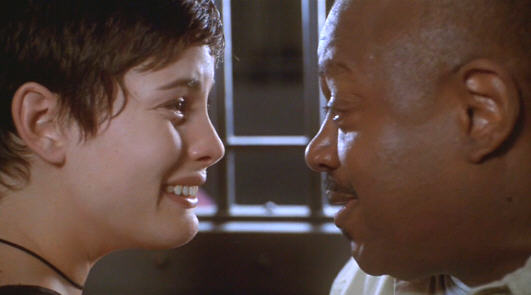
LIV TYLER and CHARLES S. DUTTON
This is an oddball, engaging story, and the outstanding cast lives up to expectations. I, for one, couldn’t get enough of Liv Tyler. This film is billed as a comedy, and it has plenty of comic moments. Still, portrayals of madness always give me a little chill, and Glenn Close — particularly in the last few moments — inspires a full-blown shudder.
Jane Russell: There’s more to the story
December 7, 2013

JANE RUSSELL
We saw the movie Philomena last night, and I was intrigued by the reference to Jane Russell. I think it’s well known by now that the movie deals with the practice of some convents and other institutions in Europe to force single young women to surrender their children for adoption and to require a large donation from American couples to take those children to the United States. The movie has to do with a particular instance in which a woman named Philomena Lee, whose child was taken from her in that manner, attempts decades later to find out what became of the boy.
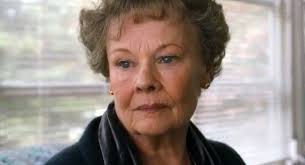
Dame JUDI DENCH
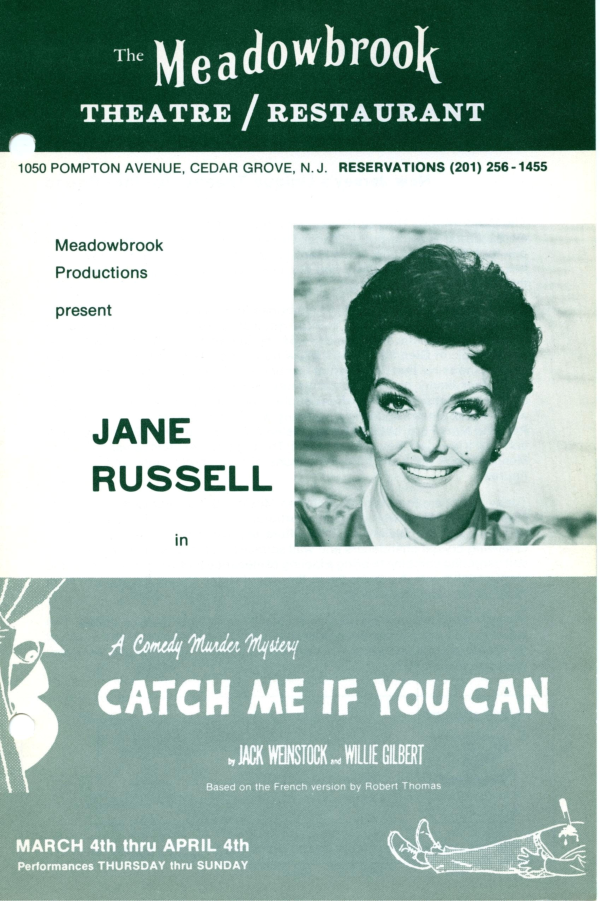
In the more or less true account, Dame Judi Dench plays Philomena, who — in the company of a freelance writer — visits the convent where she was left by her father after becoming pregnant at the age of 18. The reporter notices among the photographs hanging in the reception room at the convent an autographed, provocative photo of Jane Russell. He asks a nun about the photo, and the clear implication is that Jane Russell was among the wealthy Americans who “bought” a child at this convent. That caught my interest because I met Jane Russell in 1971 when she was appearing here in New Jersey in a production of Catch Me If You Can. In fact, I had coffee with her in Manhattan and one of the topics of our conversation was adoption.

JANE RUSSELL
Jane Russell told me that during her first marriage, which was to Hall of Fame quarterback Bob Waterfield, she visited orphanages and similar institutions in five countries in Europe and was frustrated to find that it was nearly impossible for an American couple to adopt the children who were languishing there. She eventually did adopt three children, but her experience in Europe also inspired her in 1952 to found the World Adoption International Fund which eventually facilitated tens of thousands of adoptions. She became an advocate for adoptive parents and children, testifying before Congress in 1953 in favor of the Federal Orphan Adoption Bill which allowed American parents to adopt children fathered by American troops overseas. And in 1980 she lobbied for the Adoption Assistance and Child Welfare Act which provides financial assistance based on the particular circumstances of foster and adoptive parents and adoptive children.
From what I have read so far, I deduce that Jane Russell did not adopt a child from the convent that is the focus of Philomena. I did read an account of an interview in which she told a reporter that after having failed to adopt a child in England, she was going to try her luck in Ireland. Whether any of her eventual adoptions amounted to “buying” babies, I cannot tell. I do notice that news stories that refer to her as one of the wealthy Americans alluded to in Philomena do not go on to report her work on behalf of adoptive parents and children.
Netflix Update No. 87: “Heartburn”
November 30, 2013
——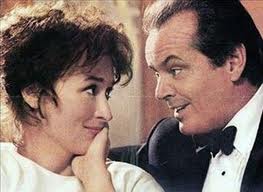
Having just watched an Angelica Huston movie, we felt that logic dictated that we watch a Jack Nicholson movie; the first one we were willing to subject ourselves to was Heartburn, a 1986 film directed by Mike Nichols and based on Nora Ephron’s fictionalized account of her ill-fated marriage to Washington Post reporter Carl Bernstein. Nicholson plays a D.C. journalist named Mark Forman and Meryl Streep plays a food writer named Rachel Samstat. These two meet at party, do the “why don’t we go somewhere else” routine, stretch “somewhere else” to mean Forman’s bed, and get married. Even if you didn’t know Ephron’s story, you’d know in the first few minutes of this film where the relationship is headed.

Mark seems to be an enthusiastic husband and, as nature takes its course, a doting father. The only stress on the marriage at first is the incompetence of the contractor the couple hired to renovate the wreck of a house they bought in D.C. But behind the scenes Mark is having friendly doings with an awkwardly tall Washington hostess, and this comes to light when Rachel is almost ready to give birth to their second child. Rachel reacts to the revelation by rushing back to her father’s home in New York, but she succumbs to Mark’s entreaty that she return to him. That turns out to be a bad decision. The messy outcome involves a key lime pie.

I don’t know how literally this story reflects what went on between Ephron and Bernstein (he had an affair with the wife of the British ambassador to the United States) but it doesn’t make clear what either of these characters really wants out of life. Rachel’s decision to marry Mark — after mutual acquaintances urge her not to, and after she holds up the ceremony for hours while she has a panic attack — is hard to absorb, and Mark’s passionate insistence on remaining in a marriage that clearly cramps his style is no more understandable. One conclusion I came to: It is possible to grow tired of Meryl Streep and Jack Nicholson within 108 minutes. It is.
By the way, Heartburn marked the film debut of Kevin Spacey, who plays an armed robber who relieves Rachel of her wedding ring. The cast also includes Maureen Stapleton, Richard Masur, Miloš Forman, and Stockard Channing.

KEVIN SPACEY
Netflix Update No. 86: “Agnes Browne”
November 30, 2013

ANJELICA HUSTON
I never thought of Tom Jones as a deus ex machina, but in the movies all things are possible. To wit, Agnes Browne, which was co-produced and directed by Angelica Huston, who, apparently to prove that she is no shrinking violet, also played the title role. This movie, filmed in Dublin and released in 1999, was based on the novel The Mammy by Brendan O’Carroll, who appears several times in the film as a derelict townsman.
At the beginning of the film, set in 1967, we learn that Agnes Browne’s husband has been killed in a motor vehicle accident, leaving her with seven children to raise. This is quite a challenge inasmuch as, unless she can collect on her husband’s union pension, her only means of support will be selling fruits and vegetables in an open-air market. She doesn’t even have enough to cover the costs of her husband’s funeral and burial, so she borrows money from neighborhood loan shark Mr. Billy, played by Ray Winstone. When, after a few months, a stroke of luck enables Agnes to pay off the balance of the loan and avoid the usurious interest, Mr. Billy is irritated and he finds a way to get even by strong-arming one of Agnes’s young sons.

ARNO CHEVRIER
On the block where the open-air market is located, a French baker named Pierre, played by Arno Chervrier, has opened a shop, and although he is very courteous, he doesn’t hide the fact that he has eyes for Agnes. Agnes is too preoccupied to respond at first, but eventually she agrees to what turns out to be a very elegant date. But Agnes gets most of her personal support during this period from her fellow street merchant Marion Monks (Marion O’Dwyer) who is full of joie de vivre and sexual insights. Marion is so solicitous of her friend that she manages to buy tickets to a Tom Jones concert that she knows Agnes yearns to attend. Tragedy will eventually deprive Agnes of Marion’s friendship, and it’s a loss that Agnes can scarcely afford.
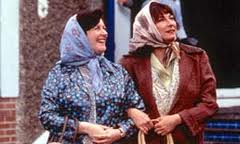
MARION O’DWYER and ANGELICA HUSTON
Because of the debt incurred by one of her sons, Agnes finds herself hours away from losing her furniture to Mr. Billy, although a viewer would hardly believe that such a blow will actually fall on this heroine.
This movie held our interest until the last few minutes despite the fact that we found the dialogue hard to follow in places because of the strong Irish accents and the tendency of some of the actors to mutter. We were absorbed mostly in the characters themselves and in the environment; the story line wasn’t very durable. It was difficult to follow Agnes’s reactions and motivations, beginning with her matter-of-fact response to her husband’s sudden death. But the real weak spot in this movie is the denouement, the resolution of the Mr. Billy crisis, which primarily involves the children, draws in Tom Jones — in person —under improbable circumstances, and is just childish in general.
This movie wasn’t received well in the United States, but it seems to have done much better in Europe.
Ishkabibble: “I should worry?”
November 22, 2013

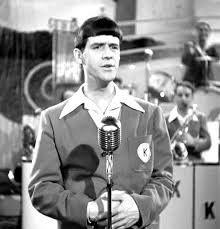
KAY KYSER and MERWYN BOGUE
From time to time, I hear myself calling Marcello the Cat by another name — Ishkabibble. Usually it’s an unconscious substitution, but I caught myself at it the other day and had a vague recollection that I first heard that name from my mother and that she told me that it was the name of a character on a radio show. Since I can’t ask Mom about it any more and time is running out for me, I looked it up and found out that, indeed, there was a radio personality, Merwyn Bogue, who went by that nickname.
Bogue was headed for a career in law but his comic bent and his skill with the cornet led him into the entertainment business. He was associated for many years with Kay Kyser’s orchestra — even while he served in the Army during World War II — and he appeared on Kyser’s radio and television show, Kay Kyser’s Kollege of Musical Knowledge.
 Bogue’s stage routine was laced with horn playing and nonsensical babble, but he was sharp enough in real life that he managed Kyser’s band from 1931 to 1951. He also appeared in ten movies between 1939 and 1950.
When the market for his brand of entertainment dried up, Bogue made a living in real estate.
According to Bogue his stage name was taken from the title of a song — “Ische ka bibble” — ostensibly a Yiddish expression meaning “I should worry?” I have read in several sources, however, that the title is gibberish, not Yiddish. The song Bogue referred to was written in 1913 with music by George W. Meyer and words by Sam Lewis. This song apparently made the term almost immediately popular as a nonsense expression. Some folks who dabble in language think Ishkabibble could be derived from one of several actual Yiddish expressions, such as “Nish gefidlt,” meaning “It doesn’t matter to me.” There’s a three-minute video about Merwyn Bogue’s life at THIS LINK.
Netflix Update No. 85: “Camilla”
November 20, 2013

JESSICA TANDY and HUME CRONYN
Movies that look squarely at romance as a phenomenon of old age are relatively rare, but we watched a worthy exception: the 1994 film “Camilla” with Jessica Tandy in the title role — the next-to-last of her career.
This film, shot in Canada and Georgia, concerns a young married couple from Toronto — Vincent and Freda Lopez (played by Elias Koteas and Bridget Fonda) — and an elderly pair who once were in love but have long been apart.
Vince is an artist and Freda is a musician and composer, but Vince doesn’t take her ambitions seriously and thinks of music only as her hobby. This, of course, is a point of tension in their marriage. The pair go off on a vacation, booking quarters in an outbuilding associated with the home of Camilla Cara, a retired concert violinist whose accounts of her past seem to drift in and out of reality.Watching over Camilla, or hovering over her, is her worrywart son Harold (Maury Chaykin) who produces B movies.

Camilla and Freda have a common interest in music, and they quickly develop a relationship in which Freda gets the encouragement that she hasn’t gotten from Vince. Vince and Harold also have some common interests, and they embark on a joint business project, but Freda declines to go along when the men leave for Toronto to pursue their scheme. Camilla’s reminiscences often focus on a concert she played in the Winter Garden in Toronto — a concert that perhaps didn’t go quite the way she describes it. After the men leave, Camilla agrees to Freda’s suggestion that they, too, go to Toronto, but for the purpose of attending a concert at the Winter Garden where a soloist will perform the same Brahms piece Camilla played there decades before. Their eventful trip includes a visit to Ewald (Tandy’s husband, Hume Cronyn), a violin maker and Camilla’s former lover.

As the two women squarely face the realities of their own lives Vincent and Howard, who panic when they return to Savannah and cannot find Camilla and Freda, undertake some reevaluation of their own. The critics didn’t rave about this film, which was directed by Deepa Mehta, but they were of one mind in praising Jessica Tandy’s performance. She died at the age of 85 the same year this film was released, and yet she seems as if she’s at the height of her powers in this role: warmhearted, impish, and passionate. Janet Maslin of the the Times wrote: “While ‘Camilla’ reveres its heroine, hers is hardly a standard great-lady role. Not every octogenarian actress would be game for skinny-dipping, fishing, violin playing and a wonderfully tender bedroom scene with her real-life husband.” This movie has been criticized as contrived, but whether or not that is valid, Jessica Tandy alone is worth the price of admission.

JESSICA TANDY and BRIDGET FONDA
Netflix Update No. 84: “The Woodcarver”
October 23, 2013

I’m not a big fan of “faith-based movies,” although my full-time work is in religion, but we did watch a movie in that category, because the star was John Ratzenberger. Like most folks, we know Ratzenberger from his eleven-year run as Cliff Clavin, the know-it-all postman and barfly on the television series Cheers. Ratzenberger has had an extensive career; among other things, he has made a specialty of providing voices for Pixar films — all Pixar films. He has also been active in Republican politics, and he is a published author, a business entrepreneur, an advocate for training in skilled trades, and a member of the boards of directors at two universities.

DAKOTA DAULBY
Ratzenberger plays the title role in The Woodcarver, a Canadian film that concerns Matthew Stevenson (Dakota Daulby), a teenager who is troubled because his parents, Jack and Rita (Woody Jeffreys and Nicole Oliver) are involved in an acrimonious breakup. The fallout, especially in the form of Jack’s angry outbursts, often lands on Matthew. The boy acts out his frustration by vandalizing the Baptist church that his family attends. In the process, he destroys ornamental work that was done by Ernest Otto, a local craftsman who has been reclusive since the death of his wife.
The pastor of the church reaches an accommodation with the Stevensons in which Matthew won’t be prosecuted if he helps repair the damage he did. The pastor also prevails on a reluctant Ernest to replace the hand-carved planks that had decorated the church. This job puts Ernest in direct competition with Jack’s boss and potential partner, who is in the lumber supply business.

Matthew does some repairs at the church, but he eventually takes an interest in Ernest and starts working in Ernest’s shop, learning the woodcarving trade. Although Jack objects to this arrangement, it continues and even goes a step further as Matthew leaves home and temporarily moves in with Ernest. In their conversations, Ernest teaches Matthew to judge his actions by asking himself, “WWJD – What would Jesus do?” It’s not so much a religious lesson as it is an ethical one; in fact, Ernest doesn’t discuss religion at all. The boy may not know his theology, but he knows the broad outlines of the kind of life Jesus led, so he has no trouble understanding Ernest’s meaning.
There’s much more to the plot than that and, “faith-based” or not, the movie held our interest to the end. Besides the story line, that’s attributable to good acting on the part of all the principles, including Ratzenberger in a much more understated role than his signature character.

Netflix Update No. 83: “Same Time, Next Year”
October 14, 2013

Although its premise and denouement seem cynical to me, I found Same Time, Next Year (1978) to be an engaging and entertaining film, and an especially apt showcase for the talents of Ellen Burstyn and Allen Alda. The romantic comedy is so apropos for Burstyn, in fact, that she starred on Broadway with Charles Grodin in the stage version in 1975 and won the Tony and Drama Desk awards for her performance.
The principal characters in this story are Doris and George, two married people who meet by chance in 1951 at an inn in California, wind up in bed together, and decide to repeat the encounter on the same weekend every year — and they do so for 26 years. Doris, who lives in the San Francisco area, is at the inn because she is supposed to attend a religious retreat nearby; George, who is from New Jersey, is an accountant in town to see a client. In the play by Bernard Slade, Doris and George are the only two characters; in the film, there are other actors, but their roles are only incidental. It’s not an easy thing for two actors to carry a film by themselves, but Burstyn and Alda succeed utterly.

At each meeting, they express and act on their passion for each other, but they also discuss their lives at home, what’s best and worst about their spouses, what’s going on with their children, of whom there are a total of six. Unlike the folks who usually turn up in this kind movie situation, neither Doris nor George claims to be in a failed marriage; in fact, both seem to genuinely like their partners. As the meetings go on — separated in this film by black-and-white images of the historical and cultural events that shaped life in those decades — Doris and George both evolve in their appearance, their mode of dress, and their outlook, and these changes don’t always blend harmoniously. But still they go on meeting, until tragic changes in George’s life force a decision — an “up or down vote,” to use the parlance of the Beltway — by both of them. As I suggested at the beginning of this post, I am repelled by the way this story line glibly accepts the deceit that was necessary for this relationship to continue. Still, I can’t help but applaud the skill with which both actors kept the story compelling and made the transitions in these characters believable.

Netflix Update No. 82: “Never Too Late”
October 8, 2013

OLYMPIA DUKAKIS
Now that I’m 71 and nearly a senior citizen myself, I find that I’m drawn to these movies about seniors who show that they are by no means through. A case in point is Never Too Late, a 1996 Canadian comedy with a cast that includes Olympia Dukakis, Cloris Leachman, Jean Lapointe, Jan Rubes, Cory Haim, and Matt Craven. The story line is that Woody (Lapointe) is a resident of a rest home and part of a card-playing quartet with three outsiders: Rose (Dukakis), an actress; Olive (Leachman), a radio host; and Joseph (Rubes), a cranky and tight-fisted Slav.
Woody has an acrimonious relationship with Carl (Craven), the owner/manager of the home, who has Woody’s power of attorney and uses it to keep Woody from getting access to his cash. When Carl prevents Woody from chipping in to pay for the burial of a friend, Rose, Olive, and Joseph begin to suspect that something is amiss in the management of the home. With the help of Joseph’s grandson, Max (Haim), they launch an investigation that at times skirts the law of the land in an effort to figure out how Carl is handling the residents’ assets. While one might jump to an accurate conclusion about how their probe turns out, one might not anticipate the plot twist at the end.
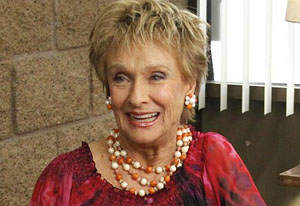
CLORIS LEACHMAN
Although this is a comedy, it looks squarely at some grim implications of old age. On the other hand, the movie includes a touching romantic relationship between Rose and Joseph — something not often portrayed by an industry that usually associates sexuality only with youth. The story line is not impossible, but some aspects of it are improbable, at least as they are portrayed in this film. There are also two scenes that seem to be cut in mid sentence. Nonetheless, it’s an entertaining little farce, and the actors all turn in sound performances. American audiences are familiar with Olympia Dukakis and Cloris Leachman, but maybe not so much with Rubes and Lapointe, two fascinating characters.

JAN RUBES
Rubes, who died in 2009, started his professional career as an operatic basso in his native Czechoslovakia and sang with the Canadian Opera Company before he switched to film and television acting. He appeared in at least 39 films, including the 1985 thriller Witness, in which he portrayed the Amish patriarch Eli Lapp. Rubes also appeared in 15 TV movies and 15 series. Lapointe, a native of Canada, is known mostly, in his entertainment career, as a singer and comedian. He was also a member of the Canadian Senate, representing Quebec from 2001 to 2010.

JEAN LAPOINTE
Netflix Update No. 81: “Sally of the Sawdust”
October 1, 2013
 Watching silent movies always gives me a melancholy feeling. I think the sensation comes from a wistful and naive attraction to the era in which those films were made — an era that was gone long before I was born. The mood comes over me almost regardless of the film I’m watching, whether it is drama or comedy.
And so it was with a mixed response that I watched D.W. Griffith’s 1925 comedy Sally of the Sawdust, in which the leading players were W.C. Fields, Carol Dempster, and Alfred Lunt. This film, which is based on Poppy, a 1923 stage musical, is lighter fare than usually comes to mind when Griffith’s name is mentioned, but it has dark undertones as well.
Fields plays “Professor” Eustace McGargle, a circus juggler and con man who befriends a single mother and her daughter, Sally (Dempster). After the mother dies, McGargle briefly considers returning Sally to her grandparents in the fictional New York suburb of Green Meadows, but he has a genuine affection for the child and decides to keep her with him.

As Sally grows, McGargle also uses her as a dancing warm-up to his own act. When their fortunes are at a low ebb, the pair wind up in Green Meadow where they work at a charity carnival while McGargle prepares to finally restore the girl to her family, who have have benefitted financially from a real estate boom in the area. Although the handsome son (Lunt) of a local tycoon falls in love with Sally, his father is repelled by the idea of such a match and does what he can to prevent it by having McGargle and Sally arrested on the basis of the professor’s three-card monte operation. There are parallel frenetic scenes as Sally attempts to escape from custody and McGargle purloins a tin lizzy and leads a gang of bootleggers on a wild chase as he attempts to reach town and his distressed ward. To make a long story short, they all live happily ever after.

CAROL DEMPSTER
One impression I couldn’t shake is that this film, which appeared toward the end of Griffith’s career, was longer than it had to be. The story is thin and obvious, and the twin sequences of Sally’s escape and McGargle’s chase, go on too long by about a third.
Still, it was interesting to watch Fields, who in his later career made so much of verbal comedy, perform for an hour and a half in silence. Also, McGargle foreshadows other roles Fields would play but, except for Wilkins Macawber in David Copperfield, his characters didn’t face situations quite as grave as the one McGargle wrestled with. Fields would get to reprise this role in Poppy, a 1936 sound version of the same story.
I found Carol Dempster to be very appealing as Sally. She was one of Griffith’s discoveries and appeared in many of his films, and she was also for a time his lover. While I was watching Sally in the Sawdust, my wife came into the room and remarked that Dempster was kind of forlorn-looking. That struck me, too, and I read that Dempster attracted critical remarks on that account at the time she was making these movies. But I found that slightly hangdog quality both suitable and, in its own way, attractive. Evidently, at least some film critics now feel the same way.
A significant factor in my enjoyment of this film was the score that was written and performed, on a digital piano, by Donald Sosin.
I’m going to watch this film again and use the pause button several times. As with most silent films that were shot on locations, I often found myself transfixed by the background, by the storefronts and the signs and the cars and the structures that were serving their purpose on a long-ago day when Griffith’s camera happened to capture them.

 CharlesPaolino's Blog