“I thought drama was when the actors cried, but drama is when the audience cries.” — Frank Capra
July 20, 2009

MILTON BERLE
Saul Austerlitz filed an interesting story for the Los Angeles Times about the ambition of many comic actors and comedy directors to work in drama. I once attended a lecture by Milton Berle in which he talked about this subject. As do a lot of comic actors, Berle maintained that comedy was the more difficult genre inasmuch as no one is funny all the time, or even a lot of the time, whereas most of us are serious much of the time and some of us all of the time. At least, I think that’s what he said.
Berle had a few opportunities to prove that he was capable of playing straight roles. His autobiography revealed that he nursed his share of bitterness over certain events and personalities in his life, and those probably provided a well for him to draw on.
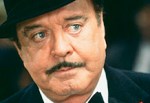
JACKIE GLEASON
Jackie Gleason who, like Berle, made his name with the broadest of comedy, had a flair for drama and demonstrated it in “The Hustler” and “Requiem for a Heavyweight.” He had already shown in a couple of his comedy characters — particularly “the poor soul” — that he could play a part for pathos, although when he tried to put that character virtually intact in a serious film — “Gigot” — the result was uninspired.
Anyway, those interested in film comics in particular might be interested in the Austerlitz piece — inspired by a new Adam Sandler project, at this link:
http://www.latimes.com/entertainment/news/la-ca-comedians19-2009jul19,0,4668140.story
There are no small roles.
July 3, 2009

JOHN DILLINGER
Amid all the tsurris about Michael Jackson’s death bubbles the question of how long his fame will endure. He will have done well, it seems, if the public fixation with him lasts as long as its interest in John Dillinger, an anti-social holdup man and murderer who was shot to death 75 years ago. Once Independence Day is out of the way, we can focus our attention on John Dillinger Day, an observance that commemorates his death, which occurred on July 22, 1934.
There are those, of course, who say that it wasn’t Dillinger who was gunned down outside a movie theater in Chicago, and I suppose we’ll have to live with those who will claim that Jackson didn’t die in Los Angeles last week but is living in Buenos Aires with Adolph Hitler, Emilia Earhart, and Elvis Presley. At last, a fourth for bridge.
The reviews in the Christian Science Monitor and the Washington Post are unenthusiastic about the movie “Public Enemies,” in which Johnny Depp portrays Dillinger. Dan Zak writes in the Post:

JOHNNY DEPP
There’s no excitement in the bank-robbing, no thrill of the chase, no emotion over justice served or thwarted. Depp’s Dillinger is neither charming nor despicable, nor does he occupy that delicious gray area between the two. His spree unspools dispassionately, cold as a Colt .380.
Peter Rainer in the Monitor writes:
Mann’s hero-worshipy treatment of Dillinger is undercut by the film’s dreamtime existentialist aura. In reality, the working poor cheered Dillinger’s bank raids but in “Public Enemies” the Depression is just a prop, and so Dillinger’s populist hero status, what little we see of it, makes scant sense. (This is probably why we see so little of it.) Missing, as a result, is the knockabout tumult of a time when gangsters could ascend to the same stardom as the movie actors who played gangsters. Dillinger was, for a while, every bit as big as Jimmy Cagney. Mann pirouettes around the twin realities of the Depression and the star culture it engendered and offers instead a moody blues doominess. It’s a vacuum filling a vacuum.
So Depp becomes neither Clyde Barrow nor Robin Hood. Maybe, in his old age, he can play Bernie Madoff.
Netflix Update No. 13: “I Am David.”
June 27, 2009

BEN TIBBER
We watched the 2003 movie “I Am David,” which is based on “North to Freedom,” a novel for children written by Ann Holm in 1965. The book was first published in Denmark, where it was a best seller.
The story concerns a 12-year-old boy who has spent his life in a Soviet labor camp in Bulgaria. The boy — the David of the title — is played by Ben Tibber. Although it isn’t overly graphic, the film makes the point that these camps were similar in their brutality to the Nazi concentration camps that the public is more familiar with. David, whose parents are inexplicably absent, is heavily influenced in the camp by an adult inmate, Johannes, played by James Caviezel.

JAMES CAVIEZEL
From the beginning of the movie, a disembodied voice urges David to escape from the camp, tells him how to accomplish it, directs him to travel to Denmark, and advises him to blend in as well as possible with the people he meets and to trust no one. David’s understanding and application of this last instruction is the battery that drives the story.
The unseen voice tells the boy to pick up a bundle that has been left for him outside the prison fence. This contains a bar of soap – heavily symbolic, as it turns out – a piece of bread, a folding knife, a compass, and a sealed envelope he is to deliver unopened to “the authorities” in Denmark.
The bulk of the movie follows David as he makes his way through Italy and Switzerland, a process that is made easier for him because life in the polygot culture of the labor camp has made him multilingual.

JOAN PLOWRIGHT
A pivotal figure in David’s journey is an artist, Sophie, whom he stumbles on while wandering northward in Italy. This character is played by the redoubtable Joan Plowright.
This film, directed by Paul Feig and shot in Bulgaria, is visually appealing. A contrast is repeatedly and effectively drawn between the harsh conditions in the labor camp and the bright and colorful outside world that David experiences for the first time but is hesitant to adopt as his own.
The actors are all exemplary, particularly Ben Tibber, who seems to have understood well how a child of that age would be affected by the inhuman treatment he received from his jailers and by the lack of a normal education in social life.
Perhaps because its source was designed for children, this film’s principal weakness is that it repeatedly strains credulity. Happenstance plays too frequent a part in David’s journey for this story to be taken seriously – or, rather, for it to be taken literally. It can be taken seriously as a kind of fable about fear and trust – including the tendency of the state, at times, to fear the people in whom its trust would be well invested.

BEN TIBBER and JOAN PLOWRIGHT
Netflix 12: “Changeling”
June 23, 2009

ANGELINA JOLIE
We watched “Changeling,” a 2008 film produced and directed by Clint Eastwood and starring Angelina Jolie and John Malkovich. This film which, I gather from independent reading, sticks fairly close to the facts, recounts the story of a 1928 kidnapping case in Los Angeles. Walter Collins, a nine year old boy, disappeared from his home and was never seen again. A boy found several months later in DeKalb, Illinois, claimed to be Walter Collins, but Walter’s mother, Christine (played by Jolie), told police the boy was not her son. The LAPD – which at the time was ridden with scandal and under public pressure to solve the Collins case — insisted that the boy was Walter and that the mother was delusional. Eventually, under a prerogative the police had at the time, police Capt. J.J. Jones (played by Jeffrey Donovan) had the woman committed to the psychiatric wing of a Los Angeles Hospital. A seemingly unrelated immigration case led police to Gordon Norcott (played by Jason Butler Harner), a murderous Canadian whose arrest figured in the somewhat incomplete resolution of the complicated case.

JASON BUTLER HARNER
This film is two hours and 22 minutes long — and that’s after two scenes were cut from the final version. It is arresting, however, even for that long — and that’s due at least in part to the awareness that the bizarre events being portrayed on the screen actually occurred.
Angelina Jolie was nominated for a “best actress” Oscar for this role, but there were equally powerful performances by Harner and Donovan. Harner appears on the screen for the first time in an inocuous situation — his car has overheated — and he has no known connection to the story, but he plays that scene in such a way that it’s immediately apparent that there is something very wrong with him. The more we see of him, the more he makes our skin crawl.

JEFFREY DONOVAN
Jeffrey Donovan is effective as the bullheaded and myopic police captain. His behavior so defies simple logic that he would have fit in well at the trial of the Knave of Hearts. Donovan’s unyielding demeanor makes the character the personification of self-justifying bureaucracy. Malkovich presents a study of the Rev. Gustav Briegleb, a Presbyterian minister who campaigned against political corruption and other things he regarded as immoral, and who provided Christine Collins with support that turned out to be critical to her own well being. Briegleb is portrayed here as a radio preacher, but he was not a broadcaster in real life. He was also known to publicly express his anti-Semitism. However, this film sets out to tell the story of Christine Collins, not of Gustav Briegleb, and other sources suggest that Malkovich correctly plays the minister as tough and single-minded.
There are some upsetting albeit not overly graphic scenes involving murder and an execution, but these things are worth facing in a film that reminds us of how much damage can be inflicted on individual lives by corrupted public institutions.

JOHN MALKOVICH
Netflix Update No. 11: “Dear Frankie”
June 10, 2009

EMILY MORTIMER
We watched “Dear Frankie,” a 2004 movie shot in Scotland, directed by Shona Auerbach. The story concerns Lizzie Morrison, played by Emily Mortimer, a single mother who has spent years avoiding her husband, Davy, who physically abused her and their son, Frankie (Jack McElhone). As the film opens, mother and son — accompanied by Lizzie’s mother, Nell (Mary Riggans), have moved again to a seaport town in Scotland.
To shield Frankie from the hard facts of his past, Lizzie has maintained the fiction that the boy’s father is a merchant seaman who travels the world aboard HMS Accra. She regularly writes letters to Frankie over his father’s name — often including exotic postage stamps — and Frankie writes back in letters that Lizzie retrieves when they are returned to the post office.

JACK McELHONE
Frankie is deaf and rarely speaks — though he can — but he is exceptionally bright and excels at reading lips. One of his schoolmates discovers in a newspaper shipping news item that the Accra, which Frankie thinks is headed for the Cape of Good Hope, is actually to dock in that Scottish town in a few days. This information spurs Lizzie to search for a man who can pose as Davy for a few days. Through one of her few friends in town, she hires a man whom she requires to have “no past, no present, no future,” and he appears — with no name as well — in the form of Gerard Butler. He presents a grim figure, but it appears from the beginning of his relationship with the Morrison family that their bizarre situation piques first his curiosity and then his interest.

GERARD BUTLER
As Lizzie and the nameless imposter carry on the charade with Frankie, Nell discovers that Davy or someone on his behalf has been searching for Lizzie and is close at hand.
This story, which was written by Andrea Gibb, could easily have disintegrated into absurdity, but no such thing happens. Offbeat as they are, the issues in this film are family issues, and they are presented in terms of the private pain and fear and disappointment that are not strange to many people. These characters and their situation have about them the smell of reality, and Auerbach firmly grounds them with every aspect of her direction, but particularly with her use of real time — pauses, stillness, silence that some directors might be afraid to employ. There is, perhaps famously by now, a scene in which Lizzie and the imposter stare at each other for what seems like minutes, though it seems that long only because it is longer than many directors would dare to abandon motion and sound. In lesser movies, their mutual stare might have led to a cheap and easy consequence, but not here.
One caveat. As annoying as subtitles can be, we left them on, because some of the actors’ pronunciation makes the dialogue difficult to follow.
Netflix Update No. 10: “You Can Count on Me.”
June 8, 2009

LAURA LINNEY
We watched Kenneth Lonergan’s 2000 film “You Can Count on Me,” which explores a theme not often treated in movies — the relationship between a grown brother and sister. In this case, the siblings are “Sammy” Prescott, played by Laura Linney, and Terry Prescott, played by Mark Ruffalo. In the opening scene, which occurs while Sammy and Terry are children, their parents are killed in a highway accident. When we next see Sammy, she is the single mother of an eight year old boy, Rudy, played by Rory Culkin, still living in the family home in an upstate New York town. She is eagerly anticipating one of the infrequent visits she receives from Terry – who has become a pot-smoking, hot-tempered but charismatic wanderer. The visit does not go well for several reasons, including Terry’s influence on Rudy, his unreliability, and his meddling in Rudy’s ignorance about his biological father.

MATTHEW BRODERICK
Sammy works as a loan officer at the local branch of a larger banking company, and her comfortable situation there is disturbed by the arrival of a new manager, Brian Everitt, played by Matthew Broderick. Brian fusses about Sammy’s practice of sacrificing some of her lunch time in exchange for running out at 3:30 every afternoon to pickup Rudy at the school bus stop. Brian’s concern with this issue seems to be a symptom of a supercilious management style and a lack of leadership skills. His relationship with Sammy seems inevitably headed toward termination, but forces in both of their private lives sends them in a direction that Sammy, at least, would not have expected.
Sammy’s only “romantic” interest is in Bob Steegerson, played by Jon Tenney, but this appears to be a match with no direction.

MARK RUFFALO
Well, those are the facts of a story that Lonergan wrote and that Lonergan tells very well. I recall reading an essay when I was in college that made the point that the American genius resides in process rather than in product — which, if it was ever true, may have dissipated in the past couple of decades. But what is fascinating about this film is that Lonergan — who, incidentally, gives an effective performance in the movie as a minister who counsels both Sammy and Terry — focuses on the lives these folks are actually living, not on the resolutions either he or we might imagine or hope for them. He assures us of one thing, that Sammy and Terry love each other unconditionally. But he doesn’t make any heavy-handed attempt to explain the siblings’ present predicaments in terms of the early loss of their parents, and instead — what is of more value — leaves us to speculate about that based on what he reveals about their experiences and their inner lives. He leaves us thinking that everything could turn out all right for these characters, but he gives us no more assurance about that than we have about our own near or distant futures.

RORY CULKIN
All of the performances are exemplary, and it would have been hard to cast a more appealing trio than Laura Linney, Mark Ruffalo, and Matthew Broderick. Rory Culkin was a remarkable actor at 11, about the age he was when he made this film. He has a haunted and haunting look that is exposed in several closeups. If we can believe what we read on the IMDb web site, Lonergan had trouble getting the boy to smile or laugh on camera; if so, that serious side of his personality served him well here.
This film was nominated for two Oscars and it won several awards, and none of that is surprising.

JACK SCANLON
We watched “The Boy in the Striped Pajamas,” a 2008 film based on John Boyne’s novel for young adults.
This movie is most effective at portraying people who can rationalize almost any behavior on the grounds that it is their duty to some entity that they perceive as being larger and more important than any individual. One doesn’t have to look too far to find places to apply this model.
The story has to do with an eight-year-old boy, Bruno, played by Asa Butterfield, whose father is a highly placed officer in the German army during World War II. The boy and his teenaged sister admire their father’s stature without thinking about the nature of the regime that gave it to him. As the movie opens, the father, played by David Thewlis, informs his family that he has a new assignment that will force them to leave their opulent house in Berlin and move to “the country.” The “country” home turns out to be a stark mansion located within eyeshot of a concentration camp – a fact the father tries to hide from his children, and particularly Bruno.

ASA BUTTERFIELD
But Bruno, being an eight-year-old boy with fantasies about exploring, is curious about what he thinks is a farm beyond the barbed-wire fence he first sees from the window of his room. Disregarding his mother’s instructions, he wanders through the woods until he reaches the fence, and there he makes friends with one of the inmates, Shmuel. Shmuel, also eight years old, disabuses Bruno of the idea that the camp is a farm, but Shmuel does not understand why he and his family are in the camp or why some of his relatives go off with “work crews” and never return. What Bruno does gradually learn is that he is supposed to hate Jews, but that Shmuel, a Jew, does not seem to him an enemy. One can’t discuss the outcome of their friendship without spoiling the experience of seeing this film for the first time.

DAVID THEWLIS
Appreciating this film requires some suspension of credibility. We are to believe, for example, that Bruno’s mother does not know until she has moved to “the country” and lived there for some time exactly what takes place in the camp her husband oversees – that Jews and presumably others who were distasteful to the Nazis are gassed and their bodies incinerated. We are also to believe that Bruno and Shmuel can carry on a friendship through the camp fence, meeting there daily in broad daylight, even playing checkers, without being discovered.
Despite those issues, this movie delivers its message with a wallop. Thewlis, and Vera Farmiga as the mother, give chilling portrayals of the impact Naziism had on the inner selves of individual men and women. Both boys are also very effective in their roles; Jack Scanlon is a heartbreaker.
“And it was always said of him that he knew how to keep Christmas, if any man alive possessed the knowledge.”
May 20, 2009

ALASTAIR SIM
I anticipate with some trepidation the release of the new Disney film version of Charles Dickens’ story, “A Christmas Carol.” This film, due to be released in November, will be a 3-D, high-tech extravaganza in which Jim Carrey plays Ebenezer Scrooge and the spirits of Christmas past, present, and future.
Carrey has said that one of his greatest inspirations for the role of Scrooge was Alastair Sim’s performance in the 1951 British movie “Scrooge,” which was released in the United States as “A Christmas Carol.” Having read all of Dickens’ work, having read all of his novels mulitple times, having read “A Christmas Carol” at least once a year since 1955, I regard the Alastair Sim film to be the best attempt at translating the story to the screen – although I maintain that the story should be read on the page as Dickens intended, and that it can only be diminished when it is tampered with by screen writers and directors.

MERVYN JOHNS and ALASTAIR SIM
What concerns me is that the Disney bunch will trivialize Dickens’ angry attack on materialistic values – a mood not entirely out of place in the world of AIG executives and Bernard Madloff. As it is, one has to search long and hard to find an adult who reads Dickens at all. Skewed versions of his work only serve to distort its meaning and obscure its value. Millions of kids who are exposed to such a presentation will go through life thinking it represents Dickens’ intentions.
I realize that I am an anachronism for suggesting that people read the classics without being required to. It’s too much work for a generation whose reading matter must fit on the screen of a Blackberry and be brief enough to be digested before the light changes to green. I once suggested that a local book club lay off the contemporary novels for a month and read “Oliver Twist” or “Great Expectations,” and the suggestion was brushed off as if it were babble coming from a dark corner in a nursing home.

JIM CARREY as SCROOGE
One of the things that makes me suspicious of the Disney movie is that Carrey will play four roles and – according to the publicity – give each one its distinctive personality. What is the purpose of that? It sounds like little more than a stunt, and the fact that the producers are approaching the film in this way – and the memory of all the wacky imagery that has characterized some of Carrey’s successful roles in the past – don’t seem consistent with the mood of Dickens’ story.
Call me old-fashioned. I am.
A clip from the film can be seen at this link:
http://www.cinematical.com/2009/05/18/first-footage-from-disneys-a-christmas-carol/
Doo be doo be do.
May 14, 2009

FRANK SINATRA
It’s a sure sign that the semester is over that I’m spending my time reading Hollywood bloggers. And that’s why I came across Nikki Finke’s report that Universal Studios prefers Johnny Depp to play Frank Sinatra in a Martin Scorsese biopic about the kid from Hoboken. Finke says Scorsese has his eye on Leonardo DiCaprio for the role. Pay attention – this is important stuff!
I don’t know that I’ll be patronizing this movie, because while I like a lot of his films and records, I’ve never been able to summon much interest in Sinatra as a person. If I do see this movie, it will be because I’m curious about the challenge it’s taking on. Sinatra is such a strong and pervasive personality that I wonder if it will be possible to accept DiCaprio or Depp or any other actor. As it is, Finke says the actor – whoever he is – won’t have to sing, because the songs will come from Sinatra’s recordings. No one would buy another voice as Sinatra’s. The question is, will anyone buy another mug as Sinatra’s?
Netflix Update No. 8: “Holiday”
May 11, 2009

KATHERINE HEPBURN
We watched “Holiday,” a wonderful 1938 film directed by George Cukor, based on a play by Philip Barry. This was the second film based on that play; the first one appeared in 1930. Both were Oscar nominees.
The cast of this version included Katherine Hepburn, Cary Grant, Lew Ayres, Jean Dixon and Edward Everett Horton. In the guise of a romantic comedy, this is an attack on conformity, greed, materialism, and hypocrisy.
The premise is that a young and rising businessman, Johnny Case (Grant) falls in love with Julia Seton (played by a rather wooden Doris Nolan), the daughter of millionaire banker Edward Seton. Johnny and Julia plan to ask Edward Seton to give his blessing to their engagement, but Edward immediately tries to take control of everything from the timing of the engagement and marriage to the future of Johnny’s career. Johnny hasn’t told Julia, let alone Edward, that his own plan is to leave business and do nothing but travel for a few years while he sorts out the real purpose of earning money. He is encouraged in this mode of thinking by close friends, Nick and Susan Potter, played with biting humor by Horton and Dixon. When Johnny is introduced into the Seton household, he meets Julia’s brother Ned – played by the talented Lew Ayres – an alcoholic young man had been browbeaten by his father to give up childish ideas like composing music and attend to the family business.

LEW AYRES
Johnny also meets, and makes an immediate connection with, Julia’s sister Linda (Hepburn) who describes herself as the “black sheep” of the Seton family and makes no secret of her disdain for its values and social circle. In the museum-like Seton home, the only place Ned and Linda are comfortable is a “play room” outfitted by their late mother, a room to which Johnny and the Potters also eventually retreat – an effective reference to their rebellion against the established order “downstairs” and to the immaturity imputed to them by the stiff-necked patriarch and his pandering, two-faced satellites.
Eventually, Johnny has to decide on what terms – if at all – he is prepared to pursue his courtship of Julia and his potential career in the Seton empire.

CARY GRANT
This is a well written and well acted film (with the exception of Nolan). Its humor and sarcasm has stood the test of time. One has to get past the idea that Johnny Case would have been attracted to Julia Seton in the first place and that it would have taken as long as it did for their values to collide head-on. Over all, though, “Holiday” is an entertaining and uplifting experience.
 CharlesPaolino's Blog