Netflix Update No. 27: “Jakob the Liar”
January 27, 2010
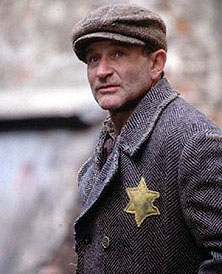
ROBIN WILLIAMS
We watched “Jakob the Liar,” a 1999 film starring its executive producer, Robin Williams.
In this story based on Jurek Becker’s novel, Williams plays the title role, a man confined to a Jewish ghetto in Poland during World War II. Jakob is summoned to the commandancy of the ghetto for being in the street after curfew, and while he is in an SS officer’s quarters, he hears a radio news report to the effect that the Red Army is advancing in the vicinity of the ghetto.
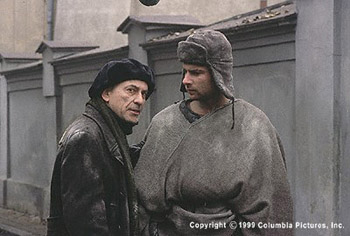
Alan Arkin and Liev Schreiber
When Jakob gives this information to his fellow inmate, Mischa (Liev Schreiber), Mischa draws the conclusion that Jakob himself has a radio — an offense punishable by death in the ghetto. Mischa shares his suspicion with others and soon the story is all over the ghetto, and nothing Jakob can say will put it to rest. The inmates beg him for more promising news, and he finally decides to lift their spirits by making up more “news” about the impending end of the war.

HANNAH GORDON
Jakob’s position becomes increasingly precarious, and it isn’t helped any by the fact that he is sheltering a young girl (Hannah Taylor-Gordon) who avoided boarding the transport that carried her parents to a death camp.
Given the fact that this movie features Williams in a dramatic role, includes fine actors such as Bob Balaban and Alan Arkin, and deals with this particular historical epoch, we expected to like it. We found, however, that the sum of the parts leaves the whole lacking.
The film is tedious and in some particulars implausible — for example, a scene in which Jakob defies and even intimidates an SS officer who, under real circumstances, would have shot him on the spot. And while Roberto Benigni proved that humor could be mixed into a serious Holocaust story, this film doesn’t strike the delicate balance between the two that the Italian movie achieved.
One that slipped by the eagle eyes
January 25, 2010

MARISA TOMEI
After we watch a movie, we get a kick out of going to the International Movie Database site and check on the “goofs” that others have found in the film we just saw. We are amazed sometimes at the obscure things that people notice. For example, we recently saw “The Blind Side” and were amused to read on imdb that in the scene in which the actor playing Michael Oher is talking to an NCAA official, a Maggiano’s Little Italy restaurant is visible through the office window, whereas – the “goofs” page points out – there is no Maggiano’s in Memphis, where the story took place.
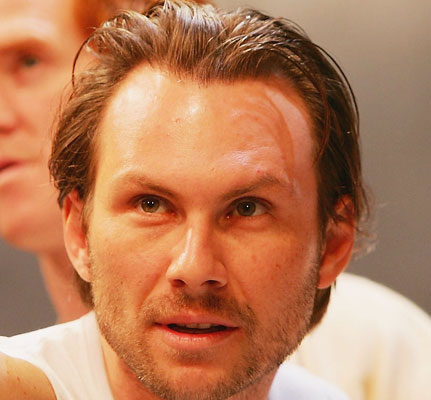
CHRISTIAN SLATER
So the other night we watched on TV the 1993 movie “Untamed Heart” with Marisa Tomei and Christian Slater. There is a scene in that movie in which Slater’s character shows Tomei’s character a box containing several vinyl LPs that had been given to him by a nun when he left an orphanage. He puts one of the LPs on a turntable, and the first cut is a recording of Roger Williams playing “Nature Boy,” a song written by Eden Ahbez in 1947. At the end of the film, when Slater’s character has died, Tomei puts the same record on and listens to the same recording.

ENRICO CARUSO
What imdb’s “goofs” page has missed so far, is that the jacket that that LP was taken from in both scenes is the RCA album “Enrico Caruso in Opera and Song.” I have owned that album for several decades and have played it enough times that I spotted the images of the tenor on the back of the jacket both times that it appeared in the film.
I’m old, but I’m still awake.
“Let me tell you about Sandy Dennis: There should be one in every home.” — Walter Kerr
January 11, 2010
Sandy Dennis Foundation
Turner Classic Movies picked an off-peak hour — 6 p.m. yesterday — to show “Sweet November,” a movie we weren’t familiar with, starring Anthony Newley and the unique actress Sandra Dennis. Knowing it was a Sandra Dennis movie, we actually planned dinner so that we’d be done in time to watch — and were we ever glad we did.
This 1968 film tells an offbeat story about a young woman, Sara Dever, who — in a disingenuous way — charms a series of men into moving in with her for a month each. Sara is, by most standards, mad, but she is also irresistible in a way that Sandra Dennis was irresistible. The men who become her temporary lovers — arriving at the stroke of midnight on the first day of the month, leaving at the stroke of midnight on the last — are chance encounters, but in each she perceives some weakness, some flaw, and she helps him overcome it in 28, 30, or 31 days.

ANTHONY NEWLEY
Sara insists on the schedule. No man is to remain even a minute more than his allotment. Some are better than others at living up to this part of the bargain. The system begins to run amok when Sara takes in Charlie Blake, a seemingly unctuous Englishman who inherited a lucrative box-manufacturing company and is trying to expand it in the United States. As Charlie’s month, November, slips away, he is less and less inclined to part company with Sara. He is also increasingly concerned that her insistence on his departure has to do with something more — something darker — than her therapeutic routine.
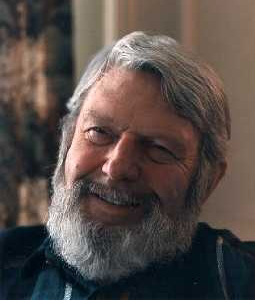
THEODORE BIKEL
The cast of this film includes Theodore Bikel as Alonzo, a vegan sign painter and Sara’s one true confidant.
All the performances are moving, and Sandra Dennis is as good as she ever was on film, blurring the distinction between the actress and the character through inimitable speech and mannerisms and deep emotional insights. I had the good fortune to meet this actress on two occasions, and I found her just as mesmerizing as Sara seems to be in this film — and for many of the same reasons.
“Sweet November” was remade in 2001 with Keanu Reeves and Charlize Theron. I haven’t seen that version, but from what I’ve read, it was a laughing stock. It might have been a bad film altogether, but even if it wasn’t, I doubt that many people who have seen Sandra Dennis play Sara Dever would want to see anyone else in the part.
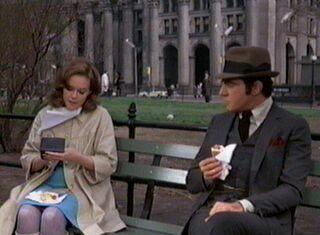
Sandra Dennis and Anthony Newley in "Sweet November"
Netflix Update No. 26: “Vicky Cristina Barcelona”
January 7, 2010

REBECCA HALL
We finally got around to watching “Vicky Cristina Barcelona,” which was a very successful film for Woody Allen in 2008. Besides making a lot of money – in proportion to its budget – the film won and was nominated for a ton of awards, including a best supporting actress Oscar for Penelope Cruz.
Allen pursues his interest in neurotic people, but in an unusual environment for him — some very attractive locations in Spain. The story involves two young American women — Vicky (Rebecca Hall) and Cristina (Scarlett Johansson) — who get a chance to spend a summer in Spain in the home of a distant relative of Vicky’s, played by Patricia Clarkson. Vicky, who is a bit prim and self-assured is engaged to marry a well-groomed go-getter. Cristina, who hasn’t been successful at relationships, tentatively plays at being a free spirit. Allen uses a narrator – Christopher Evan Welch – to describe in a documentary fashion the summer in Spain in which the lives of both women are thrown into disarray.

SCARLETT JOHANSSON
The agent for the turmoil is Juan Antonio Gonzalo (Javier Bardem), an artist whose relationship with his wife, Maria Elena (Cruz), was disrupted when she stabbed him in a characteristic fit of rage. Though it is disrupted, the relationship is not over — certainly not in Gonzalo’s mind or loins. Despite Vicky’s protestations, Cristina becomes involved with Gonzalo — in fact, moves in with him — after he unsuccessfully invites both women to join him in a menage. Vicky disapproves and says so, but by now — thanks to Gonzalo — she’s not nearly as sure of herself.
Things get very complicated even before Maria Elena reappears — with a flourish — to play a wholly unexpected part or two in turning things upside down.

JAVIER BARDEM
The credibility of this story hangs heavily on Gonzalo’s charm, and Bardem has it to spare. It’s an interesting combination of raw magnetism and sexual grace that plausibly could, on the one hand, take advantage of Cristine’s confusion and, on the other hand, crumble Vicky’s moral fortifications, and — if there were a third hand — inspire Maria Elena’s capacity for both lust and murder.
As usual, when Allen is on his game, this film is well written, well directed, well cast, well photographed, and well acted.

Penelope Cruz and Javier Bardem in a scene from "Vicky Cristina Barcelona"
Harold Lloyd, one more time
January 4, 2010

HAROLD LLOYD
An obscure public-access channel on our Comcast system showed “The Sin of Mr. Diddlebock” last night — an historic film in the sense that it was Harold Lloyd’s last.
Lloyd was such a genius at film comedy that I’m not sure anyone can be said to have surpassed him. This is not a good example of his work, and yet — because it’s Harold Lloyd — it’s worth watching anyway. Lloyd was coaxed out of retirement by Preston Sturgess, who wrote and directed this movie, but the two men fought bitterly throughout the production. In fact, there are two cuts of this film — the Lloyd version and the Sturgess version, the latter titled “Mad Wednesday.”
In what is probably the only instance of its kind in film history, Sturgess opens this 1947 sound film with a scene from Lloyd’s 1925 silent feature “The Freshman” in which the water boy on a college football team gets into the game and scores the last-minute winning touchdown. Lloyd charged Sturgess $50,000 for the use of that clip.
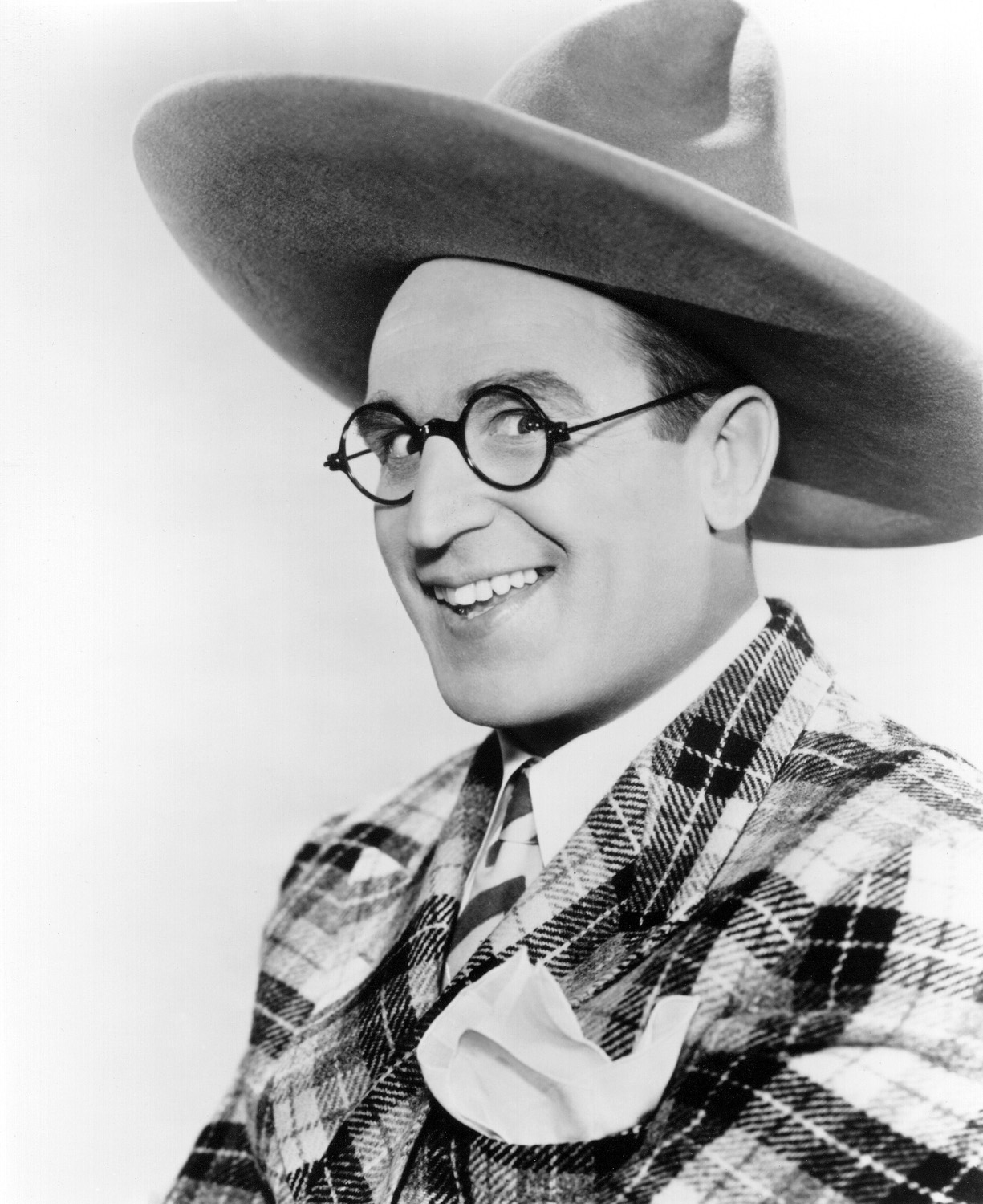
"HAROLD DIDDLEBOCK"
“The Sin of Mr. Diddlebock” ostensibly picks up the story of the same character — though with a different name — as he takes a job “at the bottom” of an advertising agency with the promise that he will get an opportunity to move up and express his bright ideas. Twenty years later, he is at the same job in the basement bookkeeping department when his boss hands him a watch and about $2,000 in savings and shows him the door. Out on the street, Diddlebock meets a panhandler and agrees to have a drink with him — the first drink of Diddlebock’s life. This is the occasion for a hilarious scene in which the bartender played by Edgar Kennedy — a wonderful comedian — mixes an original and potent concoction to make the maiden voyage memorable. You can watch that scene at THIS LINK.
Under the influence of the drink named in his honor, Diddlebock unwittingly stumbles through a series of adventures that end with him owning a horse-drawn cab complete with driver, and a penniless circus complete with 27 hungry lions.

Harold Diddlebock and his newfound friend.
The resolution comes complete with a dose of Lloyd’s trade-mark, nail-biting high-jinx on a ledge many stories above a city street.
Besides Kennedy, the cast includes Margaret Hamilton, Franklin Pangborn, and Rudy Vallee. The film — juvenile and clumsy at times — is not in the same class of the earlier work in which Lloyd was more prolific and more financially successful than Chaplin or Keaton. But Sturgess’s dialogue shows some of the old flair and Lloyd, at 54, is still able to pull off that boyish exuberance.
JIMMY DURANTE
There is a sequence of scenes in this movie in which Lloyd and other actors work closely with a lion. Some of these scenes are quite physical, and they reminded me of a story Jimmy Durante once told on the David Susskind TV show. Durante said he did a routine with an elephant in the Broadway production of Billy Rose’s “Jumbo,” which was later a movie in which Durante also appeared. In the stage show, Durante did a stunt in which he lay down on the stage while the elephant used its foot to crush a cinder block that was next to Durante’s head. According to Durante, Frank Buck — the big-game hunter — came backstage after one performance to meet the cast. He mentioned the scene with the elephant and told Durante, “I wouldn’t do that for a million dollars. You can never trust an elephant.” Well, Lloyd and his colleagues trusted a lion a lot more than I would — I don’t care how well fed, sedated, trained, or elderly the animal might be.

“Oh, to be torn ‘twixt love and duty” — Ned Washington
December 31, 2009

GARY COOPER
So anyway, I didn’t want to get up yesterday morning, and Turner Classics was playing “High Noon.” I had seen it only about three dozen times, so I decided to watch. It never gets old. Its reputation has grown with the years, and deservedly so. The idea of telling a story in real time when there is virtually no action until the last couple of minutes was a master stroke — although there seems to be some dispute over whose stroke it was.
Unlike most westerns of that period – 1952 – this film is deeply cynical. It seeks to confirm my father-in-law’s frequent pronouncement that “people are no damned good,” as an entire town folds under the threat of the returning reprobate, Frank Miller, and leaves Marshal Will Kane to face Miller and his gang alone – or so they think.
Gary Cooper played the marshal – a good choice for the cerebral lawman, although there were some doubters because Cooper was so much older than his love interest in the film, Grace Kelly.
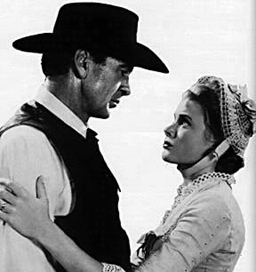
GARY COOPER and GRACE KELLY
This film was controversial in a way that illustrates the philosophical polarization of American society at the time. Carl Foreman wrote the screenplay and was a co-producer with Stanley Kramer, but when Foreman refused to cooperate with the House Unamerican Activities Committee, Kramer basically forced him out of the project and took away his credit as a producer.
John Wayne publicly denounced this film as an allegory about those who failed to support actors and other creative artists who were being badgered by the House committee. Ostensibly, he made “Rio Bravo” as a right-wing response to “High Noon.” On the other hand, Ronald Reagan took the story at face value and said he liked the portrayal of the marshal as dedicated to law and order and more concerned about the well being of the town than about his own life. Dwight Eisenhower was a fan of “High Noon,” and Bill Clinton had it screened 17 times while he was president.

TEX RITTER
Besides the concept itself, the cinematography, and the performances by Cooper and the rest of a strong cast — including Lloyd Bridges and Thomas Mitchell — this film owes its status to the title song with words by Ned Washington and music by Dmitri Tiomkin. The song, performed by the great western singer Tex Ritter, drifts into the background again and again, adding to the tension. Frankie Laine’s recording of this song sold a million copies, and I like his performance, but listening to someone other than Ritter sing “High Noon” is like listening to someone other than Johnny Mathis sing “Misty.”
The title song won an Academy Award that year. British film writer Deborah Allison maintains that the film played a pivotal role in movie-movie history. Her interesting article as at THIS LINK.
Netflix Update No. 25: “My Louisiana Sky”
December 29, 2009

Michael Cera as Jesse Wade Thompson and Kelsey Keel as Tiger Ann Parker in "My Louisiana Sky"
We watched a 2001 children’s movie from Showtime, “My Louisiana Sky,” and we weren’t surprised afterward to learn that it had won numerous awards — including the Andrew Carnegie Award and three daytime Emmys — and had been nominated for more.
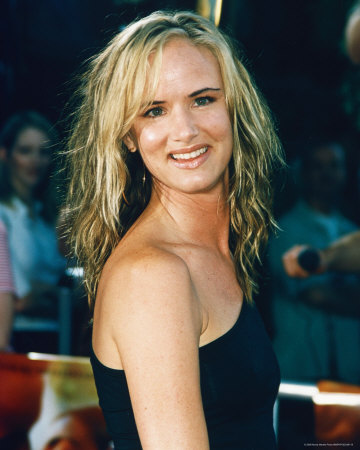
JULIETTE LEWIS
Based on a novel by Kimberly Willis Holt, the story concerns Tiger, a 12-year-old girl, who lives on a farm in Louisiana with her mentally handicapped parents — Corinna and Lonnie Parker — and her maternal grandmother, Jewel Ramsey. Corinna (Amelia Campbell) is childlike, less mature now than her own daughter, and Lonnie (Chris Owens) is barely literate but is savvy enough to not only hold down a job on a nearby farm but to win the trust and respect of the owner. Jewel (Shirley Knight) keeps the house, maintains order, and does per-diem farm work — sometimes with the help of Tiger (Kelsey Keel), to earn some cash.
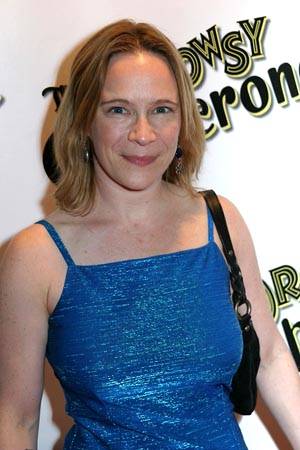
AMELIA CAMPBELL
There is one prodigal family member — Jewel’s other daughter, Dorie, played by the redoubtable Juliette Lewis — who has left rural life behind for a career in Baton Rouge.
Tiger experiences isolation and rejection because of the way other children regard her parents. The only child who pursues a friendship with her is Jesse Wade Thompson (Michael Cera), and Tiger has trouble accepting his exuberance. When life at home deteriorates, she considers but does not leap at the prospect offered by Dorie of a comfortable and exciting life in the city.

KELSEY KEEL
While adults may find it simplistic, the portrayal of a girl deciding where her true happiness lies can be a valuable object lesson for children.
Under the direction of Adam Arkin — whose brother Anthony is married to Amelia Campbell — every cast member delivers a strong performance. Arkin and Kelsey Keel won two of the Emmys.
Netflix Update 24: “Edge of America”
December 21, 2009
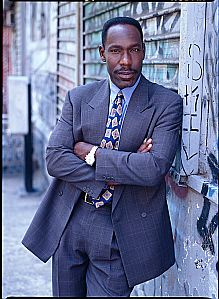
JAMES McDANIEL
We watched a 2003 Showtime movie, “Edge of America,” which concerns a black man who takes a job teaching English at a high school on an American Indian reservation. This was directed by Chris Eyre, the Cheyenne/Arapaho who was also responsible for “Smoke Signals,” and there are many similarities in mood and detail, including the wise-cracking radio personality.
Kenny Williams, McDaniels’ character, is maneuvered into taking over coaching duties for the school’s girls basketball team which, in a word, stinks. The short version is that he takes the team to the state championship finals, but not via the shortest distance. There are many obstacles, most of them born of Williams’ inability to quickly grasp the nuances of Indian culture and the realities of life for these impoverished and isolated people. He finds his way, however, with some prodding and shoving at the hands of the native people, and the movie becomes “To Sir With Love on the Rez.”

GERALDINE KEAMS
The story line and the outcome seem obvious, but there are excellent performances, including McDaniels’, which won him an Emmy. The Navajo actress Geraldine Keams is inspiring in the role of a tribal elder who is the skeptical mother of one of the team members, and Wes Studi, a Cherokee, is both credible and amusing as an auto mechanic who deftly helps the coach figure out his role in his unfamiliar surroundings. Irene Bedard, an Inuit/Metis actress, does a strong turn as a teacher who is forced to play conscience for the bungling Williams. An ensemble of young actors add a lot of guts to this film in their roles as players and students at the school.
“Edge of America” is based on the experience of Jerry Richardson, who died in an auto accident while he was head coach of the women’s basketball team at the University of Central Florida. This is how Richardson’s career was described on Humanities and Social Sciences Net Online:
Jerry Richardson, age 40, has been at UCF through four seasons and in that time has become a strong and quiet force on campus and in the community. He inherited a troubled program and last season took his team to a conference tournament championship and the NCAA tournament, a first for the UCF women’s program. Not only was he building a program, but more importantly he was having a significant impact on the lives of young women in Central Florida.
This of course is not surprising. Jerry Richardson came to UCF from the Navajo Nation Reservation in Shiprock, New Mexico, where he transformed a struggling high school women’s team into four-time State Champions. From 1982 to 1993 Jerry Richardson made the Lady Chieftans of Shiprock into a story of mythic dimensions. More importantly he changed the lives of the young women he coached. Eighty percent of them went on to college, mostly as non-athletes; this at a school with a fifty percent dropout rate in a population beset with poverty and alcoholism.
Richardson believed, and made his players believe, that there was nothing you could not do as long as you had two things: opportunity and a positive attitude. Jerry Richardson brought both to Shiprock and to UCF.
He was above all a teacher, not a coach. He understood the ephemeral character of victory on the courts, and the significance of preparing his women for life after basketball. “The trophies gather dust, the kids don’t, they keep moving,” he said. Jerry Richardson’s players moved on, well prepared for the world after basketball.
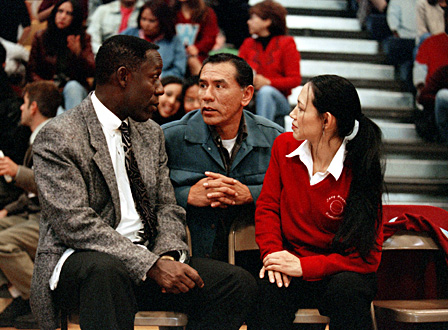
JAMES McDANIEL, WES STUDI, and IRENE BEDARD in "Edge of America"
Netflix Update No. 23: “Daphne Laureola”
November 9, 2009
JOAN PLOWRIGHT
On the theory that there’s no such thing as too much of Joan Plowright, we watched “Daphne Laureola,” a 1978 British television production of a 1949 play by James Bridie, actually a Scottish physician born Osborne Henry Mavor. Sir Laurence Olivier, who rated this play as one of the six best in the 20th century, appears in this adaptation along with Plowright, who was his third wife.
In this romantic comedy, Olivier plays the elderly Sir Joseph Pitts and Plowright plays his 50-year-old wife whose first name — perhaps deliberately — is never given. When Lady Pitts dines alone at a restaurant in London’s Soho district, her overindulgence in alcohol launches her into a uncontrolled monologue that alternately amuses and horrifies the other patrons. The one exception is Ernst, a young Polish student who becomes infatuated with her — comparing her place in his life to that of the nymph Daphne in the life of the Greek god Apollo.

LAURENCE OLIVIER and JOAN PLOWRIGHT in "Daphne Laureola"
Lady Pitts collects the names and addresses of seven of the customers — including Ernst — and promises to invite them to tea. She does, but by the time the appointed hour arrives, she has forgotten not only the invitations but the guests and the circumstances under which she met them.
Ernst has not forgotten, though, and his pursuit of an ill-defined relationship with Lady Pitts — and the manner in which Sir John and his lady deal with Ernst — provides the substance of the play.
The cast, which I believe was chosen by Olivier, is outstanding. Clive Arrindell as the deadly earnest young man who is blind to the absurdity of his situation gives a bravura performance. Bryan Marshall has a strong turn as Vincent, the Pitts’ despicable house servant and driver who doesn’t approve of Ernst nor, it seems, of Sir John, Lady Pitts, or their marriage. Olivier is moving as the baronet who knows his life is nearing its conclusion, and Plowright, of course, is Plowright. Lady Pitts is designed to befuddle the other characters and the audience, and Plowright is the woman to make her ladyship do it.

DAPHNE LAUREOLA
In the course of the play, Lady Pitts instructs Vincent to have a daphne laureola plant installed in the garden at her home, a plant Sir John insists will die because it has been planted in the fall. Lady Pitts refers to the plant as a laurel, but the daphne laureola is not a laurel — in fact, it’s a noxious weed, which was perhaps an obscure insinuation by the playwright.
The clash in this play between the nearly insane romantic obsession of the young student and the decidedly non-poetic disposition of the people around him provides the fun, the drama, and the heartbreak of this work.
We stumbled on this in the kind of accident that often occurs on a site like Netflix, and we’re glad we did.
Netflix Update No. 22: “Phoebe in Wonderland”
October 26, 2009

ELLE FANNING
We watched “Phoebe in Wonderland,” a 2008 fantasy written and directed by Daniel Barnz.
This film is an off-beat tale about a nine-year-old girl, Phoebe Lichten (Elle Fanning), who is brilliant and creative, but who confounds her parents and her rigid teachers and principal with outbursts of inappropriate remarks and behavior.
Phoebe’s mother, Hillary (Felicity Huffman as a brunette), is frustrated by her inability to find time — amid housekeeping and raising two little girls — to convert her academic dissertation on Lewis Carroll’s “Alice” novels into a book. With her mother’s encouragement, Phoebe has immersed herself in Carroll’s fanciful neighborhoods to the point that she has frequent imaginary encounters with his characters. The competing forces in Phoebe’s psyche are effectively portrayed by Barnz through the blurring of identities between people in Phoebe’s real life and Humpty Dumpty, the Caterpillar, the White Rabbit, the Red Queen, and the Mad Hatter

PATRICIA CLARKSON
Coincidentally — or not, depending on your point of view — Miss Dodger, the new, idiosyncratic drama teacher (Patricia Clarkson) is mounting a musical production based on Carroll’s stories. This enterprise becomes a kind of sanctuary for Phoebe — the one place where she can overcome her compulsive outbursts. But there is too much amiss with the little girl, and with her parents, and with the management of the school, to stave off a crisis and an unexpected if not totally comfortable resolution.
Like the film “Millions” which I wrote about here on October 19, this is not for viewers who take things literally or insist on reality in their movies. The film is blessed by a talented cast — also including Bill Pullman as Peter Lichten, Phoebe’s father, and Bailee Madison as Olivia, Phoebe’s sister. The beautiful Tessa Albertson has a brief but haunting non-speaking role as Alice.

TESSA ALBERTSON
This film argues that a person cannot be defined by one or two aspects of her personality. The world around Phoebe — her parents, her siblings, her peers, and most of her teachers — failed her as long as they embraced only the “acceptable” parts of the girl or hoped to make the whole girl acceptable to them by badgering or ridiculing her.
The inscrutable Miss Dodger and the fleeting figure of Alice — who may be better acquainted than they let on at first — provide the only unqualified reassurance Phoebe receives that she, with her strengths and her weaknesses, is a person of value.

FELICITY HUFFING, ELLE FANNING, and BILL PULLMAN
 CharlesPaolino's Blog