Ike as in “like”
May 2, 2009

DWIGHT EISENHOWER
I just finished reading “Ike: An American Hero,” the 2007 biography of Dwight Eisenhower by Michael Korda, a former RAF pilot whose books include a biography of Ulysses S. Grant. This book seemed almost as long as the Second World War, but it provides a lot of insight into the military realities of the allied campaign for control of North Africa, Sicily, and ultimately the European mainland via the beaches of France.
Korda, who is British, tries to sort out the conflicting judgments about Eisenhower’s military leadership, which varies in direct relationship to which side of the Atlantic it comes from. That’s an interesting point in itself, because what Korda finds to be the key to Eisenhower’s genius is that he was able to manage and manipulate the constant head-banging among allied leaders – Winston Churchill, Charles DeGaulle, Joseph Stalin, and Franklin Roosevelt – who seemed to have few common interests beyond defeating Nazi Germany, and – on the other hand – who had many interests that were in conflict.
Scholarly rankings of the presidents – a pointless exercise in many respects – usually place Eisenhower among the top 10. Korda – while acknowledging several embarrasments and failures in the administration – gives Eisenhower a balanced report card for his eight years in office, but devotes most of the book to Eisenhower’s military career and particularly to the war. He emphasizes a point that may be lost on later generations, namely that as Supreme Allied Commander in Europe, Eisenhower exercised – and successfully – what was arguably the greatest measure of military and political power ever placed in the hands of a single person, before or since. He acted in some cases – for instance, in dealings with Stalin – as though he himself were a head of state.
Korda discusses Eisenhower’s analysis of the Korean War – namely that it couldn’t be won without an American military commitment that probably would have sparked another world conflict; his refusal to send American combat troops into what he considered the French colonial war in Vietnam, and his caution against American military involvement in the Middle East – a bitter lesson for Eisenhower himself in Lebanon.
I got to see Eisenhower in person in 1964 or 1965, when I was a graduate student at Penn State. I was working in the public information office and heard there that Eisenhower, who lived in Gettysburg at that time, was going to visit State College to address a group of high school students. Eisenhower was the first person to be protected under the Former Presidents Act, but you couldn’t tell it from his appearance at Waring Hall. I had no business there, but no one stopped me from going in and sitting in a balcony looking down on Eisenhower as he stood alone on the stage talking to those teenagers.

PORTRAIT OF EISENHOWER
He spoke to the students about civic responsibility, about not exercising their democratic rights by standing on the sidelines of political life. He was in his late 70s then and had suffered some serious health problems, but he stood ramrod straight with the military bearing that had been drilled into his DNA. He also had that good-natured ease of manner that Korda repeatedly argues contributed as much as anything else to Eisenhower’s success in the Army and in civilian life.
So you think you got troubles?
April 22, 2009

SANDRA DENNIS
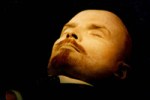
LENIN IN REPOSE
Lenin has been wearing the army type jacket for 17 years as his mummified body was resting in the Mausoleum on Red Square . His clothes need to be changed once in three years. Most recent change of Lenin’s suit took place in 2003.
The funding is hardly enough for embalming activities, specialists of Lenin’s Tomb complain. “The state has not been assigning anything since 1992. We live at the expense of the Lenin’s Tomb Fund. Then there is this crisis going on,” an embalmer said.
Lenin’s body is dressed in expensive custom-made suits made of Swiss lustrine – the fabric, which Vladimir Lenin preferred when he was alive. The suit has a modern cut, which is still popular nowadays in men’s fashion. If specialists do not change the suit during the prophylactic works, they steam-clean and press it thoroughly: a slight speck of dirt can ruin the embalming effect.
Lenin’s mummy has been exposed to biochemical treatment this year. It was placed in the bathtub filled with the solution of herbs that produce the embalming effect. “This is a unique technology. It will help the body keep up its shape for some 100 years,” an embalmer said.
Lenin’s Tomb opened its doors for the general public again on April 18. Russia will mark the 139th anniversary of Lenin’s birthday on April 22. A visitor is first shown to the check point in the Tomb, where they will have to leave photo and video cameras, cell phones, large metal items and any types of drinks. Visitors are not allowed to either eat or drink during the viewing. Men are supposed to remove hats. It is not allowed to keep one’s hands in their pockets during the viewing either.
“… if ever I forget thee …”
April 19, 2009
 The New York Times today reports on a Holocaust museum that has been established in Skokie, Ill. Skokie became the home of many survivors of the Holocaust, and 32 years ago it was chosen for that reason as the site of a march by a group of neo-Nazis. The Nazis’ plan and the opposition to it set off a debate on free speech. The march never took place, but the hubris of the Nazis inspired Holocaust survivors to be more open about what had happened to them and their families, and that change led to establishment of the museum.
The times reports that “unlike similar institutions, the Skokie museum is almost totally anchored in the local, brought to life with the personal pictures, documents, clothing, testimonies and other artifacts of the building’s own neighbors. And several of the Holocaust survivors are working as docents and other staff members, weaving their first-person stories into the history, exploring issues of genocide around the world.”
That’s a powerful and important concept and one that could be emulated, even if needs be on a smaller scale, in other towns and cities where there are still people left to tell this story first hand. That’s true not only because there will always be those who deny – contrary to the indisputable evidence – that the Holocaust took place, and because even those who acknowledge the Holocaust should be reminded of it – both the fact of it and its enduring impact on families all over the world. Historical epochs are like that; they don’t end on any given day but continue indefinitely to affect the lives of succeeding generations – as the era of American slavery directly affects millions of people living today.
The Times also published an account today of a relatively new body of research on some of the lesser-known Nazi “killing fields.” It’s at this site:
“… when mercy seasons justice …”
April 5, 2009

JOHN DEMJANUJK
The Los Angeles Times had a video on its site in which the son of a man accused of participating in the deaths of thousands of people in a Nazi concentration camp, argues both that his father, John Demjanjuk, is innocent and that his father – now 89 and frail – should not be extradited. A U.S. immigration judge on Friday issued an indefinite stay of deportation based on the Demjanjuk family’s claim that making the elderly man travel from Cleveland to Germany for trial would be tantamount to torture. The stay will continue until the judge rules on the merits of the claim.
Demjanjuk has already been convicted of lying to authorities about his past as a Nazi guard, but his conviction under a charge that he was the notorious “Ivan the Terrible” of the Treblinka death camp was overturned based on evidence that identified another man as that guard.
Now he is charged with 29,000 counts of accessory to murder at the Sorbibo concentration camp in Poland.
On the face of it, one might say that, inasmuch as he lied about his past in order to become an American citizen, it’s tough luck for Demjanjuk if travel would be hard on him or even kill him. However, modern technology makes it unnecessary for Demjanjuk to be in Germany for the trial; he could attend through closed-circuit television or a secure webcast. Also, in spite of what is already known about his past, American justice can be true to itself only by granting him the presumption of innocence on the charges at issue. If he is sent to Germany for trial and is acquitted, and dies prematurely because he was forced to attend in person, that would be one more injustice piled on all the other unrequited injustices of the past.

JOHN DEMJANJUK
If Demjanjuk is convicted of the charges against him, he should be deported to submit to whatever sentence is imposed on him – old or not, sick or not. Both the enormity of the crimes of the Holocaust and the fact that the roots of such crimes still exist among white supremacists and anti-Semites require that everyone who participated be brought to justice. But another suitable response to such crimes, especially when guilt has not yet been determined, is to act with the quality of mercy that was absent from the Nazi mind, a quality that is the antithesis of Nazi thinking.
“God save our gracious queen ….”
April 2, 2009

MICHELLE OBAMA
Television newscasters last night were preoccupied with questions about why and how the Obamas touched Queen Elizabeth II. The Obamas gave the queen the two-handed shake, and that – according to people who care about such things – is reserved for those one knows very well, indeed. Also, Michelle Obama put her arm around the queen at one point, and that – so the experts say – is flirting with impropriety (although it was obvious in the clip that was run over and over and over again that the queen also briefly touched Michelle Obama’s back during that encounter). And, of course, there’s the iPod.
This business gets me thinking again about the purpose of monarchy in the 21st century, at least in places where the monarch does not govern. Monarchs who do govern are problematic in themselves, but that’s another issue. I discussed this once with a chemist in Denmark. We were having dinner, and I asked him why he thought a country like his – advanced in most ways – hangs on to the monarchy, in that case, Queen Margrethe II. Denmark has so far removed the monarchy from any real influence in government that members of the royal family do not vote in elections, although they have the right to. The chemist thought about this for a few seconds; he seemed to never have considered the question before and certainly didn’t have a pat answer. Finally he said, “Well, she is Denmark, isn’t she?” which I guess is as good an explanation as any. Of course a flag serves the same purpose, but if you hug a flag, it doesn’t hug back.
“Never again”?
February 28, 2009
 CharlesPaolino's Blog