“Near a volcano one still falls in love.” Amos Oz
April 17, 2010

School children in Heimaey. The island has about 4500 inhabitants.
The news of a volcanic eruption in Iceland and the lingering aftermath has had me thinking of our visit a few years ago to Heimaey, one of the Westman Island group off the southern coast of Iceland — the only one that is inhabited.
We took the ferry out to Heimaey, a trip of about four nautical miles, spent the night in a very nice little hotel, and then wandered all over the island and took a cruise around its outskirts.
The centerpiece of Heimaey is Eldfell, a volcano that erupted in January 1973, an event that continued until the following July. Besides the initial output of volcanic ash — an estimated 1.6 million cubic feet were blown onto the town — there was substantial flow of lava that threatened to close the island’s harbor.

A cluster of typical Icelandic buildings on Heimaey with Eldfell in the distance.
Overnight the whole population of Heimaey was evacuated, largely thanks to the fleet of fishing boats that was in the harbor at that time of year. If the lava had continued to flow unabated, it would have closed the narrow channel into the harbor which would have been disastrous to the fishing industry that supports the island’s economy. However, the islanders prevented that by pumping sea water onto the lava, redirecting the flow of the molten rock and causing much of it to solidify.
There was enormous damage to the town. Also, because of the lava flow, the length of the island grew from about 6 miles to about 8 miles. Ultimately, the residents returned and the town was restored. Video of the 1973 eruption is a THIS LINK.

A mural on an exterior wall of a building in Heimaey depicts the principal occupations of the residents.

A panorama of Heimaey, the largest island in the Vestmannaeyjar archipelago, first settled in the ninth century AD.
Book Review: “Newton and the Counterfeiter”
February 19, 2010

ISAAC NEWTON
I was working in the faculty room yesterday when one of the instructors asked the open air, “Does anyone know anything about Newtonian physics?” I told him his question was coincidental, because I had just finished reading a book about Isaac Newton, the 17th century physicist, mathematician, and natural philosopher.
I think I correctly answered my colleague’s question, which had to do with Newton’s Second Law of Motion: “A change in motion is proportional to the motive force impressed and takes place along the straight line in which that force is impressed.” But while the book I just read explained the achievements for which Newton is still regarded as one of the greatest of geniuses, its purpose is to recount the work of his later life, when he was warden of the Royal Mint — and particularly the relentless detective work with which he brought to justice Britain’s most brazen counterfeiter.

Statue of Isaac Newton - and the apple - at the Oxford Museum of Natural History
Newton did his signature scientific work at Trinity College in Cambridge, but he lobbied friends for many years to get him a political appointment in London. It finally came in the form of position at the mint, which made the silver coins that were Britain’s only hard currency at the time. When Newton arrived at his office in the Tower of London, the kingdom’s economy was on the verge of collapse, partly because of expensive military operations undertaken by William of Orange and partly because the royal currency was, in a word, disappearing. An old issue of coins was being degraded by so-called “clippers” who shaved bits of silver from the money to be melted down and sold. Meanwhile British silver was leaving the country altogether because it was worth more in exchange for gold in other countries than it was in exchange for commodities in England. The result was a bull market for counterfeiters, including the audacious and dangerous William Chaloner.
Newton’s predecessors as warden of the mint had not taken the job seriously except as a source of income, and that was expected of Newton, too. But he applied to the mint the same combination of energy and curiosity that had fueled his discoveries in fields like gravity and the behavior of light and his development of the mathematical system known as the calculus.

Isaac Newton's image on a one-pound note
First, Newton took control of a program already underway when he arrived – the recall and replacement of all British coins then in circulation. This project was limping along when Newton took over, and he put the means in place to accelerate it and get the job done in a fraction of the projected time. Then he turned his attention to the counterfeiters, employing a network of spies and informers and counter-agents and double crossers to gather information and pounce on “coiners” – eventually including Chaloner, whose career as a counterfeiter had had its ups and downs.
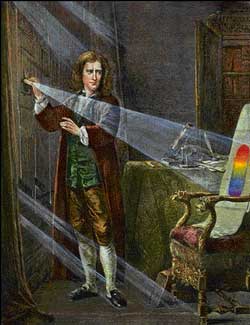
Isaac Newton investigates the refraction of light.
Like most such scoundrels, Chaloner made his share of mistakes, and one of them was to publicly claim that the heart of the nation’s counterfeiting problem was in the mint itself, and imply that Newton’s incompetence was partly to blame. Don’t knock the Rock. Newton went after Chaloner with a vengeance, spending hundreds of hours personally interrogating people who could help build a case against the fraud. Chaloner had been in and out of prison several times and had dodged the noose that was reserved for counterfeiters, whom British law regarded as traitors. In Newton, he had met his match and – ultimately – his maker.
“Newton and the Counterfeiter,” both informative and entertaining, was written by Thomas Levenson, who is a professor of science writing at MIT.
A topic that Levenson discusses throughout this book – in fact, it’s an important thread that runs through all of Newton’s activities – is Newton’s search for contact with God. In fact, Levenson reports that religious matters became the preoccupation of Newton’s life when he had put most scientific inquiry behind him. I discussed that aspect of the book in a column in the Catholic Spirit, and it’s available at THIS LINK.
Netflix Update No. 28: “The Island on Bird Street”
February 1, 2010
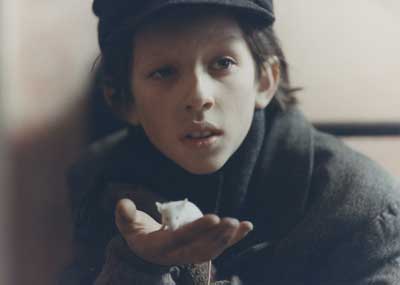
JORDAN KIZIUK
We watched a 1997 Danish film, “The Island on Bird Street,” which tells of an 11-year-old boy’s attempt to survive while the Nazis are emptying out a Jewish ghetto in Poland and sending its inhabitants to the death camps.
This film is based on what I have seen described as a “semi-autobiographical” novel by Israeli writer Uri Orlev, a Holocaust survivor who has specialized in children’s literature. Although the violence in this film is understated compared to many films about Nazi brutality, it’s not a film for young children. Teenagers wouldn’t flinch.
The story line is that the boy, Alex (Jordan Kiziuk), his father, Stefan (Patrick Bergin) and uncle Baroch (Jack Warden), are among the Polish Jews who are confined to a neighborhood fenced off by the Nazis — much like the Warsaw Ghetto where Orlev was confined as a child. When Stefan and Baroch are swept up in one of the Nazis’ “selections” for transport to a concentration camp, they conspire to let Alex escape the transport. Before the boy runs off, Stefan promises that he will return to the ghetto, and the boy takes that promise seriously.

JACK WARDEN
Alex — who reads “Robinson Crusoe” and plays with his white mouse, Snow — manages through a combination of guile and luck to avoid detection while he dodges the German troops who are gradually emptying the ghetto. The boy encounters some other stragglers, including a few men who are involved in the Polish underground. He eventually begins to slip out of the ghetto into the city at large, but always returns to wait for his father.
Jordan Kiziuk, a British actor who won an Emmy in 1999, delivers a convincing performance as Alex. Most of the film is quite tense as Alex has one close call after another, and Kiziuk has a lot of the burden of sustaining it. In fact, he’s at the center of the drama to such a degree that the other players are largely accessories.
As credible as Kiziuk is in his role, the story itself strains credulity, especially given the persistence of the Nazis in tracking down every straggler in the ghetto. There is also a contradiction in his sometimes elaborate ingenuity and his naive faith that his father will somehow survive the brutality the boy has witnessed again and again. The film ends with Alex still in the ghetto, and a title reports simply that he “survived the war.” In actual fact, Orlev was eventually caught by the Nazis after he was left behind in the ghetto and was sent to the Bergen-Belsen concentration camp where he remained until it was liberated.

PATRICK BERGIN
This film is visually very dramatic. The location in Poland presents a bleak image of the ghetto that provides an effective setting for the Nazis’ disregard for human dignity, never mind human life. The direction and photography contributed to the considerable attention and critical approval the film received when it was released.
Netflix Update No. 27: “Jakob the Liar”
January 27, 2010
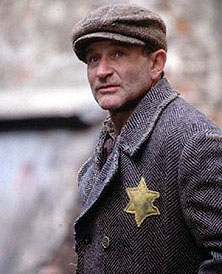
ROBIN WILLIAMS
We watched “Jakob the Liar,” a 1999 film starring its executive producer, Robin Williams.
In this story based on Jurek Becker’s novel, Williams plays the title role, a man confined to a Jewish ghetto in Poland during World War II. Jakob is summoned to the commandancy of the ghetto for being in the street after curfew, and while he is in an SS officer’s quarters, he hears a radio news report to the effect that the Red Army is advancing in the vicinity of the ghetto.
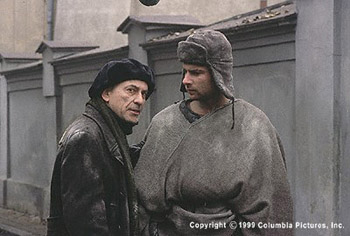
Alan Arkin and Liev Schreiber
When Jakob gives this information to his fellow inmate, Mischa (Liev Schreiber), Mischa draws the conclusion that Jakob himself has a radio — an offense punishable by death in the ghetto. Mischa shares his suspicion with others and soon the story is all over the ghetto, and nothing Jakob can say will put it to rest. The inmates beg him for more promising news, and he finally decides to lift their spirits by making up more “news” about the impending end of the war.

HANNAH GORDON
Jakob’s position becomes increasingly precarious, and it isn’t helped any by the fact that he is sheltering a young girl (Hannah Taylor-Gordon) who avoided boarding the transport that carried her parents to a death camp.
Given the fact that this movie features Williams in a dramatic role, includes fine actors such as Bob Balaban and Alan Arkin, and deals with this particular historical epoch, we expected to like it. We found, however, that the sum of the parts leaves the whole lacking.
The film is tedious and in some particulars implausible — for example, a scene in which Jakob defies and even intimidates an SS officer who, under real circumstances, would have shot him on the spot. And while Roberto Benigni proved that humor could be mixed into a serious Holocaust story, this film doesn’t strike the delicate balance between the two that the Italian movie achieved.
“You’ve been more than a daddy to me” — Henry Burr
September 4, 2009

BRIGITTA JACOB-ENGELKEN
The BBC marked the anniversary of Britain’s declaration of war on Nazi Germany with a story about the last survivor of the bunker in which Adolph Hitler killed himself.
The survivor is Rochus Misch, 92, a resident of Berlin, who was an SS officer serving as a body guard, a telephone operator, and a messenger. The report included an interview with Misch’s daughter, Brigitta Jacob-Engelken, who recalls the day in 1953 when her father returned from the gulag where the Soviets had confined him after the Red Army invaded Berlin. The homecoming was joyful, but father and daughter didn’t get along.
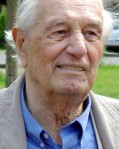
ROCHUS MISCH
Their relationship wasn’t improved when Brigitta’s maternal grandmother informed her that her mother — Misch’s wife — had been Jewish, something Misch refused to accept.
Brigitta accepted it, learned Hebrew, spent time on a kibbutz, and used her architectural talents to help restore synagogues in Germany.
She says she doesn’t hold her father’s wartime role against him, because the work he did was “harmless.” “Harmless,” of course, was a relative term during the Nazi era. Compared to ordering and carrying out the deaths of tens of millions of defenseless people, protecting the life of the worst dictator in history may seem mild.
Misch didn’t talk about his place in Hitler’s inner circle for many years, but now he discusses it freely — including his first view of the bodies of Hitler and Eva Braun.
The BBC stories are at this link:
http://news.bbc.co.uk/2/hi/europe/8237708.stm
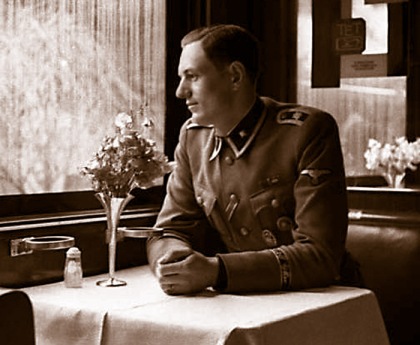
ROCHUS MISCH DURING THE WAR
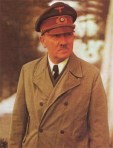
ADOLF HITLER
While we have been absorbed in the death of Michael Jackson and the whatever-you-call-it of Sarah Palin, Bernie Ecclestone has been telling what a swell guy Adolf Hitler was — and then sort of taking it back.
Ecclestone is the top man in Formula One. He was commenting recently about the seeming inability of governments to do anything to improve the economic condition of most of the world. Now Hitler, Ecclestone said, there was a guy who could get things done.
And that he could.
The remark attracted a predictable response. Ecclestone, describing himself as a “fool” for having said such a thing, took a second crack at it, writing in The Times of London:

BERNARD ECCLESTONE
During the 1930s Germany was facing an economic crisis but Hitler was able to rebuild the economy, building the autobahns and German industry. That was all I meant when I referred to him getting things done. I’m an admirer of good leadership, of politicians who stand by their convictions and tell the voters the truth. I’m not an admirer of dictators, who rule by terror.
Evidently Ecclestone was absent the day the teacher told how the German government, soon after Hitler took power in 1933, suspended civil rights including the writ of habeas corpus, suppressed the Communist party and other opposition organizations, and violently — sometimes to the point of murder — drove the Communists away. And Ecclestone might have dozed over that part of the history text that described how Hitler’s government, before turning the Fatherland into heaven on earth, got the legislature to pass an act that pushed aside inconvenient constitutional provisions and made the regime a legal dictatorship.
Every once in a while someone who hasn’t done his homework “discovers” how beneficial Hitler would have been for Germany if he hadn’t been the devil incarnate. These epiphanies always end the same way.

- MICHAEL JACKSON
When I learned last night that Michael Jackson had died, I was at a fair – kiddie rides, foot-long hot dogs, funnel cakes – in a town in Bergen County. I drove about an hour and half to get there — not for the hot dogs, which were fine, but to listen to Noise from the Basement, a band in which my son plays keyboard. I would do it again.
When I got home and checked my blog here on wordpress, I saw that traffic on my journal had already soared beyond the normal number of daily visits – by a factor of eight. This was caused by the death of Farrah Fawcett. Her passing apparently sent many people scurrying to a search engine, and some of their searches tripped over two entries I have made in the past couple of months complaining about the way some of the media and some of the public were reacting to her illness.
It might be fortuitous for Farrah Fawcett’s memory that she and Michael Jackson died almost simultaneously. Because of the complicated life that Jackson led, there is likely to be an endless stream of speculation about the nature of his death, and even some serious commentary on the meaning of his life.
I have to say that Michael Jackson meant nothing to me, one way or the other. I didn’t pay close attention to the coverage of his life, but I did see and hear enough to know that the difference between fact and fiction was difficult to discern. If the far more sedate lives of Charles Dodgson (Lewis Carroll) and Sir James Matthew Barrie are any example, some of the questions about Jackson’s behavior will never go away.
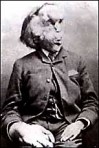
- JOSEPH MERRICK
One small issue in Jackson’s life that did get my attention was the report in 1987 that he had offered to buy the remains of Joseph Carey Merrick, known in popular culture as “John” Merrick, the “elephant man,” a 19th century Englishman who was severely deformed by a disease that has not been conclusively identified. I have spent far more time learning about Merrick than I have ever devoted to Michael Jackson, because I have been interested in Merrick’s determination to achieve some sort of human dignity despite a condition that, through no fault of his own, made it impossible for him to live in society. In fact, he had to be protected from the public. It’s worth noting that Dr. Frederick Treves, who was principally responsible for providing Merrick with a home at London Hospital, had misgivings about his own role in making Merrick something of a darling of British society, including the royal family.
My initial reaction when I heard that Jackson had tried to buy Merrick’s remains was disgust. I couldn’t imagine any legitimate purpose to such a thing, and I felt strongly that Jackson would be violating Merrick’s memory by removing what remains of him from the hospital that gave him the only true sanctuary he ever knew. Although there have been many public reports that Jackson did, indeed, acquire Merrick’s “bones,” my reading indicates that it never happened. Some have claimed that Jackson himself deliberately spread that rumor after having viewed the remains in London, but I haven’t found any substantiation of that idea. The bizarre tones and the uncertainty of this bit of Jackson’s history or legend is a microcosm of the odd and often mysterious biography that will be written and re-written for years to come.
Peter Conrad wrote an interesting essay in The Guardian about Michael Jackson in anticipation of Jackson’s appearance in London next month. It’s at http://www.guardian.co.uk/music/2009/jun/14/michael-jackson
Tammy Paolino — the name is no coincidence — also wrote an insightful piece about the impact of Jackson’s death. It’s at http://blogs.courierpostonline.com/mamadrama/ in an entry dated June 26.

JACK SCANLON
We watched “The Boy in the Striped Pajamas,” a 2008 film based on John Boyne’s novel for young adults.
This movie is most effective at portraying people who can rationalize almost any behavior on the grounds that it is their duty to some entity that they perceive as being larger and more important than any individual. One doesn’t have to look too far to find places to apply this model.
The story has to do with an eight-year-old boy, Bruno, played by Asa Butterfield, whose father is a highly placed officer in the German army during World War II. The boy and his teenaged sister admire their father’s stature without thinking about the nature of the regime that gave it to him. As the movie opens, the father, played by David Thewlis, informs his family that he has a new assignment that will force them to leave their opulent house in Berlin and move to “the country.” The “country” home turns out to be a stark mansion located within eyeshot of a concentration camp – a fact the father tries to hide from his children, and particularly Bruno.

ASA BUTTERFIELD
But Bruno, being an eight-year-old boy with fantasies about exploring, is curious about what he thinks is a farm beyond the barbed-wire fence he first sees from the window of his room. Disregarding his mother’s instructions, he wanders through the woods until he reaches the fence, and there he makes friends with one of the inmates, Shmuel. Shmuel, also eight years old, disabuses Bruno of the idea that the camp is a farm, but Shmuel does not understand why he and his family are in the camp or why some of his relatives go off with “work crews” and never return. What Bruno does gradually learn is that he is supposed to hate Jews, but that Shmuel, a Jew, does not seem to him an enemy. One can’t discuss the outcome of their friendship without spoiling the experience of seeing this film for the first time.

DAVID THEWLIS
Appreciating this film requires some suspension of credibility. We are to believe, for example, that Bruno’s mother does not know until she has moved to “the country” and lived there for some time exactly what takes place in the camp her husband oversees – that Jews and presumably others who were distasteful to the Nazis are gassed and their bodies incinerated. We are also to believe that Bruno and Shmuel can carry on a friendship through the camp fence, meeting there daily in broad daylight, even playing checkers, without being discovered.
Despite those issues, this movie delivers its message with a wallop. Thewlis, and Vera Farmiga as the mother, give chilling portrayals of the impact Naziism had on the inner selves of individual men and women. Both boys are also very effective in their roles; Jack Scanlon is a heartbreaker.

RONALD REAGAN
Pretty soon, Americans visiting London will be able to stop by to see how Ronald Reagan is making out on his pedestal. An ten-foot bronze statue of the fortieth president of these United States will be erected on a six-foot stone plinth outside the United States Embassy in London. To make this possible, local authorities had to set aside a policy under which a person must be dead for ten years before being memorialized with a statue. Apparently there is a strain of skepticism in the British, but for this purpose they’re willing to concede that Reagan is not only merely dead, but—in the words of the Coroner of Oz—really most sincerely dead. At the very least, Reagan will provide some company for Dwight Eisenhower, whose effigy stands nearby.

THE CORONER
This is the work of disciples of former Prime Minister Margaret Thatcher, who simplified modern world history for generations of students by declaring that Reagan had single-handedly toppled the Soviet Union. U.S. Ambassador Robert Tuttle, who was George W. Bush’s appointee, was said to have enthusiastically supported the idea before he left office in January, turning the embassy over to a diplomatic staff of the Obama stripe. When the current personnel were asked what would happen to Dutch when the embassy is removed to new quarters south of the Thames, they replied that they didn’t know, because “it isn’t our statue.”
There is no unanimity among the British about this development. David Boothroyd, a Labour member of the local committee that waived the “sincerely dead” rule, voted in the affirmative, remarking that “you have to set aside your personal politics when you have a person of global importance like Ronald Reagan.” A little further to the left, the Green party chair of the local committee said, “What a ridiculous person to put on top of a monument. … It would be the same as putting up a statue of Arnold Schwarzenegger. Will they do that next?”

VLADIMIR LENIN
I’m not clear on this point: Was Rochelle of “Rochelle, Rochelle” a native of Milan who happened to have relatives in Minsk, or was she a native of Minsk who had emigrated to Milan? While we’re pondering that question, there is one native of Ulyanovsk – Simbirsk to you old timers – who may be making his own trek to the capital of Belarus that became a household word thanks to Larry David and Jerry Seinfeld.
Pravda is reporting that Vladimir Lenin’s mummified body may be removed from its tomb in Red Square and taken to Minsk, where it will be buried – perhaps no longer placed on public display in a crystal casket. As I mentioned here previously, Lenin – whom Pravda describes as the “leader of the world’s working class” – has already suffered the indignity of wearing the same suit for three years, and he’s not in line for a new one ITE – “in this economy.” Now, it appears from the Pravda report, the Russian government – which seems to only half-heartedly revere the old Bolshevik – may soon dispatch him to the republic from which he sprung – and the government of Belarus has said it would be glad to have him. In fact, a monument reminiscent of the tomb in Red Square is likely to be built to receive him.

ALEXANDER LUKASHENKO
The issue of actually burying the Hero of the Proletariat apparently is controversial: the Russian Orthodox Church, for instance, would like him out of sight and out of mind, but the president of Belarus, Alexander Lukashenko, says burying Lenin would be a crime. According to Pravda, there’s a strong nostalgia in Belarus for the glory days of the Soviet Union – no doubt among folks with medium-term memory disorder.
 CharlesPaolino's Blog