Books: “Eva Braun: Life with Hitler”
December 29, 2011
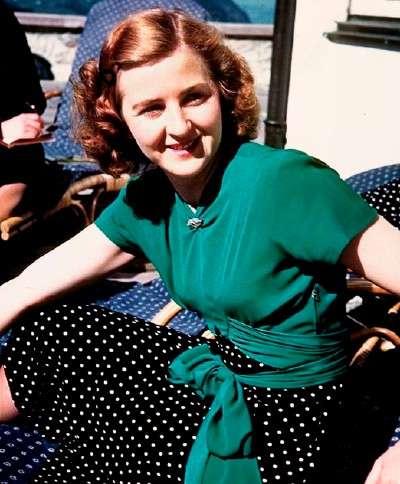 Chelsea, an aspiring actress, tells Cosmo Kramer during an episode of the TV series Seinfeld that her manager is “trying to put together a miniseries for me on Eva Braun. I mean think about it, is that a great idea? We know nothing about Eva Braun, only that she was Hitler’s girlfriend. . . . What was it like having sex with Adolf Hitler? What do you wear in a bunker? What did her parents think of Hitler as a potential son-in-law? I mean it could just go on and on….”
It could and it will, because while it isn’t true that we know nothing about Eva Braun, it is true that we know relatively little, considering that she was the consort of one of the most recognizable and most reviled men in human history.
Heike B. Görtemaker, tries to bring some clarity to this subject in Eva Braun: Life with Hitler, which was originally published in German. The very things that have made Braun an obscure figure up to now were obstacles to the author’s work, beginning with the fact that Hitler wanted to be perceived as a solitary messiah whose life and energy were devoted to lifting Germany and its people from the ignominious consequences of World War I.
 In order to maintain his image, Hitler kept the very existence of Eva Braun a secret from the German people, and he kept her at least at arm’s length and often much farther when they were in the company of his inner circle. Hitler married Braun on the day before they both committed suicide in a bunker in April 1945 while the Red Army was literally striding through the Reichstag grounds about 25 feet above their heads. He once said that he had never married because he needed the political support of German women and that he would lose some of his appeal if he had a wife. “It’s the same with a movie actor,” Hitler said. “When he marries he loses a certain something from the women who adore him. Then he is no longer their idol as he was before.”
When I read that in Görtemaker’s book, I wondered what “certain something” Hitler had that would attract any woman, never mind millions of them. Evidently the author wonders about that, too. When she writes that Braun’s life was shaped by Hitler’s power, his world view, and his “charismatic attraction,” she adds parenthetically, “however difficult it may be to explain what that consisted in.”
 Görtemaker is convinced that neither Braun nor the other women around Hitler — principally the wives of men like Albert Speer and Joseph Goebbels — were simply adornments who were expected to be seen but not heard. On the other hand, the author finds it impossible to say definitively how much Braun and the others knew about German policy, and particularly about the Holocaust. They had to know of the persecution of Jews in Europe; it was no secret. But discussion of the extermination program in Hitler’s presence was forbidden when he was in his “family circle,” as it were, meaning the crowd that frequented Berghof, Hitler’s frequent refuge in Bavaria.
 Hitler met Braun in 1929 when he was 40 and she was 17 and working as an assistant to Dietrich Hoffmann who became the privileged official photographer of the Nazi party and the Third Reich. Görtemaker speculates that the couple were not intimate until 1933 when Braun had become an adult . At first they saw each other only intermittently, and this apparently weighed on Braun and was the cause of two suicide attempts. After the second incident, Hitler arranged for Braun to have her own home in Munich and to have regular access to Berghof, where her assertion of her prerogatives irritated some of Hitler’s coterie.
Whatever attracted Braun to Hitler in the first place, long before it was clear that he would lead the German nation, her commitment to him was complete. Görtemaker writes that the level of her loyalty was the object of admiration to at least some of Hitler’s associates and it may have been the one thing that most endeared her to him. There’s no evidence that she pressured him to marry her or that she complained about being kept out of the public eye. And, in the most dramatic possible demonstration of her constancy, however misguided, she went to Berlin against Hitler’s wishes with the clear intention of dying with him while many others, including Speer and Hoffmann, were already concocting lies about being “outsiders” in Hitler’s camp. The normal confidentiality of the culture in which Hitler lived, coupled with the loss and destruction of written records and the unreliability of later testimony by turncoats trying to save their own hides and reputation may mean that we’ll never know more about Eva Braun than Görtemaker has been able to tell us in this book. That’s unfortunate, not because Braun was so different from others who supported Hitler, but because she was so like them. She was in all respects an ordinary person who came under the still elusive spell of a bumbling, absurd little man who terrorized the world for more than a decade
Books: “1493”
December 17, 2011

aka CHRISTOPHER COLUMBUS
One of my chores at Paolino’s Market when I was a kid was to open up fifty-pound bags of potatoes and divide the spuds into ten- and five-pound bags. “Packing potatoes,” as we called it, was a frequent part of the routine in our store, and that was appropriate in its way, because what could be more routine than a potato — one of the most plain, most simple, and least consequential of vegetables.
Or so I thought until I read 1493 by Charles C. Mann, author of 1491.
In this substantial and exhaustively researched volume, Mann describes the impact of the voyages of Christopher Columbus, whom he calls Cristóbal Colón, the name the explorer answered to in Spain. Overall, Mann explains, the impact of those voyages was to globalize life on earth, sending folks traveling to hemispheres they had perhaps only dreamed about and distributing other forms of life, ranging from mosquitoes to horses, from tobacco plants to rubber trees, to spots where they had never existed before — a phenomenon known as the Columbian Exchange. Simultaneously, languages and cultural traditions and man-made products were scattered across the planet. So were doleful phenomena such as malaria and potato blight.

The process that Columbus launched, and personally participated on his first trips across the Atlantic Ocean and back, is so complex and far-reaching, as Mann describes it, that I can’t adequately summarize it here. But the potato is a good example of the upheaval Columbus touched off.
Little did I know last June, when I was watching my cousins hoeing potatoes in their massive garden in Il Valle di Sessa Cilento, that potatoes, which were first domesticated in the Andes, weren’t exported to Europe in quantity until the second half of the 16th century, when some species of them were being cultivated in the Canary Islands and shipped off to the mainland.
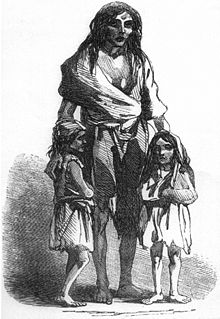
Irish mother and her children during the potato famine in 1849
The consequences of this, Mann writes, were enormous for a continent that was accustomed to frequent food shortages. In fact:
“Many scholars believe that the introduction of S. tuberosum to Europe was a key moment in history. This is because their widespread consumption largely coincided with the end of famine in northern Europe. (Maize, another American crop, played a similar but smaller role in southern Europe.) More than that, the celebrated historian William H. McNeill has argued, S. tuberosum led to empire: ‘[P]otatoes, by feeding rapidly growing populations, permitted a handful of European nations to assert dominion over most of the world between 1750 and 1950.’ Hunger’s end helped create the political stability that allowed European nations to take advantage of American silver. The potato fueled the rise of the West.”
There is much, much more just to the potato story, including the fact that a blight that also originated in the Andes migrated first to North America and then to Europe in the mid 19th century, causing almost incomprehensible hunger and illness, especially but not solely in Ireland.
Mann discusses the potato itself and its geographical history in minute detail, and he does the same with a broad range of subjects including slavery, the mixing of races in the “new world,” and the impact of world economies — most notably that of China — of the Spanish trade of silver from South America. His discussions frequently extend down to the present day, and this book in general is a valuable aid in understanding how the world evolved from the 15th century to the 21st.
Books: “Sleeping with the Enemy”
November 10, 2011
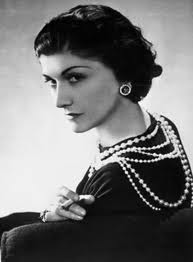 I don’t know if this is true, but I have read in several places that the government of France reports that Chanel No. 5 perfume sells at the rate of one vial every 30 seconds. By my calculation, that means 2,880 vials a day. Sephora gets $85 for 1.7 ounces and $115 for 3.4 ounces, so we’re talking about something like $100 million a year. Besides being such a hot commodity, this perfume is a monument to the woman who introduced it in 1921, the fashion designer Gabrielle “Coco” Chanel.
Chanel — the designer, not the perfume — is the subject of Sleeping with the Enemy: Coco Chanel’s Secret War, written by Hal Vaughan, who portrays her as a virulent anti-Semite who not only accommodated herself to the Nazi invasion of France but actually became a Nazi undercover agent.
When Chanel was 12, her mother had died and her father had left. She spent six years in the custody of Cistercian nuns and then stepped out into the world where she quickly progressed from cabaret singer and courtesan to fashion powerhouse. Her impact on style was enormous; her trade marks were jersey sportswear and the “little black dress” that made a lasting statement about the realtionship between simplicity and elegance.

When Germany invaded France in 1940, Chanel moved to the Ritz and accepted the occupation as the new normal. In fact, she took an influential German officer as one of her many lovers – and she continued to make millions. But Vaughn maintains that documents from that period show that Chanel did more than accept the reality of the Nazi presence, that she actually became an agent of the Abwehr intelligence agency and undertook secret missions in Berlin and Madrid. The book includes a copy of a document that seems to show that Chanel was designated Agent F-7124.
Significantly, Chanel, who was comfortable living in opulence in Paris while her countrymen suffered under the Nazi regime moved to neutral Switzerland for a while after the Third Reich collapsed. Vaughan points out that that move may have saved her from the fate of French collaborators who were publicly shamed, imprisoned or executed. Chanel was briefly arrested by the Free French, but she emerged from the war largely unscathed.
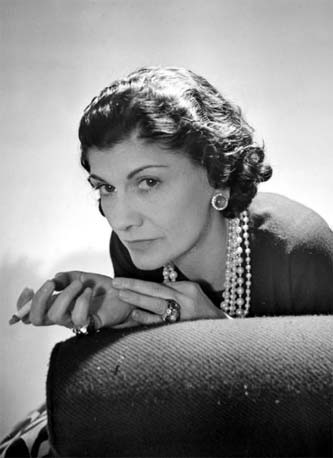
She returned to Paris in 1955 and resumed her career, getting a better reception in the United States than in France.
Vaughn portrays Chanel as anti-Semitic and speculates, without demonstrating it, that her antipathy toward Jews might have been instilled by her contact with the Catholic Church. He also reports in detail that after the initial success of the iconic perfume, Chanel transferred control of it to a Jewish family, the Wertheimers, in a deal that guaranteed her an annual return. Although she later tried unsuccessfully to get the franchise away from the family, and did negotiate a more favorable arrangement for herself, the Wertheimers still are the purveyors of Chanel No. 5.
Chanel was apolitical, and she actually fled Paris for a while in the uncertain aftermath of the invasion. There is nothing in Vaughn’s account to suggest that she was interested in the Nazis’ ambitions. Instead, it’s clear that her top priority was to continue her lavish, drug-ridden life. She also had a personal interest in staying on speaking terms with the Germans, because her nephew was a prisoner of war. She did everything she could until she got him released; in fact, Vaughan maintains that she was enticed to work for the Abwher in the first place because she thought her contacts could help her nephew.
Chanel had many liaisons with rich and powerful men, some of whom helped finance her career, but she never married, explaining that she “never wanted to weigh more heavily on a man than a bird.” An interesting aspect of the story as Vaughn tells it is that, despite her relationship with the Germans, she had many close friends in Great Britain, including Winston Churchill.
Books: “The Man who Broke Into Auschwitz”
August 26, 2011

DENIS AVEY/BBC photo
The title of the book is misleading. Denis Avey, a British soldier during World War II, didn’t break into Auschwitz. He was a POW there, so he was already within the walls, as it were. He and the other inmates had been put to work building an enormous industrial plant in which a German company planned to manufacture synthetic rubber and methanol. From the first, Avey was deeply disturbed by the condition of the Jewish prisoners – the “stripeys” he called them because of their pajama-like uniforms. He was so distressed in fact, that he became obsessed with the need to see for himself the section of the Auschwitz complex where the Jewish inmates lived. If he survived the prison himself, Avey wanted to be a witness.

AVEY with Prime Minister GORDON BROWN/BBC
So compelling was this need in Avey’s mind that on two occasions he swapped clothing with a Jewish inmate and shuffled off with the other Jewish prisoners at the end of the work day. What he found was at least as bad as he had imagined.
That part of Avey’s story is recounted in “The Man who Broke into Auschwitz,” which he co-wrote with Rob Broomby, a BBC reporter who worked very hard to help Avey reconstruct the experience 60 years after the fact.
Before he was sent to Auschwitz, Avey had seen plenty of combat in North Africa. He was part of the force that first drove the Italian army out of Egypt and across Libya and then went on the defensive when Erwin Rommel brought his Afrika Korps into the fray and reversed the tide of battle for a time.

ERWIN ROMMEL
Avey, who explains that he went to war in the first place for adventure, not for King and country, was a brash sort whose chutzpah both got him into scrapes and enabled him to survive on both the battlefield and in prison. Once he was captured, he escaped several times including one final time during a forced march eastward in the dead of winter when the Nazis abandoned Auschwitz in order to elude the advancing allies.
On one occasion, Avey watched while an SS officer repeatedly beat a Jewish inmate until the young man died. Avey was already frustrated by both the fact that the Nazis were deliberately working the Jews to death and by the knowledge that he couldn’t do anything about it. When that young man died, Avey shouted a crude German insult at the officer, who responded by cold cocking Avey with the butt of a hand gun. The injury cost Avey his sight and eventually the eye itself.
But the worst injury he suffered was psychological. When he finally returned home, his own family – including his father, who had also enlisted – didn’t want to discuss the war at all, and others wanted to hear only about derring-do on the battlefield. No one was interested in, or capable of confronting, the truth about the concentration camp.
 Avey himself stopped talking about it for decades, and he suffered nightmares and other signs of post traumatic stress disorder – a problem that was not recognized and therefore not treated at the time.
There is much more to this story, including the unexpected outcome of a small favor Avey was able to do for one Jewish inmate, but that’s best read in the pages of Avey’s book. It was largely because of Broomby’s work that Avey was eventually able to talk openly, and write, about what he experienced. The two men have performed an important service, because it is critical that knowledge of what the Nazis did be kept alive in the public consciousness.
That’s true both because of the crimes committed by the Third Reich and its collaborators but also because such atrocities have been committed again and again since then – the difference being only one of scale.

Books: “The Abacus and the Cross”
July 29, 2011
CHRISTOPHER COLUMBUS
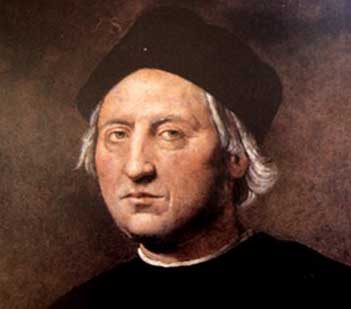
In a post last December, I mentioned in passing the widely held fiction that when Christopher Columbus set off on his first voyage, many if not most Europeans thought he would sail his ship off the edge of a flat earth and into oblivion. I was taught this in elementary school, and I have spoken to many people my age who remember being taught the same thing. More recently, I questioned my college students about this, and many of them said they had the same impression about Columbus.
The fact is that it was common knowledge among Columbus’ contemporaries in Europe that the world was round — a point that Nancy Marie Brown makes in her book, The Abacus and the Cross.
This book is not about Columbus; it’s about Gerbert of Aurillac, a French monk who lived in the 10th century. Gerbert had a thirst for knowledge and he became thoroughly schooled in the humanities and in the sciences.

GERBERT of AURILLAC
His scholarship carried him to Spain, where he came in contact with a thriving Arab Muslim culture which had preserved enormous amounts of philosophical and scientific knowledge that had been lost to Europe. Gerbert seems to have had both the curiosity and the capacity of a Leonardo or Michelangelo, and he devoured as much learning as he could. He was engrossed in both mathematics and in music, for example, and in the relationship between the two disciplines. He scrutinized the properties of organ pipes, and he eventually designed a built a prototypical organ that was not driven by water — the common technique of his time — but by forced air.
He didn’t only strive to satisfy his own curiosity. He was an influential teacher whose students included royalty. In the process of carrying out this vocation he introduced Europe to the place system of arithmetic — vertical rows for the ones, tens, hundreds, and so forth — which was much more efficient than the clumsy Roman system and which the western world has been using ever since. In this connection, he also carried back from Spain numerals that had originated in India and that had been adapted by the Muslims — the forerunners of the so-called Arabic numbers we use today. As the title of the book suggests, he learned in Spain to use an abacus board to calculate, and he later designed his own versions and taught others how to use them.
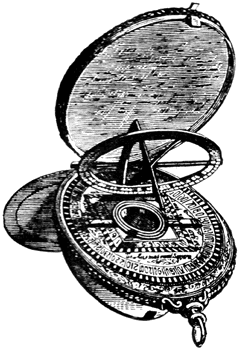
AN ASTROLABE
Also among Gerbert’s interests was astronomy. He learned all about astrolabes, overlaid disks that were used to trace the positions of the sun and the moon and the stars and the planets — and tell time — and about celestial globes, which were three dimensional representations of the apparent paths of the heavenly bodies. He made his own models of these instruments, too, sometimes taking as much as a year to finish one.
As Brown points out, it is clear not only that Gerber, in the 10th century, knew that the world was round, but that Pythagoras determined that around 530 BC, and Erastosthenes figured out how to calculate the circumference of the globe by 240 BC. Some flat-earthers persisted, but by the time of Columbus the point was moot in western Europe. Columbus knew the world was round; his mistake was in underestimating the circumference.
Being a churchman in that era, and one who enjoyed consorting with powerful people, Gerbert inevitably got drawn into the constant political turmoil in Europe, and his fortunes rose and fell along with those of his patrons.
He almost ended on a high note when he was elected Pope Sylvester II in 999 AD.
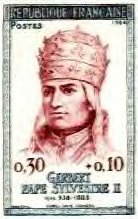
SYLVESTER on FRENCH STAMP
Even that didn’t turn out so well, because he had to flee Rome for a while along with his patron of the moment, the Holy Roman Emperor Otto III. Sylvester died in 1003.
During his lifetime and for a long time after his death he was the subject of rumors that he consorted with the devil or engaged in sorcery. Ironically, this was because of his pursuit of knowledge in astronomy and mathematics, which in some ignorant minds were associated with the occult.
Books: “The Great Fire of Rome”
December 27, 2010
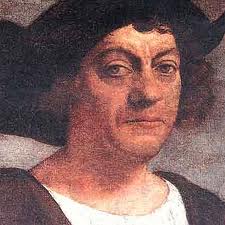
CHRISTOPHER COLUMBUS
When I was a kid, I was led to believe by adults, who I assume meant well, that his contemporaries discouraged Christopher Columbus from undertaking his first voyage to “the Indies” on the grounds that he and his ships would drop off the edge of a flat earth. I didn’t imagine this. I have asked at least a dozen folks of my vintage — which grows increasingly rare, by the way — and they have recalled being told the same thing, even by teachers. I was well into middle age when I learned that the Europeans Columbus was likely to have encountered knew that the Earth was a sphere, and that the argument current at the time had to do with the planet’s size, not its shape. I now know that the idea of a spherical Earth, dates from the sixth century BC, although it wasn’t until much later that there was practical proof of what had been generally accepted as the fact. Columbus was one who helped to demonstrate it. The Admiral of the Ocean Sea, it turns out, wasn’t wrong about the globe; he was simply wrong about its dimensions.

NERO
It wasn’t until more recently — the past few weeks, in fact — that I learned the truth about the Roman emperor Nero, namely that he couldn’t have fiddled while Rome burned, because the violin didn’t appear in Europe until hundreds of years after his death. That came up in a new biography of Nero written by Stephen Dando-Collins, who also casts doubt on the widely accepted ideas that Nero ordered the burning of Rome in 64 AD and that he initiated the Roman persecution of Christians in order to deflect blame for the fire from himself. (The writer points out that there were so few Christians in Rome during Nero’s reign that it’s even likely that the emperor knew nothing about them.)
Nero was 16 years old when he succeeded his uncle Claudius, becoming the fifth Roman emperor and the last who shared a bloodline with Julius Caesar. Among his interests were singing and chariot racing, and he wasn’t content just to be a spectator of either. Dando-Collins explains that Nero repeatedly entered amateur singing contests, which were all the rage at the time, much to the enjoyment of the hoi polloi and much to the dismay of the Roman nobility.
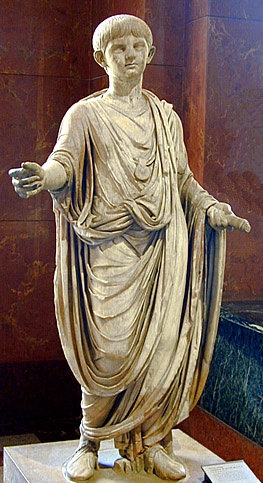
Nero: The boy emperor
Besides sponsoring and reveling in races, he also took the reins at times, once narrowly missing death when he was thrown from the chariot. He first entered a singing competition in Neapolis, what is now Naples. On the occasion of the fire in Rome, he was in his birthplace, Antium — present day Anzio — to participate in another contest. The fire evidently started in the food concessions under the stands of the Circus Maximus, which was the largest wooden structure of any kind and the largest sports arena ever built. The capacity was about 300,000 spectators.
Rumors that Nero was responsible for the fire and that he had ordered his agents to impede the firefighting — such as it was — began while the city was still in flames. The rumors were the results of a complex of jealousies and intrigues that were common to life in the corridors of Roman power. They were encouraged, ironically, by Nero’s seemingly efficient response to the fire, which some said he caused so he could remake the city in his own image. He did build an enormous new residence for himself, but he also rebuilt the devastated part of the city with broader streets and a better water supply and — of all things — building codes to prevent some of the shoddy construction that had contributed to the losses in the fire.

AGRIPPINA
Nero did a great deal to assist those whose homes and belongings were wiped out in the fire, but he was no angel. He irritated powerful people with what they considered his coarse behavior — including his bi-sexual adventures — and with his choices for appointments, favoring freedmen to blue bloods. He led the kind of uneasy life that went with being emperor of Rome, and his insecurities — some of them well founded — resulted in the suicides and executions of many a noble figure, not the least of whom were his mother, Agrippina the Younger, and his stepbrother. Dando-Collins describes in some detail the political dynamics and the bloody outcomes that both solidified Nero’s power and eventually led to his own downfall a few years after the fire, when he was only 30 years old.
Many of us, who have no reason to be students of ancient Roman history, carry around a cartoonish notion of Nero as a crazy tyrant. But while Dando-Collins doesn’t try to disguise the extreme measures the emperor would take to keep himself on the throne — and his head on his shoulders — the writer does present Nero in context. He points out that contemporary accounts of Nero’s life were written in most cases by men who disliked him, that his manner of dealing with political enemies and criminals was not out of line with the practices of the time — in fact, was more lenient — and that he was remarkably patient with people who ridiculed him. The author also regards Nero as a “visionary” with respect to public works and points out that the empire was prosperous under his administration — at least until he started collecting and spending money to rebuild the ruined capital.
As much as we’d like to know the whole truth about people like Nero, they make history more interesting in their own way by flitting in and out of the shadows.
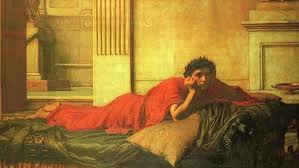
Nero agonizes over the death of his mother, whose constant interference caused the emperor to order her execution. Painting by John William Waterhouse
Trade in that phaser, Capt. Kirk
July 2, 2010
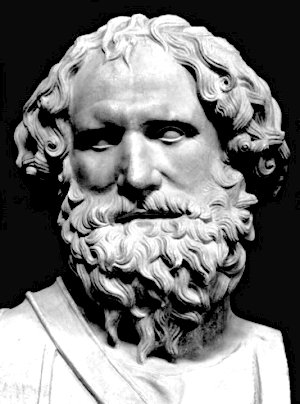
ARCHIMEDES
When it comes to killing each other, we humans owe ourselves credit for ingenuity. Long before the Christian era, we were designing elaborate and effective instruments of mayhem — although it turns out that the “flaming death ray” attributed to Archimedes wasn’t one of them. I learned about that this week in a story in the Christian Science Monitor. Although that story was about something that Archimedes did not accomplish, it still left me impressed yet again with the genius of people in what to us are ancient times.
Archimedes was born around 287 BC in Siracusa (Syracuse), Sicily, which was a Greek colony at the time. In terms of intellect, he was in the same category as Leonardo, Newton, and Einstein, and he did groundbreaking work in mathematics, astronomy, physics and engineering. Like many of the ancients, Archimedes is the subject of some stories that are either only partly true, possibly true but undocumented, or simply false.
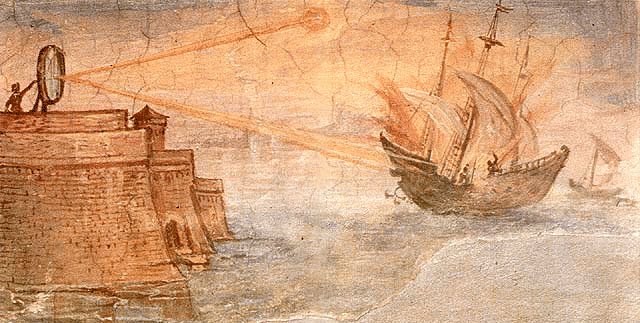
Archimedes' "death ray" directed at a Roman ship
According to one tale, apparently first known in the Middle Ages, Archimedes designed a system in which mirrors were used to direct concentrated beams of sunlight at Roman ships, causing them to catch fire. This supposedly occurred during a siege of Siracusa that lasted from 214 to 212 BC, the Second Punic War. Archimedes was killed by a Roman soldier in 212 during that siege.
The Monitor story reports on new findings that debunk the “death ray” story but propose an alternate explanation that, to my mind, is no less impressive.
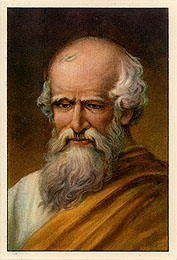
ARCHIMEDES
According to the CSM, studies done at the University of Naples have indicated that it is more likely that Archimedes used — are you ready for this? — steam cannons to fire at the Roman vessels:
“The steam cannons could have fired hollow balls made of clay and filled with something similar to an incendiary chemical mixture known as Greek fire in order to set Roman ships ablaze. A heated cannon barrel would have converted barely more than a tenth of a cup of water (30 grams) into enough steam to hurl the projectiles.”
The story cites some supporting authorities for this idea, including Leonardo Da Vinci, who spent a lot of his own time dreaming up horrible ways for people to kill each other in battle. (See my June 8 blog entry for more on Leonardo’s diabolical side.)
While I’m being a little flippant about this, I never tire of learning about the accomplishments of our forbears in the distant past. I was amused by the headline on the Monitor’s story, which said that Archimedes’ death rays were probably “just a cannon.” Just a cannon – two centuries before the birth of Jesus. Reading about people like Archimedes reminds me of the potential of the human mind — and of how much more I might accomplish with my own if I were to make the effort.
You can read the Monitor’s story by clicking HERE.
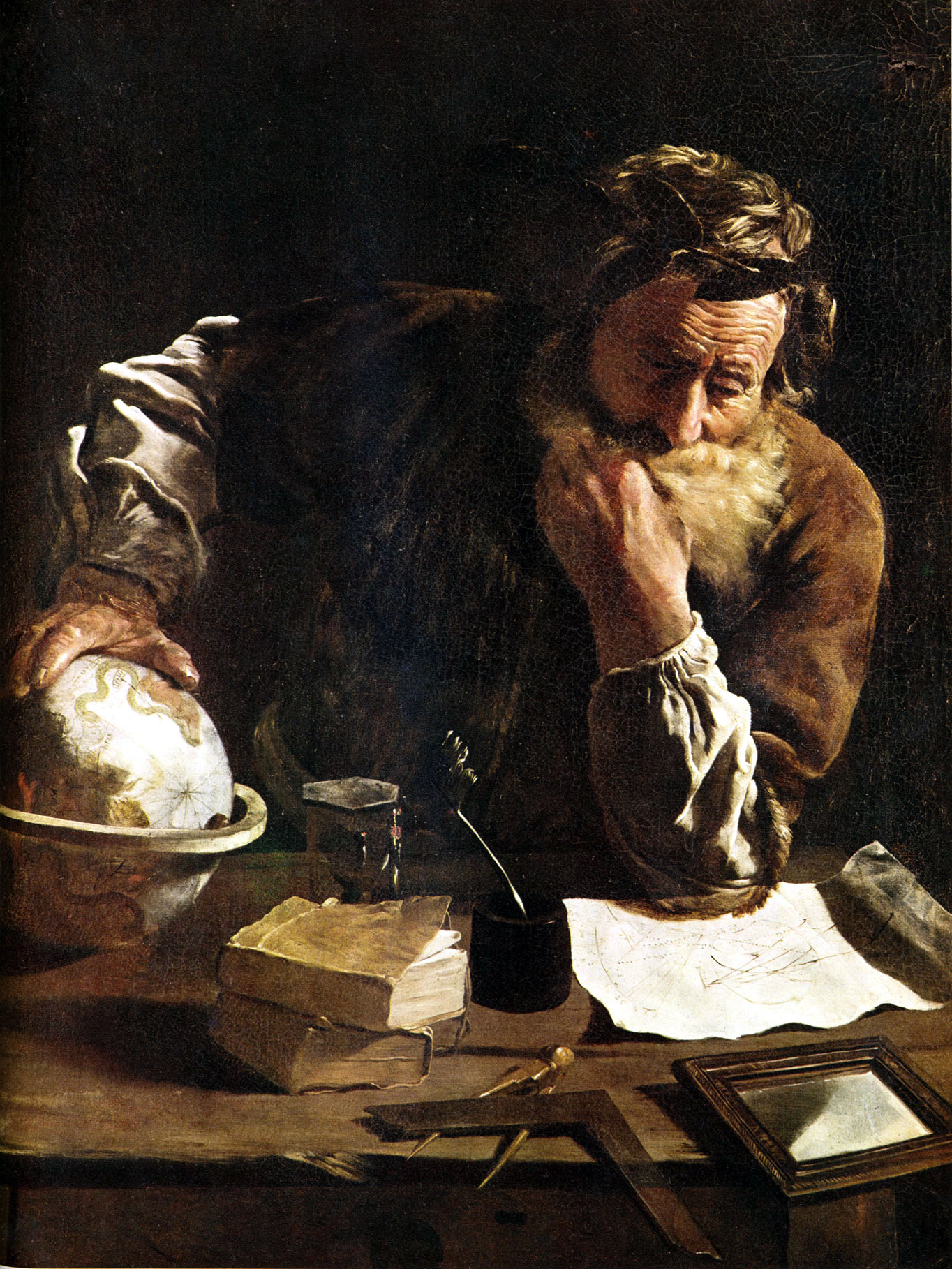
Portrait of Archimedes by Domenico Fetti (1620)
Books: “Leonardo’s Legacy”
June 8, 2010

Self portrait
By coincidence, I have read biographical works over the past several months about Isaac Newton, Albert Einstein, and Leonardo Da Vinci. In all three cases, the authors emphasized that these men were motivated by insatiable curiosities to question established “knowledge” and see beneath and beyond it.
The most recent of these books is “Leonardo’s Legacy” by European science writer Stefan Klein.
Although, Dan Brown aside, the mention of Leonardo may evoke in most people’s minds images of paintings and sculptures, Klein covers the broad range of Leonardo’s interests, from human anatomy to hydrodynamics.
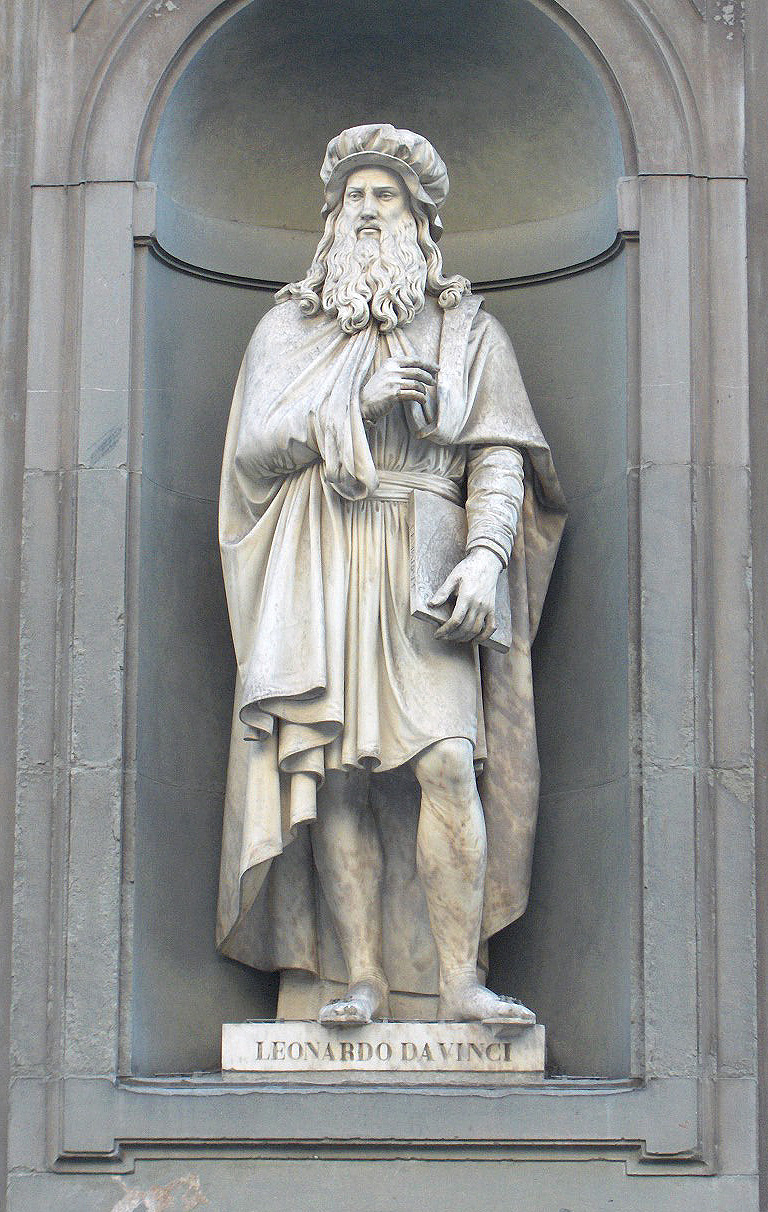
Statue of Leonardo, Uffizi, Florence
Klein doesn’t neglect the arts. In fact, I found his discussion of the Mona Lisa enlightening. I am a duffer when it comes to art, and I have never thought seriously about that painting – which appears in so many contexts that it has become a cliche. But Klein’s explanation, for instance, of Leonardo’s use of chiaroscuro to create a lifelike image helped me to look at the portrait with a new perspective. The same is true of the author’s explanation of the painter’s use of light and of the landscape that appears in the background.
Klein also pointed out that Leonardo, who had made careful studies of the muscles and nerves that control facial expressions, created the woman in the “Mona Lisa” with an asymmetrical face in which the emotions expressed on each side are not identical. Here, Leonardo seemed to be anticipating what is now understood about the left and right hemispheres of the brain controlling the right and left sides of the body, respectively. It was one of many examples of how Leonardo applied what he learned in one field to his work in another.

Portrait by Swedish artist Evald Hansen
Leonardo associated with some interesting Renaissance characters, including the philosopher Nicolo Machiavelli and the warlord Cesare Borgia. Leonardo hired himself out to men like Borgia in order to make a living, and he earned his keep by providing entertainment and by designing practical devices, including weapons. Klein makes a point of the apparent contradiction between Leonardo’s abhorrence of war and avowed respect for life and his willingness to imagine and at least design on paper the most horrible mechanisms for maiming and killing human beings.
On the other hand, Leonardo’s employment by Borgia was the occasion for creating an astounding map of the Central Italian city of Imola. By Klein’s reckoning, Leonardo and an assistant paced off very street and building in the city, using instruments that Leonardo had invented for that purpose. Leonardo then prepared a realistic view of Imola that appeared as if it were viewed from overhead – an unheard-of concept at that time.

Flying machine design
Among Leonardo’s fixations was the behavior of water, and he spent incalculable hours pursuing it – simply by observing water in nature and also by sketching it alone and including it in his paintings. He studied surface tension and the manner in which water moved through wider and narrower channels. He put to use the knowledge he gained when he designed a lock for a canal in Milan and, in a more remote way, when he studied the manner in which blood flows through the vessels of the body. Klein suggests that Leonardo may have actually built a model of a heart to reach his conclusions about the movement of blood in the cardiac ventricles – something that wasn’t scientifically observed until hundreds of years later.

Anatomical drawings
Leonardo was also determined to provide man with the freedom of flight, but Klein explains that this enterprise was doomed to failure because of Leonardo’s incorrect assumption that birds could fly because they flapped their wings. Although Leonardo understood the concept of gliding, he did not deduce that birds kept themselves afloat because of the difference in the speed and pressure of air passing above and below their wings. Given the era in which he was working, however, Leonardo’s conceptual achievements in this area are still remarkable. In fact, Klein describes an experiment in which modern hobbyists built a machine based on one of Leonardo’s designs, but provided it with a rigid wing, and the device was able to fly.
A great deal of Leonardo’s insight – literally and figuratively – came from his work in dissecting cadavers, something that he found repugnant but pursued for the sake of knowledge. Study of anatomy was not unusual among artists at that time, but Leonardo’s desire to understand the component parts of any organism – natural or artificial – took his studies far beyond those of his contemporaries. His study of the body of a centenarian with whom he had been acquainted led him to the conclusion that the man had died because hardened and constricted vessels had retarded the flow of blood, a finding that foreshadowed diagnoses of arteriosclerosis. So thorough were Leonardo’s examinations of the human body that Klein says some of the artist’s anatomical drawings could have been made in the 21st century.
The author argues that Leonardo’s expansive work was possible because the manner in which he lived gave him a great deal of freedom to observe and ponder and sketch and tinker. Klein speculates that minds like Leonardo’s still exist but wonders if they can thrive under our highly structured educational systems.
In any event, this very readable book challenges us all by reminding us of the capacity of the human mind, even ours.

Leonardo's "overhead" map of Imola. The roof of each individual house was painted in water colors.
Books: “Paris Under Water”
June 4, 2010
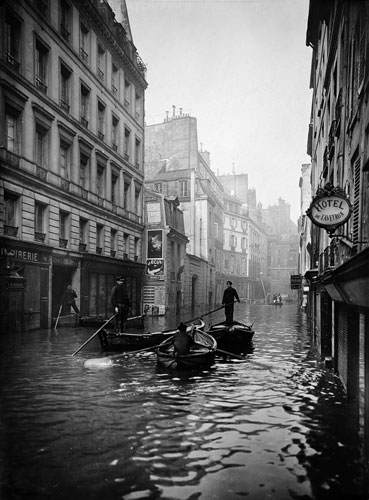
RUE-DE-SEINE
I don’t know what the writer of the Book of Genesis had in mind when he composed that ninth verse, but he provided an image that comes to my mind whenever I hear that the Passaic River has gone over its banks and once again swamped the homes of people who persist in living in its path.
And God said, “Let the water under the sky be gathered in one place, and let dry ground appear.” And it was so.
In other words, it took a command from God to get water to relinquish its superiority over earth, and the way I see it, water has never fully obeyed.
One example of the element asserting itself — just because it can — is described in “Paris Under Water” by Jeffery M. Jackson, an account of a flood in January 1910 that wrecked a large part of the city and some of its suburbs.

Marker indicates where the Seine crested, 20 feet above normal, on January 28, 1910.
Jackson, who is a history professor, explains that there was a complex of causes for this disaster. These included an unusually high amount of precipitation between June of 1909 and January of 1910 and relatively mild temperatures in western Europe that winter. In addition, Jackson writes, excessive deforestation upstream of Paris may have contributed to the deluge.
He also explains that late in the 19th century Paris had remade itself into a modern city, complete with an electric subway – the Metropolitan – and greatly expanded sewerage facilities. These very improvements, Jackson says, helped to create the calamity in 1910, because water pouring out of the river and bubbling up from the saturated ground had multiple conduits to carry it where it otherwise might not have gone — and certainly not so swiftly.

One citizen carries another through the flood water.
The flood brought with it all the problems of property loss, unemployment, and contamination that usually accompany such events, and the looting and profiteering as well.
Still, one of the most interesting and uplifting aspects of this book is Jackson’s account of how individuals and institutions rose to the challenge and helped the city and each other survive the flood.
Also engrossing is the author’s chronicle of the activities of Prefect of Police Louis Lepine, whose title described only a part of his responsibility, which included public health. Lepine, who had introduced scientific police techniques to Paris, was a dynamo during the flood, seldom resting as he personally oversaw the management of the city’s response to the crisis.
More recent events, such as our own Hurricane Katrina, have a way of dulling or even snuffing out our collective memory of natural disasters. This one, which in Jackson’s estimation has some lessons for our own time, is worth recalling.

One of the many postcards produced and sold during and after the disaster shows a scene that was repeated in many places in Paris -- citizens gingerly making their way over wooden walkways that were hastily constructed as the city fought back against the flood.
Em cee squared
May 17, 2010

A blackboard with formulas written by Albert Einstein, preserved in the Museum of the History of Science at the University of Oxford.
 Several decades ago, I began to make a point of reading several books each year on subjects about which I knew little or nothing — including subjects that I found repulsive. Among those subjects have been mathematics and physics, both of which bedeviled me when I had to study them in high school and college. As I have mentioned here before, at least with respect to mathematics, I have derived a great deal of satisfaction from pondering these subjects when examinations and grades are not at issue, and I have found that those who claim that there is beauty and wonder in these fields are telling the truth
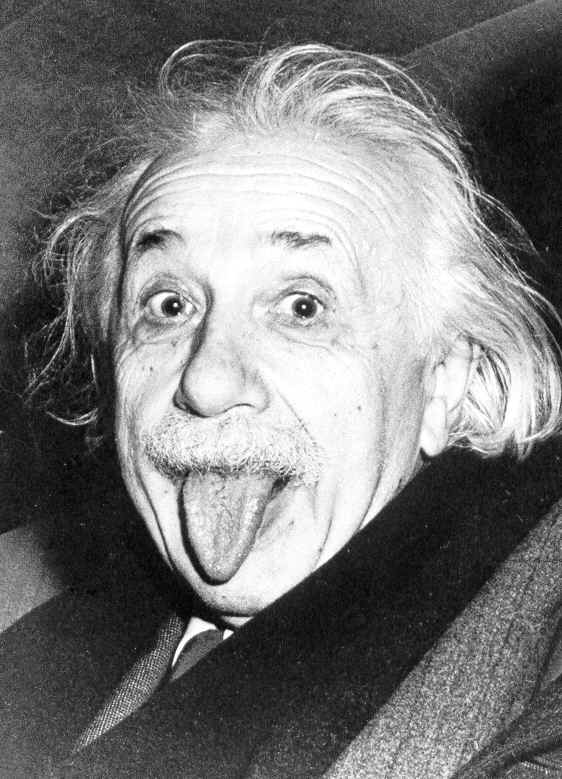
 That background explains why I grabbed the opportunity to review a popular biography entitled “Einstein: The Life of a Genius” by Walter Isaacson. This is a coffee table book that contains a limited amount of text in proportion to the number pages and illustrates its points with many photographs and also with facsimiles of several letters and documents. Among these are Einstein’s letter to Franklin D. Roosevelt in which the scientist advised the president to call together a group of experts to study the possibility of developing an atom bomb — something Nazi Germany was known to be doing at the time. As it happened, Einstein — a pacifist whose work in physics helped pave the way to such weapons — was considered too great a security risk to work on the project himself, what with him being a native of Germany, a socialist, and a Jew.
 Isaacson records that one of Einstein’s early physics instructors described him as “an extremely clever boy,” but added, “You have one great fault: You’ll never let yourself be told anything.” It wasn’t meant as compliment, but still, this tendency as much as anything else led to Einstein’s achievements in theoretical physics. Einstein — like Isaac Newton before him — would not accept anything as settled just because it was handed on to him by authoritative sources. He wondered and questioned and “experimented” with physical phenomena such as light and motion by forming images in his mind, and he changed the world.
Einstein is a curiosity in a way, because he was one of the most widely known celebrities of his time and his name is part of our language more than 50 years after his death, and yet most of us have little or no idea what he was up to. That doesn’t matter. He deserves his place in our culture if for no other reason than his persistence in questioning even his own conclusions.
 CharlesPaolino's Blog