“Near a volcano one still falls in love.” Amos Oz
April 17, 2010

School children in Heimaey. The island has about 4500 inhabitants.
The news of a volcanic eruption in Iceland and the lingering aftermath has had me thinking of our visit a few years ago to Heimaey, one of the Westman Island group off the southern coast of Iceland — the only one that is inhabited.
We took the ferry out to Heimaey, a trip of about four nautical miles, spent the night in a very nice little hotel, and then wandered all over the island and took a cruise around its outskirts.
The centerpiece of Heimaey is Eldfell, a volcano that erupted in January 1973, an event that continued until the following July. Besides the initial output of volcanic ash — an estimated 1.6 million cubic feet were blown onto the town — there was substantial flow of lava that threatened to close the island’s harbor.

A cluster of typical Icelandic buildings on Heimaey with Eldfell in the distance.
Overnight the whole population of Heimaey was evacuated, largely thanks to the fleet of fishing boats that was in the harbor at that time of year. If the lava had continued to flow unabated, it would have closed the narrow channel into the harbor which would have been disastrous to the fishing industry that supports the island’s economy. However, the islanders prevented that by pumping sea water onto the lava, redirecting the flow of the molten rock and causing much of it to solidify.
There was enormous damage to the town. Also, because of the lava flow, the length of the island grew from about 6 miles to about 8 miles. Ultimately, the residents returned and the town was restored. Video of the 1973 eruption is a THIS LINK.

A mural on an exterior wall of a building in Heimaey depicts the principal occupations of the residents.

A panorama of Heimaey, the largest island in the Vestmannaeyjar archipelago, first settled in the ninth century AD.
Netflix Update No. 28: “The Island on Bird Street”
February 1, 2010
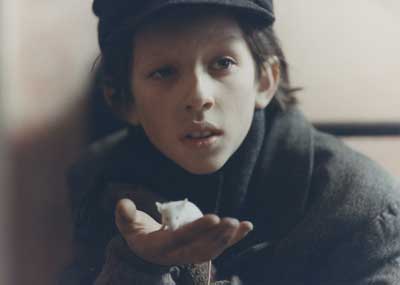
JORDAN KIZIUK
We watched a 1997 Danish film, “The Island on Bird Street,” which tells of an 11-year-old boy’s attempt to survive while the Nazis are emptying out a Jewish ghetto in Poland and sending its inhabitants to the death camps.
This film is based on what I have seen described as a “semi-autobiographical” novel by Israeli writer Uri Orlev, a Holocaust survivor who has specialized in children’s literature. Although the violence in this film is understated compared to many films about Nazi brutality, it’s not a film for young children. Teenagers wouldn’t flinch.
The story line is that the boy, Alex (Jordan Kiziuk), his father, Stefan (Patrick Bergin) and uncle Baroch (Jack Warden), are among the Polish Jews who are confined to a neighborhood fenced off by the Nazis — much like the Warsaw Ghetto where Orlev was confined as a child. When Stefan and Baroch are swept up in one of the Nazis’ “selections” for transport to a concentration camp, they conspire to let Alex escape the transport. Before the boy runs off, Stefan promises that he will return to the ghetto, and the boy takes that promise seriously.

JACK WARDEN
Alex — who reads “Robinson Crusoe” and plays with his white mouse, Snow — manages through a combination of guile and luck to avoid detection while he dodges the German troops who are gradually emptying the ghetto. The boy encounters some other stragglers, including a few men who are involved in the Polish underground. He eventually begins to slip out of the ghetto into the city at large, but always returns to wait for his father.
Jordan Kiziuk, a British actor who won an Emmy in 1999, delivers a convincing performance as Alex. Most of the film is quite tense as Alex has one close call after another, and Kiziuk has a lot of the burden of sustaining it. In fact, he’s at the center of the drama to such a degree that the other players are largely accessories.
As credible as Kiziuk is in his role, the story itself strains credulity, especially given the persistence of the Nazis in tracking down every straggler in the ghetto. There is also a contradiction in his sometimes elaborate ingenuity and his naive faith that his father will somehow survive the brutality the boy has witnessed again and again. The film ends with Alex still in the ghetto, and a title reports simply that he “survived the war.” In actual fact, Orlev was eventually caught by the Nazis after he was left behind in the ghetto and was sent to the Bergen-Belsen concentration camp where he remained until it was liberated.

PATRICK BERGIN
This film is visually very dramatic. The location in Poland presents a bleak image of the ghetto that provides an effective setting for the Nazis’ disregard for human dignity, never mind human life. The direction and photography contributed to the considerable attention and critical approval the film received when it was released.
“Don’t tread on me”
November 18, 2009

SARAH PALIN
Sarah Palin was non-committal when Barbara Walters asked, in the interview being broadcast this week, whether Palin wanted to run for the presidency. That, Palin said, is not on her radar at present, but she she cautioned that she could not predict what might happen between now and 2012. Presumably, that was a reference to that year’s national election and not to the revolution of the Mayan calendar.
If Palin does decide to seek office again, she should ask to be mentored by Vaira Vike-Freiberga, who has served two terms as president of Latvia. Perhaps on a global scale that is analogous to having been governor of Alaska from the perspective of Americans. But don’t be fooled by the relative obscurity of Freiberga’s venue. She is a force to be reckoned with and a role model for women who believe that half the population should hold half the power, if not more.

VAIRA VIKE-FREIBERGA
Vike-Freiberga has made it clear that she is a candidate for the presidency of the European Union, and she is fuming — as she should be — over public suggestions that there are no qualified women to fill the post that has been dominated by men. “Those people who say that should wash their mouths out with soap,” Mrs Vike-Freiberga told The London Times. “As far as I am concerned they are voicing the deepest and most objectionable prejudice against women. They are saying that we do not have qualified women around,and I resent that. It is a lie and we should all protest against that because it implies that somehow talent was distributed only to those with one kind of chromosome.”
Check the Times story for a sketch of Vike-Freiberga’s personal and academic resume. Not qualified, indeed! The Times also reports on her challenge to EU leadership to strip away the secrecy from the process by which the EU president is chosen — a practice she compares to the methods of the Soviet Union.
She’s my new hero.
 CharlesPaolino's Blog