Inquiring minds etc.
June 3, 2009

KING TUT’S MUMMY
One of the curiosities of American history is that no one has ever figured out who was the mother of William Franklin. We know the father well enough – Benjamin Franklin, one of the geniuses of the American Revolution. But Ben wasn’t married to Billy’s mom, and though he took good care of the boy until they split over questions of loyalty or rebellion, the old man never let slip the mother’s name. No scholar has been able to unravel the mystery.
But that’s cheap cheese compared to what the Egyptians are monkeying around with — trying to determine who was the father of King Tutankhamun. That’s been the subject of speculation at least since the king’s tomb was uncovered in 1922, but now Egyptian scholars are using DNA samples from the mummy to narrow the parentage down — presumably to either Akhenaten or Amenhotep III.

FAUX NEFERTITI
Meanwhile, there has been some controversy over a bust of the Egyptian Queen Nefertiti — a contemporary of King Tut’s — whose reputed good looks have been the source of fascination for centuries. Swiss art historian Henri Stierlin wrote in a book published this spring that the statue is a copy dating only from 1912. Worse yet, German scientists earlier this year speculated that the sculptor of the original bust may have smoothed out creases around the queen’s mouth and straightened out her bumpy nose.
If these intimate secrets aren’t safe after 3300 years, what chance has Adam Lambert got?
So, what have we learned here?
June 3, 2009

SUSAN BOYLE
Andy Burnham, the British culture secretary, wants the Office of Communications to investigate whether the television network and the producers of “Britain’s Got Talent” had acted responsibly toward Susan Boyle in the runup to the show’s finals. The implication is that the people behind the show that vaulted Boyle from the obscurity of a Scottish village to the limelight of YouTube should have done a better job of protecting her from the effects of sudden fame.
Burnham made reference to Britain’s broadcast code when he called for a determination that “duty of care” had been exercised with respect to Susan Boyle, who was briefly hospitalized for exhaustion after coming in second in the show’s finals. The Office of Communications doesn’t think the broadcast code covers what happened to Boyle, but Burnham said: “We are living in a world where it is not just about what happens on telly on a Saturday night. There is 360 degree scrutiny, 365 days a year. We need to look after people, not just around the camera. Broadcasters should always put people’s welfare first.”
This has prompted some bitter responses from readers of The Times of London, some sympathetic to Susan Boyle, some not. Some of the readers were outraged that the government would even think of becoming involved in a trivial, private matter. I liked the comment from Al of Manchester:
The UK is full of cruel people feasting on a diet of bile soaked Tabloid fodder and Reality TV trash. First they jeered and sneered at Susan for not looking like a singer and now they do the same because she not “tough enough to take it”. What a sad place and sad people we’ve become.
And Jessica of Eastbourne:
Can I just say that “they” did not treat Susan any differently than any of the other contestants. Susan was a victim of the throwaway celebrity culture that the UK and the US fawn over so much. If anyone “threw her away” it was the public, and the show’s producers are not as much to blame as we are.
What I loved about the reporting of this story is that after the universal handwringing and public penance over the snickering and eye-rolling when Susan Boyle first appeared on the show, the media couldn’t mention her without pointing out how “dowdy” she is, how unlikely a celebrity she is, or without calling attention again to the fact that she is a “virgin” who has “never been kissed.”
“All my life’s a circle” — Harry Chapin
May 31, 2009

Photo by Jim Dirden
I just finished reading a new biography of Pete Seeger by Alec Wilkinson of The New Yorker. It’s a short, well-written work that gives a good look at Pete’s personality. It is based on a series of interviews Wilkinson conducted at Pete’s home in Beacon, N.Y.
This isn’t a fawning portrait. Pete’s doubts and insecurities come through, in his own words.
It is also interesting to learn in this work about Pete’s parents, and particularly his father, Charles, who was also an idealist.
There is a lack of balance in the way many people react to Pete. There are many who think of him only as a folksy singer of campfire songs – sort of a Tennessee Ernie Ford. There are those who cast him in a messianic role that he himself would reject. And there are those who think he is the antichrist because, like many thoughtful people of his and his father’s generation, he associated for a time with people who felt Communism held the answers to chronic economic, social, and political problems. Pete acknowledges – including in this book – that that was a mistake, but more than a half century later, some folks still pillory him for it.

Pete is well known not only for singing but for encouraging his audiences to sing with him. Wilkinson’s book examines this practice, which for Pete isn’t just a cutsey stage trick. Calling on people to sing goes to the heart of Pete’s notion of what music is for, and gets to discuss that in his own words in this book.
Pete Seeger has been an important figure in the history of the past seven decades – not always clearly understood, even by himself. Wilkinson’s book at least helps formulate the questions.
Good, good grief
May 30, 2009
 I just read — for the purpose of reviewing it — a book called “Security Blankets: How Peanuts ® Touched Our Lives.” This is a collection of about 50 stories from people who feel their time on earth has been enriched somehow by the comic strip, the books, the TV specials, the tchatchke, or by some encounter with Charles Schulz himself.
It appears to me that the book is an attempt to reinvigorate the trade in stuffed Snoopy dolls (referred to repeatedly in the book as “plush”) or other “collectibles.” Maybe the Peanuts market is suffering from the combined effects of Schulz’s absence, the aging of the Peanuts Generation, and the paucity of disposable income.

THE RED BARON
That’s not to say that there aren’t some good stories here. One of my favorites was submitted by a man whose father was not only a World War I flying ace, but who piloted a Sopwith Camel and, in August 1918, actually outran the Red Baron himself.
Several of the people whose little essays appear in this book said, in one way or another, that their own cares or frustrations became a little easier to bear when they realized that others shared their feelings. Of course, the “others” were fictional cartoon characters, although many a Tuesday night meeting in the basement of a Unitarian church might have provided the same kind of support, except in flesh and blood rather than pen and ink. The writers in “Security Blankets” may have been unwittingly identifying with the often solitary and unfulfilled artist behind those characters rather than with the characters themselves.
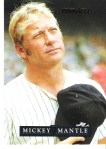
MICKEY MANTLE
Still, these stories reminded me of a book I read that contained a collection of letters that had been written to Mickey Mantle whose family published them after his death in order to raise money for an organ-transplant program. The letters told Mantle how much he had meant either to the writer or to someone in the writer’s life — a father, perhaps. Mantle, I have read elsewhere, was always mystified by sentiments of this kind. He felt, I suppose, like Louie DePalma — the “Taxi” character — who said of his girlfriend: “She sees something in me … something that’s not there.”
But both cases may be related to an idea I passed along to my students last semester — that once a writer has published a story, a poem, or an essay, he no longer owns it. Once he has published it, it belongs to the reader — and to each individual reader in a unique way. Neither the writer nor the writer’s critics can tell the reader what the reader can infer from the work. Maybe that’s true of cartoonists and swtich hitters, too: that once they have led their lives, they cannot control, nor contradict, what people infer from them.

ELLEN DEGENERES
Thank heaven for Cspann. That’s where I stumbled across Ellen DeGeneres giving the commencement address at Tulane. It’s a pleasure to see her any time, but her address to the Tulane grads was a refreshing departure from the usual approach on such occasions. And it reinforced the depth of character that makes her such an admirable figure.
Her account of the impact on her life of, first, keeping her sexual identity a secret for fear of reprisals and, second, suffering reprisals when she finally decided to get throw off the burden of secrecy, is food for thought about how we treat each other in the supposedly post-modern world.
The speech is at this link:http://video.google.com/videosearch?q=”ellen+degeneres”&hl=en&emb=0&aq=f#
What’s it all about, Sarah?
May 14, 2009

GOV. SARAH PALIN
I’m the guy who told a couple of generations of reporters and journalism students that a good writer can stop any person on the street and write an interesting story about him. So far be it from me to suggest that there isn’t a good story to be told about Gov. Sarah Palin, R-Alaska. As it turns out, Gov. Palin herself – a former journalism student – is going to take on the job herself after signing a book deal with HarperCollins and Zondervan. She anticipates that the project will take about a year which, if she can stick to that schedule, would get it into Borders in time for the 2010 gubernatorial election. I’ve seen some cynical references to that in what the governor refers to as “the anonymous blogosphere,” but why begrudge her that advantage – or the kind of money she can command while people are still interested in her? If Richard Nixon could appear on “Laugh-In,” why shouldn’t Gov. Palin write a memoir? It could be time consuming, especially because the governor says that, despite the collaborator assigned to the book, she wants to write most of it herself.

ULYSSES S. GRANT
News of this enterprise naturally evokes questions about the content. The governor is a relatively young woman who has had a relatively short – and dare we say largely inocuous – public career. Ulysses S. Grant put off his memoirs until he had been the general-in-chief of the victorious Union Army and twice president of these United States. And Dwight Eisenhower saved his written reflections until he had been supreme allied commander in Europe, general of the Army, and twice president. What will the governor write to hold a reader’s attention for two or three hundred pages? She did discuss that in a general way with a newspaper reporter as follows: “I just really look forward to being able to relate to people through this book, those who are anxious to hear stories about people who are facing similar challenges perhaps. That’s balancing work and parenting — in my case work does mean running a state, and family involves a large and fun and colorful ordinary family that really has been thrust into maybe some extraordinary circumstances.” See?
I expect Harper has editors to deal with misplaced “perhapses” and “maybes,” but I hope the book clubs are heavy with folks “anxious to hear stories about people who are facing similar challenges.” Perhaps.
If you love her, leave her in peace.
May 12, 2009

Farrah Fawcett
People who devour the details of celebrities’ personal lives should read the interview with Farrah Fawcett published in the Los Angeles Times on Monday. The interview – the only one the actress has given in more than two years – was conducted in August and was published in advance of a television program regarding Fawcett’s struggle for privacy, to be broadcast this weekend.
Fawcett was able to prove that an employee of UCLA Medical Center had illegally gained access to Fawcett’s medical records and had sold the information to the National Enquirer. That employee eventually resigned and has since died of cancer – the same disease for which Fawcett was being treated at UCLA.
The reporting of Fawcett’s illness has been revolting – and not only in the Enquirer. I have complained before about the nearly gleeful manner in which some television news anchors spit out the “headlines” on the latest developments in the woman’s illness – which appears to be terminal.
The L.A. Times story included an explanation from Brandy Navarre – identified as vice president of a “paparazzi agency” – for the compulsion to hound a woman who may be dying.
“Particularly when it’s something sexy or scandalous,” Navarre told the paper, “or on the negative side, something kind of tragic and sad, for whatever reason, the public is interested in those types of stories.”
The public is interested, see? And that’s what made it profitable for a hospital employee to commit a federal crime and for a so-called newspaper to induce her with cash to do what the editors clearly knew was a crime. Navarre attributed the interest in the case to “the public’s love of this woman.”
If the public loves this woman, why doesn’t the public – and the media that serve the public – respect the privacy they would expect for themselves under such circumstances and leave Farrah Fawcett alone.
The final frontier … again.
May 7, 2009

WILLIAM SHATNER
Judging from the reviews, I might see the new “Star Trek” film after having forsaken the Enterprise when the first television series ended. I don’t know why that happened, because the first series was must-see in our house. We wouldn’t schedule any activities away from home on “Star Trek” night.
Back in those days, I was driving by a theater here in Jersey and saw that William Shatner was going to appear there in “Period of Adjustment.” It seemed like an odd idea to me at first, but I learned later that Shatner had played stage comedy early in his career. Also, I realized after I had thought about it, his character on “Star Trek” often had comic overtones. I took the opportunity to interview Shatner for a preview of “Period of Adjustment.” It wasn’t a very satisfying experience. He answered as many questions as possible with single syllables. He was very good in the play.

WILLIAM SHATNER
Shatner appeared at the same theater a year or so later, and I interviewed him again. That time, he talked almost compulsively – in fact, at one point he came up for air and asked, “How the hell are you going to write this?” Several years later, I interviewed him yet again – by phone – for an advance on an appearance he was making at a local college. I mentioned to him that I he and I had spoken twice before, and he asked, “Have you learned anything since then?”
Some people don’t like Shatner’s acting – several have told me they find his syncopated speech contrived and annoying. I don’t agree; I like his acting, including that peculiarity in his speech.

WILLIAM SHATNER
I find his appearance a little unsettling. He looks like he’s full of cortisone.
One of my favorite examples of Shatner’s work is “The Andersonville Trial,” a 1970 television movie directed by George C. Scott, based on Saul Levitt’s play of about a decade before. Shatner played Gen. N.P Chipman, who was judge advocate of the military court that tried Capt. Henry Wirz, who had been commandant of a prison camp for Confederate prisoners. Shatner was a perfect fit for the courtroom drama, whose cast included Richard Basehart, Buddy Ebsen, Jack Cassidy and Martin Sheen.
It’s available from Netflix and I wrote a review of it for this blog. The review is at THIS LINK.
… and what’s more, they believe it.
May 5, 2009

CARRIE PREJEAN
The blather that is issuing from the controversy over Carrie Prejean and her view of same-sex marriage might set a record even in this blather-soaked age. I have paid only passing attention to this story until today – most of my attention has taken the form of amusement over the talking heads discussing it with straight faces as though it were really important – but today I came across the report in the San Diego News that photos of Prejean modelling in a state of near nakedness have started showing up on the Internet, and that some of her critics are saying those photos cast doubt on her claim to be a Christian. Given the wide application and interpretation of the word “Christian,” that in itself is a example of the silliness that has infected this incident.
This is a bit of what the San Diego paper reported:
Alicia Jacobs, a judge at the April 19 Miss USA pageant during which Prejean made her highly publicized statement opposing same-sex marriage, said the pictures go beyond what the Miss California pageant says are appropriate.
“I can assure you they were quite inappropriate, and certainly not photos befitting a beauty queen,” Jacobs, a reporter for NBC’sLas Vegas affiliate, told NBC News.

ALICIA JACOBS
Alicia is in a position to make such judgments about what is or is not appropriate, because she herself is a former “beauty queen” who has graduated to her present status as one of those jewels of 21st century journalism, an “entertainment reporter.” According to her home station, KVBC:
Alicia’s revealing one-on-one interviews with A-listers read more like comfortable chats between friends. Celebrities have come to trust her journalistic integrity, & viewers have come to expect Alicia’s easygoing way, to showcase the “real” side of their favorite celebrities.
That’s a reassuring thing in these troubled times when life can get so hard to understand.
Farrago of this kind is being circulated because of Prejean’s answer when she was asked her opinion of same-gender marriage, and her answer sounded like it could have come from the governor of Alaska:
“I think it’s great that Americans are able to choose one or the other. We live in a land where you can choose same-sex marriage or opposite marriage,” Prejean said. “And you know what? I think in my country, in my family, I think that I believe that a marriage should be between a man and a woman. No offense to anybody out there, but that’s how I was raised.”
Huh? What’d she say? She’s glad Americans have the choice, but she doesn’t want them to?

PEREZ HILTON
Perez Hilton – another wonder of celebrity journalism – asked the question of Prejean in the first place and then turned on her, complaining – according to the San Diego paper – that Miss USA is supposed to unite Americans, not divide them. What century does he live in? The very fact that an anachronistic beauty contest was the launching pad for a debate that trivializes a subject that deeply affects the personal lives of millions of men and women is in itself a sad commentary on the state of public discourse in this country.
While you weren’t looking, Perez, Bert Parks died.
“Pssssst! ‘Farrah Fawcett.’ Pass it on.”
May 3, 2009

HOPE DAVIS
I’m taking a break from the usual blogging today to put the WordPress system to the test. I have noticed what I think are odd results in the list of terms that readers ostensibly searched in order to reach my journal. By now I have dozens of entries in this blog, but the readers who come in through search terms seem to have an inordinate fixation with Hope Davis, Farrah Fawcett, and Andrew Johnson – the latter having been the 17th president of these United States.
Now, I think the world of Hope Davis as an actress, I sympathize with Farrah Fawcett for her health problems, and I have a perhaps inexplicable fascination with Andrew Johnson. However, I have referred to Hope Davis and Farrah Fawcett only once each in this journal, and I may have referred to Andrew Johnson twice or, at the most, three times. And yet those terms show up every day on the report, and the journal entry that mentioned Hope Davis – it consisted of my comments on one of her movies – has become my “all-time leader.”
So I have deliberately referred to all three of those personalities in this little rant to see if this entry, too, causes activity in the report on search terms.
More about this when the results are in.
 CharlesPaolino's Blog