“. . . one expects to find intelligence.” — Leopold Stokowski
November 26, 2009

ELIZABETH MOREHEAD "Noel"
When Elaine Benes broke up during a piano recital because Jerry Seinfeld had put a Pez dispenser on her knee, Noel the pianist played on. Oh, she was plenty upset, but she didn’t acknowledge the distraction and continued to play.
Not every artist has that kind of composure. About 45 years ago, I was at a concert at Seton Hall University at which Leopold Stokowski was conducting the American Symphony Orchestra. Some people came in after the concert had started. I guess we were all aware of the doors opening and closing and the latecomers making their way into the gymnasium, but — hey — it happens.
Well, tell that to Stokowski.
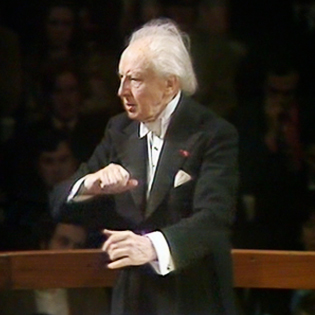
LEOPOLD STOKOWSKI
He stopped the orchestra in the middle of the first piece, turned around and glared into the darkened gym. When the place had settled down, he went to the microphone and said, “You have to excuse me. When one comes to a place of learning one expects to find intelligence.” Then he returned to his place and started the concert again.
Of course, that’s a reasonable expectation on both sides of the footlights, so to speak. But the principle apparently is lost on Ian Hart, who went to pieces during a performance of “Speaking in Tongues,” a play on London’s West End for which he has gotten good notices. And, according to an account in The Times of London, witnesses say Hart’s threatening verbal abuse of a patron in the theater was without any basis except in the actor’s imagination.
Gerald Earley — the target of Hart’s ranting — said that a certain point in the proceedings, the actor had become “pretty feral,” which I thought was a delightful choice of words. Hart brushed off the incident as silly, but he also admitted he doesn’t like acting in the theater because he doesn’t “enjoy the relationship between the audience and the actor,” and, may I say, there’s a simple solution to that.
For The Times’ account of Hart’s outburst, click HERE.
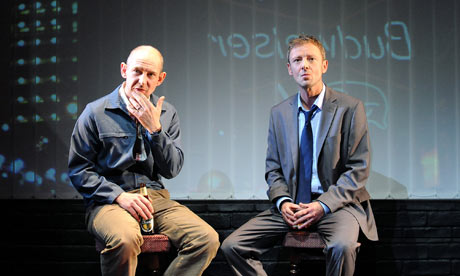
Ian Hart and John Simms in "Speaking in Tongues"
 It’s hard to imagine in our time any amount of hype being dismissed as “too much,” but that’s how former President Bill Clinton’s handlers have described the marketing of a planned joint appearance by Clinton and former President George W. Bush. The event, which was to have taken place at Radio City Music Hall on February 25, has been cancelled on the grounds that it was oversold as the toughest face-off since Leo the Great and Attila the Hun.
Ticket prices for this event, in which the two former chief executives were to have discussed various issues of domestic and foreign policy, were to range from $60 to $160.
 This would not have been the first time the two men have shared the same platform; they did it in Toronto in May. Although there were some reports that each was paid $150,000 for that gig, that has not been confirmed, nor has any information been forthcoming about what they might have been paid if the Radio City event had gone on as planned.
News reports of the Toronto appearance indicated that Clinton and Bush did not sharply disagree on many issues, so the language used to promote the New York appearance struck me as odd from the outset. The context is that Clinton and the first President Bush have formed a good post-White House relationship, and the younger Bush hasn’t been at all politically combative since he left office. If Harry Truman could make peace with Herbert Hoover, why not Clinton and the Bushes. This was looking like a love fest despite the marketing lingo.
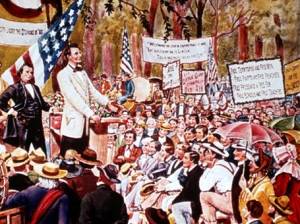
I was especially amused by the description of the encounter that has now been cancelled as “the hottest ticket in political history.” I wonder what Mr. Lincoln and Mr. Douglas — wherever they now repose — think of that.
“. . . better to burn than fade away …” — Neil Young
September 13, 2009

KURT COBAIN
Old Man Trouble can’t stay away from Kurt Cobain’s door. The huzzerai over the plaque honoring him in his hometown in Washington seems to have died down, but now there is a problem with how his image is used in the video game Guitar Hero 5.
Courtney Love, who was married to Cobain at the time of his death in 1994, gave Activision, the publisher of the game, permission to use Cobain’s image, but she says she did not know or agree that the avatar could be activated so as to sing other writers’ songs. Krist Novoselic and Dave Grohl, Cobain’s Nirvana-mates, are also annoyed. Love says there will be legal action against Activision if the game isn’t altered so as to restrict the use of Cobain’s image to songs associated with him.

SHIRLEY BOOTH
There have been similar blowups in the past, including one involving the great stage and screen actress Shirley Booth, who played the housemaid Hazel from 1961 to 1966 in a TV series based on Ted Key’s cartoon character by the same name. After the show left the air, in 1971, Key gave Colgate-Palmolive permission to use the Hazel image in a commercial for a detergent called Burst.
The sponsor or its ad agency hired an actress named Ruth Holden to provide the voice in the commercial, but the voice sounded exactly like Shirley Booth’s voice, as I recall myself. Anyone who was familiar with Booth and saw that commercial would have assumed the voice was hers.
Shirley Booth thought so, too. She sued the sponsor and its ad agency in federal court, but the court didn’t agree with her complaint.
For now, you can see the Kurt Cobain avatar and read a Christian Science Monitor blog about Courtney Love’s objections, both at this link:

MICHAEL JACKSON Megan Lewis/Reuters
“I hate it,” Charlie Brown once complained, “when there are two sides to a story.”
Too often for our comfort, there are that many and more. Carol Norris Green, writing for the Catholic News Service, perceived that with respect to Michael Jackson. Her thoughtful column follows:
Some people are insisting there were two Michael Jacksons –– the iconic entertainer and a bizarre, very troubled individual.
But there was always only the one man living out two sets of fantasies –– his own and those of so many others.
Fantasies can be both inspirational and detrimental. But it is when they motivate us to be our best that they are life–giving.
Consider Olympians, or scientists who give us groundbreaking discoveries. Many worked hard for years to realize what their spirit told them was possible.
However, their achievements were not always embraced on a monumental scale. While people worldwide appreciated what these remarkable people achieved, they didn’t always see themselves in their accomplishments.
It was this seeing of oneself in the journey of Michael Joseph Jackson, dead June 25 from cardiac arrest, that sparked an outpouring of crowds in streets and unabashed tears as people recollected the life of the “Gloved One” who overcame shyness every time he walked on stage.
Shyness can be crippling for so many people. When I work on Catholic News Service’s religious education series (Faith Alive!), I am amazed by the number of Catholics who are uncomfortable at the thought of putting their names to a simple reply to a “Faith in the Marketplace” question! They prefer to have their priest speak for them or remain anonymous.
Rest assured, you won’t see any of them in the spotlight, attempting to moonwalk.
But who hasn’t, even for the most fleeting of moments, wondered what it would be like to strut Jackson’s signature moonwalk?
I’ve done it many times –– in my mind. But I’d turn beet–red if someone caught me attempting to do that in my basement, let alone at an employee dinner–dance.
But, wow! What if one day I found the nerve and actually did a respectable imitation? It would be so fulfilling personally because it would mean I mastered a fear and experienced absolute joy.
As human beings, we all are challenged to come out of our shells to achieve our full potential. But so much of our formation, our discipline says “hold back … not now … what if it is not received well?”
And so we live the reality of routine, daydreaming –– until something out of the ordinary happens.
Enter Michael Jackson, not the child star, but the childlike adult who, like most adults, knew the meaning of love, of pain and suffering, of fantasy too wondrous to let go.
By virtue of his trade as an entertainer, Jackson could do all the things we were taught it was vain to do –– wear flashy clothes and jiggle our bodies, offering freeze–frame poses that said, “Look at me!”
He sang, he danced demanding choreographies. He was so vainglorious!
No wonder Jackson’s death is so personal for so many people.
At death, when we are judged, Scripture tells us that all of our deeds will be tested by fire; what is worthless will be consumed as if “wood, stubble and hay,” and what is worthwhile will become our lasting reward.
And so it will be with Jackson’s legacy. Media, to be credible, must review the good, the bad and the ugly aspects of Jackson’s life. The public receives it, consumes what is tragic, then clings to whatever beauty remains.
Those who choose to remember only the good about Jackson will do for him what we all want done for ourselves: to be remembered for the best that we were and tried to be.
And when we think on what is good, the reward is always an experience of love.
Copyright (c) 2009 Catholic News Service/U.S. Conference of Catholic Bishops
Never say never in Neverland
July 11, 2009

MICHAEL JACKSON
The Christian Science Monitor has joined the chorus whose song is that Michael Jackson was likely one of the the last “mega-stars.”
A story in the Monitor this week, written by Stephen Humphries, included these passages:
That Jackson could command such an audience is testament to the kind globe-straddling star power that was possible in an earlier, simpler entertainment age. Amid today’s fragmented popular culture, in which an unlimited buffet of mass media has segregated consumers into niche-oriented tribes, Jackson was arguably one of the world’s last superstars.
“It isn’t just that Michael Jackson was the last superstar because he was one of the last people to benefit from an unfragmented media,” says Timothy Burke, a cultural historian at Swarthmore College in Pennsylvania. “He may also have been one of the last people who could surprise us with a stunning innovation where we didn’t have that sense already of being so jaded by the ubiquity of spectacularly good entertainment. That someone could just leap on the stage and do this thing, and you could go, ‘Wow, I’ve never seen that before!’ “

LUCIANO PAVAROTTI
I don’t know that either niche marketing or a need for innovation supports the bold prediction that no one after Jackson will be able to appeal to a global audience.
Luciano Pavarotti, for example — whose estate was worth about a half billion dollars the last I read about it — appealed to millions of people all over the world, including people who knew nothing about opera, including people who did not want to know anything about opera, and he didn’t appeal to them because he was an innovator — certainly not in the sense that Michael Jackson was. Pavarotti’s performance was pretty much traditional. Whether he was, as a friend of mine claimed, “the second greatest tenor in history,” is a matter of conjecture — and conjecture, I might add, that has no real meaning. Most of those who bought Pavarotti’s recordings, attended his concerts, and watched his television appearances, wouldn’t know if he were second greatest or not. What they knew was that they liked him, and that was all that mattered. The implication of my friend’s remark was that Enrico Caruso was the greatest tenor in history, and Caruso and Pavarotti were alike in this: There was something about each of them that simply appealed to people, including those not normally in the opera crowd. The very fact that the something can’t be quantified, while both tenors’ enormous audiences and coincident earnings can be quantified, should tell us that it’s foolhardy to predict that no such performer will appear again.

SUSAN BOYLE
Susan Boyle’s experience is also instructive. The record-setting video on YouTube featured Boyle, not Jackson. That doesn’t imply any parallel between the two as performers, and that’s exactly the point. Boyle’s appeal was unpredictable. No one saw it coming. And I dare say that even experts in the field, if they had heard Susan Boyle perform before her appearance on the British TV competition, would not have forseen her appeal, which has cut across all the usual borders of musical taste and which, it is important to note, has been a function of a new mode of almost universal communications whose implications and whose future we can’t even imagine. Jackson only got to scratch the surface of the rapidly evolving technology. Even if Susan Boyle turns out to be a comet that will soon fade to black, we don’t know that there won’t be another Susan Boyle who will burst out into the world via YouTube or some unforseen successor to it and re-define the concept of a “star” in ways we haven’t dreamed of.
“I hear you knockin’, but you can’t come in”
July 6, 2009

GALE STORM
It escaped my notice until this morning that Gale Storm died a few days ago at the age of 87.
She was a charming personality on early television; while her series “My Little Margie” was in its first run of 126 episodes, I was getting old enough to notice that she was very cute, too.
I bought a DVD with several episodes of that show. It’s not the kind of comedy that sells today, but it’s still entertaining — especially the conflicts between Margie Albright — Gale Storm’s character — and her father, Vern, played by Charles Farrell. In our household, this series had something for everybody — well, almost everybody. Charles Farrell had been a romantic film star, and he was right up there with Cesar Romero in my mother’s pantheon. I imagine Dad liked Gale Storm’s looks, but if he did, he didn’t say so.
I kind of lost interest in Gale Storm when she went into her second series, “Oh, Susanna,” but I was in high school by then and was spending significantly less time watching television. I rediscovered her when she recorded several hit songs, including “I Hear You Knockin’ ” and “Dark Moon.”
After a couple of setbacks, Gale Storm overcame alcholism, which is always an uplifting thing to hear. Like most people, I suppose, I know several people who struggle with substance addictions. In no case does it appear that they will rid themselves of that problem. I don’t pontificate about such things the way I do about other topics, because I deeply sympathize with the addicted person. I have trouble breaking much less lethal habits, habits that don’t involve substance dependency. I don’t say anything about the habits of others, except in prayer.

GALE STORM and CHARLES FARRELL
There are no small roles.
July 3, 2009

JOHN DILLINGER
Amid all the tsurris about Michael Jackson’s death bubbles the question of how long his fame will endure. He will have done well, it seems, if the public fixation with him lasts as long as its interest in John Dillinger, an anti-social holdup man and murderer who was shot to death 75 years ago. Once Independence Day is out of the way, we can focus our attention on John Dillinger Day, an observance that commemorates his death, which occurred on July 22, 1934.
There are those, of course, who say that it wasn’t Dillinger who was gunned down outside a movie theater in Chicago, and I suppose we’ll have to live with those who will claim that Jackson didn’t die in Los Angeles last week but is living in Buenos Aires with Adolph Hitler, Emilia Earhart, and Elvis Presley. At last, a fourth for bridge.
The reviews in the Christian Science Monitor and the Washington Post are unenthusiastic about the movie “Public Enemies,” in which Johnny Depp portrays Dillinger. Dan Zak writes in the Post:

JOHNNY DEPP
There’s no excitement in the bank-robbing, no thrill of the chase, no emotion over justice served or thwarted. Depp’s Dillinger is neither charming nor despicable, nor does he occupy that delicious gray area between the two. His spree unspools dispassionately, cold as a Colt .380.
Peter Rainer in the Monitor writes:
Mann’s hero-worshipy treatment of Dillinger is undercut by the film’s dreamtime existentialist aura. In reality, the working poor cheered Dillinger’s bank raids but in “Public Enemies” the Depression is just a prop, and so Dillinger’s populist hero status, what little we see of it, makes scant sense. (This is probably why we see so little of it.) Missing, as a result, is the knockabout tumult of a time when gangsters could ascend to the same stardom as the movie actors who played gangsters. Dillinger was, for a while, every bit as big as Jimmy Cagney. Mann pirouettes around the twin realities of the Depression and the star culture it engendered and offers instead a moody blues doominess. It’s a vacuum filling a vacuum.
So Depp becomes neither Clyde Barrow nor Robin Hood. Maybe, in his old age, he can play Bernie Madoff.
RUDOLPH VALENTINO
I noticed references to a public wake for Michael Jackson, and that got me to thinking about the manner in which previous celebrities of that magnitude have taken their leave, as it were.
I should qualify this observation immediately inasmuch as I’ve been hearing for several days that there has been no other celebrity of that magnitude — and today I heard the Chicago Tribune music critic say that there won’t be another, at least not among singers. These are meaningless statements, of course, because the magnitude of any person’s celebrity is affected by multiple factors, most of them subjective. Enrico Caruso, for example, was treated all over the world as if he were royalty — even by people who had never heard him perform, and 88 years after his death he is still the standard by which male singers are measured. His name, in fact, is a synonym for “male singer.”

BABE RUTH
A man whose status as an international celebrity was emerging just as Caruso died was Babe Ruth. He transcended the sport that his fame was based on to such a degree that Japanese soldiers during World War II, nearly a decade after his career had ended, would shout “to hell with Babe Ruth” as an insult to American servicemen. Like Caruso, Ruth remains the model to whom his successors are compared.
When Ruth died, he had been retired for 14 years. His body lay in state at Yankee Stadium where an estimated 100,000 people of every age and description bid him a solemn farewell. When Francis Cardinal Spellman celebrated Ruth’s funeral mass at St Patrick’s Cathedral in Manhattan, a crowd estimated at 75,000 filled the church and spilled out into the rain-swept streets.

ABRAHAM LINCOLN
It is likely that no outpouring of grief in this nation, at least, has exceeded that which followed the murder of Abraham Lincoln. In retrospect, the reaction was not out of proportion to the importance of his death; in some respects, one might argue, the country has not yet fully recovered, given the debacle of Reconstruction and its aftermath.
Contemporary accounts describe the American people, including many who recently had excoriated Lincoln and his policies, as either numb with shock or crazy with anger. Millions of people stood along the right-of-way as the funeral train carried Lincoln’s body over the 13-day journey from Washington to Springfield.

RUDOLPH VALENTINO
Perhaps the instance that will prove the best analogy for the case of Michael Jackson is that of Rudolph Valentino, the silent film actor whose life and career were as tumultuous and controversial as Jackson’s. Valentino died in 1926 at the age of 31 from complications after surgery for appendicitis and gastric ulcers. His funeral, which was something of a circus, attracted an estimated 100,000 people in the streets of New York, a large number considering the limitations on travel at the time. The crowd erupted in a riot that lasted most of one day and required more than 100 mounted policemen plus police reserves to restore order. Several of Valentino’s fans committed suicide and the actress Pola Negri sent to the funeral home 4,000 roses in an arrangement that spelled out her name. During the wake period, Negri announced that she had been Valentino’s fiancee — something no one else was aware of — and promptly collapsed on his coffin in a fit of hysteria. She followed the funeral train from New York to California and was composed enough to stand for photographs whereever the train stopped.

POLA NEGRI and RUDOLPH VALENTINO

- MICHAEL JACKSON
When I learned last night that Michael Jackson had died, I was at a fair – kiddie rides, foot-long hot dogs, funnel cakes – in a town in Bergen County. I drove about an hour and half to get there — not for the hot dogs, which were fine, but to listen to Noise from the Basement, a band in which my son plays keyboard. I would do it again.
When I got home and checked my blog here on wordpress, I saw that traffic on my journal had already soared beyond the normal number of daily visits – by a factor of eight. This was caused by the death of Farrah Fawcett. Her passing apparently sent many people scurrying to a search engine, and some of their searches tripped over two entries I have made in the past couple of months complaining about the way some of the media and some of the public were reacting to her illness.
It might be fortuitous for Farrah Fawcett’s memory that she and Michael Jackson died almost simultaneously. Because of the complicated life that Jackson led, there is likely to be an endless stream of speculation about the nature of his death, and even some serious commentary on the meaning of his life.
I have to say that Michael Jackson meant nothing to me, one way or the other. I didn’t pay close attention to the coverage of his life, but I did see and hear enough to know that the difference between fact and fiction was difficult to discern. If the far more sedate lives of Charles Dodgson (Lewis Carroll) and Sir James Matthew Barrie are any example, some of the questions about Jackson’s behavior will never go away.
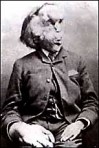
- JOSEPH MERRICK
One small issue in Jackson’s life that did get my attention was the report in 1987 that he had offered to buy the remains of Joseph Carey Merrick, known in popular culture as “John” Merrick, the “elephant man,” a 19th century Englishman who was severely deformed by a disease that has not been conclusively identified. I have spent far more time learning about Merrick than I have ever devoted to Michael Jackson, because I have been interested in Merrick’s determination to achieve some sort of human dignity despite a condition that, through no fault of his own, made it impossible for him to live in society. In fact, he had to be protected from the public. It’s worth noting that Dr. Frederick Treves, who was principally responsible for providing Merrick with a home at London Hospital, had misgivings about his own role in making Merrick something of a darling of British society, including the royal family.
My initial reaction when I heard that Jackson had tried to buy Merrick’s remains was disgust. I couldn’t imagine any legitimate purpose to such a thing, and I felt strongly that Jackson would be violating Merrick’s memory by removing what remains of him from the hospital that gave him the only true sanctuary he ever knew. Although there have been many public reports that Jackson did, indeed, acquire Merrick’s “bones,” my reading indicates that it never happened. Some have claimed that Jackson himself deliberately spread that rumor after having viewed the remains in London, but I haven’t found any substantiation of that idea. The bizarre tones and the uncertainty of this bit of Jackson’s history or legend is a microcosm of the odd and often mysterious biography that will be written and re-written for years to come.
Peter Conrad wrote an interesting essay in The Guardian about Michael Jackson in anticipation of Jackson’s appearance in London next month. It’s at http://www.guardian.co.uk/music/2009/jun/14/michael-jackson
Tammy Paolino — the name is no coincidence — also wrote an insightful piece about the impact of Jackson’s death. It’s at http://blogs.courierpostonline.com/mamadrama/ in an entry dated June 26.
The party of the second part
June 5, 2009

ELAINE STRITCH
I had a phone conversation last night with Elaine Stritch concerning her upcoming appearance at the Paper Mill Playhouse in “The Full Monty.” Something in her conversation put me to mind of a song written by Johnny Mercer sometime around the time I was born. I’m crazy about Mercer’s stuff – and there’s a lot to be crazy about since he wrote about a thousand songs. His lyrics were so hip; I never get tired of listening to them.
The song I was thinking about last night was “The Waiter, the Porter, and the Upstairs Maid.” This was part of the lyric:
The people in the ballroom were stuffy and arty / So I began to get just a little bit frayed / I sneaked into the kitchen, I dug me a party / The waiter and the porter / And the second storey maid. / I peeked into the parlor to see what was a-hatchin’ / In time to hear the hostess suggest a charade / But who was in the pantry a-laughin’ an’ scratchin’ / The waiter and the porter and the upstairs maid.
There’s a great recording of this song by Bing Crosby, Mary Martin, and the Jack Teagarden Orchestra. The smart-alec lyrics were perfect for Crosby.

JOHNNY MERCER
The reason I thought of that song last night was that Elaine Stritch was telling me about the sort of egalitarian social life she leads in which she is likely to talk to and even make friends with almost anybody. “I don’t know how I’d live,” she said, “if I couldn’t talk to the consierge when I get home after a performance or a rehearsal.”
I asked her what she meant by a remark attributed to her: “Being bored is the greatest sin.”
She said: “What is boring is spending your life with the same kind of people all the time. I avoid that. I reach out. I spent half of my life in kitchens. At parties, I would end up in the kitchen, having a ball. Or I’d be with the musicans; I l0ve to hang out with musicians.”
“But,” she said with a laugh, “I also had a lovelyevening with the Queen of England, so the hell with everybody.”
Mr. Mercer — on four:
If ever I’m invited to some fuddy-duddy’s / I ain’t-a gonna watch any harlequinade / You’ll find me in the kitchen applaudin’ my buddies / The waiter, the porter and the upstairs maid.
 CharlesPaolino's Blog