Books: “The House that Ruth Built”
April 30, 2011
 “Jumpin” Joe Dugan, who spent a few seasons as Babe Ruth’s teammate, had this to say: “To understand him, you have to understand this. He wasn’t human.”
I get that. Ruth may not have had it all — he wasn’t much of a base stealer — but he had more of it than anyone else. There’s no point in arguing about it. I love Aaron, Mays, Banks, and Mantle as much as the next fellow, but none of them went 94-46 with a 2.16 ERA before becoming one of the best hitters in history and a fine outfielder to boot. In addition to that, his bombastic personality and his enormous charity revitalized a flagging game in a way that no one else could have done, making his name familiar to people around the globe — down to our own time — no matter how much or how little they know about baseball.
I get that. John McGraw didn’t get that. McGraw was the manager and a part owner of the New York Giants, and he was by reputation one of the best skippers ever. He believed in “scientific baseball,” which was the only way to play the game successfully in the dead-ball era. McGraw was all about place-hitting, bunting, stealing, studying your opponents and taking advantage of their weaknesses.
 McGraw was not about the long ball — especially not the home run — which was coming into vogue at the beginning of the 1920s. As Robert Weintraub explains in this lively and entertaining book, Babe Ruth – the first home run hitter par excellence – represented to McGraw the ruin of the game. McGraw, by Weintraub’s account, despised Ruth, called him a “baboon” and a “bum,” and predicted that he would hit into a hundred double plays a year.
Weintraub’s book covers the 1923 season, the Yankees’ first season in the original Yankee Stadium – not the knockoff they play in now. The team first appeared in the city when three New York guys bought the minor league Baltimore Orioles franchise and moved it north in 1903. The Highlanders, as they were known for most of the first decade, played in Hilltop Park — the present site of the Columbia Presbyterian Medical Center — until 1913, when they moved into the Polo Grounds as tenants of the Giants. At the point at which Weintraub picks up the story, McGraw was fed up with the Yankees in general and Ruth in particular.
 McGraw, as Weintraub recounts, was accustomed to being the toast of the town, and he became increasingly agitated as the Yankees gained in popularity. By 1921, he engineered the Giants management’s decision to tell the Yankees to move out of the Polo Grounds. This, it turned out, was a serious error, because it spurred Jacob Ruppert and Cap Huston — whom McGraw had inspired to buy the Yankees — to build Yankee Stadium just across the Harlem River.
McGraw had a brief period of satisfaction left to him, because the Giants and Yankees won their respective pennants in 1921 and 1922, so that the whole World Series was played in the Polo Grounds, where Giants pitching made a monkey of Ruth. After the ’22 affair, there was widespread talk that the Babe was through.
 In the ’23 season, though, Ruth — seriously chastened by his failures — made at least a show of curbing his appetites — sexual and otherwise — and he tore the league apart, winning the Most Valuable Player award. The rest of the Yankees, led by their dour little manager, Miller Huggins, had an outstanding year, and the momentum carried them to a World Series win that finally took the wind out of McGraw. McGraw was so bitter that he made the Giants dress at the Polo Grounds for the away games and cab it over to Yankee Stadium. The manager himself walked across the Macombs Dam Bridge.
The only bright spot for McGraw in that ’23 series was his reserve outfielder, “Casey” Stengel, who hit two game-winning home runs, one of them inside the park. During the off season, McGraw traded the aging Stengel to the Braves. “It’s a good thing I didn’t hit three home runs,” Casey said. “McGraw might have sent me out of the country.”
This is a colorful book, loaded with the characters of the ’20s – Warren G. Harding, Charles Chaplin, Damon Runyon, Fanny Brice. And, of course, all those ballplayers – Frankie Frisch, Bob and “Irish” Meusel, Everett “Iron Man” Scott, George “Highpockets” Kelly.
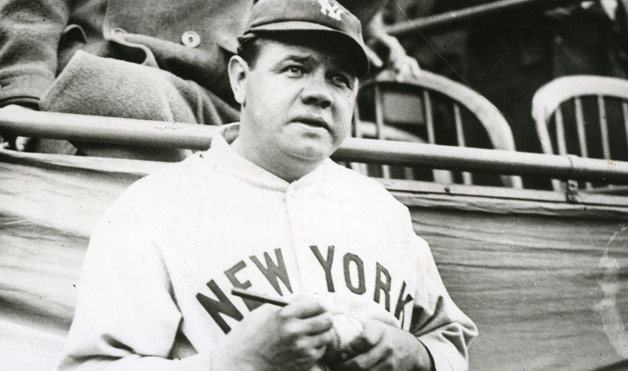 The real heart of this book, though, is found in the stories of McGraw and Ruth, two low-born, hard drinking, brawlers who clawed their way to the top where their lives intersected at a pivotal time in baseball in general and in New York baseball in particular.
Books: “The Rise and Fall of the Bible”
April 8, 2011

THEA BOWMAN
The literary scholar and Catholic nun Thea Bowman recalled in the video “Almost Home” that the old folks she knew when she was growing up in Mississippi were steeped in Holy Writ. “I was reared around a lot of old people,” she said. “They knew Scripture. I knew people who could not read or write, but they could quote you a Scripture with the chapter and verse. They would use Scripture when they were tired and a Scripture when they were frustrated, a Scripture to challenge us . . . a Scripture to threaten you, a Scripture to reward you or to praise you or to teach you; I grew up in that kind of world.’’
But these folks, Bowman said in the album “Songs of My People,” didn’t concern themselves with whether or not Jonah and the big fish that swallowed him were real. What these folks were interested in was the truth that was communicated by that story — a truth that had to do with life today — namely, the imperative of accepting the will of God.
For my money, that was an enlightened point of view, a sensible way of approaching the Bible. Everyone doesn’t agree. There are Christians who believe that the Bible means what it says — period.
 If there are two contradictory accounts of the creation of human beings, two differing accounts of the death of Judas, four accounts of Easter morning at the empty tomb, and three accounts of the conversion of St. Paul — well, this is the infallible word of God, so they say.
This is one of the issues that is explored in The Rise and Fall of the Bible (Houghton Mifflin Harcourt), an engaging little book by Timothy Beal, who is a professor of religion at Case Western Reserve University in Cleveland. Beal writes a great deal in this book about the Bible-publishing business, which he thinks is on the wane — likely to decline if not disappear in the digital revolution. Even at that, he argues, although there are lots of Bibles being published and sold — in a dizzying variety of formats — the number of people who are actually reading the sacred texts is another matter.
 In fact, Beal maintains, some versions of the Bible — loaded with sidebars and commentaries and graphics that tend to push the Chapters and Verses into the background — are not calculated to get people directly engaged with Moses and Isaiah and Mark and Matthew and the rest of that crowd. In many cases, he thinks, the design is to get the reader to accept a particular interpretation of the Biblical content and to overlook — or remain unaware of — the ambiguities and contradictions that are in the very nature of the Bible. These are Beal’s own words:
The icon of the Bible as God’s textbook for the world is as bankrupt as the idea that it stands for, of religious faith as absolute black-and-white certainty. Just as the cultural icon of the flag often becomes a substitute for patriotism, and just as the cultural icon of the four-wheel-drive truck often becomes a substitute for manly independence and self-confidence, so the cultural icon of the Bible often becomes a substitute for a vital life of faith, which calls not for obedient adherence to clear answers but thoughtful engagement with ultimate questions. The Bible itself invites that kind of engagement.
 Beal maintains that the iconic view of the Bible as the single source of religious truth ignores the history of the Bible, which did not exist as a single entity until hundreds of years into the Christian era — and still appears in more than one configuration. Beal predicts that Bible reading — like most other reading — will eventually become a digital experience, and he welcomes that prospect. He sees a healthy similarity between the generations of transmission of the traditions and texts that eventually became the Bible — a process that involved, and still involves, constant re-reading and re-translating and re-interpreting — and the generations to come in which the Scriptures will be subject to the kind of discourse that is already going on in other fields of study on, of all things, the Internet.
Beal points out that Jesus of Nazareth didn’t take the Hebrew Scriptures to have one literal meaning, but engaged in interpretation of a kind that still goes on among Jewish scholars — a process I have listened to with fascination at no less revered a venue than the Western Wall. The author doesn’t see religious faith as a science of certainties but as a struggle that has its intermittent moments of enlightenment and elation and doubt and discouragement. His viewpoint reminded me of an observation made by Albino Luciani — Pope John Paul I — that even the angels ascending to heaven on Jacob’s ladder were taking only one step at a time.
 This is Beal’s conclusion:
In kindred spirit, what if we were to think of the Word of God not as bound between two covers of a book but as that endless noise of interpretation, an inconclusive process that we are invited to join? What if that cacophonous hymn, rising up across time and space from digital networks, living rooms, lunchrooms, churches, and bus stops is the living Word of God? An endless, inarticulate din of talking, arguing, reading, and rereading in the library of questions. The Word as we don’t know it. The Word as we live it. Word without end.

AMELIA EARHART
Somewhere in this home office there is a 78 rpm recording of Jack Kaufman singing “Lucky Lindy” and “Lindbergh, the Eagle of the USA.” The record was part of the hype that followed Charles A. Lindbergh’s solo flight from New York to Paris in 1927. If a female aviator were going to be cast as Lindbergh’s counterpart, there was only one thing about Amelia Earhart that qualified her: She vaguely resembled the pilot. Where flying acumen was concerned, there were numerous women whose experience, skills, and breadth of knowledge far exceeded Earhart’s. As it turned out, that didn’t matter. Earhart had “the look” — or, at least, enough people thought so to make her marketable as “Lady Lindy,” and so, she became the legend and the other women are forgotten by all but students of aviation history. Some things never change.
I read about that in “Amelia Earhart: The Turbulent Life of an American Icon,” by Kathleen C. Winters.

Amelia Earhart and George Putnam
Winters, who died last August, was an aviation historian, biographer of Anne Morrow Lindbergh, and a licensed pilot. In short, she knew a lot about flying and her knowledge gives this book important context. I think it was because of her respect for flying that she took an unfiltered look at Earhart and presented her in what for many readers, including me, is a new light. Not that Winters went after Earhart; on the contrary, she seems to have recognized Earhart’s basic decency and approved of Earhart’s sense of adventure and her independence, her part in the campaign to promote commercial air travel, and especially her insistence and practical demonstrations that women were capable of undertakings once thought the sole province of men.
But Winters shows in some detail that Earhart was undisciplined, sometimes even careless, and that she wouldn’t take responsibility for her mistakes. But although there could have been no Amelia Earhart legend without Amelia Earhart’s cooperation, the magician who created the phantom heroine was Earhart’s husband, George Putnam.

1928 advertisement
Putnam, an opportunistic book publisher at the time, played a critical role in booking Earhart as the first woman to fly across the Atlantic Ocean — a year after Lindbergh’s solo flight. Earhart flew, all right, but she never took the controls, because she was incapable of handling the sea plane that made the flight and because she hadn’t learned to fly by instruments alone — something that could, and did, become necessary over the ocean. A two-man male crew handled the flight and Earhart was “baggage,” as she herself said. But Putnam created so much publicity — much of it exaggerated or just plain false — that Earhart became permanently larger than life, certainly larger than reality. Putnam, who eventually left his wife and married Earhart, also managed the rest of her career, encouraging her in a series of risky and often pointless performances and booking her in never-ending schedule of public appearances that financed the couple’s flamboyant lifestyle.
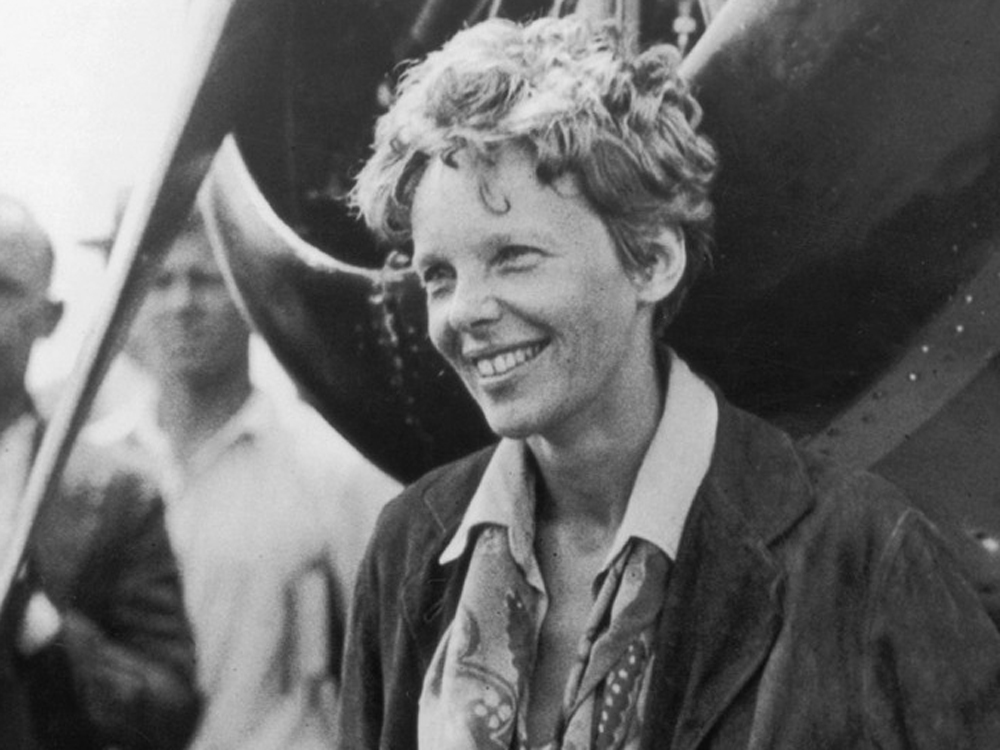
Amelia Earhart after her own solo transatlantic flight in 1932 - 1700 miles shorter than Lindy's.
It’s symbolic of Putnam’s whole approach to Earhart’s career that he signed her, over her objections, to appear in a print ad for Lucky Strike cigarettes, although Earhart did not smoke. The ad didn’t say she smoked, but the implication was clear. What Putnam didn’t anticipate was a strong negative push-back from a public — particularly a female public — that didn’t approve of women smoking.
Earhart was charming, and she did set some speed and distance records, but her indelible place in the public consciousness was based on Putnam’s manufactured image — and on her disappearance in 1937 while she and navigator Fred Noonan were over the Pacific Ocean during an attempt to fly around the world along the equator — a feat that would have had virtually no significance in aviation by that time. Winters points out that Earhart still had limited understanding of radio operation and that neither she nor Noonan knew Morse code. A naval vessel — in a typically improper use of public resources to support Earhart’s private escapades — was trying to monitor Earhart’s approach to tiny Howland Island where a landing strip had been constructed for her at public expense. The crew couldn’t keep contact with the flyer, and all indications are that she and Noonan couldn’t spot the minuscule island or wandered off course and wound up in the ocean. Bone fragments discovered late last year on a Pacific island are being examined for any connection to Earhart. Winters notes a melancholy detail: An experienced flyer encouraged Earhart to have the rudders and wing strips of her Lockheed painted red so that it would be easier to spot if it went down. Earhart liked the plane’s paint job fine just as it was.

Hilary Swank and Richard Gere as Amelia Earhart and George Putnam in the 2009 film "Amelia"
Amelia Earhart: Is it you at last?
February 22, 2011
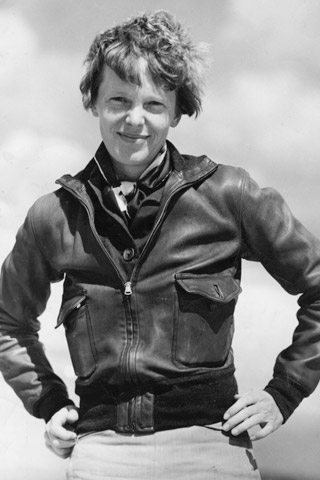 I see by the papers, as it were, that a scientist in British Columbia is going to try to identify bone fragments believed to be those of Amelia Earhart by using DNA technology. Earhart went missing in July of 1937 and was presumably killed along with navigator Fred Noonan during their attempt to fly around the world along the equator. Their bodies were never found, but bone fragments that were found on a Pacific island late last year are being examined at the University of Oklahoma to determine if they are the remains of Earhart. A story published today by The Canadian Press reported that a forensic archeologist at Fraser University in Vancouver is going to try to recover Earhart’s DNA from envelopes that contained letters written by Earhart. The letters were opened at the ends, so the flaps are intact. The premise of the study is that Earhart probably licked those flaps in order to seal the envelopes and that DNA from her saliva may still be present.
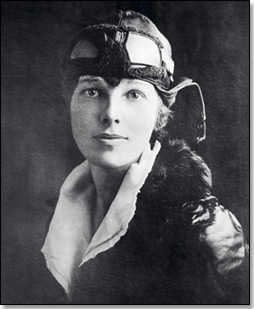 This news breaks while I’m in the midst of reading a recent biography of Earhart by Kathleen C. Winters. I’ll probably post a review here in a few days.
From a practical point of view, it may not matter very much whether those bones are Earhart’s or not. As there always are in such cases, there are folks who want to believe that the explanation for her disappearance is more complicated than that her plane went down, but there is no evidence to support them. On the other hand, anyone with a sense of history hates stories with missing conclusions. So a definitive finding that those bones belonged to Amelia Earhart would serve two purposes – putting unfounded theories to rest and putting the period to an historical epoch.
Books: “Franklin and Eleanor”
January 7, 2011

Franklin and Eleanor Roosevelt in 1941
“I hate it,” Charlie Brown once said, “when there are two sides to a story.” Actually, Charlie, there are at least two sides to every story, and none more certainly than the story of Franklin and Eleanor Roosevelt, probably the most complicated First Couple in American history. The sorting out of their relationship still goes on 65 years after FDR’s death, most recently in Hazel Rowley’s book “Franklin and Eleanor: An Extraordinary Marriage.”
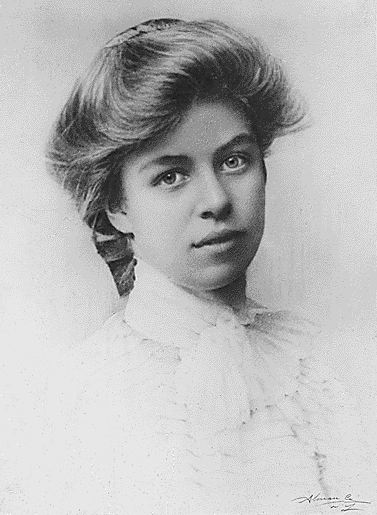
ELEANOR ROOSEVELT in1898
This is not the story of how the insatiable FDR cheated on his wife, leaving the pair in a marriage maintained only for the sake of appearances and finances. It’s a lot more complicated and — in Rowley’s view — a lot more important than that. It is well established by now that in 1918 Eleanor discovered love letters written by her secretary, Lucy Mercer, to FDR, and that the incident had a permanent impact on the marriage. It is also known that FDR promised never to see Lucy Mercer again and that he broke that promise — in fact, that Lucy was among those who were with him in Warm Springs, Ga., in 1945, when he suffered the cerebral stroke that resulted in his death. It is also known that Franklin Roosevelt was an incurable flirt, and that he highly valued his relationships with women who were both charming in their own right and — this was essential — who were charmed by him. Rowley explains that this tendency often irritated Eleanor, but that she came to understand and accept the importance of certain women in her husband’s life.
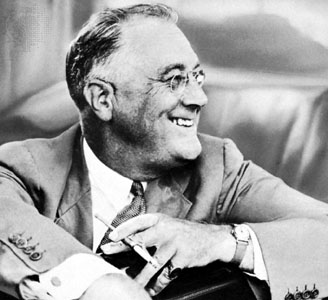
FRANKLIN ROOSEVELT
But the author explains that there was much more to the story than that. Physical intimacy disappeared from the Roosevelts’ marriage, but Rowley writes that Eleanor, who had six children in relatively rapid succession, thought of her sexual relations as a necessary but unwelcome burden. But Eleanor, like most human beings, had needs of her own with respect to affection and intimacy. She fulfilled these needs in more than one way, with both women and men, though how intimate these relationships were is largely a matter of conjecture. Rowley recounts that Franklin encouraged his wife’s friendship with a lesbian couple to the point of helping the three of them build a house and a workshop on property he owned near his mother’s home in Hyde Park, N.Y.
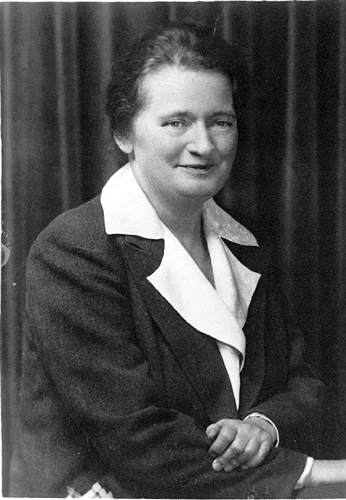
LORENA HICKOK
Eleanor also had an intense tie to Lorena Hickok, a pioneering Associated Press reporter who became so close to the Roosevelts that she herself decided she could no longer report on them objectively. By the time FDR was elected president for the first time, in 1932, Rowley writes, “Everyone in the political press corps knew that Lorena Hickok was a lesbian. By now most of the reporters had figured out that she was passionately in love with Eleanor and that her feelings appeared to be reciprocated.”
Whatever relationships Franklin and Eleanor forged outside their marriage, Rowley maintains, the two of them continued to love and support each other, and they formed a partnership whose vigor helped carry the nation through the Great Depression and the Second World War. At times they seemed to constitute a single person, as Eleanor traveled to places at home and abroad that were beyond her paralyzed husband’s capacity. Although Eleanor’s activism occasionally embarrassed the politically sensitive Franklin, they shared many of the same ideals of social justice.

LOUIS HOWE and FDR
In the process of describing the marriage of these two gigantic historical figures, Rowley draws portraits of many of the interesting characters in the Roosevelt clan and entourage — a crowd that FDR liked to think of as a big, happy family. Not the least of the players was Louis Howe, a disheveled ex-journalist who was one of FDR’s closest advisers for most of his political career, the tireless battery behind the campaigns that made Roosevelt governor of New York and president of the United States. Some of the people around Roosevelt — including his patrician mother, Sara — disapproved of this little man with cigarette ashes on his rumpled clothing, but Eleanor wasn’t one of them, and Rowley describes how it was Howe who repeatedly encouraged Eleanor to make herself heard on the issues that were important to her — a visionary attitude in that male-dominated era.
Books: “The Great Fire of Rome”
December 27, 2010
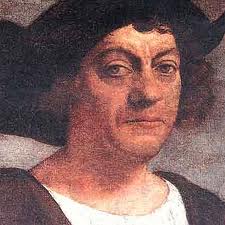
CHRISTOPHER COLUMBUS
When I was a kid, I was led to believe by adults, who I assume meant well, that his contemporaries discouraged Christopher Columbus from undertaking his first voyage to “the Indies” on the grounds that he and his ships would drop off the edge of a flat earth. I didn’t imagine this. I have asked at least a dozen folks of my vintage — which grows increasingly rare, by the way — and they have recalled being told the same thing, even by teachers. I was well into middle age when I learned that the Europeans Columbus was likely to have encountered knew that the Earth was a sphere, and that the argument current at the time had to do with the planet’s size, not its shape. I now know that the idea of a spherical Earth, dates from the sixth century BC, although it wasn’t until much later that there was practical proof of what had been generally accepted as the fact. Columbus was one who helped to demonstrate it. The Admiral of the Ocean Sea, it turns out, wasn’t wrong about the globe; he was simply wrong about its dimensions.

NERO
It wasn’t until more recently — the past few weeks, in fact — that I learned the truth about the Roman emperor Nero, namely that he couldn’t have fiddled while Rome burned, because the violin didn’t appear in Europe until hundreds of years after his death. That came up in a new biography of Nero written by Stephen Dando-Collins, who also casts doubt on the widely accepted ideas that Nero ordered the burning of Rome in 64 AD and that he initiated the Roman persecution of Christians in order to deflect blame for the fire from himself. (The writer points out that there were so few Christians in Rome during Nero’s reign that it’s even likely that the emperor knew nothing about them.)
Nero was 16 years old when he succeeded his uncle Claudius, becoming the fifth Roman emperor and the last who shared a bloodline with Julius Caesar. Among his interests were singing and chariot racing, and he wasn’t content just to be a spectator of either. Dando-Collins explains that Nero repeatedly entered amateur singing contests, which were all the rage at the time, much to the enjoyment of the hoi polloi and much to the dismay of the Roman nobility.
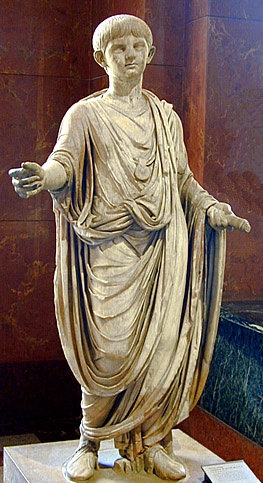
Nero: The boy emperor
Besides sponsoring and reveling in races, he also took the reins at times, once narrowly missing death when he was thrown from the chariot. He first entered a singing competition in Neapolis, what is now Naples. On the occasion of the fire in Rome, he was in his birthplace, Antium — present day Anzio — to participate in another contest. The fire evidently started in the food concessions under the stands of the Circus Maximus, which was the largest wooden structure of any kind and the largest sports arena ever built. The capacity was about 300,000 spectators.
Rumors that Nero was responsible for the fire and that he had ordered his agents to impede the firefighting — such as it was — began while the city was still in flames. The rumors were the results of a complex of jealousies and intrigues that were common to life in the corridors of Roman power. They were encouraged, ironically, by Nero’s seemingly efficient response to the fire, which some said he caused so he could remake the city in his own image. He did build an enormous new residence for himself, but he also rebuilt the devastated part of the city with broader streets and a better water supply and — of all things — building codes to prevent some of the shoddy construction that had contributed to the losses in the fire.

AGRIPPINA
Nero did a great deal to assist those whose homes and belongings were wiped out in the fire, but he was no angel. He irritated powerful people with what they considered his coarse behavior — including his bi-sexual adventures — and with his choices for appointments, favoring freedmen to blue bloods. He led the kind of uneasy life that went with being emperor of Rome, and his insecurities — some of them well founded — resulted in the suicides and executions of many a noble figure, not the least of whom were his mother, Agrippina the Younger, and his stepbrother. Dando-Collins describes in some detail the political dynamics and the bloody outcomes that both solidified Nero’s power and eventually led to his own downfall a few years after the fire, when he was only 30 years old.
Many of us, who have no reason to be students of ancient Roman history, carry around a cartoonish notion of Nero as a crazy tyrant. But while Dando-Collins doesn’t try to disguise the extreme measures the emperor would take to keep himself on the throne — and his head on his shoulders — the writer does present Nero in context. He points out that contemporary accounts of Nero’s life were written in most cases by men who disliked him, that his manner of dealing with political enemies and criminals was not out of line with the practices of the time — in fact, was more lenient — and that he was remarkably patient with people who ridiculed him. The author also regards Nero as a “visionary” with respect to public works and points out that the empire was prosperous under his administration — at least until he started collecting and spending money to rebuild the ruined capital.
As much as we’d like to know the whole truth about people like Nero, they make history more interesting in their own way by flitting in and out of the shadows.
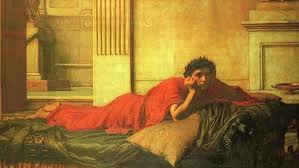
Nero agonizes over the death of his mother, whose constant interference caused the emperor to order her execution. Painting by John William Waterhouse
Books: “Here’s Looking at Euclid”
November 24, 2010
 Overall, I don’t think my father was disappointed in me. He didn’t set himself up for disappointment, because he didn’t pressure me to pursue any particular career. When I said I wanted to be a priest, that was all right with him. When I became a newspaper journalist instead, that was all right, too. He was both a practicing Catholic and a newspaper reader, so he was in a good position for success.
There was, however, one thing that he might have found frustrating about the younger of his sons — Tony’s brother, as it were — and that was my inability to learn how to add several columns of figures without carrying numbers.

NACD photo
At slow moments in my family’s grocery store — where adding columns of figures was a frequent chore — Dad would try to show me how to add three or four columns at once, rather than starting with the right-hand column (the pennies column) and carrying the excess to the top of the column to the left. “Put down the two, and carry the four” — that was how I had learned arithmetic. I couldn’t understand the alternate method Dad tried to teach me, which annoyed me, because he could add columns of figures with his technique nearly twice as fast as I could do it with mine.
Many years later, the dawn broke in my clouded mind while I was reading a book on math. There, for Pete’s sake, was Dad’s method — explained just as I remembered Dad explaining it — but somehow I finally understood it and have used it ever since.
 Like many people, I suppose, I regarded math at best as a necessary evil in elementary and high school. I didn’t go near the subject in college or graduate school. When I was in my 30s, however, I inexplicably chose to read a book on math written by Bertrand Russell, and was surprised to find that the subject was attractive. As I result, I have read many books about math, the most recent one being “Here’s Looking at Euclid” by the British journalist Alex Bellos.
In fewer than 300 pages, Bellos covers a remarkably wide range of topics. He explains the origins of mathematical concepts that we take for granted — the sixty-minute hour and sixty-second minute, for example — and how mathematical understanding has evolved since some Sumerian in the fourth millennium B.C. first pressed a stylus into a clay tablet. He writes about pi and infinity and probability (including its role in gambling), and the bell curve.

MUNDURUKU MEN
Bellos begins his book with an account of the Munduruku people of Brazil, who have a number system that goes only from one to five. Moreover, the Munduruku use only the numbers one and two to count precisely, using three, four and five more as estimates. In fact, Bellos explains, the Munduruku are baffled by others’ compulsion to enumerate people or objects and either cannot or will not answer if asked how many children they have. They know who their children are; that’s enough for them. It’s healthy, I think, to be reminded from time to time that everyone doesn’t look at the world through the lens we use.

Ventura College
What I particularly like reading about is the mystery and elegance that many people find in numbers. One example is the “golden proportion” or “golden ratio,” to which Bellos devotes a chapter. The definition of this term, known to mathematicians as phi, might be off-putting at first. Here it is as Bellos explains it: “The golden mean is the number that describes the ratio when a line is cut in two sections in such a way that the proportion of the entire line to the larger section is equal to the proportion of the larger section to the smaller section.” That number begins as 1.61803 and, like pi, goes on forever. It appears in many familiar geometric figures, including the five-pointed star. The 16th century mathematician Luca Pacioli, Bellos reports, “concluded that the number was a message from God, a source of secret knowledge about the inner beauty of things.” That notion may seem remote until Bellos explains how a retired dentist discovered that the golden proportion was the key to designing dentures that give an individual patient a proper smile – now a widely accepted principle in dentistry.
I’m sorry now that I once thought of math only as a nuisance, but books like this one have helped me make up for a misspent youth.
Books: “Lyndon B. Johnson” by Charles Peters
August 27, 2010

LYNDON B. JOHNSON
For my own amusement, I keep a file of presidential trivia, but there is one fragment of information about the 36th president that I have chosen to omit: Lyndon Johnson was the only president who conducted staff meetings in his bathroom while he was moving his bowels. The fact that he bullied his staff into participating in this bizarre behavior speaks to one of the worst characteristics of the president. And, I suppose — to the extent that they didn’t have enough personal pride to tell him to go take a whaddyacallit — it speaks to the self image of Johnson’s toadies. He was a coarse, loud-mouthed bully, and that went along nicely with his appetites for alcohol and women.
Johnson, in a few words, was no damned good. That is, he would have been if he hadn’t conducted the most successful domestic policy of any president except Franklin Roosevelt; if he hadn’t used his political brawn and skill to enact such measures as the Elementary and Secondary Education Act and the Voting Rights Act, and if he hadn’t sponsored such programs as Medicare. These contrasting realities about LBJ are described in “Lyndon B. Johnson” by Charles Peters, one of a series of short presidential biographies by Times Books.
 Maybe it has been true of every president including George Washington and Abraham Lincoln that the nation has had to accept the bad with the good sides of a man, but that lesson has hardly been more boldly drawn than it was in the case of Lyndon Johnson.
Peters, who was a member of the administrations of John F. Kennedy and Johnson, gives plenty of examples of Johnson’s petulance, pettiness, and cruelty, including his weakness for publicly humiliating the people around him. Peters reports instances in which Johnson obfuscated or simply lied, including to the American public, in order to get his way — although LBJ hardly originated that tactic. In fact, Peters describes the scenario in which LBJ, then vice president, was left out of the loop when Robert Kennedy secretly agreed to the withdrawal of American missiles from Turkey as a quid pro quo for the withdrawal of Soviet missiles from Cuba. LBJ succeeded to the presidency and pursued what turned out to be a very aggressive policy against North Vietnam and the Viet Cong without knowing how the missile crisis had been resolved.
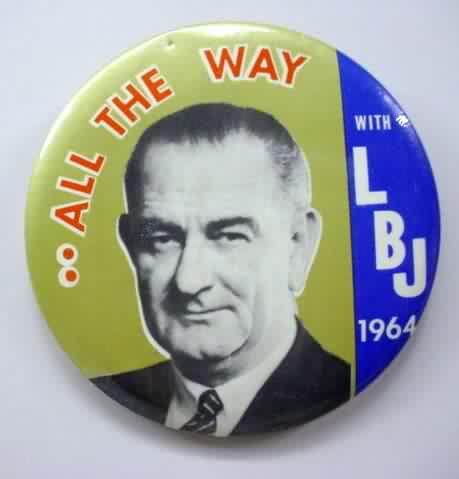 Johnson was an extraordinarily ambitious man, and he never made decisions without weighing the political consequences for himself. For instance, he abhorred the idea that he would be cast as a weakling if he publicly vacillated from a determination to prevent the fall of South Vietnam — even while he seriously doubted that the war could be won and made several efforts to achieve a negotiated peace.
The war — or, at least, the way the war was perceived by much of the American public by 1968 — was Johnson’s undoing. People may forget about Johnson showing off his surgical scar, using an aide’s lap as a footrest, lifting his hound by its ears, or even pursuing one sexual affair after another. However, as Peters notes, the bloodshed and the divisiveness and LBJ’s unprecedented decision to decline to run for reelection will always be associated with his memory.
Still, this unlikeable man took a courageous stand during a time of great uncertainty in the country and doggedly promoted his programs to help the poor, to assure medical care for the elderly, to assist students, and to finally bring true political equality to black Americans. Historians can spend eternity speculating whether all of that could have been achieved in the America of the 1960s without an SOB of Shakespearean proportions in the White House.
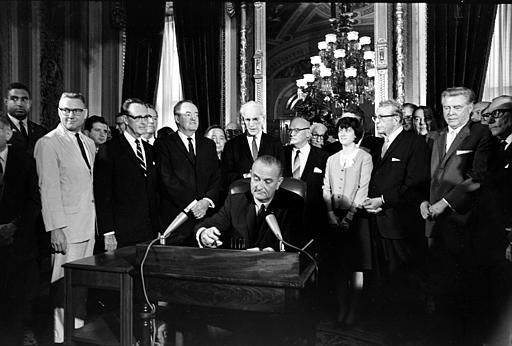
President Johnson signs the Voting Rights Bill in August 1965. Although previous legislation had guaranteed the franchise to all citizens, this bill was actually enforceable.
“Time is blind, but man is stupid.” — Victor Hugo
August 19, 2010

CHARLES LAUGHTON
I heard a promo recently about a segment on Public Radio, and the gist of it was, “What book did you read when you were young that changed your life?” I heard only the promo, but it got me to thinking about the question, and my answer — momentous if not quite life-changing — seemed to be Victor Hugo’s 1831 novel known in English as “The Hunchback of Notre Dame” and in French as “Notre Dame de Paris.” I was around 13 or 14 years old when I spotted a paperback copy of the novel on one of those carousels in a sweet shop near our house. I think I was attracted to it because of the suggestive illustration of the gypsy girl Esmeralda on the cover. (Did I mention that I was about 14?) In those days a paperback book cost less than a buck, so I bought it and sneaked it into the house, figuring the cover might attract unwanted attention.
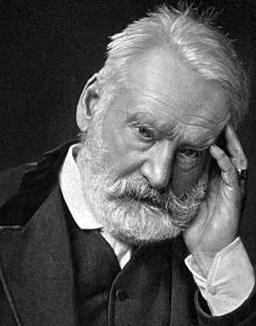
VICTOR HUGO
I went to elementary school from the late ’40s to the mid ’50s, and the most provocative thing I read was Henry Wadsworth Longfellow’s “Hiawatha.” I was taking quite a leap from that curriculum to Victor Hugo — although I didn’t know it at the outset because writers like Victor Hugo weren’t mentioned at Memorial School. I was mesmerized by the book. I read it over and over. I certainly had never read such descriptions of lust and violence, and I was scandalized but fascinated by the idea of all this immorality in the Church.
What I found most absorbing, however, was not the salacious aspects of the plot nor the images of Esmeralda but the deformed bell ringer, Quasimodo, who has become the popular symbol of this story. As I mentioned in a post about six months ago, Quasimodo was so named because when he was an infant his mother abandoned him at the cathedral of Our Lady of Paris (“Notre Dame de Paris”) on Quasimodo Sunday — the first Sunday after Easter. The Introit of the Mass for that day is taken from the second chapter of the First Letter of Peter: Quasi modo geniti infantes, rationabile, sine dolo lac concupiscite ut in eo crescatis in salutem si gustastis quoniam dulcis Dominus. That passage is often translated, As newborn infants do, long for pure spiritual milk so that through it you may grow into salvation, for you have tasted that the Lord is good.
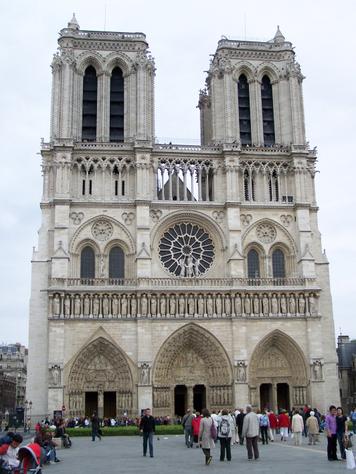
NOTRE DAME DE PARIS
When I first read the novel, I was especially energized by the passage in which Quasimodo defies both public and ecclesiastical authority and rescues Esmeralda from imminent execution, and I was deflated by his ultimate failure to save her. Aside from the drama, though, one seemingly innocuous phrase in the translation I read had a permanent impact on me — so much so that I recall it more than 50 years later. It was Hugo’s reference to Quasimodo as “the unfortunate man.”
In the popular retelling of this story, what is frequently lost is that core reality that the grotesque figure who plays a critical part in it was a human being with the same desires and sensibilities that motivate all human beings. The very fact that the story is popularly known as “The Hunchback of Notre Dame” — as though his misshapen spine defined Quasimodo as a person — suggests a disregard for, or at least an ignorance of, Hugo’s intention to present Quasimodo as a man motivated by two understandable feelings — a sense of loyalty to the archdeacon Claude Frollo, Esmeralda’s nemesis, who had provided the foundling with a home, and a chaste affection for Esmeralda, the only person to show Quasimodo compassion.

LON CHANEY
This experience of the fictional Quasimodo resonates in the experience of the real Joseph Merrick, the 19th century Englishman who was known to his contemporaries and is widely known now as “the elephant man” because he was so “unfortunate” as to suffer from a disease that badly deformed his body. Life gave Merrick two choices — to be alternately displayed and hounded as a freak or to withdraw from society almost entirely and live in seclusion in London Hospital. I think it is a telling detail in Merrick’s biography that once he was living permanently at the hospital he asked to be confirmed in the Church of England. I suppose that request was an indication of his hope, or faith, that in the mind of God he was as much a human being as any other amalgamation of body and soul.
Hugo’s novel was my answer to the NPR question both because it introduced me to classical fiction and because it made me aware for the first time of the whole creature that may be imperfectly displayed in the features and posture of a man, woman, or child — something, I am sorry to say, I have had to be reminded of many times since.
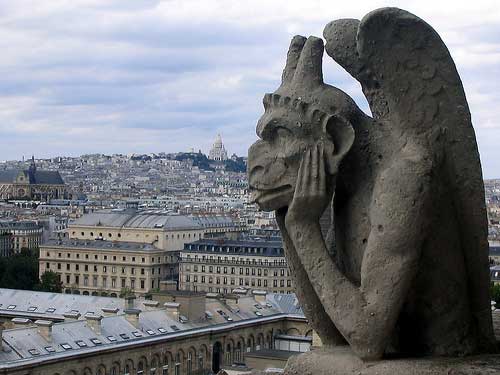
Gargoyle at Notre Dame de Paris
While I have been musing over the question posed by NPR, I have learned that among Hugo’s many concerns was what he construed as a threat to the integrity of architecture in Paris and throughout Europe. In his mind, Hugo connected this fear with what he worried would be the numbing effect of the recently-invented printing press, an idea he touches on in “Notre Dame de Paris.”
The cathedral itself, which was begun in the 12th century and completed in 1345, was in disrepair in the early 19th century, partly as a result of the protracted political turmoil in the city and partly because of simple neglect. Hugo writes:
The church of Notre-Dame de Paris is still, no doubt, a majestic and sublime edifice. But, beautiful as it as been preserved in growing old, it is difficult not to sigh, not to wax indignant, before the numberless degradations and mutilations which time and men have both caused the venerable monument to suffer, without respect for Charlemagne, who laid its first stone, or for Philip Augustus, who laid the last
On the face of this aged queen of our cathedrals, by the side of a wrinkle, one always finds a scar. “Tempus edax, homo edacior,” which I should be glad to translate: Time is blind, man is stupid.
The attention Hugo called to the condition of the cathedral was at least partly responsible for a major renovation of the structure, which is the focal point for many visitors to Paris. You can see interactive panoramic views of the cathedral by clicking HERE.Alfred Barbou illustration from the first edition of the novel.
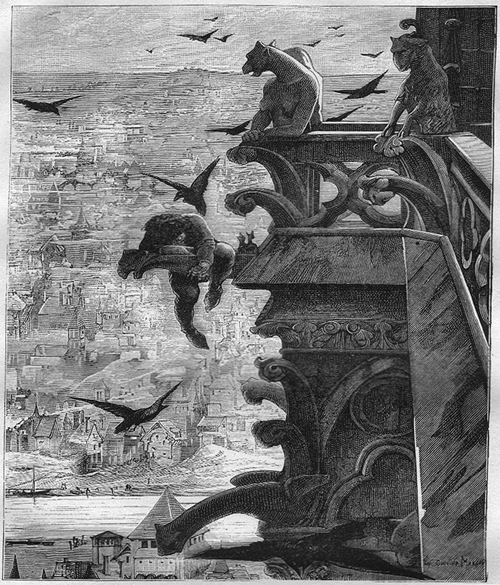
Netflix Update No. 36: “The Last Tycoon”
August 16, 2010
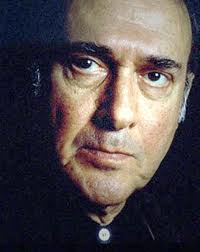
HAROLD PINTER
A friend told me last night that on Saturday he saw a play by Harold Pinter, “No Man’s Land.” My friend posed a question: “Did Pinter always write like that?” I am not an expert on Pinter, and I have never seen “No Man’s Land,” so I could have escaped this conversation save for the fact that while my friend was watching “No Man’s Land” on a stage, my wife and I were watching “The Last Tycoon” on a Netflix DVD. The 1979 film, directed by Elia Kazan, had a screenplay written by Pinter based on an unfinished novel by F. Scott Fitzgerald.
I asked my friend what he meant by his allusion to Pinter’s writing, and he said that while the play was literate and funny, and the performances were engaging, the experience left him with a feeling of ambiguity. I have since learned that while “No Man’s Land” was well received when it first appeared in 1975, it left critic Michael Coveney, writing, “Yes, but what does it all mean?”

F. SCOTT FITZGERALD
I was in no position to sort that out, but I did tell my friend that while “The Last Tycoon” is a worthwhile diversion for some reasons — including excellent performances by an impressive cast — the movie, too, raises questions that it doesn’t answer. It has been said that Pinter liked to lead his audiences somewhere between reality and dream, and that is the effect of this film.
“The Last Tycoon” is Monroe Stahr, a Hollywood producer whose demanding personality, at least, Fitzgerald ostensibly based on MGM’s “boy genius,” Irving Thalberg. The premise of the film is that Stahr’s wife, who was a major star at the same studio, died suddenly and at an early age, and that Stahr has not gotten over it. In the meantime, he is engaged in a power struggle with studio executive Pat Brady, whose young daughter is in love with Stahr. In the aftermath of a minor earthquake, Stahr notices a young woman — Kathleen Moore — who strongly resembles his late wife. He becomes obsessed with Kathleen, pursues her, seduces her, loses her. As he unravels emotionally, he also runs afoul of his employer, allowing Brady to push him aside.
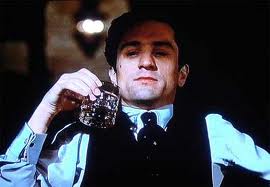
Robert De Niro as Monroe Stahr
Stahr is played by a 36-year-old Robert De Niro in a performance so devoid of emotion that the audience gets no help in determining what this character’s reactions to people and situations really mean. Kathleen is played by Ingrid Boulting, a South African-born actress who is now an artist and yoga instructor in California. Her performance is much more interesting, but — thanks to the writing and direction — her character is inscrutable. Does she resent the fact that Stahr was attracted to her because of her resemblance to his lost love? Does she love him? Is she a woman easily used by men, is she a tease, or is she an opportunist — even a prostitute? What becomes of her? What becomes of Stahr?

INGRID BOULTING
It’s not the worst experience in the world — this not knowing; in fact, maybe it’s more like life than the movies usually are. At any rate, flawed or not, the story is well told by a cast that includes Robert Mitchum as Pat Brady; Jack Nicholson as a Communist who is trying to organize the studio’s writers; Dana Andrews as a director who incurs Stahr’s dissatisfaction; Ray Milland as a studio attorney; Tony Curtis as a top leading man; Donald Pleasance as a writer, and John Carradine in a brief but charming turn as a studio tour guide.
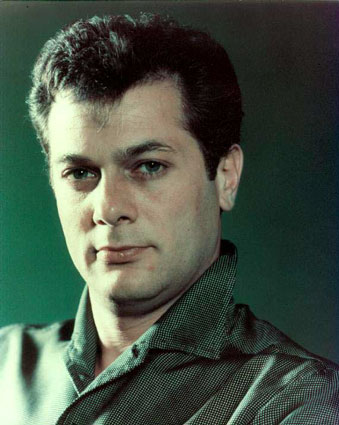
TONY CURTIS
A scene between De Niro and Curtis provides one of the best examples of Pinter’s approach. The leading man, Rodriguez confides in Stahr: the actor is in love with his wife but has become impotent, and not only with her. Stahr’s reaction to the inexplicable fact that the actor has come to him with this problem is, like the rest of De Niro’s performance, difficult to plumb. More than that, the scene ends abruptly — with no resolution– but when Rodriguez and his wife encounter Stahr later in the film, they appear deliriously happy with each other, and the change is never explained.
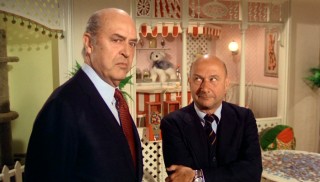
Ray Milland and Donald Pleasence
To give credit where it is deserved, I should mention that De Niro has one scene in this film that I could watch again and again. Stahr is having a confrontation with a British writer, Boxley, played by the great character actor Donald Pleasence. Boxley is complaining about the “hack” writers he’s working with, and he’s complaining about the story line on the film he has been assigned. In an attempt — fruitless, as it turns out — to get Boxley off the schneid, Stahr fabricates the fragment of a story line that has no beginning or end — a mysterious vignette about a girl who comes into a room, unaware that she’s being observed, with two dimes and a nickel and a box of matches, and a pair of black gloves that she burns in a wood stove. De Niro tells this story with such skill, with such a teasing air of mystery, that he make the story irresistible and the desire to know the rest of it palpable.
If you don’t mind scrolling through the whole script, you can read that story at THIS LINK. It begins with Monroe Stahr’s words: “Listen … has your office got a stove in it that lights with a match?” See if you can read that without thirsting for the rest of the story.

Robert De Niro as Monroe Stahr
 CharlesPaolino's Blog