Warp speed and other diversions
July 2, 2009
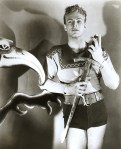
BUSTER CRABBE as Flash Gordon
I once saw a cartoon panel taped to the wall outside a psych professor’s office at Kean University. A man of middle age was slumped in an easy chair in what seemed to be a state of depression. His wife stood over him, hands on her hips, and addressed him more or less as follows: “What I can’t understand is why you would read a book called ‘Oblivion and the Abyss’ in the first place!”
Well, I just got around to reading “Physics of the Impossible” by Michio Kaku, who is a theoretical physicist. In this book, which came out last year, Kaku discusses the possibility that various achievements that human beings have imagined and even tinkered with will become practical realities. We’re talking here about such things as teleportation, telepathy, time travel, invisibility, and visitations from “outer space,” concepts that have been the fodder of science fiction from Jules Verne to Flash Gordon to Star Trek.
I don’t know why I was disappointed; I think I already knew the overall thrust of what Kaku would say. Certain of these concepts – invisibility and teleportation, for example – are not contrary to the known laws of physics and may be achievable within a forseeable amount of time, where what is forseeable might be measured in hundreds of years. (I’m oversimplifying this.) Others, such as travel to other galaxies, are not contrary to the known laws of physics but are beyond the capabilities of a civilization of our rudimentary level of advancement. Still others — perpetual motion and travel into the past, for example — are contrary to the known laws of physics and impossible, period.

SATURN
Intellectually, I’m not surprised, but I’m disappointed nonetheless. I would rather have continued nursing the fantasy, born while I watched Flash Gordon and Doctor Zarkov matching wits with Ming the Merciless, that some day, somehow, I would board a space-going vessel and leave the gravitational pull of this planet, at least for a long weekend.
But Kaku has taken the wind out of my sails, if I may be allowed the metaphor, and I look with a twinge of melancholy at the images of Saturn and her moons being transmitted by the Cassini craft — and particularly the one in which Alpha Centauri gleams in the perpetual night sky far beyond the great planet’s rings (http://saturn.jpl.nasa.gov/index.cfm).
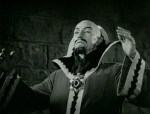
MING THE MERCILESS Charles Middleton
A friend of mine told me a couple of years ago that her employer had reserved a place for her on a voyage into space as soon as such a thing became available to consumers. That would have been all right as far as it went, but the trip envisioned would have been a little more than 300 miles each way. My ambition far exceeded that, and Kaku has made it clear that I was deluding myself.
Well, it was a relatively short time ago that some of the ideas that Kaku fools around with — such as an electron that can be in two places at the same time — were not only unknown but unimagined. So rather than put my vacation to Alpha Centauri out of my mind, I’ll put it on hold. After all, I’m only 66 years old. In the meantime, I still have to see the Grand Canyon.

CASSINI VIEW OF ALPHA CENTAURI OVER THE RINGS OF SATURN
“All my life’s a circle” — Harry Chapin
May 31, 2009

Photo by Jim Dirden
I just finished reading a new biography of Pete Seeger by Alec Wilkinson of The New Yorker. It’s a short, well-written work that gives a good look at Pete’s personality. It is based on a series of interviews Wilkinson conducted at Pete’s home in Beacon, N.Y.
This isn’t a fawning portrait. Pete’s doubts and insecurities come through, in his own words.
It is also interesting to learn in this work about Pete’s parents, and particularly his father, Charles, who was also an idealist.
There is a lack of balance in the way many people react to Pete. There are many who think of him only as a folksy singer of campfire songs – sort of a Tennessee Ernie Ford. There are those who cast him in a messianic role that he himself would reject. And there are those who think he is the antichrist because, like many thoughtful people of his and his father’s generation, he associated for a time with people who felt Communism held the answers to chronic economic, social, and political problems. Pete acknowledges – including in this book – that that was a mistake, but more than a half century later, some folks still pillory him for it.

Pete is well known not only for singing but for encouraging his audiences to sing with him. Wilkinson’s book examines this practice, which for Pete isn’t just a cutsey stage trick. Calling on people to sing goes to the heart of Pete’s notion of what music is for, and gets to discuss that in his own words in this book.
Pete Seeger has been an important figure in the history of the past seven decades – not always clearly understood, even by himself. Wilkinson’s book at least helps formulate the questions.
Good, good grief
May 30, 2009
 I just read — for the purpose of reviewing it — a book called “Security Blankets: How Peanuts ® Touched Our Lives.” This is a collection of about 50 stories from people who feel their time on earth has been enriched somehow by the comic strip, the books, the TV specials, the tchatchke, or by some encounter with Charles Schulz himself.
It appears to me that the book is an attempt to reinvigorate the trade in stuffed Snoopy dolls (referred to repeatedly in the book as “plush”) or other “collectibles.” Maybe the Peanuts market is suffering from the combined effects of Schulz’s absence, the aging of the Peanuts Generation, and the paucity of disposable income.

THE RED BARON
That’s not to say that there aren’t some good stories here. One of my favorites was submitted by a man whose father was not only a World War I flying ace, but who piloted a Sopwith Camel and, in August 1918, actually outran the Red Baron himself.
Several of the people whose little essays appear in this book said, in one way or another, that their own cares or frustrations became a little easier to bear when they realized that others shared their feelings. Of course, the “others” were fictional cartoon characters, although many a Tuesday night meeting in the basement of a Unitarian church might have provided the same kind of support, except in flesh and blood rather than pen and ink. The writers in “Security Blankets” may have been unwittingly identifying with the often solitary and unfulfilled artist behind those characters rather than with the characters themselves.

MICKEY MANTLE
Still, these stories reminded me of a book I read that contained a collection of letters that had been written to Mickey Mantle whose family published them after his death in order to raise money for an organ-transplant program. The letters told Mantle how much he had meant either to the writer or to someone in the writer’s life — a father, perhaps. Mantle, I have read elsewhere, was always mystified by sentiments of this kind. He felt, I suppose, like Louie DePalma — the “Taxi” character — who said of his girlfriend: “She sees something in me … something that’s not there.”
But both cases may be related to an idea I passed along to my students last semester — that once a writer has published a story, a poem, or an essay, he no longer owns it. Once he has published it, it belongs to the reader — and to each individual reader in a unique way. Neither the writer nor the writer’s critics can tell the reader what the reader can infer from the work. Maybe that’s true of cartoonists and swtich hitters, too: that once they have led their lives, they cannot control, nor contradict, what people infer from them.
“But on the other side, it didn’t say nothin’. That side was made for you and me.” — Woody Guthrie
May 27, 2009
 One of my favorite encounters with the unique Italian mentality involved a police officer who was trying to give me driving directions to the Piazza di Venezia in Rome. He repeated the directions several times, but each time I was stumped when he said, “You’ll see a sign that says ‘don’t turn left.’ Turn left.’ ” Finally, he became frustrated with me and told me to follow him with my car while he walked me through the first part of the trip. At the end of a narrow street – an alley, really – he turned toward the car and held up both hands. He walked over to the driver’s widow, pointed at the universal symbol displayed on the street corner, and asked, “Si vede il segno che significa non girare a sinistra?” Yes, I said, I could see the sign that meant “don’t turn left.” “Beh!” he said. “Svoltare a sinistra!!”
Oh.
The Christian Science Monitor has interesting reviews of several books and a web site that explore various aspects of the signs that tell us where we should or can or should not or cannot go. It’s at this link: http://www.csmonitor.com/2009/0522/p17s03-algn.html
What’s it all about, Sarah?
May 14, 2009

GOV. SARAH PALIN
I’m the guy who told a couple of generations of reporters and journalism students that a good writer can stop any person on the street and write an interesting story about him. So far be it from me to suggest that there isn’t a good story to be told about Gov. Sarah Palin, R-Alaska. As it turns out, Gov. Palin herself – a former journalism student – is going to take on the job herself after signing a book deal with HarperCollins and Zondervan. She anticipates that the project will take about a year which, if she can stick to that schedule, would get it into Borders in time for the 2010 gubernatorial election. I’ve seen some cynical references to that in what the governor refers to as “the anonymous blogosphere,” but why begrudge her that advantage – or the kind of money she can command while people are still interested in her? If Richard Nixon could appear on “Laugh-In,” why shouldn’t Gov. Palin write a memoir? It could be time consuming, especially because the governor says that, despite the collaborator assigned to the book, she wants to write most of it herself.

ULYSSES S. GRANT
News of this enterprise naturally evokes questions about the content. The governor is a relatively young woman who has had a relatively short – and dare we say largely inocuous – public career. Ulysses S. Grant put off his memoirs until he had been the general-in-chief of the victorious Union Army and twice president of these United States. And Dwight Eisenhower saved his written reflections until he had been supreme allied commander in Europe, general of the Army, and twice president. What will the governor write to hold a reader’s attention for two or three hundred pages? She did discuss that in a general way with a newspaper reporter as follows: “I just really look forward to being able to relate to people through this book, those who are anxious to hear stories about people who are facing similar challenges perhaps. That’s balancing work and parenting — in my case work does mean running a state, and family involves a large and fun and colorful ordinary family that really has been thrust into maybe some extraordinary circumstances.” See?
I expect Harper has editors to deal with misplaced “perhapses” and “maybes,” but I hope the book clubs are heavy with folks “anxious to hear stories about people who are facing similar challenges.” Perhaps.
Ike as in “like”
May 2, 2009

DWIGHT EISENHOWER
I just finished reading “Ike: An American Hero,” the 2007 biography of Dwight Eisenhower by Michael Korda, a former RAF pilot whose books include a biography of Ulysses S. Grant. This book seemed almost as long as the Second World War, but it provides a lot of insight into the military realities of the allied campaign for control of North Africa, Sicily, and ultimately the European mainland via the beaches of France.
Korda, who is British, tries to sort out the conflicting judgments about Eisenhower’s military leadership, which varies in direct relationship to which side of the Atlantic it comes from. That’s an interesting point in itself, because what Korda finds to be the key to Eisenhower’s genius is that he was able to manage and manipulate the constant head-banging among allied leaders – Winston Churchill, Charles DeGaulle, Joseph Stalin, and Franklin Roosevelt – who seemed to have few common interests beyond defeating Nazi Germany, and – on the other hand – who had many interests that were in conflict.
Scholarly rankings of the presidents – a pointless exercise in many respects – usually place Eisenhower among the top 10. Korda – while acknowledging several embarrasments and failures in the administration – gives Eisenhower a balanced report card for his eight years in office, but devotes most of the book to Eisenhower’s military career and particularly to the war. He emphasizes a point that may be lost on later generations, namely that as Supreme Allied Commander in Europe, Eisenhower exercised – and successfully – what was arguably the greatest measure of military and political power ever placed in the hands of a single person, before or since. He acted in some cases – for instance, in dealings with Stalin – as though he himself were a head of state.
Korda discusses Eisenhower’s analysis of the Korean War – namely that it couldn’t be won without an American military commitment that probably would have sparked another world conflict; his refusal to send American combat troops into what he considered the French colonial war in Vietnam, and his caution against American military involvement in the Middle East – a bitter lesson for Eisenhower himself in Lebanon.
I got to see Eisenhower in person in 1964 or 1965, when I was a graduate student at Penn State. I was working in the public information office and heard there that Eisenhower, who lived in Gettysburg at that time, was going to visit State College to address a group of high school students. Eisenhower was the first person to be protected under the Former Presidents Act, but you couldn’t tell it from his appearance at Waring Hall. I had no business there, but no one stopped me from going in and sitting in a balcony looking down on Eisenhower as he stood alone on the stage talking to those teenagers.

PORTRAIT OF EISENHOWER
He spoke to the students about civic responsibility, about not exercising their democratic rights by standing on the sidelines of political life. He was in his late 70s then and had suffered some serious health problems, but he stood ramrod straight with the military bearing that had been drilled into his DNA. He also had that good-natured ease of manner that Korda repeatedly argues contributed as much as anything else to Eisenhower’s success in the Army and in civilian life.
 CharlesPaolino's Blog