Who wouldn’t love a guy named “Vinegar Bend”?
March 3, 2010

JIM BUNNING
I suppose Jim Bunning is used to being taken off the mound. As good a pitcher as he was, he still got the hook from time to time, so the maneuver tonight to put an end to his filibuster so the Senate could pass a bill extending unemployment benefits and other programs should have felt familiar.
If Republican leaders have found Bunning hard to handle, they will get some sympathy from Gene Mauch, who managed — some say mismanaged — Bunning when he was playing for the Phillies and Mauch was his manager. Mauch, who is a partaker in Glory at present, was an early practitioner of calling pitches from the bench — that is, giving signs to the catcher as to what pitch to call for.

GENE MAUCH
Bunning would irritate Mauch by shaking off pitches repeatedly when he knew the signs were coming from the manager. Mauch, who is deservedly well respected as a manager, has come in for some criticism of the way he used Bunning and Chris Short during the 1964 National League pennant race. The Phillies that year performed the flop heard ’round the world. They had a 6 1/2 game lead on September 21, but they lost 10 games in a row to finish tied for second place while the Cardinals won the pennant. Mauch, some say, overdid his reliance on Bunning and Short, who were worn out by that time in the season. I think he started Bunning three times in one week.

WILMER MIZELL
It’s a shame that Bunning, whose baseball career was outstanding, chose to make himself a laughing stock in Congress. He might have emulated Wilmer “Vinegar Bend” Mizell, who pitched in the majors for nine years and ended up with a winning record and a respectable lifetime earned run average. He was no Jim Bunning on the mound, and he was no Jim Bunning in Congress. A conservative Republican like Bunning, he was one of the most popular men in the House of Representatives, where he represented a North Carolina district from 1968 to 1974, when he was swept away in the voters’ reaction the scandals of the Nixon Administration. He later served in a number of appointed federal offices.

MARIE OSMOND
The news that Marie Osmond’s son, Michael Blosil, has “committed suicide,” is unsettling, as such stories always are. What I find particularly sad about a person dying in that way is the loneliness that seems to be a necessary part of the context. I don’t even like the term “committed suicide,” because it evokes the notion that the person involved was ipso facto guilty of wrongdoing, whereas he or she was most likely making a solitary decision to end the torment of fear or confusion or sadness, or perhaps an indefinable feeling that made life unbearable.
I am shaken whenever I hear of someone taking his or her own life, and I had plenty of opportunities to be shaken in that way in more than 40 years of newspaper reporting. My mind almost involuntarily imagines the path that led that person from the potential with which most of us are born to the mental illness or physical ailment or poor choices or bad luck or combination of factors that made only death seem reasonable.

BILL BIXBY and BRENDA BENET
I went through that exercise when I heard of the death of the actress Brenda Benet in 1982. About a decade before, I had interviewed Brenda and her husband at the time, Bill Bixby. I was struck by how animated they were and especially how charged up they were about their lives together. They both talked at once, and he paced back and forth so vigorously that a couple of times he paced right out of the room and into the hallway. They had struck a balance, they told me, between the intimacy of their marriage and the independence of their separate careers, and they were almost defiant in proclaiming it — so much so, that I began my account of the meeting by writing, “You don’t interview Bill Bixby and Brenda Benet so much as you defend yourself.”
They had a child in 1974 and were divorced in 1980, and the child – a boy – fell suddenly ill and died in 1981. Brenda ended her own life in 1982. How alone she must have felt with her grief.
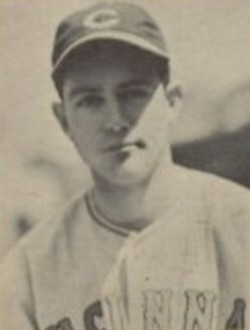
WILLARD HERSHBERGER
News of suicide also reminds me of Willard Hershberger, who died by his own hand — when he was 30 years old — two years and a month before I was born. I know of him because he belongs to a class of men who never die to memory — major league baseball players.
Hershberger, whose home town had the comforting name of Lemon Cove, California, had a distinction that he shared with only a few dozen others; he played for the 1937 Newark Bears. The Bears — who had no connection to the present team of that name — were a Yankees farm club and are reputed in baseball lore to have been the greatest minor league team ever. Their record that year was 109-43, and they finished 25 1/2 games ahead of Montreal. The lineup included Joe Gordon, Babe Dahlgren, George McQuinn, and Charlie “King Kong” Keller.

Willard Hershberger
It must have been an exciting experience for Hershberger, a catcher, who appeared in 96 games that season and batted .325 on a team that collectively batted .299 for the season. He was already 27 years old when he made his major league debut with the Cincinnati Reds in 1938. He was the backup to Hall of Fame catcher Ernie Lombardi. During the 1940 season — with the Reds in contention for the National League pennant — Hershberger was standing in for Lombardi when the team lost games on July 31 and August 2. Hershberger picked up a buzz among the players that they would not have lost if Lombardi had been in the lineup. Hershberger was distraught, and he expressed himself to manager Bill McKechnie.

BILL McKECHNIE
Hershberger evidently told McKechnie that he felt responsible for the losses, mentioned that his father had taken his own life about a ten years before, and intimated that he might make the same decision. This was a private conversation, but accounts say that the manager thought he had calmed the young man. But Hershberger didn’t appear before the next day’s game, and he was found dead in his hotel room.
He was a member of a team, but in the end he felt that failure was his alone. Linda Loman could have been speaking of Hershberger when she said of her husband: “Attention, attention must be paid to such a person,” and I’m sure McKechnie second-guessed himself every day after Hershberger died. But I have had the experience of trying to help such a person and found, in the end, that the loneliness can be intractable, insistent, and that’s the most frustrating and the saddest thing about it.

CHAN HO PARK
The news that Chan Ho Park has signed to pitch for the Yankees got me to thinking about men from other countries who have played in the Bigs. Players from the Spanish-speaking Americas and from the Caribbean have been around the majors for a long time, but the signing of Park shows that there are still frontiers to be crossed: He is the first big-league player to have been born in South Korea — or in any Korea, for that matter.
The first player from outside the United States was probably Andy Leonard, who was a native of County Cavin, Ireland. Leonard broke in in 1876 as a second baseman and left fielder with the Boston Red Caps and appeared with that team until 1878. In 1880 he played shortstop and third base with the original Cincinnati Red Stockings.

ANDY LEONARD
Although Leonard was born on the Auld Sod, he was raised in Newark, N.J., and got some of his early playing experience with a club in Irvington. In ’76, when he broke into the majors, five other players from Ireland appeared with major league teams, along with five from England and one from Germany, which means that England and Ireland had more representatives in the big leagues than all but four states of the Union — New York, Pennsylvania, Massachusetts, and New Jersey.
Other than the United States, the Dominican Republic has contributed the most players to the Major Leagues — 494 through the 2009 season. Venezuela is second with 246 and Canada is third with 225. Puerto Rico, which is part of the United States, has chipped in with 228.

RENO BERTOIA
Considering all the Italian-Americans who have played Major League baseball — not the least of whom were the three DiMaggio brothers — it’s curious to find that there have been only six players who were born in Italy. The first of these was Lou Polli, who was born in Baveno, which is up there in the Piedmont region. Polli pitched a few innings of relief for the St. Louis Browns in 1932 and didn’t appear again until 1944 — a war year in which a lot of guys who otherwise wouldn’t have been in baseball got a crack at it while the regulars were Over There. In ’44, Polli pitched almost 36 innings for the Giants.
The most successful Italian-born player was Reno Bertoia, who might as well have been a Canadian inasmuch as his family moved there when Reno was a year old. He was born in St. Vito al Tagliamento in the comune of Udine, which is near the border of Slovenia. He played in the big leagues from 1953 to 1962, the first six and last two of those years with the Tigers. He was an infielder — a second and third baseman — and he had a lifetime batting average of .244 over 612 games. After he retired from baseball, he was a Catholic-school teacher for 30 years in Windsor.
The Baseball Almanac has a lot of stats about foreign-born baseball players at THIS LINK.
“Half the lies they tell about me ain’t true” — Yogi Berra
February 21, 2010

MICKEY MANTLE
I’m ready to talk baseball, not that I ever stop. The camps are up and running, Johnny Damon has signed with the Tigers, George Steinbrenner was out watching his grandson play in a high school game, and the Yankees are starting to say “Chamberlain” and “bullpen” in the same sentence with more and more consistency.
The more things stay the same, they more they stay the same, and Yogi Berra turned out for yet another spring training. It seems to me that there is a doctoral dissertation in Yogi Berra, maybe in American Studies. Some scholar should examine the history of Berra’s public image, which is more like Babe Ruth’s image than is immediately apparent. The man hasn’t been a day-to-day part of baseball for decades, and his name is still known to people who know nothing about the game, who weren’t yet born when Berra played his last game or, for that matter, managed his last game. He has ears like flapjacks and a hound-dog mug that now looks like a relief map of northern Greece. And we love him.

LAWRENCE PETER BERRA
It is a little early for serious talk about the 2010 season, what with Joe Girardi saying things like this: “I think our No. 1 concern is ironing out our lineup. When I say it’s a concern, I’m not concerned that we don’t have the players to do it, I’m concerned with where you place them.” Uh, did he read that in one of Casey Stengel’s old notebooks?
In my search for some baseball intelligence, the most interesting thing I found today was about a game played in 1953. Several sites have picked up on this story, originally published in the New York Times. This is a hilarious account of Whitey Ford and Mickey Mantle arguing about how the Yankees aborted an 18-game winning streak by losing a game to the St. Looie Browns. As the writer demonstrated, both players were sure of themselves and both had it very very wrong. It’s an object lesson for the rest of us when we’re cock sure of our memories. You can read it by clicking HERE.
“Hard to get happy after that one.” — Andy Kaufman (“Taxi”)
December 5, 2009

Sen. JIM BUNNING
Some baseball players lose their edge over time, but Jim Bunning ain’t one of ’em. He can still put them over the plate, as he demonstrated last week in his verbal assault on Ben Bernanke, who was appearing before a U.S. Senate committee that was considering Bernanke’s nomination to continue as head of the Federal Reserve.
Bunning, a Republican senator from Kentucky and one of the most conservative members of Congress, made a statement at the hearing in which he explained not only why Bernanke shouldn’t be reappointed but why — as my brother might put it — he has no reason to exist. Amid a detailed dissection of what Bunning considers Bernanke’s contributions to the nation’s financial crisis, the senator said: “You are the definition of a moral hazard … Your time as Fed Chairman has been a failure.” The complete statement was published by the Huffington Post at THIS link.

JIM BUNNING
Bunning holds a degree in economics, so for all I know he could be right about Bernanke and about Bernanke’s predecessor, Alan Greenspan, for whom the senator has at least as much affection. On the other hand, his political career has been peppered with bizarre incidents and statements, including his prediction of the death of Supreme Court Justice Ruth Ginsburg and his public pronouncement that he doesn’t read newspapers and gets all his information from Fox News. His approval ratings, for what they’re worth, are at present in the sewer. He has been unable to raise campaign funds — which he blames on a conspiracy against him within his own party — and he will not run for reelection.
Well, if his political career hasn’t been exemplary, that fact will never outweigh his baseball career. He was one of the very best pitchers of his time and is a member of the National Baseball Hall of Fame. He could throw strikes — oh, could he ever! He struck out 2,855 batters while walking only 1,000. Bunning was one of only 40 pitchers in the history of baseball to strike out the side by throwing nine pitches — all strikes. Try that sometime.
“Buy me some peanuts and Cracker Jack.” — Jack Norworth
November 1, 2009

CC SABATHIA
The image of CC Sabathia lumbering out to the mound tonight as the Yankees and Phillies continue the World Series naturally got me to wondering about how Sabathia sizes up, as it were, among the largest players in baseball history. We baseball fanatics always like to know about the extremes. Determining Sabathia’s rank, it turns out, is an inexact process for several reasons: teams don’t always report accurate weights for their players, players’ weight can fluctuate significantly over the course of their careers, and records from the early days of major league ball are unreliable or nonexistent.
With those caveats in mind, I note that Sabathia’s weight has been reported this year as 290 pounds, which is very heavy for a baseball player. The weight of most of about 16,000 players who have appeared since 1876 has ranged from 160 to 200 pounds. Only 1,057 players during that period weighed under 160, which– for example — was Phil Rizzuto’s playing weight.

ALBIE PEARSON horsing around with Angels manager BILL RIGNEY
Being a lightweight hasn’t necessarily impeded a player’s success. Rizzuto is one example. Albie Pierson, whom I mentioned here recently in another connection, weighed only about 140 pounds, but he had a respectable career as an American League outfielder, batting .270 over nine seasons. I don’t know who the lightest legitimate major league player was, but there have been 13 who weighed under 130 pounds. Eddie Gaedel, of course, who made a single plate appearance with the St. Louis Browns — a stunt by Browns owner Bill Veeck — weighed only 65 pounds. Because Gaedel had been signed to a contract and completed an at-bat, he is officially the lightest major leaguer.
The person currently being recognized as the heaviest player in history is Walter Young, a first baseman who appeared in 14 games with the Baltimore Orioles in 2005. Young’s weight that year is placed at 322 pounds. He is six-foot-five. Sabathia is six-foot-seven.
I haven’t been able to determine if Young is still in pro baseball. After his stint in Baltimore, he played in the Padres’ and Astros’ organizations — though not in the majors — and he played with several other clubs until August of this year, when he was released by the Edmonton Capitals of the Golden Baseball League.
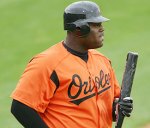
WALTER YOUNG
Young wasn’t with the Orioles long enough to demonstrate how a man of his size could perform in the major leagues. He had 33 charged at-bats in 14 games and hit .303 with one home run. Although it’s difficult to imagine a man of such girth making the kinds of stops made by, say, Mark Teixeira, Young played 54 innings at first base that year, participated in nine double plays and made no errors. All of this projects out to a good full season, but we likely will never know if Young could have played at that level for 162 games.
If Young is through with baseball — or is it the other way around? — he did leave his mark in a certain way. He spent part of the 2008 season with the Sioux City Explorers, who are affiliated with the Yankees and the Indians, and he played an important part in the Explorers’ American Association championship. Young appeared in 26 games and hit .367 with 5 home runs and 29 RBIs.
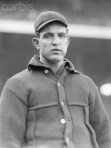
HIPPO VAUGHN
The player whose nickname made the most blunt reference to his weight was James “Hippo” Vaughn, who pitched in the majors from 1908 to 1921, including a couple of seasons with the New York Highlanders, as the Yankees were originally known. Vaughn was six-foot-four and weighed 215 pounds. His bulk apparently worked to his advantage in some way, because he won 20 games in five different seasons — a rare achievement, relatively speaking.
Vaughn, incidentally, was involved in one of the oddest games ever played in the majors — a 1917 contest in which Vaughn started for the Chicago Cubs and Fred Toney started for the Cincinnati Reds. That was the only game in history in which neither starting pitcher allowed a hit for nine innings — a double no-hitter. Vaughn lost the game in the tenth inning. Because of a rule change that occurred much later, Vaughn does not get credit for a no-hitter, which is absurd. Fred Toney, who does get credit, weighed 195 pounds.
“It’s very simple: Keep your eye on the ball.” — Joe Sewell
October 31, 2009
 The coverage this week of Derek Jeter receiving the Roberto Clemente Award got me to wondering again about how he will be regarded a few decades from now. I’m not questioning Jeter’s qualifications; the performance and the stats are there. But baseball immortality, if that’s the right word, comes in more than one form. Many players of at least Jeter’s ability are enshrined in the Hall of Fame, and their statistics are indelibly spread upon the record book, but they are largely forgotten except by people like me who have nothing better to occupy their minds.
Jeter isn’t done, and his career base-hits total promises that his name will come up again and again when that category is open for discussion. But whether he will take on a more transcendent presence in the baseball conversation of the future — especially outside the New York area — is not at all certain.
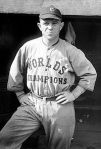 A player who comes to mind in this regard is Joe Sewell, who was a starting infielder in the American League from 1920 to 1933, the last three years with the Yankees and the rest with the Cleveland Indians. Sewell got into the Indians’ everyday lineup as a replacement for Ray Chapman, who was killed by a pitch thrown by the Yankees’ Carl Mays. A couple of Sewell’s batting statistics compare favorably to Jeter’s. His lifetime batting average was .312 compared to Jeter’s .317, and his on-base percentage was .391 compared to Jeter’s .388. But hidden in that on-base percentage was a factor that made Sewell one of the most remarkable players in history.
 Sewell was the hardest man to strike out in the history of the game. Not by a little bit, by a lot. No one else comes close. He came to bat 7,132 times, and he struck out 114 times. Nick Swisher, to pick a convenient example, strikes out more than that every year — 129 times in 2009, for instance. There were four seasons in which Sewell played every day and struck out only four times — only three times in 1932, which is the all-time record. He once went 115 consecutive at-bats without a strikeout — also the record. Over his career, he averaged one strikeout per 63 at-bats. The closest challenger is George Stone who, over seven years in the early 20th century, struck out once in every 50 at-bats.
It’s always risky to talk about sports records that will never be broken, but it’s safe to say that I’ll be shagging flies with Shoeless Joe and “Moonlight” Graham long before anyone makes contact better than Old Whatshisname.
The human element
October 10, 2009

RON GARDENHIRE
Ron Gardenhire is a stand-up guy.
I liked his reaction to the terrible call — against the Minnesota Twins — in last night’s playoff game against the Yankees. The mistake by right-field baseline umpire Phil Cuzzi couldn’t have come at a worse time as he ruled what should have been a double by Joe Mauer a foul ball. The replay clearly showed that Cuzzi was wrong, even though he was in a perfect position to see the play.
Instead of railing at Cuzzi or at umpires in general or at the Fates, Gardenhire said that what’s done is done. He didn’t mention — so far as I know — that his team was the beneficiary of a bad call in its one-game playoff with the Tigers when plate umpire Randy Marsh missed the call when Brandon Inge was brushed by a pitch in the top of the 12th inning – a call that would have scored a run for the Tigers, who lost the game in the bottom of the 12th.

PHIL CUZZI
The conventional wisdom is that bad calls even out, which is a lot more demonstrable in a 162-game regular season than it is in a one-game playoff. Still, I was glad to see Gardenhire’s observation when he was asked if more videotape reviews should be introduced in baseball.
“The great thing about baseball,” he said, is the human element …. and I hope we keep it that way.”
I’m with Gardenhire. Probably enough technology exists to eliminate umpires altogether, but where would be the fun in that? I don’t like when the call goes against my team, but I’d miss complaining about it — and gloating when the call goes the other way.
Just stand in and hit.
“How about that?” — Mel Allen
October 9, 2009

JOHN STERLING
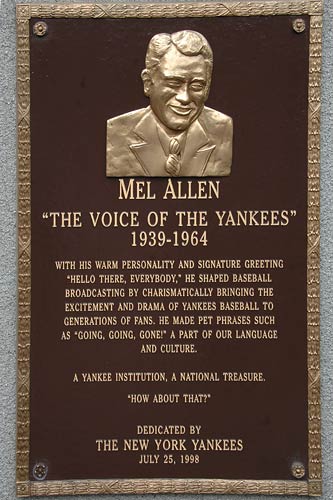
I was amused to read an Associated Press story today by a writer who had the naivete to suggest that John Sterling is a successor to Mel Allen. It is true that Sterling has a job analogous to Mel’s old job, but he’s about as much a successor to Mel as I am a successor to St. Stephen.
The writer refers to Sterling as “the voice of the Yankees,” which is what Suzan Waldman calls Sterling when she introduces him on the radio broadcasts. Frank Messer, who took over when Mel was inexplicably fired, had the grace to always introduce Mel as “the only real voice of the Yankees.”
Sterling and some other baseball broadcasters today are like carnival barkers. I had to laugh the other night when he was making his usual complaints about all the noise in the Blue Jays stadium. What about the noise he makes on the air during every game? Every home run is “high” and “far” whether it’s high and far or not …. and some fly balls are “high” and “far” that aren’t home runs at all. Anyone can find an old Yankee broadcast on the Internet and hear the difference between that and Mel’s mellow “going, going, gone.” And that’s to say nothing about the contrast between Mel’s “and the ballgame is over” and Sterling’s “theeeeeeeee Yankees win!!!!!!” Whenever I hear that I chuckle about the critics who used to call Mel a “homer” — meaning a Yankee partisan.

MEL ALLEN
The quality of baseball broadcasts isn’t helped any, of course, by the fact that almost every word that comes out of the announcers’ mouths is commercialized. The fifteenth out is sold, the call to the bullpen is sold. It won’t be long before there’s a sponsor for every time Nick Swisher looks up at the sky to make sure God is still there. “This look to the heavens is brought to you by ….” Announcers like Mel and Red Barber had it easier; they could talk about baseball for whole half innings at a time. But frankly, I’d rather hear Mel pitching White Owl cigars or Ballantine ale then listen to Sterling shrieking, “the Melkman delivers … that’s the Melky way!”
The AP report says Swisher likes that stuff.
He would.
The AP story is at the following link: http://www.google.com/hostednews/ap/article/ALeqM5jUoeWQsFlz_CsbkUuN-rVb6x3AGgD9B72ASG2
Talkin’ baseball
September 3, 2009
DEREK JETER
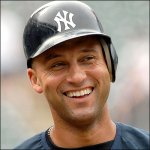
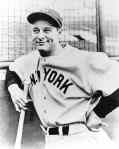
Derek Jeter is on the verge of accumulating the most hits by any member of the New York Yankees – surpassing the record of 2,720 held since 1939 by Lou Gehrig. Gehrig would have had more, of course, had he not come down with ALS and died before he was 37 years old. That’s not Jeter’s fault; he got his hits one at a time like everybody else, and he deserves whatever recognition comes with them.
This not the kind of record that is subject to rationalization by people who don’t like the player — like those who say that Alex Rodriguez built up his records by driving in runs when his team didn’t need them. When a man gets 2,700 hits, there’s only one reason for it. He’s damn good.
LOU GEHRIG
Still, there will be some hint of melancholy around the hit that breaks Lou’s record. Maybe this is a generational thing. I don’t remember Gehrig, but I didn’t miss him by much, and my father — who saw him play scores of times throughout his career — kept the memory alive in our house. Younger people may not feel the regret that someone my age will feel when Lou is no longer Number One on that list.
One of the charms of baseball has always been that everyone who has ever played is still in the game. Today’s players compete against yesterday’s players in statistics and in memory. I wonder, though, if that is waning. I notice, for instance, that the frame of reference for the play-by-play and color announcers usually extends back only as far as they can remember. References to people like Gehrig are rare, and they often sound like references to fictional characters.

BILL DICKEY
I was in the Yankee clubhouse with Ed Lucas one day about 15 years ago, and Ed was talking to a young player who had come up from the farm for a cup of coffee. In the conversation, Ed mentioned Yogi Berra. Ed is blind, but I noticed the blank look on the player’s face, and I said, “You know who Yogi Berra is, don’t you?” The guy said: “I’ve heard of the gentleman.” I guess there would have been no point in asking the young man if he knew who Bill Dickey was — the Hall of Fame catcher who preceded Berra on the Yankees.
People of my generation lived through the phenomenon of grieving a record when Roger Maris hit 61 home runs in 1961 to break the mark set by Babe Ruth in 1927. I was rooting for Maris, partly, I suppose, because Ruth’s transcendent place in the game doesn’t depend on any of his individual records. But a lot of people resented Maris and said so. If anyone broke that record, it should have been Mickey Mantle, a legitimate power hitter year after year and a lifetime Yankee. That was the feeling. We were at Yankee Stadium the day Maris broke that record; the excitement was muted, to put it mildly, Phil Rizzuto notwithstanding. Henry Aaron went through something similar when he broke Ruth’s lifetime home run mark — and there was a strong racial ingredient in that — but Aaron was such a great all-around player for so many years, that only cranks were against him.
CARL HUBBELL
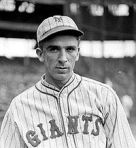
Speaking of Bill Dickey, he came to mind the other day when a friend of mine mentioned Carl Hubbell’s well-known feat in the 1933 All-Star Game, striking out in succession Babe Ruth, Lou Gehrig, Jimmy Foxx, Joe Cronin, and Al Simmons — all future Hall of Famers. Hubbell, a Hall of Fame pitcher himself, was a screwball-throwing left-hander and one of the best of his time — many would say all time.
It doesn’t come up often, but the batter who followed Simmons was Bill Dickey, who got a hit to break Hubbell’s streak. The next batter was Lefty Gomez, a pitcher with the Yankees and one of the great humorists of the game, and a notoriously bad hitter in the days when American League pitchers were fully employed and took their turn at bat.
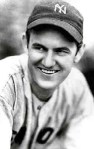
LEFTY GOMEZ
Gomez struck out, and when he went back to the dugout, he was ripping mad at Dickey.
“What did I do?” asked Dickey, who was flabbergasted. “It’s going to go down in history,” Gomez told him, “that Hubbell struck out five of the greatest hitters in baseball. If you had had the decency to strike out, it would have been seven, and I would have been one of them!”
The Times has a story about Jeter’s achievement in the context of the end of Gehrig’s career. It’s at this link:
http://www.nytimes.com/2009/09/04/sports/baseball/04gehrig.html?hp
 CharlesPaolino's Blog