Books: “William Henry Harrison”
January 27, 2012
 United States presidents and baseball players have at least this in common: They can alter the record books just by showing up.
A case in point is William Henry Harrison, the ninth president and the subject of a book by the same name — one of the Times Books series of short biographies of the presidents. The author is New York Times columnist Gail Collins.
Harrison was in office hardly a month, but he still made his marks. He was the first presidential candidate to personally campaign for the office. He was the last president born before the Declaration of Independence. He gave the longest inaugural address. He was the first president to be photographed while in office. He was the first president to die in office. He was the first president to die in office of natural causes. He served the shortest term — 31 days. He was part of one of two sets of three presidents who served in the same year — 1841 and 1881. He was the only president whose grandson was president.
 As Gail Collins recounts with a lot of good humor, the campaign of 1840, in which the Whig Harrison defeated the incumbent Democrat Martin Van Buren, was a first of its kind, too, in the sense that it was the first really populist election in the United States, the first one that wasn’t dominated by a political and economic elite.
Harrison had unsuccessfully challenged Van Buren in 1836 when the fractious Whigs ran two candidates — basically a northern and a southern. But in 1840, the party got behind Harrison and he far out paced Van Buren in electoral votes, although the popular vote was much closer. More than 80 percent of the eligible voters participated — a statistic that must be filtered through the fact that women and a great many men did not have the franchise in those days.
As Collins describes it, the Whig campaign was like a three-ring circus, with literally thousands of stump speakers going from town to town, parades, rallies, and dinners with plenty of alcohol.

MARTIN VAN BUREN
The campaign was further distinguished by the Whigs’ successful effort to sell the public a candidate whom they could appreciate — a kind of frontiersman, one of the common folks, whose idea of a good time was flopping down in his log cabin and swilling hard cider.
In actual fact, Harrison was born on a Virginia plantation, was well educated and very mannerly, drank only in moderation and disapproved of drunkenness, and lived in a 16-room farmhouse in Ohio.
The 21st century voter may not be surprised to hear that the facts didn’t matter. The public bought the lie, which was encouraged with all kinds of “log cabin” events, images, songs, and verses, and other Whig politicians were happy to let some of the backwoods shading rub off on them.

TECUMSEH
This was also the campaign of “Tippecanoe and Tyler Too” — the “Tyler” being a reference to vice-presidential candidate John Tyler. Harrison had served in the army before retiring to his farm, and he was involved in several fights with the Indians and British in the struggle over the Northwest Territories. In one of those battles, near the juncture of the Tippecanoe and Wabash rivers in the Indiana Territory, Harrison, who was governor of the territory, routed a settlement being built by the brothers and Shawnee leaders Tecumseh and Tenskwatawa (“the Prophet). Harrison had far more men, and he took far more casualties, and the battle wasn’t really decisive in the long run. He had a couple of much greater successes under his military belt. But, hey, “Tippecanoe and Tyler too” rhymes, and the alliteration was irresistible.

It is well known that Harrison was inaugurated on a bitter winter day, and that he foolishly appeared at the outdoor event — including his two-hour speech — without a hat or coat. Gail Collins explains further that the amiable president-elect arrived in Washington already exhausted from both celebratory events and sieges by office-seekers, and that the pressure didn’t let up in the capital.
The author writes that Harrison was 67 years old when he campaigned for the office, and that the Democrats dismissed him as a feeble old man — not a far-fetched idea in 1840, when a man of that age frequently was in his dotage. Collins says Harrison’s recklessness might have been his attempt to refute the Democrats’ claims. In any case, shortly after the inauguration, he came down with what was probably pneumonia. He died on April 4, 1841.
Books: “1493”
December 17, 2011

aka CHRISTOPHER COLUMBUS
One of my chores at Paolino’s Market when I was a kid was to open up fifty-pound bags of potatoes and divide the spuds into ten- and five-pound bags. “Packing potatoes,” as we called it, was a frequent part of the routine in our store, and that was appropriate in its way, because what could be more routine than a potato — one of the most plain, most simple, and least consequential of vegetables.
Or so I thought until I read 1493 by Charles C. Mann, author of 1491.
In this substantial and exhaustively researched volume, Mann describes the impact of the voyages of Christopher Columbus, whom he calls Cristóbal Colón, the name the explorer answered to in Spain. Overall, Mann explains, the impact of those voyages was to globalize life on earth, sending folks traveling to hemispheres they had perhaps only dreamed about and distributing other forms of life, ranging from mosquitoes to horses, from tobacco plants to rubber trees, to spots where they had never existed before — a phenomenon known as the Columbian Exchange. Simultaneously, languages and cultural traditions and man-made products were scattered across the planet. So were doleful phenomena such as malaria and potato blight.

The process that Columbus launched, and personally participated on his first trips across the Atlantic Ocean and back, is so complex and far-reaching, as Mann describes it, that I can’t adequately summarize it here. But the potato is a good example of the upheaval Columbus touched off.
Little did I know last June, when I was watching my cousins hoeing potatoes in their massive garden in Il Valle di Sessa Cilento, that potatoes, which were first domesticated in the Andes, weren’t exported to Europe in quantity until the second half of the 16th century, when some species of them were being cultivated in the Canary Islands and shipped off to the mainland.
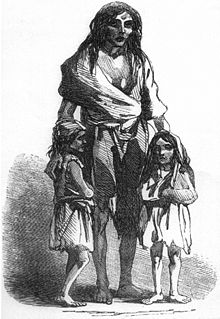
Irish mother and her children during the potato famine in 1849
The consequences of this, Mann writes, were enormous for a continent that was accustomed to frequent food shortages. In fact:
“Many scholars believe that the introduction of S. tuberosum to Europe was a key moment in history. This is because their widespread consumption largely coincided with the end of famine in northern Europe. (Maize, another American crop, played a similar but smaller role in southern Europe.) More than that, the celebrated historian William H. McNeill has argued, S. tuberosum led to empire: ‘[P]otatoes, by feeding rapidly growing populations, permitted a handful of European nations to assert dominion over most of the world between 1750 and 1950.’ Hunger’s end helped create the political stability that allowed European nations to take advantage of American silver. The potato fueled the rise of the West.”
There is much, much more just to the potato story, including the fact that a blight that also originated in the Andes migrated first to North America and then to Europe in the mid 19th century, causing almost incomprehensible hunger and illness, especially but not solely in Ireland.
Mann discusses the potato itself and its geographical history in minute detail, and he does the same with a broad range of subjects including slavery, the mixing of races in the “new world,” and the impact of world economies — most notably that of China — of the Spanish trade of silver from South America. His discussions frequently extend down to the present day, and this book in general is a valuable aid in understanding how the world evolved from the 15th century to the 21st.
Books: “Pearl Harbor Christmas”
December 15, 2011

I grew up among the remnants of war. I was born in September 1942 when the United States had been engaging Nazi Germany and Japan for less than a year. By the time I was old enough to be aware of my surroundings, there still were handwritten letters from the front, brass uniform buttons, photos of soldiers, sailors, and marines, patriotic records, and newspaper clippings reporting on the service of relatives and friends, including cousin Mike Aun, who was awarded the Bronze Star twice, the Silver Star, and the Purple Heart with three oak-leaf clusters.

FRANKLIN D. ROOSEVELT
I also recall that for a long time after 1945, my parents and other adults would frame their conversations in terms of what had occurred before, during, and after “the war.” They needn’t say which war.
So although I don’t remember the war itself, I feel that it was a part of my life, and I eagerly learn as much about it as I can. My most recent opportunity came in the form of Pearl Harbor Christmas, a new book by Stanley Weintraub.
In this compact book, Weintraub describes events at home and abroad from December 22, 1941, to January 1, 1942 — devoting a chapter to each day. The dominant personalities by far are Franklin Roosevelt and Winston Churchill. Churchill was staying at the White House after crossing the submarine-infested Atlantic in winter seas. He couldn’t wait to get to Washington, because Pearl Harbor had accomplished what he could not, forcing the United States into a war that Britain probably could not survive otherwise. But, although the newborn American belligerence was directed mostly at Japan, Churchill wanted to make sure, and did, that the U.S. would go to war first against Nazi Germany.

WINSTON CHURCHILL
Churchill addressed a joint session of Congress, spoke at the Christmas tree-lighting ceremony on the White House lawn — the only time he and Roosevelt spoke from the same platform — and dashed up to Ottawa to speak before the Canadian Parliament. What with his blustering, his cigar-smoking, and his drinking, he was quite the counterpoint to patrician, dignified Roosevelt. Actually, he came across more like Lyndon Johnson: Weintraub describes an incident on December 26 when Churchill was dictating to a male secretary notes for the address to Congress. Churchill was in his bath when he started dictating. He got out, wrapped a towel around himself, walked to an adjoining bedroom, dropped the towel, and continued dictating, stark naked. Suddenly, the secretary recalled, “President Roosevelt [in his wheelchair] entered the bedroom and saw the British Prime Minister completely naked walking around the room dictating to me. WSC never being lost for words said, ‘You see, Mr. President, I have nothing to conceal from you.”’
While Roosevelt and Churchill and others were in Washington working issues of joint command, Adolf Hitler was in Berlin or Bavaria trying to chew the great deal he had bitten off.

ADOLF HITLER
Hitler’s troops were in trouble on the Russian front, and even those closer to home were suffering from a lack of adequate supplies. Hitler actually had Joseph Goebbels run a clothing drive to help keep his soldiers warm. In a radio address, Goebbels told the German people that they “would not deserve a moment’s peace if a single German soldier was exposed to the harshness of winter without articles of warm clothing.”
Meanwhile, the situation in the Pacific continued to deteriorate as the Japanese took advantage of their momentum and munched away at the region. Churchill had not yet publicly acknowledged the reality, Weintraub writes, and continued to waste resources trying to defend ground that was already as good as lost.
Even more closely involved in such a charade was U.S. Army Gen. Douglas MacArthur, who had to abandon his headquarters and retreat with his wife and son to a tunnel in Corregidor while he continued to send out dispatches about tank battles, with nonexistent tanks, putting up a fight that wasn’t occurring.
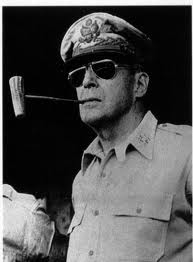
DOUGLAS MACARTHUR
Weintraub explains that there was a certain ambivalence about the war in the United States at first; it still seemed far away.
Still, the government took the impending conflict seriously enough to pack up the founding documents — the Declaration of Independence, the Constitution, and the Bill of Rights — and ship them off under heavy security to repose in Fort Knox for the duration.
The holidays went on as usual. Despite security concerns, Roosevelt insisted that the national tree be on the White House lawn, not in Lafayette Park where the Secret Service wanted it. There were presents, too, including eight thousand cigars sent to Churchill from various sources.
The new year was marked by a couple of oddities – Churchill making a rare visit to a church, attending a service with Roosevelt in Alexandria, Va., and the beleaguered Hitler publicly invoking “the Lord” in hoping that 1942 would bring positive results for the German people.
Throughout the United States, however, the prospects of what would come in the next three and half years did not weigh heavily on the celebratory spirit, and that, Weintraub writes, included the biggest celebration of all:
“ ‘If there was uneasiness over the possibility of Axis bombs falling into Times Square,’ the Times reported, ‘you could not read it in the celebrants’ faces.’ Despite Pearl Harbor and the reality of world war, it had not yet reached very far into the American psyche.’’
Books: “American Emperor”
November 29, 2011

ALEXANDER HAMILTON
I grew up with Alexander Hamilton. It’s not that I was his contemporary; it’s that I was born in Paterson, New Jersey, and grew up on its streets. I heard over and over again that Hamilton had founded the city. Like a lot of things children are taught, that wasn’t true. What was true was that Hamilton accurately envisioned an industrial city growing up around the Great Falls of the Passaic River. Paterson became the silk-weaving center of the world and was also the source of steam locomotives and Colt revolvers.
Aside from the fact that he was born on Nevis – a rare distinction – the only other thing I associated Hamilton with was the duel in which Aaron Burr, who was then the vice president of the United States, shot Hamilton to death. That happened in Weehawkin in 1804.
I never thought much about Burr at all until I read David O. Stewart’s book, American Emperor: Aaron Burr’s Challenge to Jefferson’s America. Come to find out that Burr was a rip-snorting renegade who wanted to invade Spanish territories in North America, merge them with states he hoped would secede from the Union, and set himself up as ruler of the new nation.

AARON BURR
Burr, who was born in Newark, came from a distinguished family. He himself had an impressive military and political career which reached its zenith, in a sense, when he was elected the third vice president in the old electoral system. After a contentious series of ballots, Thomas Jefferson and Burr were tied for the presidency. Although Burr was willing to serve as vice president – which was the consolation prize under that system – Jefferson, once he was in office, gave Burr the cold shoulder, marginalizing him to the point that the once influential man was a supernumerary.
Meanwhile, Stewart explains, although Burr and Hamilton had been on good social terms, Hamilton conducted a political campaign against Burr in the public press, ridiculing him in the acidic fashion that was common in those days. Burr – whatever other faults he may have had – wouldn’t wouldn’t play that game, and he did not answer Hamilton until he read a published account of remarks Hamilton had made at a dinner. Burr and Hamilton exchanged a series of letters over the incident, with Hamilton ultimately refusing Burr’s demand that he apologize for that and other slights. Burr challenged him to a duel, and Hamilton accepted. Dueling was illegal in New York and New Jersey; the two men and their parties crossed the Hudson from Manhattan to a spot on the bluff in Weehawkin that was inaccessible from above. Hamilton was mortally wounded.
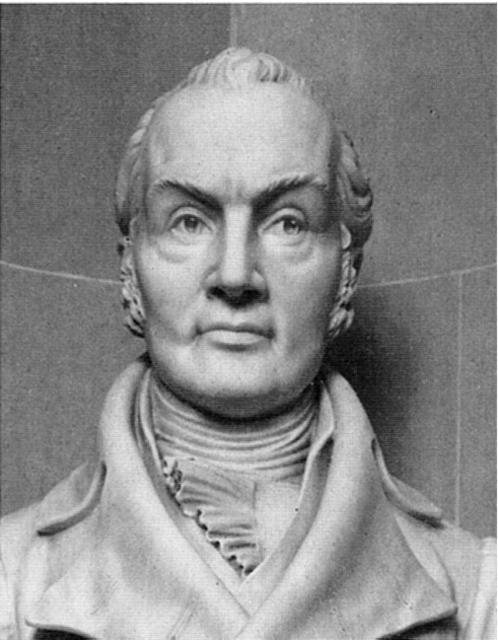
AARON BURR
Burr was indicted for murder in both states, which meant that he had to live on the road – an odd situation for the vice president of the United States. By this time, he was already concocting a vague plan to put together a realm for himself carved out of Spanish holdings – including parts of Mexico and Texas – and what were then western states that Burr imagined might be interested in leaving the union. He actually negotiated directly with Great Britain over this idea.
Meanwhile, Burr enlisted as one of his principal co-conspirators Gen. James Wilkinson who, on the one hand, was the highest ranking officer in the U.S. military and, on the other hand, was a paid spy for Spain. Burr enlisted numerous other people, including Andrew Jackson, although he seems to have given different information to different people, including in some cases the fantastic claim that the Jefferson administration was aware of and sympathetic to his plan.
Burr went so far as to assemble the crude makings of a private army, and set off by river transport to carry out a plot that still wasn’t clear to anyone except, perhaps, Aaron Burr. The numbers of supporters he had hoped for did not materialize, and some of those who did were arrested. Burr himself was taken into custody and sent to Richmond to be tried for treason.

JAMES WILKINSON
He was not convicted of treason, however. Stewart, who is an attorney, explains the fascinating intricacies of the trial and the verdict. The short version is that treason consists of conducting an armed attack on the United States, and Burr hadn’t done that.
Burr facing further charges in Ohio and was still under both murder indictments. Although he was broke, he traveled to Europe and stayed for four years. Even then, he tried to get first the British government and then Napoleon to support him in a campaign against Spain in the Americas.
When the indictments had been dropped, Burr returned to New York and in 1831 resumed the practice of law.
This account portrays the United States and its surroundings as tumultuous and unstable. Stewart points out, in fact, that even Jefferson accepted the idea that some of the states still might opt out of the republic and go off on their own.
Stewart also provides details of a contrasting and touching aspect of Burr’s life – his affectionate but ill-fated relationship with his daughter. The portrait Stewart paints of Burr is that of a charismatic, adventurous, and impetuous rascal, a man of courtly manners and an incorrigible womanizer — in short, far more interesting a character than I had ever imagined.

Murder most foul
November 24, 2011

GREG HALMAN
When I first heard the other day that Greg Halman had been stabbed to death I was, of course, shocked, but not just because of the murder itself. Murder usually takes us by surprise, whether the victim was someone we knew, someone we only knew about, or someone we never heard of. It’s in the nature of the crime that it seems to come, as it were, out of left field.
In this case, my shock was doubled because the victim was a major league baseball player. It’s a hangover from my growing-up years when I thought those guys were special. I came to learn, as we all do, that they’re subject to all the weaknesses and vulnerabilities of our kind. I know that intellectually, but emotionally I’m the type who still thinks Santa Claus will show himself some day and sit in judgment over the sheep and the goats.
The fact is, though, that baseball players may be more susceptible to homicide than the general population is. Something like 17,000 men have played in the major leagues and I know of ten who have been murdered. What’s that – one in about 1700? The murder rate in the United States last year – ostensibly an all-time low – was nearly one in 10,000.

LUKE EASTER
The ones I know about are Frank Bell, Frank McManus, Ed Morris, Lymon Bostock, Tony Solaita, Gus Polidor, Ivan Calderon, Dernell Stenton, and Luke Easter.
The one that most sticks in my mind is Easter, because he was one of my first “favorite” players. He came into the major leagues in 1949 when I was seven years old. He was about six-foot-four and weighed 240 pounds. I got most of my baseball on the radio then, and for a while I thought his name was Lou Keester. I didn’t know it then, but because he was black he didn’t get to play in the bigs until he was 34 – although he was inconsistent when reporting his age and place of birth. He is a prime example of the damage that racism did to major league baseball. He appeared in only six seasons in the majors and played in more than 100 games in only four. He was a good first baseman and a slugger in semi-pro ball — which was a big deal in his day — and in the Negro Leagues. He hit a total of 86 home runs in 1950, ’51, and ’52; he played only 396 games in those three seasons, and he was 37 years old in 1952. He and Mickey Mantle were the only players to hit a ball over the right-field scoreboard in Cleveland’s Municipal Stadium. Easter’s traveled 477 feet.
After his major league stint, Easter played in the minors until he was 48 and coached for a while. Wherever he went, he added to his reputation as a genuinely nice man who liked to help other players. When he and baseball were done with each other, he went to work for the Aircraft Workers Alliance and became the chief union steward at a company in Euclid, Ohio. In 1979, he was delivering payroll money to a bank when he was accosted by armed robbers who shot him to death when he wouldn’t turn over the money.
When a fan remarked that he had witnessed one of Easter’s longest home runs, Easter said: “If it came down, it wasn’t mine.”
Books: “Clarence Darrow: Attorney for the Damned”
November 11, 2011

Richard Loeb (left) and Nathan Leopold
I was surprised to find in some recent conversations that acquaintances my age don’t remember the “Free Nathan Leopold” movement. I was in my teens when it reached its climax, and I remember reading about it in newspapers and hearing about it on broadcast news. I probably was more attuned to it, because I read a paperback book about Leopold and his friend Richard Loeb, who in 1924 had murdered a 14-year-old boy just to show that they could do it. It was characterized for many years as “The Crime of the Century.” Leopold and Loeb were very rich and very bright young men, not yet 20, and they had gotten caught up in the philosophy of Friedrich Nietzsche. They decided that they fit the mold of Nietzsche’s “superman” and that they were above the law — an idea that the State of Illinois didn’t share.
This is one of the cases John A. Farrell writes about to support the title of his excellent book, Clarence Darrow: Attorney for the Damned. It was one of the two cases for which Darrow is best remembered — the other being the Scopes trial, which involved the teaching of evolution in a Tennessee school — but, as Farrell describes in detail, there was much more to Darrow himself and his tumultuous legal career.

Clarence Darrow
Darrow was a complicated man, a mass of contradictions. He was also one of the great celebrities of his era, attracting enormous crowds to courtrooms and to the streets outside with his eloquence and logic and with his theatrical, sometimes outrageous style of questioning witnesses and addressing juries.
Darrow defended John Thomas Scopes, who was tried in 1925 in the evolution case. That trial was a charade, because Scopes was a willing dupe who agreed to face the charge in order to get the subject before the courts.
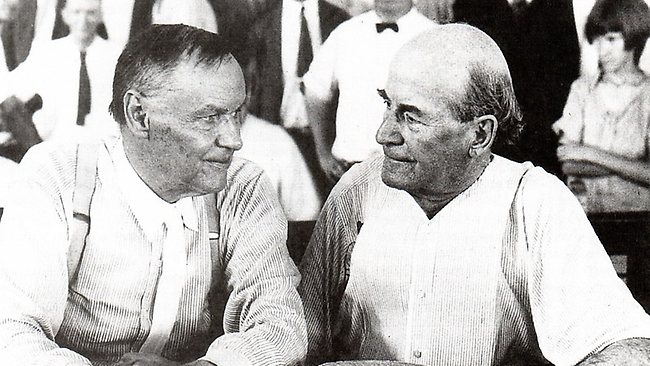
Clarence Darrow and William Jennings Bryan
The case set up an historic confrontation between the agnostic, libertarian Darrow and the three-time Democratic presidential candidate, William Jennings Bryan, who won the case in the sense that Scopes was convicted but who squirmed as Darrow’s questions showed Bryan’s ignorance of both history and the Bible.
The subtitle of the book refers to Darrow’s penchant for taking on clients whose fate seemed sealed – and frequently bringing in an unexpected result.

Dr. Ossian Sweet
At times he stood for underdogs – such as Dr. Ossian Sweet, his brother Henry, and nine other black men charged with murder after a bystander was shot to death while the Sweets and their friends defended the doctor’s Detroit home from a violent white mob.
It was 1925 and the jury was white — hardly the circumstances a lawyer would hope for — but Darrow, who had been hired by the NAACP – got a hung jury in the first trial and acquittal when Henry Sweet was retried alone.

Clarence Darrow
As he often did, Darrow moved the focus of the proceedings off the immediate charge before the court and drew attention to a broader principle: “There is nothing but prejudice in this case,” he told the jury. “If it was reversed, and eleven white men had shot and killed a black while protecting their home and their lives against a mob of blacks, nobody would have dreamed of having them indicted . . . . .
“That’s all there is to this case,” he said. “Take the hatred away and you have nothing.’’
The same Darrow who stood up for that black family was just as willing to defend people of privilege, such as Leopold and Loeb, and just as skillful in doing it. Inasmuch as Leopold and Loeb admitted the murder, those following the case expected them to enter a plea of guilty by reason of insanity. But Darrow entered a plea of guilty and said he would rely on the mercy of the court. In a performance that no judge would allow today, he concluded the penalty trial with an eight-hour argument in which he presented “these boys” as “immature and diseased children . . . wandering around in the dark.’’ Speaking, as he always did, without notes, Darrow cited the lack of precedent in Chicago for hanging defendants under the age of 21, and for hanging defendants who had pleaded guilty.
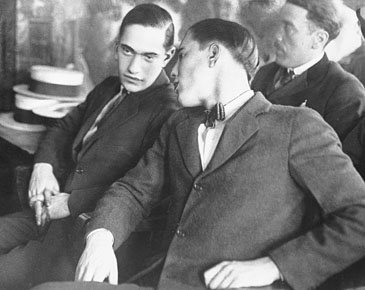
Leopold and Loeb
Darrow dismissed the death penalty itself as “one long slaughter house,” and he brought tears to the eyes of onlookers, including the defendants, when he spoke of their mothers and the mother of the slain Bobby Franks: “The mother who looks into the blue eyes of her little babe cannot help wonder what will be the end of this child, whether it will be crowned with the greatest promises which her mind can imagine, or whether he may meet death from the gallows.’’
Leopold and Loeb were sentenced to life in prison for the murder plus 99 years for kidnapping. Loeb was killed by another inmate, but Leopold led an exemplary and productive life in prison, which eventually inspired public pressure on his behalf. He was paroled in 1958 and moved to Puerto Rico, where he was a model citizen.
Farrell devotes a lot of attention to Darrow’s work on behalf of labor during an epoch in which workers were resorting to violence in order to free themselves from exploitation – whether in the mines of Pennsylvania or in the headquarters of the Los Angeles Times, which was liquidated by explosives in 1910.
Farrell also writes of the brooding, disheveled, boozy attorney’s insatiable thirst for women, his literary ambitions, and his wildly vacillating economic fortunes. As Farrell illustrates and explains, Darrow at times seemed to be an idealist who would take on a lost cause for no pay and at other times seemed to be an opportunist, interested only in money and his own aggrandizement.The jury, as it were, is still out on those questions, but Farrell does make one thing clear: Whatever else Darrow was, he is one of the most memorable characters of his time.
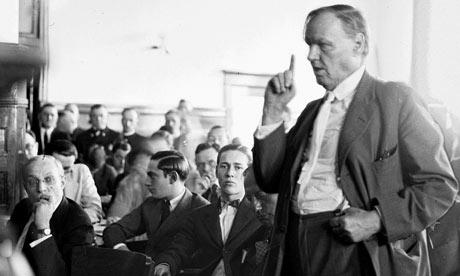
Clarence Darrow in the courtroom during the trial of Richard Loeb and Nathan Leopold, seen to Darrow's right in this picture.
Books: “Wonder Girl”
August 31, 2011
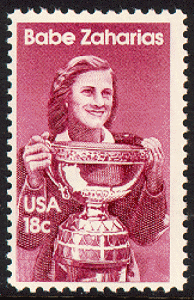 If ever an athlete embodied the phrase sic transit gloria mundi, it was Babe Didrikson Zaharias. There are a couple of generations of adults among whom she is virtually unknown, and yet she was such a combination of natural ability, hard work, and results, that she has no peer.
I’m not an expert on this subject. I had only the vaguest idea of who Babe Didrikson was until I read Don Van Natta’s excellent book, Wonder Girl. But thanks to Van Natta’s scholarship, his journalistic discipline, and his entertaining and literate writing style, I now know plenty about Babe – and I’m glad I learned, even at this late stage of my life.
Babe Didrikson died of cancer in 1956, when I was 16 years old. In those days, I followed baseball and boxing, so I had only the slimmest knowledge that she was a prominent golfer. What I learned from Van Natta’s book is that Babe Didrikson would have excelled at almost any sport she chose and that she made a considerable mark in both track-and-field and in basketball before she turned her whole attention to golf.
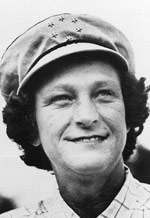 I’ll mention only one particular performance, because every time I think about it I am impressed all over again. Babe, who gave up on education before she finished high school, took a job with a Dallas-based insurance company, but not because she was interested in actuarial tables. Some companies in those pre-television days sponsored amateur sports teams that competed with each other around the country and acted as living advertisements for their employers. Babe’s principal job at the insurance company was playing basketball and track, both of which she did at a championship level. She was so extraordinary, in fact, that in 1933 her boss and coach sent her to the American Athletic Union’s national championship meet in Illinois.

DON VAN NATA JR.
I mean that literally. He didn’t send the rest of the team — only Babe. And competing against squads from around the U.S., she entered eight of the ten events and won the gold medal in broad jump, baseball throw, shot put, javelin, and the 80-meter hurdles and tied for first in the high jump. She collected a total of 30 points; the second-place team scored 22. In that meet, Babe qualified for the 1932 Olympic Games in Los Angeles, where she won two gold medals and a silver and set two world records and an Olympic record.
I had to tell that story. But Van Natta’s book isn’t engrossing only because it reports on that and Babe’s many other achievements. This book tells the story of an American life. Babe’s parents were faithful and hard-working natives of Norway who settled in Texas. They had a large family, and they lived from hand to mouth. Babe loved this family and she remained loyal to her parents and siblings and other connections, always including their financial well being in her reasons for driving herself so hard.
Babe was a tomboy, and when she grew older she was perceived as mannish. This plus the fact that she remained single for so long led busybodies, including prominent sports writers, to speculate about her sexual orientation. She also was the target of verbal abuse from sports writers and others who believed, as Joe Williams wrote in the New York World Telegram, that “it would be much better if she and her ilk stayed at home, got themselves prettied up and waited for the phone to ring.” The rough-and-tumble Babe broke through the barrier of snobbery that surrounded amateur golf at that time; she was a founding member of the LPGA.
She put an end to much but not all of that talk when she married popular pro wrestling villain George Zaharias in 1938. The marriage lasted a lifetime, but it was tumultuous. Zaharias was a compulsive promoter, and he insisted that Babe keep up an exhausting schedule of competition and personal appearances, even when she would rather have taken a break.
 An important factor in the story of Babe Didrikson’s life was her complicated personality, which was at the same time endearing and obnoxious. She was a bold braggart, constantly tooting her own horn. Van Natta reports that Babe would walk into the clubhouse before a golf match and announce herself by saying, “Babe’s here! Who’s gonna finish second?” And when she wasn’t bragging and even lying about her prowess, she was needling and annoying her opponents, deliberately trying to throw them off their game. But it is part of the genius of Van Natta that while he tells a great deal about this aspect of Babe Didrikson, he tells it in the wider context of her life, so that her braggadocio does not define her in the reader’s mind.
Babe Didrikson was diagnosed with rectal cancer and underwent a permanent colostomy. There would still be enough greatness in her to resume her golf career and win tournaments. But the cancer prompted her to rise to the occasion in another way. She became a tireless campaigner for funds to support cancer treatment and education, and she made a point of visiting cancer patients, especially children, to encourage them to go on with their lives.
Babe Didrikson: a life worth remembering.
“We never repent of having eaten too little” — Thomas Jefferson
August 17, 2011

Gov. CHRIS CHRISTIE
I caught a few minutes of Ann Coulter’s appearance on one of the Sunday talk shows this week, and found that by not tuning in earlier I had missed hearing her reasons for promoting Chris Christie as a Republican presidential candidate.
Apparently, it wasn’t a half-hearted endorsement; I heard her refer to the governor as “my first love.”
Coulter is not the first person to make this case. Christie is a controversial figure in terms of his public policy and his style, but he seems to be developing a following around the country.
Still this kind of talk has an unfamiliar ring to us in New Jersey because, except for Bill Bradley’s failed attempt to win the Democratic nomination in 2000, making presidents has not been our thing in recent decades.
Even the two we contributed in the distant past had imperfect credentials. Woodrow Wilson wasn’t born in New Jersey, and Grover Cleveland – who was born here and is buried here – spent most of his life someplace else.
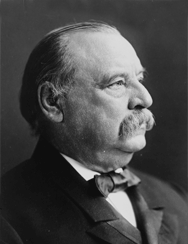
GROVER CLEVELAND
Christie hasn’t lent much credibility to the idea that he would be a willing candidate, but if he should run, one thing that has come up already and surely would get a lot of attention in the news coverage – and late-night commentaries – would be his girth.
Christie himself has often acknowledged that his weight is a result of his eating habits and that it is unhealthy.
In the world we live in, it is also a potential liability from the aesthetic point of view.
There already have been stories speculating as to whether a man of Christie’s size can be elected president – kind of a diss on the intelligence of the body politic.
In fact, that question has already been answered twice by the elections of William Howard Taft and Grover Cleveland.
Taft, the largest president so far, was six feet tall and weighed more than 330 pounds when he was elected president in 1908. After Taft had left the presidency, he lost about 80 pounds, which lowered his blood pressure and improved his ability to sleep.
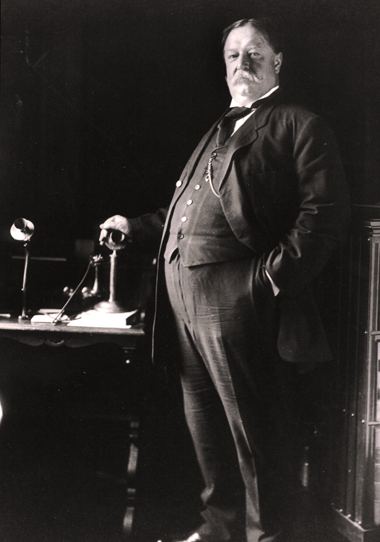
WILLIAM HOWARD TAFT
Cleveland – whose weight isn’t mentioned as frequently as Taft’s – was five-feet-eleven and weighed between 235 and 280 pounds. His weight is noticeable in photographs from his presidential years, but it apparently didn’t trouble the citizens who gave him the majority of the popular vote three times in a row – the only president besides Franklin Roosevelt to achieve that. (In 1888, Benjamin Harrison won the majority of the electoral votes.)
The criticism directed at political candidates in the 19th and early 20th centuries could be as cruel, in its own way, as the attacks that are leveled today. Cartoonists gleefully exploited the proportions of both Cleveland and Taft, and no one’s physical appearance attracted more public ridicule than that of Abraham Lincoln.
But the pervasive and relentless nature of media in our age add a lot of destructive power to negative messages.
Some voters might be legitimately concerned about the life-threatening nature of Christie’s weight, but the web of electronic communications has given people the idea that they can – and should – say virtually anything that comes into their heads. The comments posted on web sites suggest that many writers think it’s a virtue to be as coarse and demeaning as they can.
I noticed, for instance, that folks who frequent a Facebook page for graduates of my high school alma mater, say some pretty awful things about former teachers and classmates – undaunted by the fact that most of their targets are still living and could easily read these messages.
For his own well-being – particularly if he takes on the rigors of a presidential campaign and a term or two in the White House – Christie ought to do something about his weight.
Besides prolonging his life, it would spare him and his family the meanness that has become the lingua franca of smart alecs in the digital age.

Woodrow Wilson with his predecessor, William Howard Taft, shortly before Wilson was inaugurated as the 28th president. In 1921, the 29th president, Warren G. Harding, appointed a slimmer Taft chief justice of the United States. Taft is the only person to have held both offices.
Books: “What a Wonderful World”
August 13, 2011
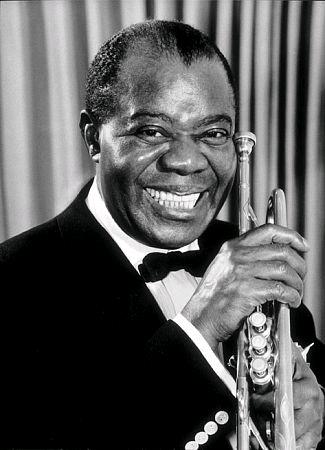
LOUIS ARMSTRONG
Sometime in the early 1960s, I went with a couple of my cousins to hear Louis Armstrong and his band play at Seton Hall University. I can’t remember how I decided to attend that show; there was not a single Armstrong recording among my LPs – which were dominated by operatic arias and country-and-western songs. I knew Armstrong from his television appearances, and I do recall finding him irresistible: not the trumpeter — I didn’t know from trumpets — the whole package. Whenever Armstrong’s image appeared on the black-and-white screen, I would pay attention. He was unique, and he was entertaining.
I was not aware until I read Ricky Riccardi’s recent book, What a Wonderful World, that the quality that attracted me to Louis Armstrong was the very thing that some folks found irritating, disappointing, even traitorous. Jazz purists objected to Armstrong’s departure from his musical roots in his native New Orleans, and many black Americans objected to his on-stage persona, in which they saw the perpetuation of the minstrel end man – a clown whose vocation was amusing white audiences. This was complicated by the fact that although Armstrong was at the height of his international fame in the heyday of the American civil rights movement, he played no visible part in the campaign — this, despite the fact that he and his band had often felt the sting of prejudice.
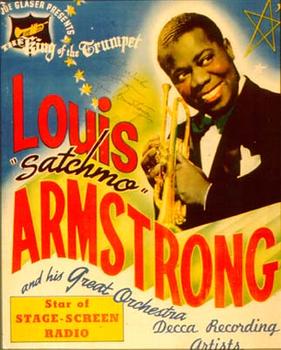
In fact, Armstrong refused for decades to appear in New Orleans as long as local laws prohibited mixed-race bands — perhaps an ironic position for him to take, given the fact that one of the raps on him was that he was willing to play before segregated audiences. His explanation was that he played where his manager booked him, and that he played for whoever wanted to hear him — and they were legion. Armstrong maintained that he contributed as much as anyone else to the progress of black Americans, because he paved the way for others to be received by white audiences.
His bookings are an interesting topic in Riccardi’s book. Armstrong’s manager during the last several decades of his career was Joe Glaser, a Chicago tough guy with a criminal background. There was some kind of bond between the two men — so much so that their arrangement was based on a handshake so that Glaser’s financial obligations to Armstrong were not spelled out. Glaser certainly got rich on the relationship, and Armstrong insisted that he had everything he wanted in life, including his daily regimen of marijuana and an herbal laxative that he treated as kind of a sacrament.
 Riccardi describes in some detail the schedule kept by Armstrong and his band, the All Stars. It’s exhausting just to read about it. It was not unusual for the musicians to perform forty one-nighters in a row without a break — and this went on for decades. Outsiders thought Glaser was taking advantage of Armstrong, wringing out every dime he could before the man dropped dead. Armstrong denied this; Riccardi doesn’t seem to accept it, but even in the material the author provides in this book — such as a letter in which Armstrong complains to Glaser about being treated “like a baby” — there’s a strong insinuation that the critics were right. Armstrong himself insisted that he was doing what he wanted to do, but he also complained from time to time about exhaustion, and he lost more than one player from the All Stars because the grind was just too much.
 Riccardi, who is a student of music and an authority on Armstrong, defends Armstrong’s repertoire; the subtitle of the book is The Magic of Louis Armstrong’s Later Years. Among the criticisms of Armstrong was that he played almost the same song set night after night, to which Armstrong replied that he played what the paying audience expected him to play. As for the indictment of Armstrong’ s wide grin and rolling eyes, it never occurred to me that those mannerisms were supposed to be a stereotype of a black man — if it had occurred to me, I would have been offended and would not have been at that show at Seton Hall. To me, Armstrong was just being himself. Still, his position on race, as Riccardi presents it in this book, was ambiguous at most. At times he would lose his temper and rant about the way black Americans were treated, but he was also capable of making a statement in which he adopted a shaky rationale based on a distinction between “lazy” black people and industrious ones like him. In the event, Armstrong had almost no black audience when he was recording his enormous pop hits, “Hello, Dolly” and “What a Wonderful World” and whether that was due to his play list or to his attitude toward his race remains a matter of conjecture.
You can watch and listen to Armstrong sing and play “Mack the Knife” by clicking HERE.

Pete Sheehy in the clubhouse of the real Yankee Stadium
I don’t think many journalists ever interviewed Pete Sheehy, but I was among the few who did. Pete, who was the clubhouse man at Yankee Stadium for about seven decades, didn’t like to talk, and I suppose that accounts for the fact that he made only rare appearances in print. I arranged an interview through a mutual friend, and I wasn’t with Pete for very long before I realized what a challenge I had taken on. In fact, Pete was forthright about it — in his way. He told me that he figured he had kept his job for so long, being in the confidence of members of the Yankees and, for a time, the football New York Giants, because he knew how to keep his mouth shut. Whatever he knew about Babe Ruth, Billy Martin, and Mickey Mantle, he kept it to himself.
 So I asked Pete if it were possible that a man who had had such intimate contact with the Yankees of the ‘twenties to the ‘eighties could have a favorite. This was how Pete answered: “Joe.”
He didn’t have to say any more. “Joe” meant DiMaggio, and his choice didn’t surprise me. My father had been a Yankee fan since the Ruth era, too, and although I never asked him, I am confident that he would have said “Joe” too — despite a reverence for Lou Gehrig.
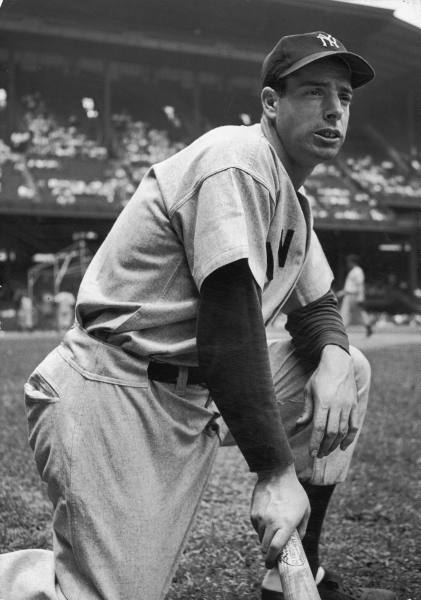 DiMaggio had an outstanding career. He was among the very best hitters, baserunners, and outfielders of his time or any time. Not the very best, necessarily, but one of the best. As Kostya Kennedy mentions in his book, 56: Joe DiMaggio and the Last Magic Number in Sports, a poll taken in 1969 named DiMaggio the “greatest living baseball player.” DiMaggio believed it; he was that kind of a guy. But there were skeptics who noted, for instance, that Ted Williams, DiMaggio’s contemporary, outstripped the Yankee in every major hitting category and had a longer career, despite combat duty tours in two wars.
If there is an inequity in the way DiMaggio is regarded, it may be attributed at least in part to the fact that he played for the New York Yankees while they were the preeminent team in baseball if not in sports in general. DiMaggio appeared in 10 World Series in his 13 years in the majors.
But the primary reason for the aura around Joe DiMaggio may be the record he set 60 years ago this season — the record that was the occasion for Kennedy’s book. In the 1941 campaign, DiMaggio got a base hit in 56 consecutive games.
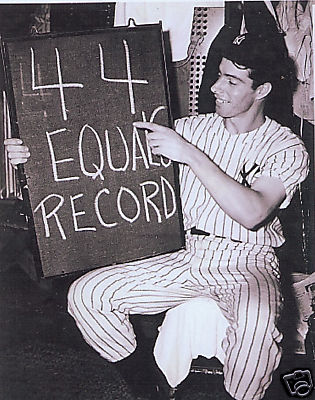 To put that record in context, Kennedy points out that more than 17,000 men have played Major League baseball, and only DiMaggio has achieved it. The only others to come close were Willie Keeler, who hit in 44 straight games in 1897 in the dead-ball era, and Pete Rose, who hit in 44 in 1978. (Keeler’s streak began on the first day of the ’97 season, so the hit he got in the last game in ’96 puts his official record at 45.)
The subtitle of Kennedy’s book refers to the fact that while DiMaggio’s record once formed a holy trinity with Babe Ruth’s single-season and lifetime home run records, Ruth’s marks have been exceeded several times and in some cases under questionable circumstances. DiMaggio’s 56 is the only individual record of its kind still standing.
Kennedy describes in his very literate book the atmosphere in which the streak occurred. It captured the attention of the whole country — and even folks in some other countries. DiMaggio’s sizable family, people who were tight with him, baseball fans, and people who didn’t know anything else about him or the game were all caught up in his day-day-progress. Everywhere, Kennedy writes, people stopped to ask each other: “Did he get a hit today?”
 And, as Kennedy artfully shows, this didn’t happen in a vacuum. In 1941, there was something far more ponderous on people’s minds — the increasing aggression of Nazi Germany. The idea that the United States could stay out of the war seemed more and more like wishful thinking as American plants turned out material to assist the European allies and as more and more American men were drafted into military service. DiMaggio’s streak was a fortuitous respite in such an atmosphere — the counterpart, in a way, to Susan Boyle’s triumph on Britain’s Got Talent in the midst of worldwide recession and seemingly pointless wars.
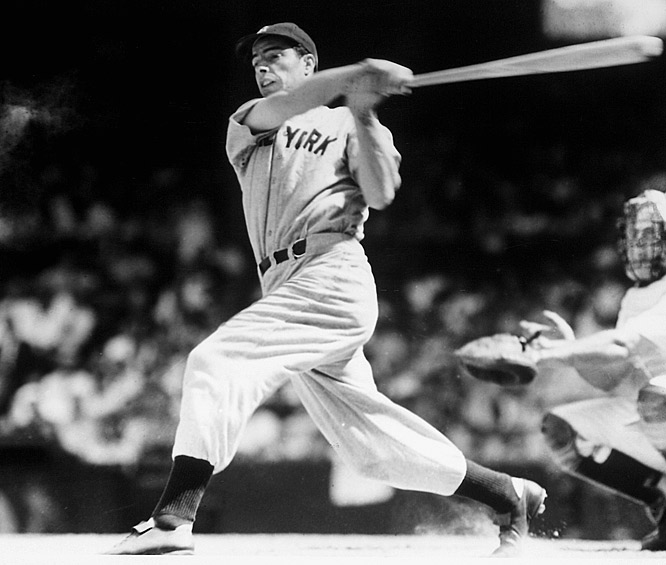 The streak served another purpose, too. It was something for Italian-Americans to cling with pride as they — thanks to Benito Mussolini — came under the same kind of suspicion that was being directed at Americans of Japanese and German background. Even at that, DiMaggio’s own father, Giuseppe, who had made his living as a commercial fisherman, was placed under wartime restrictions that kept him from approaching San Francisco Bay.
 In telling this story, Kennedy carefully constructs a portrait of DiMaggio that isn’t at all endearing. DiMaggio was a cold fish. He was known from his youth for his spells of silence. Kennedy writes a lot about DiMaggio’s relationship with his first wife, movie actress Dorothy Arnold, and that isn’t a happy tale. DiMaggio — in spite of the girls he invited to his hotel rooms — missed Dorothy when he was on the road. But when he was home, he stifled her, resented her, and often subjected her to his emotional and sometimes his physical absence.
This book is peppered with the interesting characters who played large and small parts in DiMaggio’s life — his relatives, including his major league brothers, Don and Vince; his somewhat “connected” Italian-American friends in Newark; his fans — not the least of whom were the boys Mario Cuomo and Gay Talese; and, of course, his fellow ballplayers: Gehrig, Phil Rizzuto, and DiMaggio’s wacky road-trip roommate, Lefty Gomez.
On the field, DiMaggio appeared impassive as the streak progressed. If a pitcher had boasted that he would stop DiMaggio, and DiMaggio got a hit off him, there would be none of the fist pumping that cheapens the game today. Inside, however, Kennedy writes, DiMaggio’s stomach was often in knots. And, of course, if he didn’t have to talk about the streak, he didn’t:
” ‘You nervous about the streak?’ a reporter would call out and it would be Lefty who would turn and reply, ‘Joe? Nah, he’s fine. Me? I threw up my breakfast.’ “
 CharlesPaolino's Blog