What’s it all about, Sarah?
May 14, 2009

GOV. SARAH PALIN
I’m the guy who told a couple of generations of reporters and journalism students that a good writer can stop any person on the street and write an interesting story about him. So far be it from me to suggest that there isn’t a good story to be told about Gov. Sarah Palin, R-Alaska. As it turns out, Gov. Palin herself – a former journalism student – is going to take on the job herself after signing a book deal with HarperCollins and Zondervan. She anticipates that the project will take about a year which, if she can stick to that schedule, would get it into Borders in time for the 2010 gubernatorial election. I’ve seen some cynical references to that in what the governor refers to as “the anonymous blogosphere,” but why begrudge her that advantage – or the kind of money she can command while people are still interested in her? If Richard Nixon could appear on “Laugh-In,” why shouldn’t Gov. Palin write a memoir? It could be time consuming, especially because the governor says that, despite the collaborator assigned to the book, she wants to write most of it herself.

ULYSSES S. GRANT
News of this enterprise naturally evokes questions about the content. The governor is a relatively young woman who has had a relatively short – and dare we say largely inocuous – public career. Ulysses S. Grant put off his memoirs until he had been the general-in-chief of the victorious Union Army and twice president of these United States. And Dwight Eisenhower saved his written reflections until he had been supreme allied commander in Europe, general of the Army, and twice president. What will the governor write to hold a reader’s attention for two or three hundred pages? She did discuss that in a general way with a newspaper reporter as follows: “I just really look forward to being able to relate to people through this book, those who are anxious to hear stories about people who are facing similar challenges perhaps. That’s balancing work and parenting — in my case work does mean running a state, and family involves a large and fun and colorful ordinary family that really has been thrust into maybe some extraordinary circumstances.” See?
I expect Harper has editors to deal with misplaced “perhapses” and “maybes,” but I hope the book clubs are heavy with folks “anxious to hear stories about people who are facing similar challenges.” Perhaps.
Omerta.
May 8, 2009
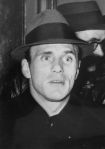
JOE GALLO
I just finished reading Tom Folsom’s book “The Mad Ones,” the story of Joe Gallo and his brothers and satellites, a clumsy Brooklyn crime family that inspired Jimmy Breslin’s novel “The Gang that Couldn’t Shoot Straight.” I feel a little guilty because these dangerous and destructive people are so much fun to read about. And Folsom makes it fun, because he seems to be having such a good time telling this yarn, using a vernacular perfectly suited to the subject. And how can you go wrong with characters like Big Lollypop, Little Lollypop, Johnny Bath Beach, Mondo the Midget and Grandma Nunziato?
Joe and Larry Gallo themselves were worth the price of admission. Larry, anticipating open warfare with the Profaci gang, wiled away the time playing operatic arias on his violin. Joey spent a lifetime – what there was of it – painting, or reading Spinoza, Lenin, Mao, and Nietzsche. Joe Gallo was probably certifiably nuts, but he apparently was also a magnetic personality who sucked in people like Jerry Orbach and David Steinberg. And he didn’t kill Don Rickles for razzing him in a nightclub after being warned not to, so how bad could he have been?
Reading Folsom’s book, one wonders why Breslin had to fictionalize this whacked-out crowd who never made it to the top of organized crime in New York but shed and lost a lot of blood in the effort. The truth is entertaining enough.
The chicken or the egg?
May 6, 2009

CHARLES DARWIN
As I was driving to Passaic last night, I was listening to songs by Kate Smith that had been recorded from her radio broadcasts. It occurred to me that she might have been surprised if she had been told that people – well, one person at least – would be listening to those songs 60 years later while cruising along an interstate highway.
I also thought yesterday morning, when the women on The View were talking about evolution, that Charles Darwin might have been surprised – and maybe a little dismayed – to know that 150 years after the publication of “The Origin of Species” people would still be arguing about his ideas.
But we are still arguing. The latest flurry of discourse – the one that got the tongues wagging on The View – was a study from the University of Minnesota that showed the degree to which high school biology teachers influence whether students accept the idea of evolution or question it based on its perceived conflict with the idea of creationism.
THE FORERUNNER
A story on the web site sciencenews.com included this passage: “For example, 72 to 78 percent of students exposed to evolution only agreed that it is scientifically valid while 57 to 59 percent of students who were exposed to creationism agreed that it can be validated.”
In other words, the survey suggests that high school teachers who introduce the religious idea of creationism into a science class may influence a considerable number of students to deny what is constantly being reinforced by studies of the effects environmental factors have on life forms from one generation to the next and over longer spaces of time.
I believe that high school students should be exposed to the full range of ideas that have been held and still are held by large parts of the population – including the idea that existence itself and particular things that have existence are brought into being by a deity, however that may be expressed in various religious and philosophical disciplines. I don’t believe the biology class is the place to teach that. It belongs in the humanities curriculum. To exclude from a student’s education at least the main themes on the subject of creation that are held by Jews, Muslims, Christians, Hindus and others is to send him off to college or into the working world with an incomplete understanding of how most of the people on the planet think.
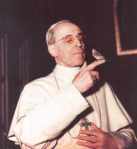
POPE PIUS XII
The discussion on The View didn’t have any intellectual depth, and it seemed to imply that a person must choose between belief in evolution and belief in the idea of a First Cause. That’s partly because the women were using the term “creationism” as though it stood for every shade of thought about a divine or supernatural origin of existence. Students who aren’t taught otherwise but who are exposed to such a simplistic public discourse on the subject might draw that erroneous conclusion.
Pope Pius XII, hardly a progressive, wrote in his 1950 encyclical letter “Humani Generis”:
“The Teaching Authority of the Church does not forbid that, in conformity with the present state of human sciences and sacred theology, research and discussions, on the part of men experiences in both fields, take place with regard to the doctrine of evolution, in as far as it inquires into the origin of the human body as coming from pre-existent and living matter—for the Catholic faith obliges us to hold that souls are immediately created by God.”
More recently, in 1996, Pope John Paul II – taking note of what Pius had written – added this:
“Today, almost half a century after publication of the encyclical, new knowledge has led to the recognition of the theory of evolution as more than a hypothesis. It is indeed remarkable that this theory has been progressively accepted by researchers, following a series of discoveries in various fields of knowledge. The convergence, neither sought nor fabricated, of the results of work that was conducted independently is in itself a significant argument in favor of the theory.”
Many Catholics, I’m afraid, are unaware of this point of view and I know that many of them are creationists as such, rejecting evolution out of hand. They and parents like them, more than the biology teachers, may ultimately be responsible for this outdated argument to go on for at least another generation.
Ike as in “like”
May 2, 2009

DWIGHT EISENHOWER
I just finished reading “Ike: An American Hero,” the 2007 biography of Dwight Eisenhower by Michael Korda, a former RAF pilot whose books include a biography of Ulysses S. Grant. This book seemed almost as long as the Second World War, but it provides a lot of insight into the military realities of the allied campaign for control of North Africa, Sicily, and ultimately the European mainland via the beaches of France.
Korda, who is British, tries to sort out the conflicting judgments about Eisenhower’s military leadership, which varies in direct relationship to which side of the Atlantic it comes from. That’s an interesting point in itself, because what Korda finds to be the key to Eisenhower’s genius is that he was able to manage and manipulate the constant head-banging among allied leaders – Winston Churchill, Charles DeGaulle, Joseph Stalin, and Franklin Roosevelt – who seemed to have few common interests beyond defeating Nazi Germany, and – on the other hand – who had many interests that were in conflict.
Scholarly rankings of the presidents – a pointless exercise in many respects – usually place Eisenhower among the top 10. Korda – while acknowledging several embarrasments and failures in the administration – gives Eisenhower a balanced report card for his eight years in office, but devotes most of the book to Eisenhower’s military career and particularly to the war. He emphasizes a point that may be lost on later generations, namely that as Supreme Allied Commander in Europe, Eisenhower exercised – and successfully – what was arguably the greatest measure of military and political power ever placed in the hands of a single person, before or since. He acted in some cases – for instance, in dealings with Stalin – as though he himself were a head of state.
Korda discusses Eisenhower’s analysis of the Korean War – namely that it couldn’t be won without an American military commitment that probably would have sparked another world conflict; his refusal to send American combat troops into what he considered the French colonial war in Vietnam, and his caution against American military involvement in the Middle East – a bitter lesson for Eisenhower himself in Lebanon.
I got to see Eisenhower in person in 1964 or 1965, when I was a graduate student at Penn State. I was working in the public information office and heard there that Eisenhower, who lived in Gettysburg at that time, was going to visit State College to address a group of high school students. Eisenhower was the first person to be protected under the Former Presidents Act, but you couldn’t tell it from his appearance at Waring Hall. I had no business there, but no one stopped me from going in and sitting in a balcony looking down on Eisenhower as he stood alone on the stage talking to those teenagers.

PORTRAIT OF EISENHOWER
He spoke to the students about civic responsibility, about not exercising their democratic rights by standing on the sidelines of political life. He was in his late 70s then and had suffered some serious health problems, but he stood ramrod straight with the military bearing that had been drilled into his DNA. He also had that good-natured ease of manner that Korda repeatedly argues contributed as much as anything else to Eisenhower’s success in the Army and in civilian life.
“Come away with me, Hernando ….”
April 28, 2009

1952 De Soto
My father had two De Sotos – a ’48 and a ’52. The ’48 is the first family car of ours that I can remember. Chrysler stopped making the DeSoto in 1961. The car was named after Hernando De Soto and many models had a nifty likeness of De Soto as a hood ornament. Perhaps school kids are still taught that De Soto discovered the Mississippi River in 1542. Actually, he led the first European party to find the Mississippi River. A few folks had already seen it, but hadn’t sent word far enough East to reach De Soto, whose achievement was put into even sharper context by Jerry Seinfeld: “Yeah, like they wouldn’t have found that anyway.”
But I digress.

HENRY J
Joe Engel drove a Henry J. That was a more or less compact car manufactured by Kaiser Frazer, beginning in 1950. The car was named after the head of the company, Henry J. Kaiser. The Henry J disappeared from the market in 1954. Under the terms of a federal loan Kaiser had received in 1949, specifications for the Henry J were dictated by that harbinger of efficiency, the federal government. Under those terms, the basic Henry J had to sell for no more than $1,300, including federal tax and dealer prep charges. It had to accommodate at least five adults and be able to sustain a speed of 50 miles per hour. In order to meet those standards, the Henry J was bare bones. For instance, there was no trunk. Well, there was a trunk, but to get to it, a person had to pull out the back of the rear seat. There was no access from the outside; that was to save parts. The basic model also had no glove compartment, no arm rests, no sun visor on the passenger side, and no ventilation of outside air. It wasn’t a success, especially since a driver could buy a better car from another manufacturer without spending much more. Frank Zappa once rode across country in the back seat of a Henry J, and lived to tell about it.
I heard that Joe Engel had once played for a Yankee farm club in Binghamton. That was when the Yankees had a farm system that developed so many good players that …. But I digress again.
I’m thinking about the De Soto and the Henry J because of the news about discontinuing the Pontiac line. The layoffs and the impact on ancillary businesses and industries will be murder, but a decision like this is a reminder that one thing healing the economy should not be about is preserving business models and government practices that contributed to the false prosperity that recently collapsed around our heads. Over-production and over-expansion were among the wrongheaded practices, and the goal should not be to get back to making those mistakes. I don’t have such fond memories of the Pontiac anyway. The only one I ever drove was a ’56 that my brother let me borrow for a date. The driver’s side door wouldn’t open from the inside. Every time I wanted to get out, I had to roll down the window and reach the outside door handle. Naturally, it rained that night, so I spent the date with a drenched left arm. Fortunately, I’m right handed.
This is your life?
April 26, 2009

FANNY BRICE
Last night, after watching a two-year-old Barbra Streisand concert on CBS, we switched to American Movie Classics to catch most of “Funny Girl,” the 1968 film starring Streisand and Omar Sharif. This is still an entertaining film in its way, but it seems interminable. Like it or not, it’s a shame that this film is responsible for the impressions most people today have of Fanny Brice and “Nicky” Arnstein, because the story line might as well be about two other people entirely. The characterization of Fanny Brice – her upbringing, her personality, her love life, her relationship with Florenz Ziegfeld – none of it is true.
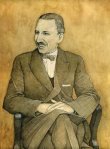
JULIUS "NICKY" ARNSTEIN
What’s even farther afield is the portrayal of “Nicky” Arnstein, who is presented in the film as a handsome, cultured, lovable rascal whose pride wouldn’t allow him to accept his wife’s financial help when his gambling luck ran out. In actual fact, Arnstein was a louse who shamelessly sponged off Brice for years. Brice – who had two other marriages – lived with Arnstein for six or seven years before they married, and he took full advantage of her resources and her status. He did time in Sing Sing before they married – this is not mentioned in the film – and he did 13 months in Leavenworth during their marriage after he was caught trying to transport stolen securities into Washington, D.C. Brice spent a lot of her money trying to defend him from the federal charge, and then he dropped her cold when he got out of stir. Why someone with Fanny Brice’s talent wanted to associate in any way with Arnstein I am not aware.
Apparently there were at least two reasons why the movie – and the Broadway show that inspired it – departed so far from the facts of Brice’s life. One was that the writers were trying to create good entertainment, not a documentary. The other was that Arnstein was still alive when this material was written and was known to be prepared to litigate anything derogatory said about him.
“Yoo hoo! Mrs. Goldberg ….”
April 25, 2009

GERTRUDE BERG
We were happy last night to find that the web site http://www.archive.org has several episodes of the television series “The Goldbergs,” a program far superior to most half-hour shows today, with allowances for the technical advances that have taken place since the ’50s. This is a warm show, humorous without being silly, with a solid dramatic basis. The show starred Gertrude Berg, who also owned it and wrote it and insisted on such things as everday situations and no laugh track. The Goldberg family consisted of Molly Goldberg; her husband, Jake, who was in the wholesale garment business; her uncle, David Romaine; and her children, Rosalie and Sammy – to whom Molly always referred as “my Rosalie” and “Samalie.” The family first appeared in a long-lived radio series and also was portrayed in a Broadway play written by Berg and in a film. The episode we watched last night was the final season in what was not a continuous run. In this 1955 show, the family had just moved to the suburbs from The Bronx – mirroring what was actually going on with a lot of urban Jewish families at the time – and Molly was having a hard time adjusting to an unfamiliar neighborhood. The dialogue in this show is priceless; Berg had a good ear for how people talk. Molly and David, in particular, use a peculiar verbal shorthand one doesn’t hear often. For instance, when Molly wants to say, “Give me a minute to write that down,” she says, “Pardon me while I jot.” We’re grateful for whoever preserved these shows.

GERTRUDE BERG and PHILIP LOEB
There was a shadow over “The Goldbergs.” Philip Loeb, who was cast as Jake when the television series was on CBS, was fingered as a Communist by Lee J. Cobb and Elia Kazan in their testimony in 1950 before the House Un-American Activities Committee. Berg was pressured to fire Loeb, and she refused, so CBS dropped the show. Loeb resigned and accepted a monetary settlement, but he committed suicide in 1955. Eight months after CBS dropped it, NBC picked the show up with another actor in the role.
Alma mater studiorum, you guys
April 23, 2009

BARBRA STREISAND
I learned the other night that Arthur Laurents, who wrote the books for “West Side Story” and “Gypsy,” is a graduate of Erasmus Hall High School in Brooklyn. That’s one more notch in the belt of a school that has been serving students in Brooklyn since 1786. I learned of it while reading the playbill at the George Street Playhouse, where Arthur’s latest work, “New Year’s Eve,” is having its world premiere. Arthur is 91, which may say something about the good old Brooklyn stock.
Erasmus Hall first came to my attention in the 1960s when my childhood friend Joe Cantalupo was enrolled there. He was in the same class as Barbra Streisand, and when she first became a public figure, Joe showed me her picture in the Erasmus Hall yearbook. Streisand’s latest project is a musical program scheduled for Saturday night on CBS.

ERASMUS HALL
Erasmus Hall has an impressive roster of graduates. To name a few: performers Beverly Sills, Susan Hayward, Jeff Chandler, Lainie Kazan, Bernie Kopell, Stephanie Mills, Donny Most, Barbara Stanwyck, Norma Talmadge, Eli Wallach, Shirley Booth and Mae West; playwright Betty Comden; former New Jersey Gov. Jim Florio; Yankees pitcher Waite Hoyt; comedian Marty Ingels; sportswriter Roger Kahn; and authors Bernard Malamud and Mickey Spillane.
Among those who just passed through were singer Neil Diamond, actor Gabe Kaplan, quirky chess champion Bobby Fischer, and Moe Howard, one of the Three Stooges.
Besides the remarkable legacy of this high school, its roster of alumni speaks to the contributions Brooklyn has made to American culture. There’s something palpably inspiring about the place, something you can feel if you get a chance to hang out there or are fortunate enough to live there.
Put ‘er there, pal.
April 21, 2009

DICK CHENEY
Former Vice President Dick Cheney thinks President Obama has sent the wrong message by traveling to Europe and Latin America and suggesting that the United States is rethinking its recent foreign policies. Cheney said last night that Obama needs to distinguish more clearly between “the good guys and the bad guys,” which I learned to do when I was 10 years old playing cops and robbers with Mike and Joe Pellegrino. That’s how we think when we’re 10.
Cheney is dismissing what we learned from Richard Nixon, that pretending that your adversaries and critics don’t exist (Cheney said the Bush administration’s policy was to “ignore” Hugo Chavez) is seldom productive. Cheney didn’t like that Obama shook hands with Chavez. Nixon shook hands with Zhou Enlai because China’s fall-out with the Soviets created an opportunity for the U.S. with respect to both countries, and, I suppose, because Henry Kissinger’s earlier snub of the Chinese premier had gained the United States nothing. The old “good guy-bad guy” model seldom works. And the idea that Cheney casts himself and his kind as the “good guys” in this world is exactly the kind of hubris that causes more trouble than it solves.
He was nice to mice
April 14, 2009

Bo, a dog
One thing is certain: The president, no matter who he is or what he does, can’t win.
The Christian Science Monitor, for one, was reporting today that the First Man, if that’s the counterpart to the First Lady, is getting flack for accepting Bo, the dog, as a gift from Edward F. Kennedy after promising before the November election that the White House dog would be adopted from a shelter. This chatter is going on at the same time that folks are, on the one hand, giving the president credit for approving the use of lethal force against the pirates holding an American sea captain and, on the other hand, predicting that the same decision will result in escalated violence against Americans and American interests.

Andrew Johnson
With regard to the pet, the 44th president of these United States might have been better off emulating the 17th. Andrew Johnson discovered a family of mice that appeared in the Oval Office each evening. Instead of having them eradicated, he started leaving them bits of food. He got along better with those mice than he did with the Republicans in Congress, who would have lynched him if they thought they could get away with it.
 CharlesPaolino's Blog