They don’t make ’em like they used to.
July 22, 2009

ANDREW JOHNSON
When Andrew Johnson was governor of Tennessee in the middle of the 19th century, he was warned that if he kept a certain speaking engagement, he would be shot. Those were times of — how you say — partisan excitement. Johnson kept the date, produced a pistol and announced that he understood assassination was part of the program and that good order dictated that it be first on the agenda. He waited. Nothing happened. He went ahead with his speech. Whatever his shortcomings, Johnson apparently wasn’t afraid of assassins.
Now Sarah Palin is governor of Alaska and she has agreed to speak — after she leaves office — before the Simi Valley Republican Women’s Club at the Ronald Reagan Presidential Library in California. Considering the timing and the audience and the venue, this might have been the first volley in Palin’s new career — whatever that may be. But it won’t do for that purpose because — of all things — the press won’t be admitted. No one is saying who made that decision. Maybe it was the club. Of course, why wouldn’t a political club celebrating an anniversary of its charter with an event at one of the presidential libraries want to exclude news coverage? The arrangements were made too far in advance for this to have anything to do with the latest ethics issue swirling around the governor — the report by a special investigator that Palin used her position to improperly receive gifts from a political fund, ostensibly to help pay her legal bills from previous ethics complaints. So it must just be that the Republican Women of Simi Valley are shy, not that the governor doesn’t want to face the assassins …. uhhh, the press.
The investigator, by the way, made a sensible recommendation, which was that public officials who are the subjects of ethics complaints that eventually are dismissed should not have to pay for their own defense. That’s the position that Palin is in, and it isn’t just.
“Life, death, and rebirth are inevitable.” — Rig Veda
July 18, 2009
 It was sort of uplifting yesterday to be able to sit at a restaurant on the boardwalk at AsburyPark, admiring the details on the Paramount Theater/Convention Center building, and watching the passing parade. The last time I drove near that boardwalk, many years ago, I was afraid to get out of my car. It wasn’t that I was afraid of the people there; I’m kind of foolhardy in that way — seldom afraid of people. I was afraid that looking more closely at what was obvious from inside my car would break my heart altogether. I knew what happened there, but I had never seen it.
We were staying in Belmar for a couple of days this week, so we drove up to Asbury Park to tread the boardwalk and have dinner. There was a very mixed crowd making the promenade — which reminded us of the corniche in Beirut. That was one of the best things about the reborn boardwalk, that all sorts of people seem to feel welcome there.

CONVENTION HALL (DETAIL)
There wasn’t a crowd there last night although several of the retaurants were doing a brisk trade, but the waitress at Tom McLoone’s told us that on weekends the boardwalk is packed. Again, better than it’s opposite.
One can’t help wondering, though, how this regeneration will be sustained and made to grow. I understand progress has been stunted by the general economic malaise, and while it is heartening to see what is new on the boardwalk, it is chilling to see what is still in ruins and to see the voids where businesses and games and rides have vanished. I tried to recall where Bubbleland was located — the collection of kiddie rides that was owned and managed by Lloyd McBride, who also was one of my instructors in communications when I was an undergrad at Seton Hall. We took our eldest three children there, and Mr. McBride — I still have too much respect for him to call him anything else — would often let them ride for free.
I was sorry that at the same time I was feeling a certain elation at seeing that boardwalk revived I also had a sense of foreboding that this grand experiment wasn’t going to work. But when we got home, I puttered around the Internet until I found an interview with Mr. McBride that was published in the Spring of ’08. He’s retired from Seton Hall and he lost his rides to eminent domain, but he’s still in Asbury Park and he assured the interviewer that the city “will come back.” Since I’m too much of an optimist to be afraid of people, I think I’ll be too much of an optimist to think that Mr. McBride could be wrong.
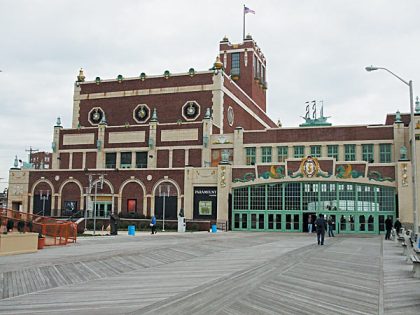
THE PARAMOUNT THEATER AND CONVENTION HALL
“But baseball has marked the time.”
July 8, 2009

BOSTON RED SOX
One thing that is unlikely to appear in a photograph of Boston Red Sox players is red socks. Players for Boston, like most players in professional baseball, have forsaken the knickers and high stockings that have been a distinctive element of the baseball uniform for 140 years.
According to the National Baseball Hall of Fame web site, knickers were introduced to the game in 1868 by the Cincinnati Red Stockings. The innovation met with some resistence. The Hall of Fame site reports as follows:
“The showing of the manly leg in varied-colored hose … [was] unheard of, and when [team captain] Harry Wright occasionally appeared with the scarlet stockings, young ladies’ faces blushed as red, and many high-toned members of the club denounced the innovation as immoral and indecent.”

ALEX RODRIGUEZ
But stockings quickly became de riguer in the game and remained so for many decades. Now, however, in this epoch in which everyone does what he pleases, this tie to the past has been withering away. During last night’s game between the Yankees and the Twins, I counted only four men on the field wearing high stockings: Alex Rodriguez, R.A. Dickey, Joe Crede, and Brendan Harris. The rest looked like they were wearing their pajama bottoms — and walking on the hems at that. Besides looking foolish, they’re monkeying with something essential about The Game — its tradition.
Remember what Terence Mann told Ray Kinsella at the climax of “Field of Dreams”?
“The one constant through all the years, Ray, has been baseball. America has rolled by like an army of steamrollers. It has been erased like a blackboard, rebuilt and erased again. But baseball has marked the time.”

1869 CINCINNAT RED STOCKINGS
There are no small roles.
July 3, 2009

JOHN DILLINGER
Amid all the tsurris about Michael Jackson’s death bubbles the question of how long his fame will endure. He will have done well, it seems, if the public fixation with him lasts as long as its interest in John Dillinger, an anti-social holdup man and murderer who was shot to death 75 years ago. Once Independence Day is out of the way, we can focus our attention on John Dillinger Day, an observance that commemorates his death, which occurred on July 22, 1934.
There are those, of course, who say that it wasn’t Dillinger who was gunned down outside a movie theater in Chicago, and I suppose we’ll have to live with those who will claim that Jackson didn’t die in Los Angeles last week but is living in Buenos Aires with Adolph Hitler, Emilia Earhart, and Elvis Presley. At last, a fourth for bridge.
The reviews in the Christian Science Monitor and the Washington Post are unenthusiastic about the movie “Public Enemies,” in which Johnny Depp portrays Dillinger. Dan Zak writes in the Post:

JOHNNY DEPP
There’s no excitement in the bank-robbing, no thrill of the chase, no emotion over justice served or thwarted. Depp’s Dillinger is neither charming nor despicable, nor does he occupy that delicious gray area between the two. His spree unspools dispassionately, cold as a Colt .380.
Peter Rainer in the Monitor writes:
Mann’s hero-worshipy treatment of Dillinger is undercut by the film’s dreamtime existentialist aura. In reality, the working poor cheered Dillinger’s bank raids but in “Public Enemies” the Depression is just a prop, and so Dillinger’s populist hero status, what little we see of it, makes scant sense. (This is probably why we see so little of it.) Missing, as a result, is the knockabout tumult of a time when gangsters could ascend to the same stardom as the movie actors who played gangsters. Dillinger was, for a while, every bit as big as Jimmy Cagney. Mann pirouettes around the twin realities of the Depression and the star culture it engendered and offers instead a moody blues doominess. It’s a vacuum filling a vacuum.
So Depp becomes neither Clyde Barrow nor Robin Hood. Maybe, in his old age, he can play Bernie Madoff.
RUDOLPH VALENTINO
I noticed references to a public wake for Michael Jackson, and that got me to thinking about the manner in which previous celebrities of that magnitude have taken their leave, as it were.
I should qualify this observation immediately inasmuch as I’ve been hearing for several days that there has been no other celebrity of that magnitude — and today I heard the Chicago Tribune music critic say that there won’t be another, at least not among singers. These are meaningless statements, of course, because the magnitude of any person’s celebrity is affected by multiple factors, most of them subjective. Enrico Caruso, for example, was treated all over the world as if he were royalty — even by people who had never heard him perform, and 88 years after his death he is still the standard by which male singers are measured. His name, in fact, is a synonym for “male singer.”

BABE RUTH
A man whose status as an international celebrity was emerging just as Caruso died was Babe Ruth. He transcended the sport that his fame was based on to such a degree that Japanese soldiers during World War II, nearly a decade after his career had ended, would shout “to hell with Babe Ruth” as an insult to American servicemen. Like Caruso, Ruth remains the model to whom his successors are compared.
When Ruth died, he had been retired for 14 years. His body lay in state at Yankee Stadium where an estimated 100,000 people of every age and description bid him a solemn farewell. When Francis Cardinal Spellman celebrated Ruth’s funeral mass at St Patrick’s Cathedral in Manhattan, a crowd estimated at 75,000 filled the church and spilled out into the rain-swept streets.

ABRAHAM LINCOLN
It is likely that no outpouring of grief in this nation, at least, has exceeded that which followed the murder of Abraham Lincoln. In retrospect, the reaction was not out of proportion to the importance of his death; in some respects, one might argue, the country has not yet fully recovered, given the debacle of Reconstruction and its aftermath.
Contemporary accounts describe the American people, including many who recently had excoriated Lincoln and his policies, as either numb with shock or crazy with anger. Millions of people stood along the right-of-way as the funeral train carried Lincoln’s body over the 13-day journey from Washington to Springfield.

RUDOLPH VALENTINO
Perhaps the instance that will prove the best analogy for the case of Michael Jackson is that of Rudolph Valentino, the silent film actor whose life and career were as tumultuous and controversial as Jackson’s. Valentino died in 1926 at the age of 31 from complications after surgery for appendicitis and gastric ulcers. His funeral, which was something of a circus, attracted an estimated 100,000 people in the streets of New York, a large number considering the limitations on travel at the time. The crowd erupted in a riot that lasted most of one day and required more than 100 mounted policemen plus police reserves to restore order. Several of Valentino’s fans committed suicide and the actress Pola Negri sent to the funeral home 4,000 roses in an arrangement that spelled out her name. During the wake period, Negri announced that she had been Valentino’s fiancee — something no one else was aware of — and promptly collapsed on his coffin in a fit of hysteria. She followed the funeral train from New York to California and was composed enough to stand for photographs whereever the train stopped.

POLA NEGRI and RUDOLPH VALENTINO
 Bill McGraw writes in the Detroit Free Press about what seems like the increasing tendency of political figures to invoke the name of God to justify virtually anything. The immediate inspiration for McGraw’s column was a remark by Detroit City Councilwoman Monica Conyers, who is in the crosshairs of a potential federal bribery indictment. “On Tuesday,” McGraw writes, “when it became clear the feds were closing in on Conyers, she described herself to viewers of her weekly TV show as ‘a child of God,’ and told viewers ‘if you’re not praying for me, then you’re just adding to the problem.’ Then she added: ‘All these things that are going on right now … I believe in my heart that God will deliver me from them.’ ”
McGraw went on to reminisce about invocations of the Diety by Detroit public figures over the past couple of decades, including former Police Chief William Hart who was charged in 1989 with using public funds to subsidize $72,000 in rent on his daughter’s former home in Beverly Hills. “With God as my witness,” Hart said, “I swear I did not do that.” He was subsequently convicted of stealing $2.3 million.
 McGraw observed that few office holders have made as many public references to God as did George W. Bush while president of these United States. “I trust God speaks through me,” the president told an audience in Lancaster, Pa., in July 2004. “Without that, I couldn’t do my job.” I’ve seen that quote many times, and I’ve always suspected that the president said, or at least meant, “I trust God speaks to me.” I don’t know about George Bush, but I don’t think I would attribute to God many of the things that come out of my mouth.
“All my life’s a circle” — Harry Chapin
May 31, 2009

Photo by Jim Dirden
I just finished reading a new biography of Pete Seeger by Alec Wilkinson of The New Yorker. It’s a short, well-written work that gives a good look at Pete’s personality. It is based on a series of interviews Wilkinson conducted at Pete’s home in Beacon, N.Y.
This isn’t a fawning portrait. Pete’s doubts and insecurities come through, in his own words.
It is also interesting to learn in this work about Pete’s parents, and particularly his father, Charles, who was also an idealist.
There is a lack of balance in the way many people react to Pete. There are many who think of him only as a folksy singer of campfire songs – sort of a Tennessee Ernie Ford. There are those who cast him in a messianic role that he himself would reject. And there are those who think he is the antichrist because, like many thoughtful people of his and his father’s generation, he associated for a time with people who felt Communism held the answers to chronic economic, social, and political problems. Pete acknowledges – including in this book – that that was a mistake, but more than a half century later, some folks still pillory him for it.

Pete is well known not only for singing but for encouraging his audiences to sing with him. Wilkinson’s book examines this practice, which for Pete isn’t just a cutsey stage trick. Calling on people to sing goes to the heart of Pete’s notion of what music is for, and gets to discuss that in his own words in this book.
Pete Seeger has been an important figure in the history of the past seven decades – not always clearly understood, even by himself. Wilkinson’s book at least helps formulate the questions.
 Condominium living has its ups and downs. Among the downs are some of the provisions in the covenant one agrees to when buying onto a condo community. Most of the provisions make sense; they are designed to preserve the value of everyone’s property. But part of the overkill in our community is the prohibition against attaching anything to the outside of the structure. For the most part, that makes sense, but there should be an exception for a flag holder. You have to use some ingenuity to display a full-size flag here. Pat came up with the idea of using the gizmo that we screw into the beach to hold the umbrella. It works well in the mulch in the garden in front of our unit, so our flag is out there, but it looks kind of lonely.
 I’ve been reading a lot lately about World War II, and I am really learning about it for the first time. I had only the most broad-brush knowledge of the war – the military challenges and the political issues. And I really never appreciated, except in the abstract, the suffering endured by those who served in the military forces.
The Washington Post had a good Memorial Day editorial today. It’s at this link:

RONALD REAGAN
Pretty soon, Americans visiting London will be able to stop by to see how Ronald Reagan is making out on his pedestal. An ten-foot bronze statue of the fortieth president of these United States will be erected on a six-foot stone plinth outside the United States Embassy in London. To make this possible, local authorities had to set aside a policy under which a person must be dead for ten years before being memorialized with a statue. Apparently there is a strain of skepticism in the British, but for this purpose they’re willing to concede that Reagan is not only merely dead, but—in the words of the Coroner of Oz—really most sincerely dead. At the very least, Reagan will provide some company for Dwight Eisenhower, whose effigy stands nearby.

THE CORONER
This is the work of disciples of former Prime Minister Margaret Thatcher, who simplified modern world history for generations of students by declaring that Reagan had single-handedly toppled the Soviet Union. U.S. Ambassador Robert Tuttle, who was George W. Bush’s appointee, was said to have enthusiastically supported the idea before he left office in January, turning the embassy over to a diplomatic staff of the Obama stripe. When the current personnel were asked what would happen to Dutch when the embassy is removed to new quarters south of the Thames, they replied that they didn’t know, because “it isn’t our statue.”
There is no unanimity among the British about this development. David Boothroyd, a Labour member of the local committee that waived the “sincerely dead” rule, voted in the affirmative, remarking that “you have to set aside your personal politics when you have a person of global importance like Ronald Reagan.” A little further to the left, the Green party chair of the local committee said, “What a ridiculous person to put on top of a monument. … It would be the same as putting up a statue of Arnold Schwarzenegger. Will they do that next?”
Good for the gander
May 17, 2009
 If former Vice President Cheney or Ann Coulter or others of that stripe find time to read Jonathan J. McCullough’s book “A Tale of Two Subs,” there’s one paragraph they shouldn’t overlook. This book concerns the U.S. submarine service during World War II, and it recounts the sinking of the sub USS Sculpin and the imprisonment and mistreatment of the survivors from its crew. McCullough mentions Lieutenant Commander John Fitzgerald, who had commanded the USS Grenadier and was captured by the Japanese. McCullough writes:
Fitzgerald had also undergone what he called “the water treatment.” The guards strapped him to a table, elevated his feet by about 30 degrees, covered his mouth with their hands, and poured water into his nostrils, asking questions all the while. After a few minutes he passed out, and when he came to, the process started all over again. For hours. He was barely able to muster any sort of answer, let alone tell them what they wanted to know, and when he was lucid he told them only lies and misleading half-truths. This was waterboarding. After the war the Allied war crimes tribunals classified the practice as a form of torture, a war crime, and handed down prison sentences spanning decades to its practitioners.
Torture. A war crime. Then and now.
 CharlesPaolino's Blog