Two hearts that stopped as one
September 2, 2009

ART CARNEY
In a 1956 episode of “The Honeymooners,” Ed Norton (Art Carney) is advising Ralph Kramden (Jackie Gleason) that one of their neighbors reads all the mail that comes into the building. To illustrate his point, Norton tells Ralph what the Kramdens’ gas bill was the previous month. And then he congratulates Ralph for breaking the all-time low gas bill record set by the Collyer Brothers in 1931.
The studio audience laughs, because they remember the Collyer Brothers, whose macabre death had occurred only about nine years before that episode was filmed. Homer and Langley Collyer, offspring of a well-to-do family, lived in a mansion in what was then high-fashion Harlem — remaining there after their father inexplicably abandoned them in 1919 and moved downtown. By that time the brothers were well educated — at least one of them had graduated from nearby Columbia — but instead of pursuing careers in engineering or admiralty law, they gradually withdrew from society, living like hermits and literally filling the house with tons of newspapers, bicycles, firearms, electric motors, musical instruments — a collection far too varied to be characterized, although it is usually referred to as “junk.”

LANGLEY COLLYER
In 1947, the two men died in the house under tragic circumstances. Langley Collyer had been killed by one of the booby traps he had assembled to ward off intruders and Homer, who was blind and largely helpless, had died of starvation, just a few feet from his brother’s body. Police and laborers removed 103 tons of material from the house, which was condemned and razed.
E.L. Doctorow has written a novel, “Homer and Langley,” being released this month, which consists of what Doctorow describes of his “reading” of the Collyer Brothers’ lives. By that he means that the book is not a history; in fact, he said he did no research, which may be an exaggeration, but he makes his point. He was curious, not about morbid details that had been repeated again and again, but about what motivated the two men to shut the world out of their lives or rather, as he puts it, to “emigrate” to a life within their home, a life lived on their own terms.
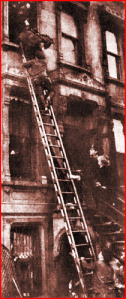
HOMER COLLYER'S BODY IS REMOVED FROM THE HOUSE
Doctorow was interviewed on NPR today — specifically, on “All Things Considered: — and his remarks suggested more respect for the Collyers than they usually are afforded. Certainly he eschewed the ridicule that an Ed Norton couldn’t help but attach to the names. The writer apparently doesn’t begin with a judgment about the brothers — or about people who don’t choose to live as others do. He begins with curiosity about how their lives fit into the whole picture of life in their time. He also said that he was saddened by a comment made in the novel by Homer, who is the narrator: “What could be more terrible than to be turned into a mythic joke?”
A story based on the Doctorow interview, the audio, and an excerpt from the novel are at this link:
http://www.npr.org/templates/story/story.php?storyId=112346577
“Out in right field — it’s easy ya know” — Noel Paul Stookey
August 26, 2009
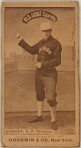
BILLY SUNDAY Chicago White Stockings
As I was picking up my suitcases at the airport in Savannah the other day, my cell phone rang. It was my brother, who wanted to know when major league baseball players stopped leaving their gloves on the field while their team was at bat. And why did they do that in the first place?
Between us, my brother and I have been working for years on collecting all human knowledge. This was just the latest installment. The only answer I had at the moment, as I yanked a suitcase off the carousel, was that the practice was still in place when I first went to a game at Yankee Stadium in 1951, and I was certain it had been discontinued by ’57 or ’58. So my guess was that it stopped in the early ’50s.
Since then, I learned that a rule requiring that all equipment be removed from the field at the end of each half inning was adopted in 1953 and took effect for the 1954 season.
As for how the practice began, the information is sketchy. It is certain that when organized baseball emerged in the middle of the 19th century, fielders didn’t wear gloves at all. When gloves first appeared, on an individual basis, they were work gloves — probably used to protect an injured finger or hand — and a player would stuff those gloves in his pocket when he left the field.

ADMIRAL SCHLEI New York Giants
As gloves made specifically for baseball appeared, they were too large to fit in a pocket, so that was no longer an option. Those early gloves were left on the field at the end of a half inning because they were used by players on both teams. As gloves and mitts became more customized, players no longer shared them, but they continued to leave them on the field. If a thrown or batted ball hit a glove that was lying on the field, that ball was in play. If a fielder tripped over a glove, that was his tough luck.
The rule adopted in 1953 was in a way based on the idea that a glove lying on a field constituted a hazard to navigation. Gloves and mitts by that time had become much larger than their forbears — though not nearly as large as those in use today — that baseball officials decided the practice should be discontinued.
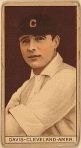
HARRY DAVIS Philadelphia Athletics
The fact that gloves were left on the field for so many years suggests that there weren’t many incidents in which players were injured or the outcome of a game was affected. That doesn’t mean there were never repercussions from the odd habit. On September 28, 1905, for instance, Harry Davis of the Philadelphia Athletics hit a ball that struck a glove left on the outfield grass by teammate Topsy Hartsel, and the carom enabled Hartsel to score the winning run in a 3-2 victory over the Chicago White Sox.
“Every good painter paints what he is.” — Jackson Pollock
August 21, 2009

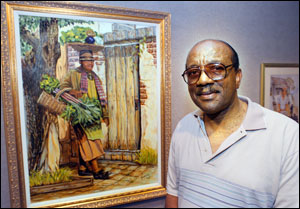
JOE PINCKNEY
We’re heading for Hilton Head tomorrow which means that sometime in the mid-afternoon, I’ll be thinking about Joe Pinckney. He’s always on my mind when we head down there, but even if he weren’t, the sign that calls attention to the Pinckney Colony would remind me.
Pinckney Colony is on the mainland in Beaufort County. The name always intrigued me, but intrigue became lively curiosity about 25 years ago when my son, Christian, and I were sitting around in Port Royal Plantation leafing through the local telephone book. We might have been looking for people named Paolino — unlikely in those parts, or people who share Pat’s family name — Kamieniecki — perhaps more unlikely. What caught our attention, though, was the list of folks named Pinckney. So we picked one out — Joe Pinckney — jotted down his address and set out to find him.
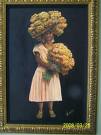
PAINTING BY JOE PINCKNEY
He was in his studio, and when we told him why we were interrupting his work, he greeted us as though there were nothing peculiar about two strangers from Jersey picking his name out of a phone book and dropping in unannounced. He spent a long time with us, showing us his work and telling us his personal history.
He was born in New York, but during World War II he moved as a boy to the Low Country of South Carolina, where his parents were born. The stories I have read about him don’t go into this, but he told us the move back south was motivated by his family’s fear — a fear shared by many in those days — that Nazi Germany would attack the Northeast Coast from the sea. It was quite an adjustment for Joe. He was dazzled by the sight of the night sky, unobstructed by the artifical light of the city. He also had to get accustomed to an unfamiliar cuisine, and he absorbed some of the local dialect.

PAINTING BY JOE PINCKNEY
Joe Pinckney studied art in New York and received a scholarship from the Norman Rockwell Foundation, but he became a permanent resident of South Carolina and spent several decades creating a body of work that depicts the culture of the Gullah people who have lived and farmed in the Low Country since the 19th century. He died in November 2005.
I have my son’s inquisitive nature to thank for the fact that we visited Joe Pinckney. Our whole family loves Hilton Head and we have vacationed there often, but in a way every vacation was like every other one, except for the one blessed by that gracious and gifted man.
The Pinckney Colony was founded by a family of white farmers, and I don’t think Joe explained whether his forbears had adopted that name or if the names were coincidental. After spending time in his company, maybe it didn’t matter to us any more.
There is a story about Joe Pinckney at this link: http://www.blufftontoday.com/node/3053
Four of Joe’s paintings, including the two I have included in this journal, are at the web site of the J. Costello Gallery in Hilton Head: http://www.jcostellogallery.com/artists/joe-pinckney
JOE PINCKNEY
 I see by the papers that Starbucks is going to raise the prices on some of its drinks and lower prices on others — and see what happens. The short version is that sales have been declining. So frappucchinos and caramel macchiatos are going up — maybe 30 cents a pop — and lattes, cappuccinos and brewed coffees are going down.
I won’t be a part of this study. I’m atypical where coffee is concerned. I drink it every morning, and I order it after most dinners out, but I wouldn’t care I never had it again. And when I do drink it, it can be Chock Full o’ Nuts or Folgers, with no additives. And I don’t want to pay for coffee as if it were gasoline. I have been in a Starbucks three times, and one of those occasions was to avoid freezing to death on a Manhattan street. On the other two visits, I had hot chocolate, which was also overpriced — but it was chocolate.

SHELLEY BATTS
I had a supervisor on one of my first jobs who instructed everyone in our section not to talk to her in the morning until she had had two cups of coffee. She was serious. I’m sure she believed it herself, but I couldn’t understand it because the caffeine in coffee doesn’t affect me. It doesn’t make me jumpy, it doesn’t calm my nerves, it doesn’t jolt me out of a stupor, it doesn’t give me indigestion, and it doesn’t keep me awake. Whether two cups a day does anything else to me, I don’t know. Coffee’s reputation as a deadly poison or a life-giving nectar seems to ebb and flow. Shelley Batts, a candidate for a doctorate in neuroscience, looked back a couple of years ago in her fascinating blog “Retrospectacle” at a recurring theory that coffee was a treatment for plague. You can read about that at the following link: http://scienceblogs.com/retrospectacle/2007/08/science_vault_coffee_as_a_cure.php

THEODORE ROOSEVELT
I just read a book — “Rebirth of a Nation” by Jackson Lears — that paints an uncomplimentary picture of Theodore Roosevelt, to the extent that Roosevelt was one of the principal proponents, during the so-called “gilded age” — of American empire-building. Considering his appetite for action at any price, maybe Roosevelt was hopped up on coffee. He was, after all, the source of the Maxwell House coffee slogan: “Good to the last drop.” The first time I heard that, I dismissed it as a fable, but apparently there is some authority for it. You can read about that at this link: http://www.theodoreroosevelt.org/life/Maxwell.htm
A news story about the Starbucks pricing strategy — which I guess was broken by Bloomberg — can be found here: http://latimesblogs.latimes.com/money_co/2009/08/investors-know-that-businesses-cant-cost-cut-their-way-back-to-prosperity-and-rising-earnings-so-what-wall-street-most.html
Shelley Batts is co-authoring a new blog — “Of Two Minds” — which can be found at this link: http://scienceblogs.com/twominds/
Netflix Update No. 16: “The Andersonville Trial”
August 14, 2009

WILLIAM SHATNER
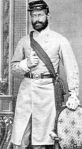
We watched the 1970 television production of “The Andersonville Trial,” which was an adaptation of a 1959 play by Saul Levitt. The play is based on the trial in 1865 of Henry Wirz, commandant of the Confederate military prison at Andersonville, Georgia. Some 13,000 Union soldiers died while incarcerated there under inhumane conditions. Wirz was found culpable by a military court and was hanged, but the degree of his blame was the subject of controversy then as it is now.
Levitt’s play focuses, as the actual trial did not, on the moral question of whether Wirz had an obligation in conscience to disobey his superiors and provide relief for the inmates. That issue may sound familiar to 21st century audiences as may another issues raised in the play — the rights of prisoners held under military law and the propriety of trying Wirz by a military court when the war had ended.

CAMERON MITCHELL
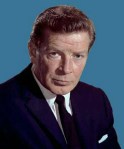
The play, presented in three acts, stars Richard Basehart as Wirz; William Shatner as Lt. Col. Norton Chipman, who prosecuted Wirz; Cameron Mitchell as Gen. Lew Wallace, who presided at the trial; Jack Cassidy as Otis Baker, the civilian attorney who defended Wirz; and Buddy Ebsen as a physician who was assigned to the prison and testified at the trial.
Shatner, Basehart, Mitchell, and Cassidy should have paid to appear in this production — it was that much of a tour de force for each of them. All of them gave intense performances that together provide a glimpse of the brutal and corrosive character and consequences of a war that has since been wrapped up in too much glory and nostalgia.
Shatner has at times been rightfully criticized for chewing the scenery, but in this case he brought the appropriate passion to his role — an army officer who knew that the moral questions he was putting to Wirz also applied to him. One distraction, though, is what has to be the worst of the bad hairpieces Shatner has worn during his long career.

JACK CASSIDY
Cassidy was a master of cool, and he used his controlled reactions to make Baker a chilling opponent for the over-the-top prosecutor. Mitchell was equally effective as Wallace — a lawyer and military man who later wrote “Ben Hur” — who was impatient with the proceeding itself and with the constantly bickering attorneys and unruly defendant.
I last saw this presentation when it first appeared on PBS in 1970, but Basehart’s performance in particular remained vivid in my memory. Wirz — a native of Switzerland — was presented here as a man tortured by Chipman’s questions, by his own assessment of his behavior, and by his concern for the legacy he was leaving his family.
RICHARD BASEHART
Basehart was so thoroughly invested in these aspects of his character that it is almost as uncomfortable to watch and listen to him as it would have been to sit in that courtroom.
I had forgotten about the performance by Michael Burns, who did a skillful turn as a shell-shocked soldier called to testify about the atrocities at the prison. His disoriented posture and vacant look was disturbing even as a dramatization. Burns was an interesting figure who left acting early in life and became a respected history professor and author.
This production was directed by George C. Scott who played Chipman on Broadway. The only actor from the Broadway production who appeared in the television adaptation was Lou Frizzell who did not, however, play the same role.
Some of the dialogue in this play is taken from the trial, but the overall portrayal of the proceeding is Levitt’s interpretation. Even so, it is a valuable reflection on the role of conscience in the Civil War and war in general.
HENRY WIRZ
… and it’s gone!
August 10, 2009

GABBY HARNETT baseball card
The Boston Globe has a touching little story about Sara Bejoian, a Watertown woman who carried on a friendly baseball rivalry with her husband, Jim, who died last year when the couple had been married just shy of 54 years. Sara was a Red Sox fan and Jim rooted for the Yankees.
The point of the story was that Sara has agreed to throw out the first ball at an old-time baseball game, as a tribute to her late husband. The account by Peter DeMarco includes this sentence: “Jim Bejoian’s passion for the sport extended to the Oldtime Baseball Game, an annual charity game held at St. Peter’s Field in Cambridge in which local amateurs dress in uniforms from bygone teams and swing wooden bats in the gloaming of a late-summer night.”
What caught my eye in that sentence was the word “gloaming,” a favorite word of mine, but a word that has been neglected to the point that it is practically extinct. “Gloaming” means “twilight” or “dusk.” To my ear, each of those terms has its own connotation, each suggests a different atmosphere in those moments after sunset. Gloaming has a kind of a brooding sound.
Baseball fans — I mean fans — know that the word “gloaming” occupies a special place in the history of the game. It is associated with a game between the Chicago Cubs and the Pittsburgh Pirates at Wrigley Field on Sept. 28, 1938. The Cubs were a half game behind the Pirates in the National League pennant race, and their record for September up to that point was 18 wins, 3 losses, and a tie.

GABBY HARTNETT
On Sept. 28, the teams were locked in a 5-5 tie in the bottom of the ninth inning. The sun had set, and night was coming on. There were no lights at Wrigley Field, so when Cubs playing manager Gabby Hartnett came to bat with two men out, it was clear to everyone that if he didn’t reach base, the umpires would end the game in a tie. With two strikes on him, Hartnett hit the ball into the darkness. The Cubs won and, three days later, clinched the pennant. The event has been known ever since as “the home run in the gloaming,” and what expression could capture it better?
I hope Hartnett is still an iconic figure in Chicago, where he played for 18 years. He certainly isn’t one in the everyday vernacular of baseball. He deserves better. He was one of the leading catchers of his time and an excellent hitter. He was a six-time All Star and an MVP, and he is a member of the National Baseball Hall of Fame.
In addition to his outstanding record as a hitter and fielder, Hartnett took part in two more of baseball’s legendary moments, at least one of which actually happened. He was behind the plate in the 1934 All Star Game, when Carl Hubbell struck out in succession Babe Ruth, Lou Gehrig, Jimmy Foxx, Al Simmons, and Joe Cronin. And Hartnett was the catcher in the 1932 World Series when Babe Ruth ostensibly called his own home run to centerfield.
I think I’ll start slipping “gloaming” into the conversation and see if I can inspire others to do the same.
The Globe story is at this link:
Sui generis
August 5, 2009
GERTRUDE BERG
A few months ago, I wrote in this journal that my wife and I had discovered and watched on line a few episodes of the television series “The Goldbergs.” Those episodes are at http://www.archives.com.
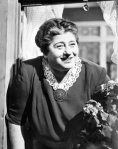
After I wrote that blog, I heard from a publicist who was handling a new documentary film about the owner, writer, and star of “The Goldbergs” — Gertrude Berg — who was one of the most remarkable women of the second half of the 20th century. As a result of that contact, I wrote the following story, part of which has appeared in the Courier-Post of Cherry Hill and has been picked up on other blogs:
When the U.S. Postal Service issues its “Early TV Memories” stamps this summer, don’t look for Gertrude Berg.
The New York City native, who 80 years ago created the domestic situation comedy, and became a media mogul, was not included with the likes of Lucille Ball and Harriet Nelson, who decades later followed her into American homes.
But Berg is being reintroduced to the American public in a documentary film – “Yoo Hoo, Mrs. Goldberg” – written and directed by Aviva Kempner.
The title evokes the phrase associated with Berg during the radio and television runs of the show she created and controlled, most widely known as “The Goldbergs.”
The principal character, Molly Goldberg, and her neighbors in a Bronx apartment building, interacted by leaning out their windows and calling: “Yoo Hoo, Mrs. Goldberg … Yoo Hoo, Mrs. Bloom.”
From her window, Molly – portrayed by Berg – invited listeners and viewers into the Goldberg household to share the lives of her husband, Jake; their children, Sammy and Rosalie; and Molly’s brother, David Romaine.
The show ran on radio from 1929 to 1946 – five days a week for much of that time – and on television from 1949 to 1956. Berg herself wrote every script in longhand.
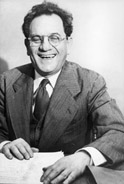
PHILLIP LOEB
There were also a stage play, a movie, a lucrative vaudeville tour, a comic strip, a jigsaw puzzle, a newspaper column, a line of women’s dresses, and a popular cookbook – although Berg couldn’t cook.
Berg’s rise to prominence, Kempner emphasized, occurred “at the time of the greatest domestic anti-Semitism in America, and during the rise of Adolf Hitler in Europe.’’
Berg presented the family as Jewish – adopting a mild Yiddish accent and a unique use of language that became a hallmark of the character:
As Molly shows off a hat, a neighbor asks: “With what dress are you going to wear it?’’
“With mine periwinkle,’’ Molly answers, striking a pose: “Visualize!”
And Berg didn’t shy away from difficult issues affecting Jews.
The documentary points out that in 1933, the year Hitler became dicator of Germany, she had a rabbi conduct a Seder service on the program. And after Kristallnacht in 1938, she wrote an episode in which a stone smashed an apartment window while the Goldbergs were celebrating Passover; Molly calmed the children and urged Jake to continue leading the Seder.
“And yet,’’ Kempner said, “Molly Goldberg was universal. You didn’t have to be Jewish to love her.’’
This urban mother first appeared on radio a month after the stock market crash, and the Goldbergs became so important to the national psyche during the Great Depression, as people maintaining the family circle in spite of want, that Franklin Roosevelt himself acknowledged it.
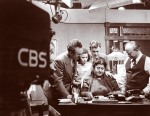
THE CAST OF "THE GOLDBERGS"
Kempner – based in Washington, D.C. – made the documentary through her Ciesla Foundation, whose goal is to “produce films about under-known Jewish heroes.” Kempner – whose work includes a 2000 film about baseball legend Hank Greenberg – said that although the Gertrude Berg film is complete, she is still raising money to pay for it.
The new film includes vintage photos and motion pictures and input from members of Berg’s family, actors, her biographer and others, including U.S. Supreme Court Justice Ruth Bader Ginsburg.
The story they tell has its dark sides.
Berg, born in 1898, did not grow up in the kind of setting she portrayed in her shows.
“She never had a nurturing mother like Molly Goldberg,’’ Kempner said. “She created what she didn’t have.’’
Berg’s own mother sunk into depression after the early death of her son and ended her life in a mental institution. Berg’s father badgered Gertrude into working at resorts he opened in the Catskills and in Florida but never supported her career as an actress and producer.
By contrast, her husband, Lewis Berg, a chemical engineer, typed many scripts from his wife’s handwritten originals.
Especially unsettling in Gertrude Berg’s life was the impact of “Red Channels,” the publication that purported to expose Communists working in radio and film.
One of those identified was Philip Loeb, an actors’ union leader, who played Jake Goldberg on the television series. Berg herself was listed as a “sympathizer.”
CBS and her sponsor pressured Gertrude Berg to fire Loeb. She refused, and her show was cancelled. NBC eventually picked up the show, but Loeb had accepted a cash settlement out of consideration for Berg and the other actors. Blacklisted from radio and film, he committed suicide in 1955.
Berg won an Emmy for her portrayal of Molly Goldberg, and a Tony for her 1959 Broadway performance in “A Majority of One,” and her autobiography was a best seller.
Still, only a small percentage of Americans today know who Gertrude Berg was, Kempner said, “and I want to restore her correct place in our cultural history.’’
The home web site for the film is at http://www.mollygoldbergfilm.org/home.php Information about theaters showing the film is available there.
The Ciesla Foundation web site is at http://www.cieslafoundation.org/
Gratuitum prandium non existet.
July 31, 2009
PRESIDENT REAGAN
Back in the days when I was somebody, I had lunch a couple of times at the White House. Well, in the interest of full disclosure I should admit that I had lunch at the White House precisely because I was nobody. I don’t know if this is still true, but for a couple of administrations anyway the White House would invite “out-of-town” editors to stop in for a day — “out of town” editors meaning those whose publications were not significant enough to have regular representation in the capital.
One of my visits occurred during the Reagan administration. It consisted of a series of individual briefings by the top cabinet members and by George H. W. Bush, who was then vice president. I took some great pictures of Jeane Kirkpatrick, giving no thought to what I would do with them.
At lunch time, we out-of-towners were ushered into the East Room, which had been done up for a banquet. A Marine chamber group played and we lunchers were served by the liveried staff as though we … well, as though we were somebody. There were other guests there — no doubt a little more influential than any of us — and Ronald Reagan gave a talk. That was our contact with the president.

PRESIDENT CARTER
My first visit was during the Carter administration. There were morning briefings similar to those in the Reagan era and a discussion in the Cabinet Room in which we and Jimmy Carter were the only participants. Between the briefings and the meeting with the president, we were ushered into a large mundane business office whose occupants apparently had been shooed away. On one of the desks were trays of sandwiches and canned soda. This, we were told, was “a Carter lunch.” Presumably there were messages in all this about access to the president and about care for the public’s money.
I see by the papers that the Obama administration has taken the second part of that message a little further and is requiring some visitors, and even some staff members, to pay for what they eat when they are chatting with his excellency. Calvin Coolidge would have liked that.
The story, from the Christian Science Monitor, is at this link:
“Say it ain’t so, Joe.”
July 28, 2009

PETE ROSE
There has been a story circulating this week to the effect that Bud Selig, to whom some refer as the commissioner of baseball, may be softening the Major Leagues’ position regarding Pete Rose. At present, Rose, who has admitted gambling on baseball when he was a player and a manager, is barred from having anything to do with baseball beyond buying a ticket as do the rest of the hoi poloi. The Major League ban also means that Rose can’t be elected to the baseball Hall of Fame.
This last is understandable. If you go to Cooperstown and take the time to read the plaques that record the accomplishments of the 202 men inducted so far, you’ll find that by a singular coincidence there wasn’t an SOB among them. Or, at least, you will get that impression. It’s akin to reading the sanitized biographies of the presidents on the White House web site.

ANDRIAN 'CAP' ANSON
One of the men you can read about at Cooperstown is Adrian “Cap” Anson who played 27 straight seasons in the Major Leagues in the 18th century and was the first player to accumulate 3,000 base hits. His plaque briefly summarizes his accomplishments, but it really doesn’t give him enough credit for his influence. Anson was the first real “superstar” in baseball, and he carried a lot of weight. Using his clout, he played a decisive public role in banning black players from Major League baseball, an injustice that lasted from 1888 until 1947, destroying the hopes of thousands of potential big league players.
While you will find Cap Anson represented in the Hall of Fame, you will not find Joe Jackson.

JOE JACKSON
Jackson was banned from baseball along with seven other Chicago White Sox players who were accused of participating in a scheme to throw the 1919 World Series to the Cincinnati Reds. There are conflicting reports about how culpable Jackson was in the scheme; he himself admitted to taking a $5,000 bribe though there is no documented evidence that he did anything to give the series to Cincinnati. In fact, he had a fine series at the plate. A criminal jury acquitted Jackson and the others, but Kennesaw Mountain Landis, the first baseball commissioner, banned them from the game. There is a perenniel campaign to permit election of Jackson to the Hall of Fame, both because of the perception of many that he was a hapless dupe, and because he was one of the greatest players in the history of the game — a man with a .356 lifetime batting average and a .408 season to his credit.
What does it mean to be enshrined in the Hall of Fame — that a man was Prince Charming or that he was a good ballplayer? Pete Rose is an obnoxious character but, on balance, Cap Anson did a lot more harm to baseball. Jackson, so far as anyone can show, did none.
Selig said just ten years ago that Jackson’s case was under review. I hope Rose isn’t holding his breath.

DICK CHENEY
The report in the New York Times that Vice President Cheney tried to convince President
Bush to use federal troops to round up suspected al-Qaeda terrorists in Buffalo, N.Y. gives me a chance to brush the dust off my perenniel proposal that the office of vice president be overhauled. I have argued as nauseam that the vice president should head one of the cabinet departments — specifically that he or she should serve as secretary of state, secretary of defense, or secretary of the treasury. The advantages of this change would be as follows:
- It would discourage political parties from nominating non-entities like Spiro Agnew.
- It would avoid wasting the time of a valuable person like Hubert Humphrey.
- It would make it difficult for a president to deliberately ignore a vice president.
- It would keep the vice-president engaged in the legitimate, above-board daily business of the executive department — a particular advantage to a vice president whose background is principally legislative.
- It would give the vice president an opportunity to establish a track record as a top administrator.
- It would spare taxpayers from paying a salary for no work.
- It would keep people like Dick Cheney busy and obstruct them from behaving as though they had authority that the Constitution hasn’t given them.
Cheney had no understanding of — or respect for — the concept that government is at the service of the people, not the other way around. He established a pattern of operating in secrecy — again, without the authority to operate at all — that should outrage Americans of any political stripe. If the Times report is correct, it demonstrates Cheney’s disregard for well established principles of American governance — notably the broad constitutional prohibitions against using troops for what amount to police actions on domestic soil. Bush evidently listened to more responsible advisers in that instance. Incidentally, the Washington Post report on Cheney’s shadow “presidency” is still available at this link:
 CharlesPaolino's Blog