Netflix Update No. 79: “Marvin’s Room”
July 30, 2013

DIANE KEATON and MERYL STREEP
If blood is, indeed, thicker than water, does the same chemistry apply to bone marrow? That question is at the heart of the matter in “Marvin’s Room,” a 1996 film produced by Robert De Niro and starring Diane Keaton, Meryl Streep, Leonardo Di Caprio, Gwen Verdon, and Hume Cronyn.
The story, which is based on a play by Scott McPherson, concerns the uneasy reunion of a badly fractured family. The Marvin of the title (Cronyn) has been bed-ridden at his Florida home for 17 years after suffering a stroke. Unable to walk or to speak coherently, Marvin is cared for by his daughter Bessie (Keaton), who also looks after her aunt Ruth (Verdon), who is in the early stages of dementia.
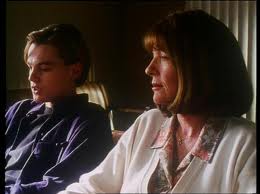
LEONARDO Di CAPRIO and DIANE KEATON
Bessie is diagnosed with leukemia and needs a marrow transplant. She turns for help to her sister Lee (Streep) although they haven’t communicated since Lee moved to Ohio 20 years ago. Lee has two sons who are potential donors, Hank (DiCaprio) and Charlie (Hal Scardino). Lee and Hank have a poisonous relationship which recently reached new depths when he was confined to a mental health facility after deliberately setting fire to their house.
Despite the mutual hard feelings between the sisters, Lee takes her sons to Florida to be tested for compatibility, although Hank is coy about whether he would agree to donate marrow even if he were a match. The atmosphere is uncomfortable and not made any better when Lee considers the possibility that she could inherit this responsibility if Bessie should die.

GWEN VERDON, HAL SCARDINO, DIANE KEATON, LEONARDO Di CAPRIO
There is an unexpected chemistry between Bessie and Hank, however, and the story turns on that, though not in a simplistic way.
This film was very well received when it first appeared, and with good reason. Although the premise has all the potential for a sob story, it is written and directed (by Jerry Zaks) into a tense and moving drama. The unusual array of stars (which includes De Niro as Bessie’s doctor) delivers on its promise, too.
Books: “Southern League”
July 9, 2013
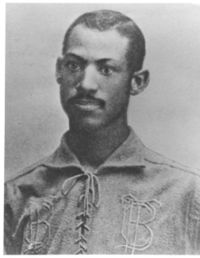
FLEETWOOD WALKER
When Jackie Robinson’s place in baseball history is discussed, there often is a slight error in the way it is expressed. Robinson, who famously joined the Brooklyn Dodgers in 1947 to become the only black player in professional baseball, was not the first black player in the majors. That doesn’t diminish Robinson’s achievement in the least, but the fact is that the first black player in the major leagues, so far as we know, was Moses Fleetwood Walker, a catcher, who appeared with the Toledo Blue Stockings of the American Association in 1889. The second black player in the majors, so far as we know, was his brother, Weldy Wilberforce Walker, a practitioner of several diamond positions, who also played a few games for Toledo that year.
It was in that same year that the baseball owners decided that they would no longer include black players on their rosters, and it would be 58 years before another black player — Robinson — would appear in the bigs. But it would be 72 years, in 1961, before Major League Baseball, which wasn’t fully integrated until the Red Sox capitulated in 1959, ordered the minor leagues to start signing black players.
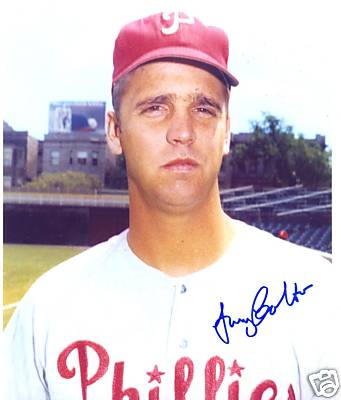
LARRY COLTON
That’s the background for Southern League, an absorbing book by former major leaguer Larry Colton that reports on the 1964 season of the Birmingham Barons, the first integrated pro sports team to play in Alabama. The team had been disbanded by its owner, millionaire businessman Albert Belcher, under pressure from segregationists, but Belcher was convinced that the team could be a financial success. His confidence was bolstered by the fact that Alabama native Charlie Finley, wackadoodle owner of the Kansas City Athletics, agreed to make his team the major-league parent of the Barons.
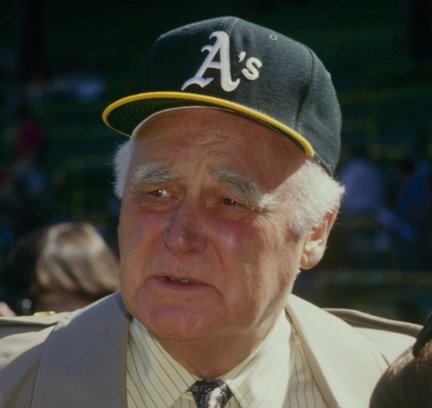
CHARLIE FINLEY
Neither Belcher nor Finley was a civil rights activist, but both were realists. They picked a tough environment in which to practice their pragmatism: Alabama, led by Gov. George Wallace, was digging in its heels against the federal government’s campaign to integrate schools and put an end to racial discrimination in general.
As Colton reports, Finley made a couple of commitments to the Barons. First, he said he would see to it that the Barons got the players it needed to win the Southern League pennant. That was an odd thing for an owner to promise, because the owner’s interest in a minor league franchises usually has to do only with developing players for the major-league team. Second, Finley and Belcher jointly promised the team that they would take all of the players and their significant others to Hawaii if the Barons won the title.

BLUE MOON ODOM
The Barons started their season with five minority players on the roster, including future major league standout pitcher Blue Moon Odom and future big league journeyman Bert Campaneris, a refugee from Cuba. The black players had to put up with vocal abuse from fans and discrimination in public accommodations such as hotels and restaurants.
Still, while Belcher experienced a few tense moments, the season, although it fell just short of fulfilling everyone’s dreams, went off without a serious incident, so that the Barons, who didn’t see themselves as trailblazers, still demonstrated to Birmingham how an integrated enterprise could actually work in the city.
Colton tells this story largely by telling the stories of the ordinary men who made up the Barons roster and the ordinary circumstances of their lives: their often hardscrabble origins, their family lives, their loves, their ailments. Prominently included is the story of Heywood Sullivan, a former major league catcher and future Red Sox exec and owner, for whom the ’64 Barons were the first assignment as a manager, an assignment he handled with wisdom, skill, compassion, and common sense.
King of the Hill, in a manner of speaking
July 6, 2013
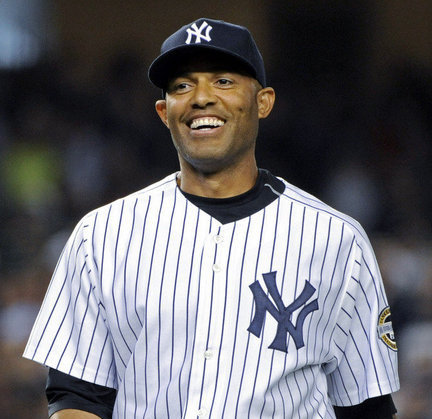
MARIANO RIVERA
The Times, perhaps because it realizes that the window of opportunity is rapidly closing, published a story on June 30, in which Joshua Prager makes the case that by “just about every metric, simple or complex, (Mariano) Rivera is the greatest relief pitcher ever.”
I love Mariano Rivera, and baseball metrics, as much as the next fellow, but I have a problem with words like “ever” in comparisons like this one.
In the recent Times account, the marquee statistic among those used to make this case is the so-called WHIP, which is the average of walks plus hits per innings pitched. When the story was written, Rivera’s average was 1.0035, meaning that in the 1086 innings that Rivera has pitched in his career as of this moment, he has allowed about one hit or walk per inning. A WHIP average approaching this has been rare over the history of baseball. That statistic wasn’t kept until relatively recently, but it has been calculated retroactively and, as The Times points out, Rivera’s average is the third lowest among pitchers who have thrown 1000 or more innings.
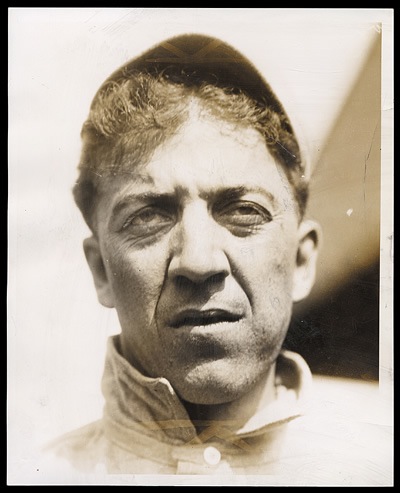
ADDIE JOSS
The lowest WHIP average, 0.9678, belongs to Addie Joss, who pitched for the American League Cleveland franchise from 1902 to 1910 and also was a very popular sports writer in Toledo and Cleveland. Joss pitched a one-hitter in his major league debut, pitched the second perfect game in major league history, and pitched another no-hitter. He was ill throughout most of his career and died at 32 after contracting malaria. Because he pitched only nine seasons, he was not eligible for election to the National Baseball Hall of Fame, but he was admitted under a special rule.
Second place on the WHIP list, with an average of 0.9996, is Ed Walsh, who pitched from 1904 to 1917, virtually all of it with the Chicago White Sox. He also holds the record for lowest career earned-run average: 1.82. His finest individual season came in 1908 when he went 40–15 with 269 strikeouts, 6 saves and a 1.42 ERA.
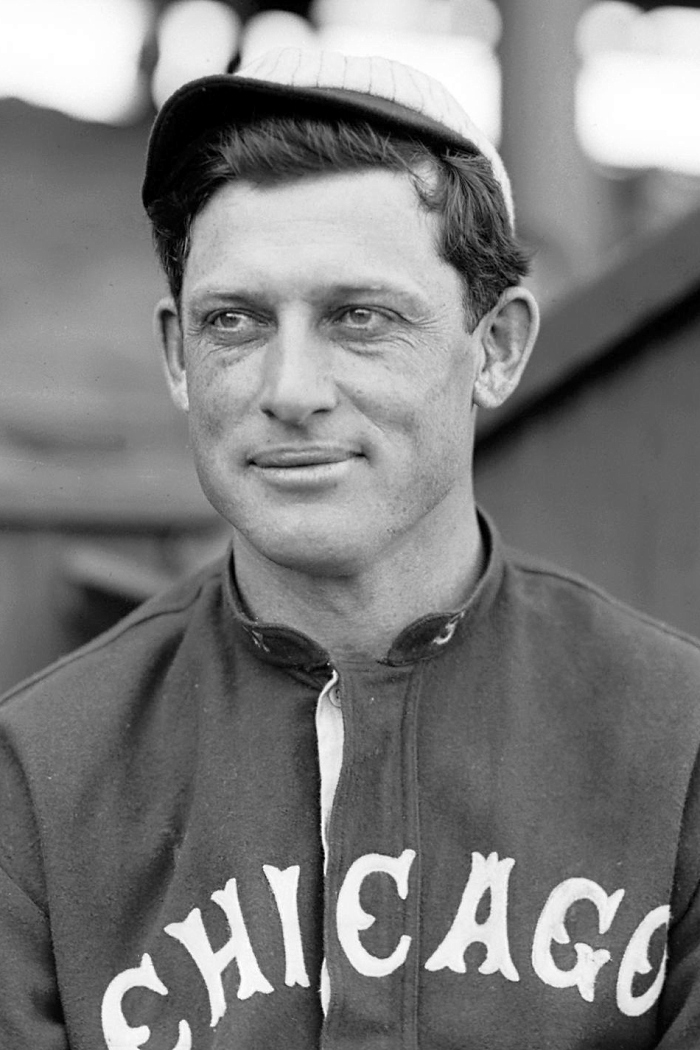
ED WALSH
Inasmuch as The Times called attention to these two players, I will cite their records in order to make my own point. As The Times story mentions, most of Rivera’s relief appearances consist of one inning. Addie Joss and Ed Walsh were starters, not relievers. But the relief specialist as we now know him — the middle reliever, the set-up man, the closer — didn’t exist in that era or for many decades afterward. Ed Rommel’s 17-inning relief appearance in 1932 was an anomaly, to be sure, but relievers for most of baseball history could not count on pitching one inning per appearance.
In compiling his WHIP average, Joss appeared in 286 games and pitched 2327 innings, an average of 8.14 innings per game. Walsh appeared in 430 games and pitched 2964 innings, an average of 6.89 innings per game. To cite a later example, Hoyt Wilhelm, who pitched mostly relief for many teams from 1952 to 1972, appeared in 1070 games and pitched 2254 innings, an average of 2.10 innings per game.
At this writing, Rivera had appeared in 1086 games and pitched only 1251 innings, an average of 1.15 innings per game. His performance has been astounding. It is unheard of for a pitcher to achieve his level of success, to be virtually unhittable, while throwing only one pitch. But pitching one inning per game is a modern, one might say post-modern, phenomenon in baseball. It’s pointless to speculate about how Rivera would have fared if he had been a starter or a long reliever or the jack-of-all-trades that was common in the earlier history of the game. We can certainly appreciate him for the unique player he has been, but “the greatest relief pitcher ever” — EVER? In a game like baseball, that has been played by so many men and that has evolved over so many years, that kind of statement is impossible to defend.
 CharlesPaolino's Blog