“… the consent of the governed.”
July 3, 2010
 Once in a while we hear of an Independence Day ceremony in which someone reads the text of the Declaration of Independence. I have never attended such an event, but I can imagine that the presentation could be effective. The language in the document has always enthralled me. I have read it so often and pored over various passages while I was simultaneously reading about the history of that period, that I know the declaration as well as I do the prayers we say at Mass.

- THOMAS JEFFERSON

I frequently use portions of the text — most of which was written by Thomas Jefferson — as examples for my English students. There are excellent illustrations, for example, of the use of parallel structure: He has plundered our seas, ravaged our coasts, burnt our towns, and destroyed the lives of our people.
Unfortunately, many of my students don’t seem to know what part the Declaration of Independence played in American history, as though the title didn’t make it clear enough. I don’t mean to ridicule the students, but I have learned in their essays that many can’t distinguish between the Declaration and the Constitution. They don’t understand that the nation as we know it was not formed until a couple of decades after the Continental Congress published the Declaration.
 I don’t know how well the public at large knows that history, but I do wonder at least once a year about how deeply citizens appreciate the philosophy of the Declaration, and especially its observation that in order to secure people’s natural rights “governments are instituted among men, deriving their just powers from the consent of the governed.” Jefferson was arguing, of course, that the British Parliament was not operating under that principle, that Parliament was making decisions without the consent of the governed. The underlying principle didn’t apply only to that situation, however.
 The idea codified in the Declaration was, indeed, that government should act in accordance with the will of the majority of citizens, but that also presumed that more than a few citizens would participate in the process, at least by exercising the right to vote. As it is, some parts of the population had to struggle long and hard to gain full citizenship, including the franchise. The turnout at most elections in this country suggests that the ballot is not as valuable to many of us as it is to those who have been denied it.
So you’ll have a hot dog, and you’ll think about it. The text of the Declaration of Independence is available HERE.

John Trumbull's 19th century painting of the presentation of the Declaration of Independence to the Continental Congress
Trade in that phaser, Capt. Kirk
July 2, 2010
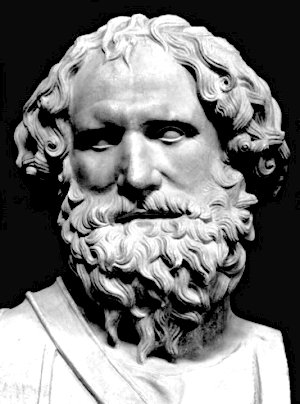
ARCHIMEDES
When it comes to killing each other, we humans owe ourselves credit for ingenuity. Long before the Christian era, we were designing elaborate and effective instruments of mayhem — although it turns out that the “flaming death ray” attributed to Archimedes wasn’t one of them. I learned about that this week in a story in the Christian Science Monitor. Although that story was about something that Archimedes did not accomplish, it still left me impressed yet again with the genius of people in what to us are ancient times.
Archimedes was born around 287 BC in Siracusa (Syracuse), Sicily, which was a Greek colony at the time. In terms of intellect, he was in the same category as Leonardo, Newton, and Einstein, and he did groundbreaking work in mathematics, astronomy, physics and engineering. Like many of the ancients, Archimedes is the subject of some stories that are either only partly true, possibly true but undocumented, or simply false.
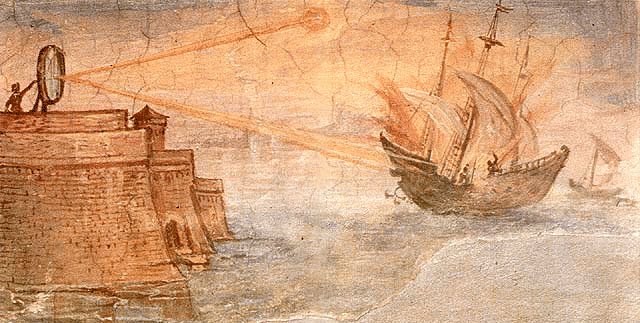
Archimedes' "death ray" directed at a Roman ship
According to one tale, apparently first known in the Middle Ages, Archimedes designed a system in which mirrors were used to direct concentrated beams of sunlight at Roman ships, causing them to catch fire. This supposedly occurred during a siege of Siracusa that lasted from 214 to 212 BC, the Second Punic War. Archimedes was killed by a Roman soldier in 212 during that siege.
The Monitor story reports on new findings that debunk the “death ray” story but propose an alternate explanation that, to my mind, is no less impressive.
ARCHIMEDES
According to the CSM, studies done at the University of Naples have indicated that it is more likely that Archimedes used — are you ready for this? — steam cannons to fire at the Roman vessels:
“The steam cannons could have fired hollow balls made of clay and filled with something similar to an incendiary chemical mixture known as Greek fire in order to set Roman ships ablaze. A heated cannon barrel would have converted barely more than a tenth of a cup of water (30 grams) into enough steam to hurl the projectiles.”
The story cites some supporting authorities for this idea, including Leonardo Da Vinci, who spent a lot of his own time dreaming up horrible ways for people to kill each other in battle. (See my June 8 blog entry for more on Leonardo’s diabolical side.)
While I’m being a little flippant about this, I never tire of learning about the accomplishments of our forbears in the distant past. I was amused by the headline on the Monitor’s story, which said that Archimedes’ death rays were probably “just a cannon.” Just a cannon – two centuries before the birth of Jesus. Reading about people like Archimedes reminds me of the potential of the human mind — and of how much more I might accomplish with my own if I were to make the effort.
You can read the Monitor’s story by clicking HERE.
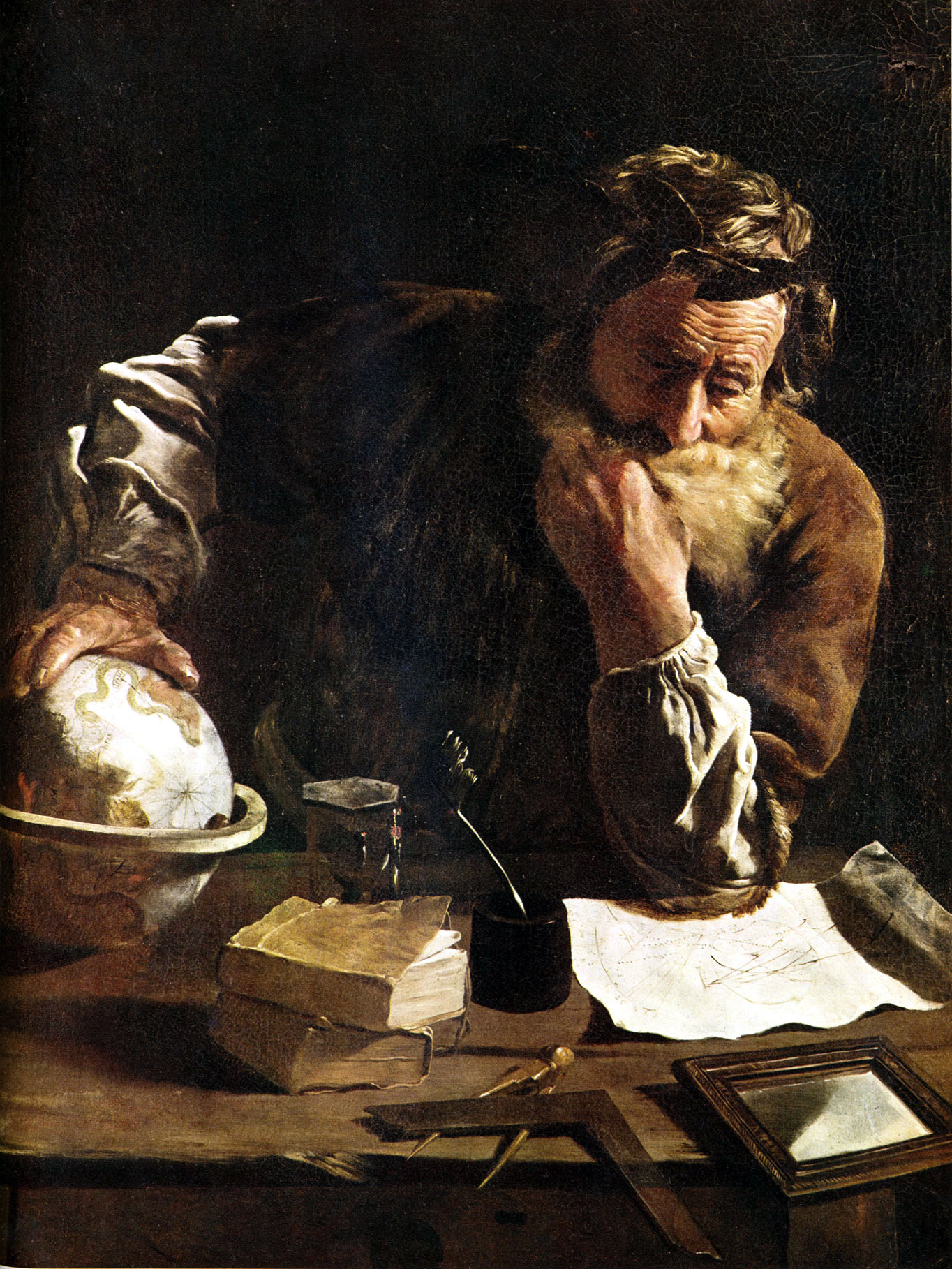
Portrait of Archimedes by Domenico Fetti (1620)
 CharlesPaolino's Blog