“One man is a world in miniature.” — Albert Pike
August 5, 2009

The Statue of Liberty in a needle's eye
The BBC World News broadcast this morning included a report on Willard Wigan, a British sculptor whose works are so small that they can be seen only through a microscope.
Wigan traced this vocation to the fact that he is dyslexic. When he was a child, he said, dyslexia was not well understood, and he was accordingly treated as a cipher. He retreated into a fantasy world in which he built minature houses and other articles for use by the ants he found on the grounds outside his home.
It was one thing to hear the BBC radio reporter describing Wigan’s work; it was another thing to see photos of his creations for myself. They put me to mind of what I have recently read about the sizes of some circuits now in use and the prospects for such devices to become even smaller.
What are we more fascinated with, I wonder, the very large or the very small? In nature, the answer may be the very large; the Blue Whale still leaves us breathless. But where the man-made is concerned, my money is on the very small. The debacle at Babel aside — I think we are all convinced that man can build as large as he cares to, and so we aren’t so impressed when he outdoes himself. The Sears Tower? The Empire State Building? Yeah, yeah. Where should we have lunch?
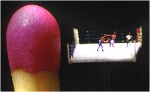
Match head and boxing match
The compelling thing about small, is that our imaginations don’t contain smallness as easily as they contain bigness. We could visualize a building tall enough to reach the moon — even if it’s a physical impossibility — but we can’t visualize things so small that we cannot see them. There is nothing in our everyday experience to give us a frame of reference — those of us who aren’t physicists or bacteriologists, that is.
At any rate, you can read all about Mr. Wigan and see more of his work at this link:
http://www.willard-wigan.com/default.aspx

Girl on an eyelash
“Down the road of life we’ll fly.” — Vincent C. Bryan
August 3, 2009
 The controversy of the federal government’s “cash-for-clunkers” program dramatizes the odd position we Americans have put ourselves in as victims of our own success.
The program provides a $4,500 subsidy for a qualified buyer who wants to trade in an old inefficient vehicle for a new and “greener” one. Everybody wins in this program: the buyer can afford a new car, the auto dealer and — by extension — the manufacturer gets rid of inventory, the environment is subject to one less outrage, and the junk yard gets another heap to turn back into cash. The program is so beneficial, and consequently so popular, that it went broke in a hurry, and the question of whether to re-fund it is now being debated in Congress.
 One of those opposed to more funding for this program is U.S. Sen. John McCain — Sarah Palin’s former running mate. McCain thinks this program is an unfair subsidy of the auto industry, as distinct from other classes of business that are at risk in this economic downturn. But the auto industry is getting this attention because it has become such a pervasive part of the overall economy; if it goes down, according to conventional wisdom, everything else goes with it.
 At the root of this phenomenon is the American obsession with cars and with new cars in particular. This has been out of control for a long time, but we were too giddy to notice. The industry produces too many cars, and whole sectors of the economy have grown around that practice like barnacles. This has happened in a country that has failed miserably at building an efficient mass-transit system, though it talks endlessly, and without blushing, about the need to get travelers off the roads and onto trains and buses and monorails and — while we’re daydreaming — into teletransporters. I don’t know if this is what McCain means by his opposition to this latest proposal to expand the federal deficit, but despite the rhetoric about reforming the auto industry, the game plan really seems to be to help it continue overproduction. And what do we think will happen in the long run if we win at that game? I admit to a prejudice here, because I drive a car until it has well over 150,000 miles on the clock, but if we continue the same behavior and expect a different outcome, aren’t we all — by definition — crazy?
"Beam me up"

JOHN F. KENNEDY
You can’t turn your back on anybody.
Take Harvard University, for example, an institution one might think of as a temple of virtue. It turns out that Harvard has been using the trade-mark laws to get control of common expressions. The university has an pending application, for example, to register the phrase “Managing Yourself.” The rationale is that the phrase is used by the university in promotional campaigns for one of its schools, and Harvard doesn’t want someone claiming a prior right to the words. As if.
If that sounds overly cautious, consider the fact that the university has filed a trademark application for the expression “The world’s thinking” based on the idea that the school may want to use those words in the future.

KAHLIL GIBRAN
Among the items so highly treasured in Cambridge is the line “Ask what you can do,” used by the Kennedy School of Government in a variety of campaigns. Those words were, of course, a high point in the presidential inaugural address of a Harvard alum, and the John F. Kennedy Presidential Library is said to be raising its corporate eyebrows over alma mater’s decision to nail down the clause.
There’s no word on whether Harvard has checked with the heirs, if any, of the Lebanese philosopher Kahlil Gibran, who wrote a remarkably similar “ask not” formula in his 1925 work entitled — cough, cough! — “New Frontier.”
Is it all very innocent? One Harvard professor, Harry Lewis, takes at least philosphical exception, expressed in the Boston Globe as follows: “Universities should not be in the business of locking words down. We’re in the business of enlightening the world. To lock down common English phrases seems to be antithetical to the spirit of what universities are supposed to be about.’’
Meanwhile, if Harvard intends to go on registering phrases for which it hasn’t yet found a use — well, Yogi, watch your back.
You can read the Globe’s account of this matter at the following link:

 CharlesPaolino's Blog