
KURT COBAIN
I suppose Kurt Cobain had it both ways — he was who he wanted to be, and he wasted the person he was, if such things can be measured by longevity alone. But it’s a little late to moralize about how his life was spent. Without intending it, although he might have enjoyed it, Cobain is at the center of a tempest in Aberdeen, Wash., his hometown. More specifically, a monument to the musician placed in a public park, and even more specifically, a word on that monument, has the pond stirred up.
The monument in question bears a picture of Cobain and seven quotes from him. “The duty of youth is to challenge corruption,” for instance. One of the quotes begins with the words “Drugs are bad for you ….” — a sentiment that should play well in Aberdeen, if you’ll pardon the stereotype. But the rest of that quote includes a word that shocks the sensibilities of some Aberdeenians, a word one seldom sees engraved on public monuments, the word, if you get my drift.

ROBERT DE NIRO
“I don’t like that word,” said one member of the Aberdeen governing body. “The city pays thousands of dollars a year just to remove it from our parks — painting and sandblasting.”
“The majority of the people who are going to make their way down there, it’s not like that’s the first time they’re ever going to see that word,” said another councilman, who was a founder of the official Kurt Cobain Memorial Committee in a city that appreciates Cobain’s talent and his contributions to music.
Language is so interesting. One word is widely regarded as offensive and another word that means precisely the same thing is fit to be pronounced in a middle-school sex-education class. It’s all in the connotation, isn’t it?
One night about 20 years ago a couple came to spend the evening with us and, on the way, they picked up a video — “Midnight Run.” While we watched, our female guest blushed and apologized profusely for bringing that movie, because she hadn’t expected Robert De Niro’s language which was laced with a word fit for — well, for a Kurt Cobain monument. Meanwhile, we all roared at that movie, which, thanks to De Niro and Charles Grodin, is one of the funniest of its kind ever made.

KURT COBAIN
Years later, I watched that movie on television, and it wasn’t nearly as funny. That was partly because I had already seen it, but it was also partly because De Niro’s language had been dubbed out with language that sounded ridiculous coming from the mouth of such a character. It’s hard to know what to make of that. It’s only a word, after all, and people like De Niro’s character use it so habitually that they aren’t even aware of it. And yet, many of us, like the Aberdeen councilman, don’t like it and don’t want to hear it or see it cut into granite in a public park.
It’s one of those things that makes us human beings so fascinating.
The Los Angeles Times reported on the Aberdeen dispute and how it was resolved. The story is at this link:
http://www.latimes.com/news/nationworld/nation/la-na-hometown-aberdeen16-2009aug16,0,19620.story
Netflix Update No. 16: “The Andersonville Trial”
August 14, 2009

WILLIAM SHATNER
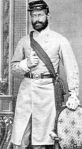
We watched the 1970 television production of “The Andersonville Trial,” which was an adaptation of a 1959 play by Saul Levitt. The play is based on the trial in 1865 of Henry Wirz, commandant of the Confederate military prison at Andersonville, Georgia. Some 13,000 Union soldiers died while incarcerated there under inhumane conditions. Wirz was found culpable by a military court and was hanged, but the degree of his blame was the subject of controversy then as it is now.
Levitt’s play focuses, as the actual trial did not, on the moral question of whether Wirz had an obligation in conscience to disobey his superiors and provide relief for the inmates. That issue may sound familiar to 21st century audiences as may another issues raised in the play — the rights of prisoners held under military law and the propriety of trying Wirz by a military court when the war had ended.

CAMERON MITCHELL
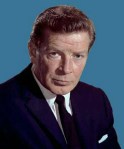
The play, presented in three acts, stars Richard Basehart as Wirz; William Shatner as Lt. Col. Norton Chipman, who prosecuted Wirz; Cameron Mitchell as Gen. Lew Wallace, who presided at the trial; Jack Cassidy as Otis Baker, the civilian attorney who defended Wirz; and Buddy Ebsen as a physician who was assigned to the prison and testified at the trial.
Shatner, Basehart, Mitchell, and Cassidy should have paid to appear in this production — it was that much of a tour de force for each of them. All of them gave intense performances that together provide a glimpse of the brutal and corrosive character and consequences of a war that has since been wrapped up in too much glory and nostalgia.
Shatner has at times been rightfully criticized for chewing the scenery, but in this case he brought the appropriate passion to his role — an army officer who knew that the moral questions he was putting to Wirz also applied to him. One distraction, though, is what has to be the worst of the bad hairpieces Shatner has worn during his long career.

JACK CASSIDY
Cassidy was a master of cool, and he used his controlled reactions to make Baker a chilling opponent for the over-the-top prosecutor. Mitchell was equally effective as Wallace — a lawyer and military man who later wrote “Ben Hur” — who was impatient with the proceeding itself and with the constantly bickering attorneys and unruly defendant.
I last saw this presentation when it first appeared on PBS in 1970, but Basehart’s performance in particular remained vivid in my memory. Wirz — a native of Switzerland — was presented here as a man tortured by Chipman’s questions, by his own assessment of his behavior, and by his concern for the legacy he was leaving his family.
RICHARD BASEHART
Basehart was so thoroughly invested in these aspects of his character that it is almost as uncomfortable to watch and listen to him as it would have been to sit in that courtroom.
I had forgotten about the performance by Michael Burns, who did a skillful turn as a shell-shocked soldier called to testify about the atrocities at the prison. His disoriented posture and vacant look was disturbing even as a dramatization. Burns was an interesting figure who left acting early in life and became a respected history professor and author.
This production was directed by George C. Scott who played Chipman on Broadway. The only actor from the Broadway production who appeared in the television adaptation was Lou Frizzell who did not, however, play the same role.
Some of the dialogue in this play is taken from the trial, but the overall portrayal of the proceeding is Levitt’s interpretation. Even so, it is a valuable reflection on the role of conscience in the Civil War and war in general.
HENRY WIRZ
Netflix update No. 15: “Mrs. Palfrey at The Claremont”
August 13, 2009
JOAN PLOWRIGHT
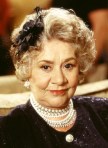
We watched the 2005 film “Mrs. Palfrey at The Claremont,” which director Dan Ireland and screenwriter Ruth Sacks adapted from a novel by the late British writer, Elizabeth Coles Taylor. We are in our Joan Plowright period, and that wonderful actress plays the title role in this film — Mrs. Palfrey, that is, not The Claremont.
The Claremont is a past-its-prime London hotel where the aged, refined widow, Mrs. Palfrey, takes up temporary residence in the hope of establishing a relationship with her only grandson, Desmond. The grandson, who labors in the archives of the British Museum — one can only imagine — does not return her telephone calls, leaving Mrs. Palfrey to fill her days reading Wordsworth and cautiously interacting with the odd collection of residents at the hotel, who gradually begin to suspect that Desmond doesn’t exist.

RUPERT FRIEND
Mrs. Palfrey’s life takes an unexpected turn when she stumbles, literally, into the acquaintance of a nearly destitute writer Ludovic Meyer, played by Rupert Friend. The story of their relationship explores the question of what actually constitutes family.
This is a deceptively intense film that pokes at some potentially painful issues that many of us will confront in reality sooner or later — issues of loneliness, vulnerability, and fulfillment.
Joan Plowright is magnetic and moving as always, and she is supported by several skilled performers, including those who play the quirky guests and staff at The Claremont, and the stunning Zoe Tapper, who appears as the lover Meyer finds only because his path first crossed that of Mrs. Palfrey.
Don’t pass this one up.

RUPERT FRIEND and JOAN PLOWRIGHT
Visit our concession stands
August 12, 2009

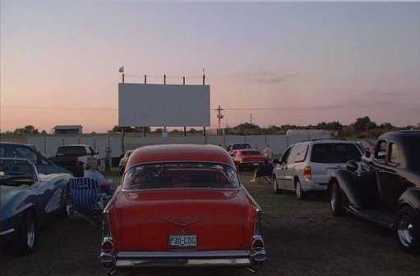
The Christian Science Monitor has a story about a phenomenon known as “guerrilla drive-in” — referring to a fad in which movie buffs or people out for a good time are setting up ad-hoc outdoor movie sites.
In one sense, the full-blown outdoor movie — the drive-in — had two practical advantages that the indoor theater couldn’t match. One was the opportunity to make out in relative privacy — or so I’m told; the other was the opportunity to take kids to a movie regardless of how they behaved.
There were some disadvantages, including poor sound systems, mosquitos, susceptibility to bad weather, and rowdy patrons. Apparently these outweighed the advantages, because the number of drive-ins in the United States has dwindled from about 5,000 in the 1950s to 383 ( including the Delsea in Vineland, here in New Jersey) according to the Monitor’s story.
My strongest memory of the experience is of taking the kids to a drive-in one steamy summer night and being stuck with the choice of being eaten by the famous Jersey Mosquitos or rolling up the windows and suffocating — unable to see the screen through the fogged-up windshield.
 But I also remember going to outdoor movies in a less formal way when I was a student at Penn State. Every Friday night, a screen was erected on one of the campus lawns, and we could sit on the grass and watch several slightly dated films, plus cartoons. That was almost 40 years ago, and I can’t remember whether we paid an admission. What I do remember was that, because we were seeing them outdoors, we enjoyed the movies almost regardless of their quality. I guess it’s the same effect as eating a dirty-water hot dog on a street corner in Manhattan.
The Monitor’s story is at this link:
http://www.csmonitor.com/2009/0810/p17s02-almo.html
You can make your own drive-in movie marquee at this link:

The lady and the dragon
August 11, 2009

KUKLA, OLLIE, and FRAN ALLISON
The stamps the Postal Service issued today under the title “Early TV Memories” omit broadcasting legend Gertrude Berg but do include the influential puppet show “Kukla, Fran and Ollie,” which first appeared 60 years ago. The show adopted the medieval format of hand puppets on a miniature stage, but added on-camera human being Fran Allison to interact with the characters. The major figures were Kukla — a bald creature inexplicably dressed as a clown, and Ollie – a dragon. They were joined as the situation dictated by about a dozen others, including Beulah Witch, Madame Oglepuss, Colonel Crackie, and Fletcher Rabbit, a letter carrier who was always singing “Buffalo Gal, Won’t You Come Out Tonight?”
The show, which was live when it first appeared, was done without a script. While Fran Allison was sort of an innocent, many of the puppet characters were wise-crackers. The impromptu gags often brought on audible laughter from the crew — with whom the characters frequently exchanged remarks. There is an instance of that kind of interaction — a gag about ad agencies — in the 1951 episode at the link below. That episode also has an example of a commercial — this one for a brand of shampoo — that is worked into the story line, a common device in early televison. There is also a more conventional commercial for Tide at the end of the program. The half-hour show included only those two commercials.

KUKLA and OLLIE
“Kukla, Fran and Ollie” was the brainchild of Burr Tillstrom, who appears briefly at the end of the episode I have linked to. Tillstrom worked all the puppets and provided their voices. What is most striking about his concept in this show is that it was not played for slapstick laughs and it was not condescending to children. It was conducted on such a thoughtful level, in fact, that its audience among adults was reputed to be at least as large as its audience among children. In the episode I have linked to, the characters make several references to “Tallulah” and “Tallulah’s place in New York.” Those were references to the stage and film actress Tallulah Bankhead, who was one of many public figures who were enthusiastic followers of the show.
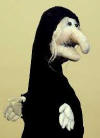
BEULAH WITCH
The leisurely pace of “Kukla, Fran and Ollie” was in sharp contrast to the frenetic programming that dominates television today. Tillstrom’s show relied heavily on character, and that was an important part of its attraction for adults. In this and other respects, the show foreshadowed — and, in fact, led to — the Muppets. The simple and silly figure of Oliver Dragon — who could be at turns romantic and manipulative — became as real and sympathetic to his audience as Burt and Ernie and Kermit became to theirs. Tillstrom and Allison recognized that; in fact, Ollie unblushingly discusses his charisms in the episode at this link:
http://video.google.com/videosearch?gbv=2&hl=en&q=kukla%20fran%20and%20ollie&ie=UTF-8&sa=N&tab=iv#
A Los Angeles Times story about the release of a DVD collection of later episodes of “Kukla, Fran, and Ollie” is at this link:
http://www.latimes.com/entertainment/news/la-et-kukla11-2009aug11,0,1322349.story
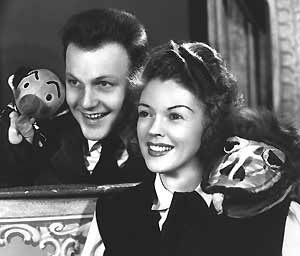
KUKLA, BURR TILSTROM, FRAN ALLISON, and OLLIE
… and it’s gone!
August 10, 2009

GABBY HARNETT baseball card
The Boston Globe has a touching little story about Sara Bejoian, a Watertown woman who carried on a friendly baseball rivalry with her husband, Jim, who died last year when the couple had been married just shy of 54 years. Sara was a Red Sox fan and Jim rooted for the Yankees.
The point of the story was that Sara has agreed to throw out the first ball at an old-time baseball game, as a tribute to her late husband. The account by Peter DeMarco includes this sentence: “Jim Bejoian’s passion for the sport extended to the Oldtime Baseball Game, an annual charity game held at St. Peter’s Field in Cambridge in which local amateurs dress in uniforms from bygone teams and swing wooden bats in the gloaming of a late-summer night.”
What caught my eye in that sentence was the word “gloaming,” a favorite word of mine, but a word that has been neglected to the point that it is practically extinct. “Gloaming” means “twilight” or “dusk.” To my ear, each of those terms has its own connotation, each suggests a different atmosphere in those moments after sunset. Gloaming has a kind of a brooding sound.
Baseball fans — I mean fans — know that the word “gloaming” occupies a special place in the history of the game. It is associated with a game between the Chicago Cubs and the Pittsburgh Pirates at Wrigley Field on Sept. 28, 1938. The Cubs were a half game behind the Pirates in the National League pennant race, and their record for September up to that point was 18 wins, 3 losses, and a tie.

GABBY HARTNETT
On Sept. 28, the teams were locked in a 5-5 tie in the bottom of the ninth inning. The sun had set, and night was coming on. There were no lights at Wrigley Field, so when Cubs playing manager Gabby Hartnett came to bat with two men out, it was clear to everyone that if he didn’t reach base, the umpires would end the game in a tie. With two strikes on him, Hartnett hit the ball into the darkness. The Cubs won and, three days later, clinched the pennant. The event has been known ever since as “the home run in the gloaming,” and what expression could capture it better?
I hope Hartnett is still an iconic figure in Chicago, where he played for 18 years. He certainly isn’t one in the everyday vernacular of baseball. He deserves better. He was one of the leading catchers of his time and an excellent hitter. He was a six-time All Star and an MVP, and he is a member of the National Baseball Hall of Fame.
In addition to his outstanding record as a hitter and fielder, Hartnett took part in two more of baseball’s legendary moments, at least one of which actually happened. He was behind the plate in the 1934 All Star Game, when Carl Hubbell struck out in succession Babe Ruth, Lou Gehrig, Jimmy Foxx, Al Simmons, and Joe Cronin. And Hartnett was the catcher in the 1932 World Series when Babe Ruth ostensibly called his own home run to centerfield.
I think I’ll start slipping “gloaming” into the conversation and see if I can inspire others to do the same.
The Globe story is at this link:
“Newman!”
August 9, 2009

"Nevertheless!"
The Baltimore Sun this week published a story about the impact of digital media on the U.S. Postal Service and specifically on handwritten letters. The basis for the story is familiar: Handwritten letters, which were already in decline, have all but disappeared now that modern electronics provide so many other means to send messages. The Sun reporter discussed this development, and the recently-announced contraction of the postal system, with young people and with older people. The result was predictable.
I am almost 67 years old, and I can’t recall writing letters by hand. I used to write a lot of long personal letters — I recently discarded most of them — but I wrote them on a typewriter. Still, I have some nostalgia for the handwritten letter, mostly because I recall when my mother wrote letters to her out-of-state friends and relatives. Mom had won awards for her handwriting when that was still considered an important part of a person’s training, and she wrote those letters in a disciplined and attractive cursive. Correspondence in those days did not have the convenience of immediacy, and I recall the excitement when Andy, the mailman — who used to sing when he made his twice-a-day visits — brought a response from Lexington, South Carolina, or some other exotic port.
 Of course, that form of correspondence is still available to anyone who wants to exercise his handwriting skills and experience the anticipation of awaiting an answer. That wouldn’t be me. Like many people in this century, I communicate with people all day long through the various means now available, and I think I get as much satisfaction out of the quick reply as Mom did out of the long-term one.
 The Sun’s story and other reports on this topic include remarks from some authorities who worry that increasing reliance on e-mail, text messages, tweets, and whatever program may appear next, threatens to cause our handwriting skills to atrophy. But our kind have lost other communication skills that became obsolete, and we don’t seem to be any the worse for it. Well, we may be worse, but I doubt that our writing skills had anything to do with that.
The Sun’s story is at this link:
http://www.baltimoresun.com/features/bal-md.pa.lettersaug07,0,5960461.story?page=1
I learned it in the movies
August 9, 2009

TOM HULCE
The Times of London, on its web site, presents its candidates for the ten most historically inaccurate movies. The bad news is that all but two were made before 1999, which — if one were to take this seriously — would suggest a fearsome and precipitous trend.
The earlier of the two monstrosities that were made before ’99 was “Amadeus,” the 1984 hatchet job on Antonio Salieri in which Tom Hulce played Mozart. The second was “Braveheart,” which I understand is a significantly inaccurate account of the life of a 13th century Scottish hero, Sir William Wallace. I don’t know anything about Wallace, which is to the point: If I had overlooked the fact that Mel Gibson starred in this film and had gone to see it, I might have accepted the account as roughly correct.

ANNE BANCROFT
Why The Times focused its attention mostly on the past decade I am not aware; maybe it reflects the level of confidence the editors have in their audience. Of course, inaccurate historical films have a proud history that extends back to decades before “Amadeus” appeared. Virtually every film based on the Hebrew and Christian scriptures, for example, tries to outdo the original writers — even one of my favorites of that genre, Franco Zefferilli’s “Jesus of Nazareth,” made for television in 1977. Zef famously took pains to place the events of the gospels in their proper historical context, but he couldn’t restrain the tinkering hand. Like all dramatists, he had to portray poor Mary Magdalene, played by Anne Bancroft, as a prostitute — indeed, show her in a scene with one of her clients — even though there is no support for that idea. In Zefferelli’s tale, Barabbas — encouraged by a well-meaning Judas Iscariot — personally invites Jesus to support an armed rebellion against the Roman occupation of Palestine.

VAN HEFLIN
And as long ago as 1942, the year I was born, Van Heflin starred in the mercifully long-forgotten “Tennessee Johnson,” which purported to be a biography of Andrew Johnson, 17th president of these United States and a particular obsession of mine. The film had a pretty good cast, including Ruth Hussey, Lionel Barrymore, and Noah Beery, but the title itself set the tone for the movie as history: Nobody ever called the man “Tennessee Johnson.” The climactic scene in which Johnson goes to the floor of the Senate to defend himself against charges of impeachment was wholly fabricated. In fact, Johnson’s counsel — recalling how he came to be impeached in the first place — would not hear of him appearing at the trial for fear of what he might say. Sort of the Joe Biden of his day, in that respect.
At any rate, decide for yourself on the The Times’ choices, available at this link:
“That’s right – you’re wrong!” — Kay Kyser
August 7, 2009
ABBOTT and COSTELLO
I just reviewed a book of photographs taken at the New Jersey Shore between the late 19th century and the 1970s. As frequently happens when I read books these days, I was annoyed to distraction by the careless errors in the text – the text, in this case, consisting of chapter introductions and photo captions.
The author of the text, a New Jersey resident vaguely identified as a history teacher, must have a loose view of what constitutes history. For example, he identified the birthplace of comedian Lou Costello as “Patterson.” He also made several references to a shore community that he called “Tom’s River.” Who “Tom” is, I am not aware.

MARGARET GORMAN
The book includes three photos of Margaret Gorman, dressed in an outlandish outfit for her “coronation” as the first Miss America at the pageant that originated and persisted for many years in Atlantic City. In one photo she is accompanied by a man dressed up as King Neptune; in another, she poses on the boardwalk with a group of young girls in dancing costumes; in the last, she is being borne along the boardwalk by in what looks like a sedan chair in the shape of a seashell. The writer explains — twice — that Gorman was installed as Miss America in 1922. It was 1921.

JOE WARDELL
In one of several stunning photos of the amusement areas in Atlantic City, a marquee announces that the live entertainment on the Steel Pier includes The Three Stooges. Taking note of that, the writer adds to the name of the act the names of the individual characters — “Moe, Larry, and Curly Joe.” The photo was taken in 1938. Curly Joe Wardell didn’t join The Three Stooges until 1958. Perhaps the history teacher was thinking of Curly Howard.
Is this sort of thing the result only of downsizing in the workshops of publishing houses, or is it symptomatic of a more general disregard for precision? There was a time when it would might have taken hours for a writer to double-check the date of the first Miss America, the spellings of well-known places in his own home state, and the chronology of the evolution of a comedy act. In the 21st century, all of that would take no more than fifteen minutes.
Sui generis
August 5, 2009

GERTRUDE BERG
A few months ago, I wrote in this journal that my wife and I had discovered and watched on line a few episodes of the television series “The Goldbergs.” Those episodes are at http://www.archives.com.
After I wrote that blog, I heard from a publicist who was handling a new documentary film about the owner, writer, and star of “The Goldbergs” — Gertrude Berg — who was one of the most remarkable women of the second half of the 20th century. As a result of that contact, I wrote the following story, part of which has appeared in the Courier-Post of Cherry Hill and has been picked up on other blogs:
When the U.S. Postal Service issues its “Early TV Memories” stamps this summer, don’t look for Gertrude Berg.
The New York City native, who 80 years ago created the domestic situation comedy, and became a media mogul, was not included with the likes of Lucille Ball and Harriet Nelson, who decades later followed her into American homes.
But Berg is being reintroduced to the American public in a documentary film – “Yoo Hoo, Mrs. Goldberg” – written and directed by Aviva Kempner.
The title evokes the phrase associated with Berg during the radio and television runs of the show she created and controlled, most widely known as “The Goldbergs.”
The principal character, Molly Goldberg, and her neighbors in a Bronx apartment building, interacted by leaning out their windows and calling: “Yoo Hoo, Mrs. Goldberg … Yoo Hoo, Mrs. Bloom.”
From her window, Molly – portrayed by Berg – invited listeners and viewers into the Goldberg household to share the lives of her husband, Jake; their children, Sammy and Rosalie; and Molly’s brother, David Romaine.
The show ran on radio from 1929 to 1946 – five days a week for much of that time – and on television from 1949 to 1956. Berg herself wrote every script in longhand.
PHILLIP LOEB
There were also a stage play, a movie, a lucrative vaudeville tour, a comic strip, a jigsaw puzzle, a newspaper column, a line of women’s dresses, and a popular cookbook – although Berg couldn’t cook.
Berg’s rise to prominence, Kempner emphasized, occurred “at the time of the greatest domestic anti-Semitism in America, and during the rise of Adolf Hitler in Europe.’’
Berg presented the family as Jewish – adopting a mild Yiddish accent and a unique use of language that became a hallmark of the character:
As Molly shows off a hat, a neighbor asks: “With what dress are you going to wear it?’’
“With mine periwinkle,’’ Molly answers, striking a pose: “Visualize!”
And Berg didn’t shy away from difficult issues affecting Jews.
The documentary points out that in 1933, the year Hitler became dicator of Germany, she had a rabbi conduct a Seder service on the program. And after Kristallnacht in 1938, she wrote an episode in which a stone smashed an apartment window while the Goldbergs were celebrating Passover; Molly calmed the children and urged Jake to continue leading the Seder.
“And yet,’’ Kempner said, “Molly Goldberg was universal. You didn’t have to be Jewish to love her.’’
This urban mother first appeared on radio a month after the stock market crash, and the Goldbergs became so important to the national psyche during the Great Depression, as people maintaining the family circle in spite of want, that Franklin Roosevelt himself acknowledged it.
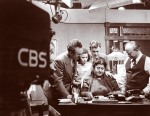
THE CAST OF "THE GOLDBERGS"
Kempner – based in Washington, D.C. – made the documentary through her Ciesla Foundation, whose goal is to “produce films about under-known Jewish heroes.” Kempner – whose work includes a 2000 film about baseball legend Hank Greenberg – said that although the Gertrude Berg film is complete, she is still raising money to pay for it.
The new film includes vintage photos and motion pictures and input from members of Berg’s family, actors, her biographer and others, including U.S. Supreme Court Justice Ruth Bader Ginsburg.
The story they tell has its dark sides.
Berg, born in 1898, did not grow up in the kind of setting she portrayed in her shows.
“She never had a nurturing mother like Molly Goldberg,’’ Kempner said. “She created what she didn’t have.’’
Berg’s own mother sunk into depression after the early death of her son and ended her life in a mental institution. Berg’s father badgered Gertrude into working at resorts he opened in the Catskills and in Florida but never supported her career as an actress and producer.
By contrast, her husband, Lewis Berg, a chemical engineer, typed many scripts from his wife’s handwritten originals.
Especially unsettling in Gertrude Berg’s life was the impact of “Red Channels,” the publication that purported to expose Communists working in radio and film.
One of those identified was Philip Loeb, an actors’ union leader, who played Jake Goldberg on the television series. Berg herself was listed as a “sympathizer.”
CBS and her sponsor pressured Gertrude Berg to fire Loeb. She refused, and her show was cancelled. NBC eventually picked up the show, but Loeb had accepted a cash settlement out of consideration for Berg and the other actors. Blacklisted from radio and film, he committed suicide in 1955.
Berg won an Emmy for her portrayal of Molly Goldberg, and a Tony for her 1959 Broadway performance in “A Majority of One,” and her autobiography was a best seller.
Still, only a small percentage of Americans today know who Gertrude Berg was, Kempner said, “and I want to restore her correct place in our cultural history.’’
The home web site for the film is at http://www.mollygoldbergfilm.org/home.php Information about theaters showing the film is available there.
The Ciesla Foundation web site is at http://www.cieslafoundation.org/
 CharlesPaolino's Blog