Hipster doofus cuisine
May 21, 2009
 What country has the greatest number of Domino pizza restaurants per capita?
That’s right! Iceland!
Oh, that wasn’t your guess? Well it wouldn’t have been mine either, but them’s the facts, at least according to a blogger on IcelandReview.com.
There are relatively few fast-food chains in Iceland, as we Americans know and love them, so we have noticed the Domino restaurants when we’ve been there, but only as an anomaly. Frankly, eating pizza never has occurred to us in Iceland and, even if it did, we wouldn’t have eaten Domino’s pizza there any more than we would eat it here.
The blogger, Aina Fuller, who is writing from Italy, not from Iceland, is musing over where she has had the best pizza of her life. I don’t have to think about that; it was the pizza my grandmother made, but there’s no point in dwelling on the unattainable. Fuller’s journal includes this observation:
But the glaring memory of the best in my mind, pulsing with Icelandic enthusiasm, is a mixed cheese pizza I had from a tiny restaurant in Saudárkrókur, where we shamelessly dipped bite after bite in home-made jam.
(For the foreign contingent, I know what you’re thinking. Pizza and jam might sound like trying to play a violin with a chicken feather, but don’t knock it ‘til you try it—and inevitably start doing it with a lot more strange combinations than pizza.)

CHEF KRAMER
Call me a stick-in-the-mud, but I won’t be trying that. I have to go along with Poppie, who told Cosmo Kramer that if you let people put anything they want – including cucumbers – on pizza, pretty soon you can no longer call it pizza.
Fuller mentioned salted cod as a favorite home-grown topping for Icelandic pizza, and she accurately pointed out that it isn’t so far afield of the anchovies Italians like. In fact, even though I normally don’t eat anchovies, I would inhale the pizzas my grandmother made with anchovies, garlic and wild mushrooms. I was surprised – maybe I should say relieved – that Fuller didn’t report that Icelanders like to top their pizzas with the rancid shark meat that is supposed to be such a delicacy up there.
Her blog is a lot of fun. It’s at this link:
http://www.icelandreview.com/icelandreview/daily_life/?cat_id=16539&ew_o_a_id=324402
“And it was always said of him that he knew how to keep Christmas, if any man alive possessed the knowledge.”
May 20, 2009

ALASTAIR SIM
I anticipate with some trepidation the release of the new Disney film version of Charles Dickens’ story, “A Christmas Carol.” This film, due to be released in November, will be a 3-D, high-tech extravaganza in which Jim Carrey plays Ebenezer Scrooge and the spirits of Christmas past, present, and future.
Carrey has said that one of his greatest inspirations for the role of Scrooge was Alastair Sim’s performance in the 1951 British movie “Scrooge,” which was released in the United States as “A Christmas Carol.” Having read all of Dickens’ work, having read all of his novels mulitple times, having read “A Christmas Carol” at least once a year since 1955, I regard the Alastair Sim film to be the best attempt at translating the story to the screen – although I maintain that the story should be read on the page as Dickens intended, and that it can only be diminished when it is tampered with by screen writers and directors.

MERVYN JOHNS and ALASTAIR SIM
What concerns me is that the Disney bunch will trivialize Dickens’ angry attack on materialistic values – a mood not entirely out of place in the world of AIG executives and Bernard Madloff. As it is, one has to search long and hard to find an adult who reads Dickens at all. Skewed versions of his work only serve to distort its meaning and obscure its value. Millions of kids who are exposed to such a presentation will go through life thinking it represents Dickens’ intentions.
I realize that I am an anachronism for suggesting that people read the classics without being required to. It’s too much work for a generation whose reading matter must fit on the screen of a Blackberry and be brief enough to be digested before the light changes to green. I once suggested that a local book club lay off the contemporary novels for a month and read “Oliver Twist” or “Great Expectations,” and the suggestion was brushed off as if it were babble coming from a dark corner in a nursing home.

JIM CARREY as SCROOGE
One of the things that makes me suspicious of the Disney movie is that Carrey will play four roles and – according to the publicity – give each one its distinctive personality. What is the purpose of that? It sounds like little more than a stunt, and the fact that the producers are approaching the film in this way – and the memory of all the wacky imagery that has characterized some of Carrey’s successful roles in the past – don’t seem consistent with the mood of Dickens’ story.
Call me old-fashioned. I am.
A clip from the film can be seen at this link:
http://www.cinematical.com/2009/05/18/first-footage-from-disneys-a-christmas-carol/
Let’s play two … or more.
May 19, 2009

JOE OESCHGER
The announcement that post-season baseball games broadcast on Fox will start before bedtime this year is better than no progress at all. Games that were running well over three hours and ending after midnight on the East Coast were hard on fans who have to get up early, and they were precluding many kids from watching – and that’s an audience baseball shouldn’t take for granted.
Of course it wasn’t the bleary-eyed fan or the starry-eyed kid who inspired this change. It was the poor ratings for last year’s American League playoffs and for the World Series, both of which threaten revenues from advertisers who were probably nodding off while their own commercials were playing.
If the advertisers get nervous enough, maybe the post-season process itself will be streamlined so that it isn’t crowding Thanksgiving. Meanwhile, the announcement by Fox that many of the games will start earlier has evoked comments about the fact that the games are too long no matter how early they start. I, for one, am in no hurry when I watch baseball on TV or listen to it on the radio, and at the prices we pay now to see a game in person, I figure the longer it takes the more I get for my money. After all, one of the things that makes baseball unique among American spectator sports is that it has no clock; a game – in theory, at least – can go on forever. That’s what Katie Casey was referring to in the lyric of Jack Norworth’s song: “Buy me some peanuts and Cracker Jack. I don’t care if I never get back.”
To some extent, nothing can be done about the length of games that are held hostage to the radio and TV commercial schedule. The plate umpire still carries out his responsibility and strides ominously toward the mound if the pitcher and catcher confer for more than 20 seconds, but he’s not about to interfere with the shilling that creates the wide gap between half innings. Nor will he reprimand the batter who steps out after every pitch to adjust his golfing gloves.

LEON CADORE
To put the modern, televised, 3 1/2-hour game in perspective, the Boston Braves and the Brooklyn Dodgers played to a 1-1 tie in 26 innings on May 1, 1920. That game took 3 hours and 50 minutes so the teams, in effect, played one game every hour and a quarter. There was no pitch count in those days, fewer calls to the bullpen, and the starting pitchers – Joe Oeschger for Boston and Leon Cadore for Brooklyn – both pitched complete games (and, incidentally, lived to pitch another day). There was no lack of offense – a total of 25 hits – and there was a total of 8 walks. To look at it another way, on Sept. 26, 1926, the St. Louis Browns and the New York Yankees played a nine-inning game in 55 minutes, the Browns winning 6-2. That projects to a little less than 2 3/4 hours if that game had gone on at the same pace for 26 innings.
When I was a kid in elementary school, and the World Series was played in the daytime as God intended, instruction was suspended, and we were told to work quietly at our desks while the play-by-play was piped in through the public-address system. It all depends on what’s important to you.

VLADIMIR LENIN
I’m not clear on this point: Was Rochelle of “Rochelle, Rochelle” a native of Milan who happened to have relatives in Minsk, or was she a native of Minsk who had emigrated to Milan? While we’re pondering that question, there is one native of Ulyanovsk – Simbirsk to you old timers – who may be making his own trek to the capital of Belarus that became a household word thanks to Larry David and Jerry Seinfeld.
Pravda is reporting that Vladimir Lenin’s mummified body may be removed from its tomb in Red Square and taken to Minsk, where it will be buried – perhaps no longer placed on public display in a crystal casket. As I mentioned here previously, Lenin – whom Pravda describes as the “leader of the world’s working class” – has already suffered the indignity of wearing the same suit for three years, and he’s not in line for a new one ITE – “in this economy.” Now, it appears from the Pravda report, the Russian government – which seems to only half-heartedly revere the old Bolshevik – may soon dispatch him to the republic from which he sprung – and the government of Belarus has said it would be glad to have him. In fact, a monument reminiscent of the tomb in Red Square is likely to be built to receive him.

ALEXANDER LUKASHENKO
The issue of actually burying the Hero of the Proletariat apparently is controversial: the Russian Orthodox Church, for instance, would like him out of sight and out of mind, but the president of Belarus, Alexander Lukashenko, says burying Lenin would be a crime. According to Pravda, there’s a strong nostalgia in Belarus for the glory days of the Soviet Union – no doubt among folks with medium-term memory disorder.
Good for the gander
May 17, 2009
 If former Vice President Cheney or Ann Coulter or others of that stripe find time to read Jonathan J. McCullough’s book “A Tale of Two Subs,” there’s one paragraph they shouldn’t overlook. This book concerns the U.S. submarine service during World War II, and it recounts the sinking of the sub USS Sculpin and the imprisonment and mistreatment of the survivors from its crew. McCullough mentions Lieutenant Commander John Fitzgerald, who had commanded the USS Grenadier and was captured by the Japanese. McCullough writes:
Fitzgerald had also undergone what he called “the water treatment.” The guards strapped him to a table, elevated his feet by about 30 degrees, covered his mouth with their hands, and poured water into his nostrils, asking questions all the while. After a few minutes he passed out, and when he came to, the process started all over again. For hours. He was barely able to muster any sort of answer, let alone tell them what they wanted to know, and when he was lucid he told them only lies and misleading half-truths. This was waterboarding. After the war the Allied war crimes tribunals classified the practice as a form of torture, a war crime, and handed down prison sentences spanning decades to its practitioners.
Torture. A war crime. Then and now.
The wide tent is put to the test.
May 16, 2009

GOV. JON HUNTSMAN
You have to like the implications of President Barack Obama’s choice of Gov. Jon Huntsman of Utah as ambassador to China. Obama ignored what to many is conventional thinking by giving such a plum job to the man who co-directed the McCain-Palin campaign. And while Huntsman described his own high ground by saying he could not refuse the call to service, the fact is that he could have turned down a position that will disrupt his family and preempt what would have been a certain new term as governor. As to the idea that giving Huntsman this appointment was Obama’s way of getting the governor out of the running for the White House in 2012, Huntsman will be only 57 years old in 2016 by which time the Democratic juggernaut, such as it is, should have run out of steam anyway.
More important, Huntsman is by reputation a straightforward, intelligent, sensible man who is well equipped to help further a foreign policy that promises to forsake the bullheaded and arrogant policies of the Cheney-Bush administration — transposition deliberate. Huntsman, from what I have read so far, can strike the balance necessary to deal with a country like China: respecting its history and the culture of its people, exploring the interests it shares with the United States, and keeping up the discussion of American concerns about human rights issues in China.
It will be interesting to see what effect this appointment has on Huntsman’s standing in his party, both because the appointment makes him a part of an administration that the most vocal Republicans profess to loathe and because he is likely to help advance a policy of engagement – in China and elsewhere – that was rejected by the last administration and by the Republican candidates in the last national election.
Doo be doo be do.
May 14, 2009

FRANK SINATRA
It’s a sure sign that the semester is over that I’m spending my time reading Hollywood bloggers. And that’s why I came across Nikki Finke’s report that Universal Studios prefers Johnny Depp to play Frank Sinatra in a Martin Scorsese biopic about the kid from Hoboken. Finke says Scorsese has his eye on Leonardo DiCaprio for the role. Pay attention – this is important stuff!
I don’t know that I’ll be patronizing this movie, because while I like a lot of his films and records, I’ve never been able to summon much interest in Sinatra as a person. If I do see this movie, it will be because I’m curious about the challenge it’s taking on. Sinatra is such a strong and pervasive personality that I wonder if it will be possible to accept DiCaprio or Depp or any other actor. As it is, Finke says the actor – whoever he is – won’t have to sing, because the songs will come from Sinatra’s recordings. No one would buy another voice as Sinatra’s. The question is, will anyone buy another mug as Sinatra’s?
What’s it all about, Sarah?
May 14, 2009

GOV. SARAH PALIN
I’m the guy who told a couple of generations of reporters and journalism students that a good writer can stop any person on the street and write an interesting story about him. So far be it from me to suggest that there isn’t a good story to be told about Gov. Sarah Palin, R-Alaska. As it turns out, Gov. Palin herself – a former journalism student – is going to take on the job herself after signing a book deal with HarperCollins and Zondervan. She anticipates that the project will take about a year which, if she can stick to that schedule, would get it into Borders in time for the 2010 gubernatorial election. I’ve seen some cynical references to that in what the governor refers to as “the anonymous blogosphere,” but why begrudge her that advantage – or the kind of money she can command while people are still interested in her? If Richard Nixon could appear on “Laugh-In,” why shouldn’t Gov. Palin write a memoir? It could be time consuming, especially because the governor says that, despite the collaborator assigned to the book, she wants to write most of it herself.

ULYSSES S. GRANT
News of this enterprise naturally evokes questions about the content. The governor is a relatively young woman who has had a relatively short – and dare we say largely inocuous – public career. Ulysses S. Grant put off his memoirs until he had been the general-in-chief of the victorious Union Army and twice president of these United States. And Dwight Eisenhower saved his written reflections until he had been supreme allied commander in Europe, general of the Army, and twice president. What will the governor write to hold a reader’s attention for two or three hundred pages? She did discuss that in a general way with a newspaper reporter as follows: “I just really look forward to being able to relate to people through this book, those who are anxious to hear stories about people who are facing similar challenges perhaps. That’s balancing work and parenting — in my case work does mean running a state, and family involves a large and fun and colorful ordinary family that really has been thrust into maybe some extraordinary circumstances.” See?
I expect Harper has editors to deal with misplaced “perhapses” and “maybes,” but I hope the book clubs are heavy with folks “anxious to hear stories about people who are facing similar challenges.” Perhaps.
If you love her, leave her in peace.
May 12, 2009

Farrah Fawcett
People who devour the details of celebrities’ personal lives should read the interview with Farrah Fawcett published in the Los Angeles Times on Monday. The interview – the only one the actress has given in more than two years – was conducted in August and was published in advance of a television program regarding Fawcett’s struggle for privacy, to be broadcast this weekend.
Fawcett was able to prove that an employee of UCLA Medical Center had illegally gained access to Fawcett’s medical records and had sold the information to the National Enquirer. That employee eventually resigned and has since died of cancer – the same disease for which Fawcett was being treated at UCLA.
The reporting of Fawcett’s illness has been revolting – and not only in the Enquirer. I have complained before about the nearly gleeful manner in which some television news anchors spit out the “headlines” on the latest developments in the woman’s illness – which appears to be terminal.
The L.A. Times story included an explanation from Brandy Navarre – identified as vice president of a “paparazzi agency” – for the compulsion to hound a woman who may be dying.
“Particularly when it’s something sexy or scandalous,” Navarre told the paper, “or on the negative side, something kind of tragic and sad, for whatever reason, the public is interested in those types of stories.”
The public is interested, see? And that’s what made it profitable for a hospital employee to commit a federal crime and for a so-called newspaper to induce her with cash to do what the editors clearly knew was a crime. Navarre attributed the interest in the case to “the public’s love of this woman.”
If the public loves this woman, why doesn’t the public – and the media that serve the public – respect the privacy they would expect for themselves under such circumstances and leave Farrah Fawcett alone.
Lemme hear that high note!
May 12, 2009

PAUL POTTS
I saw Paul Potts singing on TV last week and heard an announcement that his new CD would be in stores on May 4. I went to Border’s and bought a Potts CD which turned out to be from 2007. I can’t complain about that; I took it off the shelf without examining it very closely. He has a pleasant enough voice that reaches into the upper end of the tenor range seemingly without strain. I think he lacks the firepower demanded by much of the tenor repertoire, but tenors – like cigars and coffee – are a matter of taste.
I, for one, never bought into all the excitement about Pavarotti. Clearly, I’m outnumbered. My taste is affected by the fact that I’m kind of a tenor maven, so I listen to many singers that most people have no reason to know about – obscure figures like Edmond Clement, Francesco Tamagno, Leon Escalais, and Father Sidney McEwan. I think the perennial discussion about “the greatest tenor” is a pointless exercise, because there are no objective criteria on which to base such a judgement. It’s more a question of “favorite” than of “greatest.”

Giovanni Martinelli
For example, I prefer some tenors over some singers whom I know to be technically superior, precisely because I prefer them. Giovanni Martinelli is an example. He was nicknamed the “lion of the opera” because of the way he sometimes roared out his notes. He had his detractors on that account, but he has me as a fan for the same reason. When he was in his 70s he made a recording of “Wintersturme” from “Die Walkure” – but sung in Italian as “Cede il Verno” – and I think it’s the equal of a recording that Lauritz Melchior made at a much younger age.
My favorite tenor altogether is Count John McCormack, a legendary Irish singer whose career included roles with the world’s major opera companies as well concert tours, many recordings, and radio appearances. When McCormack first appeared on the operatic scene, he called himself Giovanni Foli (after his wife, Lily Foley) on the theory that he would fare better if audiences thought he was Italian.
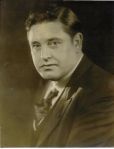
JOHN McCORMACK
It’s part of opera lore that McCormack once greeted Enrico Caruso as “the world’s greatest tenor” to which Caruso replied: “And when did you become a baritone?” I love to listen to McCormack singing Italian and French with that lilting brogue. But I especially like to hear his Irish songs, many of which are so melancholy. I also have a few recordings on which he speaks (one is a funny radio conversation with Bing Crosby), and I find it hard to listen to McCormack without smiling.
 CharlesPaolino's Blog
